Neurones, nerve impulses and synapses
مُقدَّم 10:16
الوحدة 5: التنفس، البيئة الداخلية، التنسيق والتكنولوجيا الجينية
السباق للالتقاط الحافلة وأداء جسمك سيمفونية: تحرق العضلات الجلوكوز بسرعة أكبر، يتضاعف تدفق القلب، تتعمق التهوية، يبدأ التعرق، الكلى…
سرد باللغة الإنجليزية · ترجمة نصية بالإنجليزية و中文 يمكنك التبديل بينهما
في هذا الدرس
| English | المعنى |
|---|---|
| neurones/ˈnjuːrəʊnz/ | Nerve cells specialised to transmit information using electrical and chemical signals. |
| resting potential/ˈrestɪŋ pəˈtenʃl/ | |
| sodium-potassium pump/ˈsəʊdɪəm pəˈtæsɪəm pʌmp/ | A membrane protein that uses ATP to move sodium ions out of a cell and potassium ions into it, maintaining their gradients. |
| threshold/ˈθreʃəʊld/ | A boundary value at which a specified effect begins or a decision changes. |
| all-or-nothing/ɔːl ɔː ˈnʌθɪŋ/ | The principle that a single action potential is triggered when threshold is reached and has a characteristic amplitude rather than a graded size. |
| refractory period/rɪˈfræktəri ˈpɪərɪəd/ | The interval after an action potential when another action potential is impossible or requires a stronger stimulus. |
| myelinated/maɪˈelɪneɪtɪd/ | Having an insulating myelin sheath around an axon, enabling faster saltatory conduction. |
| saltatory conduction/ˈsɒltətəri kənˈdʌkʃn/ | Transmission of an action potential along a myelinated axon by regeneration at successive nodes of Ranvier. |
| synapse/ˈsɪnæps/ | A junction through which a neuron communicates with another cell, usually using a chemical transmitter. |
| neurotransmitter/ˈnjuːrətrænsmɪtə/ | A chemical released by a neuron that transmits a signal across a synapse by binding to receptors on a target cell. |
| acetylcholinesterase/ˈæsɪtɪlkəlaɪnstəreɪz/ |
Why you pull your hand back before you feel the pain
- Touch a hot pan and your hand moves away in about 0.2 s. You feel the pain only afterwards.
- The message travels along neurones 神经元 as electrical impulses, and crosses the gaps between them as chemicals.
The resting potential: a charged membrane
- The sodium-potassium pump 钠钾泵 uses ATP to move 3 Na⁺ out of the axon for every 2 K⁺ it moves in.
- The membrane leaks K⁺ out more easily than Na⁺ comes in, so the inside is negative: about −70 mV, the resting potential 静息电位.
Why is the inside of a resting axon negative?
الصعوبة 1/5 · 100 عملة + مكافأة صغيرة عند الإنجاز الأول اليوم
More positive ions end up outside than inside, so the inside is about −70 mV.
Depolarisation: sodium rushes in
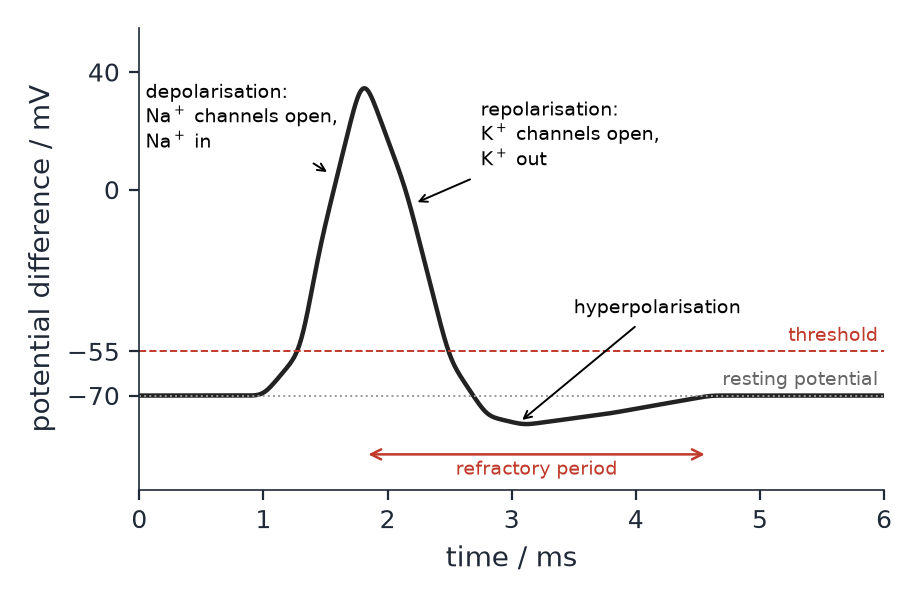
- A stimulus opens some sodium channels. If the potential reaches the threshold 阈值 (about −55 mV), many voltage-gated Na⁺ channels open.
- Na⁺ diffuses in and the inside becomes positive, up to about +30 mV.
Repolarisation and the all-or-nothing rule
- The Na⁺ channels close and voltage-gated K⁺ channels open. K⁺ leaves, the inside becomes negative again and briefly drops below −70 mV (hyperpolarisation).
- Every action potential reaches the same size: it is all-or-nothing 全或无. A stronger stimulus gives more impulses per second, not bigger ones.
Put the events of an action potential in order.
الصعوبة 3/5 · 200 عملة + مكافأة صغيرة عند الإنجاز الأول اليوم
Depolarisation comes from Na⁺ entering; repolarisation from K⁺ leaving.
Travelling along the axon
- The Na⁺ that enters spreads sideways and depolarises the next part of the membrane. The part behind is in its refractory period 不应期, so the impulse moves one way only.
- In myelinated 有髓 neurones, action potentials happen only at the nodes of Ranvier, so the impulse jumps from node to node: saltatory conduction 跳跃传导, much faster.
Worked example: conduction speed. An impulse takes 4.0 ms to travel 0.30 m along a myelinated axon.
- Change the time to seconds: 4.0 ms = 0.0040 s.
- Speed = distance ÷ time = 0.30 ÷ 0.0040 = 75 m/s. An unmyelinated axon of the same width conducts at only about 1–2 m/s.
An impulse travels 0.45 m along an axon in 6.0 ms. What is its speed in m/s?
الصعوبة 2/5 · 140 عملة + مكافأة صغيرة عند الإنجاز الأول اليوم
6.0 ms = 0.0060 s, and 0.45 ÷ 0.0060 = 75 m/s.
The refractory period makes the impulse travel in one direction along the axon.
الصعوبة 1/5 · 100 عملة + مكافأة صغيرة عند الإنجاز الأول اليوم
The membrane behind the impulse cannot depolarise again yet, so the impulse can only move forward.
At the synapse: releasing the transmitter
- The impulse reaches the end of the presynaptic neurone. Voltage-gated Ca²⁺ channels open and calcium ions enter.
- Vesicles of neurotransmitter 神经递质 (for example acetylcholine) fuse with the membrane and release it into the synaptic cleft by exocytosis.
At the synapse: binding and clearing
- The transmitter diffuses across the cleft and binds to receptors on the postsynaptic membrane. Na⁺ channels open; if threshold is reached, a new action potential starts.
- The transmitter is then removed: acetylcholine is broken down by acetylcholinesterase 乙酰胆碱酯酶. Receptors are only on the postsynaptic side, so a synapse 突触 passes signals one way.
Put the events at a cholinergic synapse in order.
الصعوبة 3/5 · 200 عملة + مكافأة صغيرة عند الإنجاز الأول اليوم
Calcium entry is the trigger for release; breakdown stops the signal.
Drugs that act at synapses
- Lidocaine blocks voltage-gated Na⁺ channels, so no impulses pass and the area goes numb.
- SSRIs block the reuptake of serotonin, so it stays in the cleft longer; MDMA releases extra serotonin and then leaves the stores depleted.
Match each drug to how it acts.
الصعوبة 2/5 · 140 عملة + مكافأة صغيرة عند الإنجاز الأول اليوم
Each changes one step of signalling.
A bigger stimulus does not give a bigger action potential. Every action potential reaches about +30 mV. The brain learns how strong a stimulus is from the frequency of impulses and from how many neurones fire.
The pump and K⁺ leakage hold the resting potential at about −70 mV. At threshold, Na⁺ enters (depolarisation), then K⁺ leaves (repolarisation). The refractory period keeps impulses one-way and separate, and myelin makes them jump between nodes. At a synapse, Ca²⁺ entry releases neurotransmitter, which diffuses, binds postsynaptic receptors and is then removed.
Explain why impulses travel faster along myelinated axons than unmyelinated ones.
Name the mechanism, then link it to speed.
ما المشكلة؟ لا يرى ذلك سوى فريق الموقع.