Motion of Orbiting Satellites
مُقدَّم 8:12
الطاقة والزخم للأنظمة الدوارة
راقب مُتزلج على الجليد يدور. ذراعاته ممدودة، يدور ببطء. يسحب ذراعيه نحوه — وبدون دفع أي شيء، يدور أسرع بكثير. لا أحد…
سرد باللغة الإنجليزية · ترجمة نصية بالإنجليزية و中文 يمكنك التبديل بينهما
| English | المعنى |
|---|---|
| orbital period/ˈɔːbɪtl ˈpɪərɪəd/ | الفترة المدارية |
The endless fall
- The Moon is always falling toward Earth, yet it never lands.
- A space station circles the planet once every ninety minutes.
- Gravity pulls it inward, but its sideways speed keeps missing the ground.
- One pull, one speed, and a perfect endless curve.
Gravity is the centripetal pull
- For a light satellite orbiting a much more massive, spherically symmetric body in a circle, gravity supplies exactly the centripetal force:
- Solving for the speed: $v = \sqrt{\dfrac{GM}{r}}$.
- Lower orbits are faster; higher ones are slower.
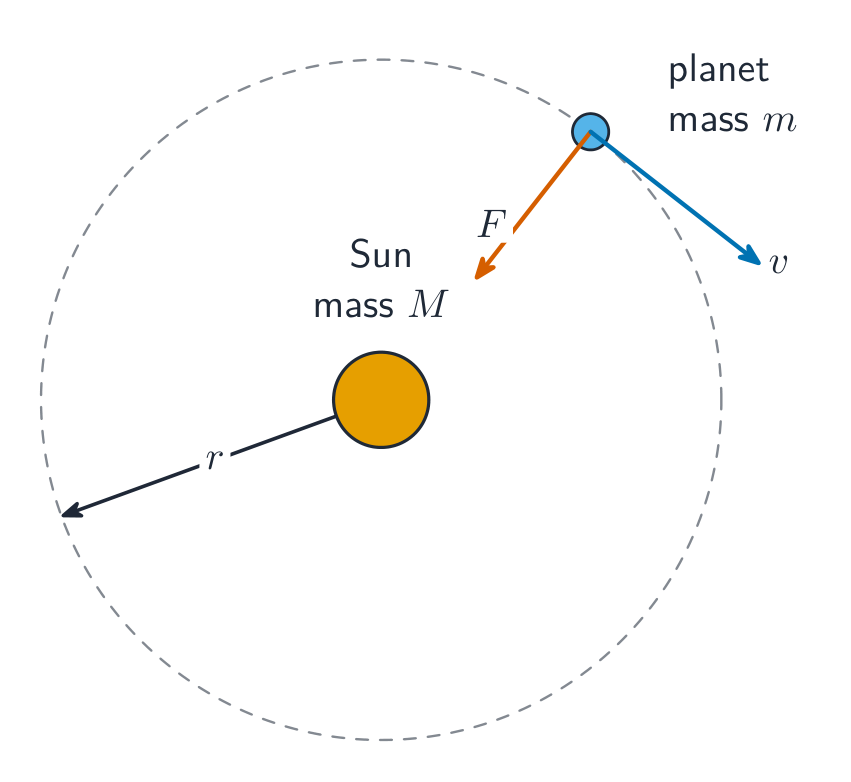
Gravity provides the centripetal force that keeps a satellite in orbit
A satellite moves to a lower circular orbit. Its orbital speed...
الصعوبة 1/5 · 100 عملة + مكافأة صغيرة عند الإنجاز الأول اليوم
$v = \sqrt{GM/r}$, so a smaller $r$ gives a larger $v$.
What provides the centripetal force that holds a satellite in a circular orbit?
الصعوبة 1/5 · 100 عملة + مكافأة صغيرة عند الإنجاز الأول اليوم
$GMm/r^2 = mv^2/r$ -- gravity is the centripetal force.
Compute the orbital speed where $GM/r = 4.0\times10^7\ \text{m}^2/\text{s}^2$ (in m/s).
الصعوبة 2/5 · 140 عملة + مكافأة صغيرة عند الإنجاز الأول اليوم
$v = \sqrt{4.0\times10^7} \approx 6325\ \text{m/s}$.
Period grows with radius
- Cancelling and rearranging gives the orbital period 轨道周期:
- The period squared grows with the radius cubed — Kepler's third law.
- A bigger orbit takes much longer to go around.
A satellite in a larger orbit has a longer period.
الصعوبة 1/5 · 100 عملة + مكافأة صغيرة عند الإنجاز الأول اليوم
$T^2 \propto r^3$, so a bigger $r$ means a bigger $T$.
Faster when closer
- In an elliptical orbit, gravity points along $r$, so it makes no torque.
- With no torque, the planet's angular momentum is conserved.
- It speeds up near the star and sweeps equal areas in equal times.
Low orbit or high orbit?
Compare circular orbits about the same much more massive central body, using the same satellite mass. Sort each fact by orbit height.
In an elliptical orbit, a planet moves fastest...
الصعوبة 1/5 · 100 عملة + مكافأة صغيرة عند الإنجاز الأول اليوم
Angular momentum gives constant r times the tangential velocity component, not r times the full speed everywhere. Conservation of orbital energy gives v squared = GM(2/r - 1/a), where a is the semimajor axis, so speed is largest at the smallest r.
A satellite orbits where $GM/r = 5.0\times10^7\ \text{m}^2/\text{s}^2$.
- Orbital speed: $v = \sqrt{GM/r} = \sqrt{5.0\times10^7} \approx 7100\ \text{m/s}$.
- That is about $7.1\ \text{km/s}$ — typical for a low orbit.
Doubling the satellite's own mass changes its orbital speed at the same radius.
الصعوبة 1/5 · 100 عملة + مكافأة صغيرة عند الإنجاز الأول اليوم
The mass $m$ cancels in $GMm/r^2 = mv^2/r$, so $v$ is independent of $m$.
Measure $r$ from the centre of the planet, not the altitude above the surface — add the planet's radius. The speed formula assumes a circular orbit; an ellipse has a changing speed (fastest at the closest point). And the satellite's own mass $m$ cancels out, so orbital speed and period do not depend on it.
Gravity is the centripetal force of a circular orbit, giving $v = \sqrt{GM/r}$ (lower means faster) and the orbital period $T^2 = \tfrac{4\pi^2}{GM}r^3$ (Kepler's third law). Because gravity makes no torque, a planet's angular momentum is conserved, so it moves fastest at its closest approach. Measure $r$ from the centre; the orbiting mass cancels.
Write from the data: find the orbital speed
- GM over r equals 9.0 million m squared per s squared.
- Find the circular orbital speed.
For a circular orbit, GM divided by r equals 9.0 times 10 to the 6, in m squared per s squared. What is the orbital speed, in m/s?
The square root of 9 million is 3000.
In a circular orbit, GM/r = 9.0 million m squared per s squared. What is the orbital speed?
الصعوبة 1/5 · 100 عملة + مكافأة صغيرة عند الإنجاز الأول اليوم
Speed is the square root of GM over r. Other options — 6325 m/s (the lesson speed); 9.0 million m/s (the value under the square root).