Angular Momentum and Angular Impulse
مُقدَّم| English | المعنى |
|---|---|
| angular momentum/ˈæŋɡjʊlə məʊˈmentəm/ | زخم الزاوية |
| angular impulse/ˈæŋɡjʊlə ˈɪmpʌls/ | اندفاع الزاوية |
Even straight lines can carry spin
- A puck sliding in a straight line past a pivot has angular momentum about that pivot. If it hits a rod hinged there and sticks, the rod starts to turn: the puck's angular momentum was there all along.
- This lesson defines angular momentum for rigid bodies ($L=I\omega$) and for single objects ($\vec L=\vec r\times\vec p$), and shows how a torque acting over time, the angular impulse 角冲量, changes it.
Rigid bodies: $L=I\omega$
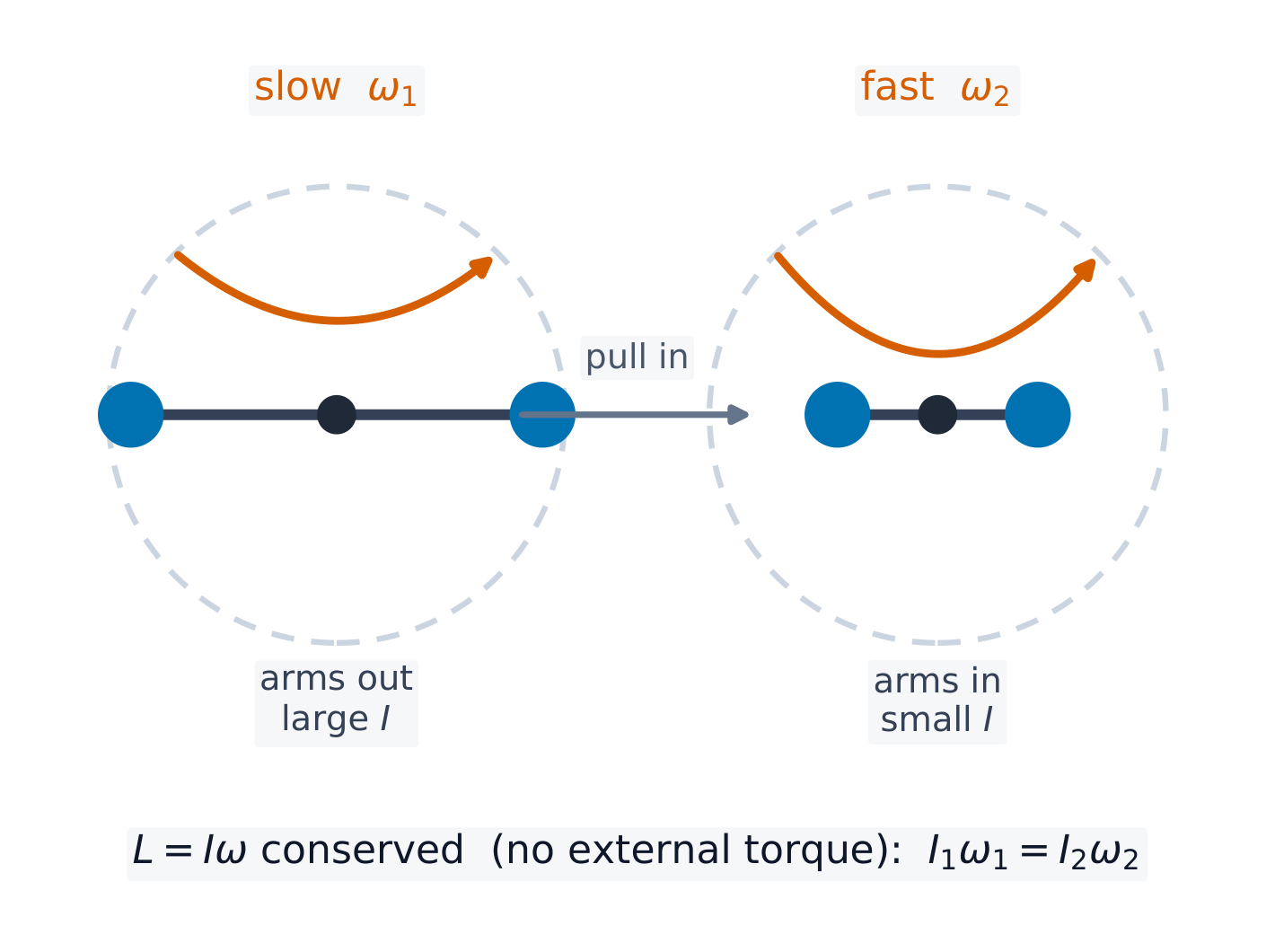
- For a rigid system turning about a fixed axis, the angular momentum about that axis has magnitude $L=I\omega$, units $\text{kg}\cdot\text{m}^2/\text{s}$. Its direction follows the right-hand rule along the axis.
- It is the rotational partner of $p=mv$: $I$ plays the role of mass, $\omega$ of velocity.
A flywheel with $I = 5\ \text{kg}\cdot\text{m}^2$ spins at $\omega = 4\ \text{rad/s}$. Its angular momentum (in kg·m²/s)?
الصعوبة 2/5 · 140 عملة + مكافأة صغيرة عند الإنجاز الأول اليوم
$L = I\omega = 5 \times 4 = 20\ \text{kg}\cdot\text{m}^2/\text{s}$.
Angular momentum $L = I\omega$ is the rotational twin of which linear quantity?
الصعوبة 1/5 · 100 عملة + مكافأة صغيرة عند الإنجاز الأول اليوم
$I$ mirrors $m$ و $\omega$ mirrors $v$, so $L = I\omega$ mirrors $p = mv$.
Single objects: $\vec L=\vec r\times\vec p$
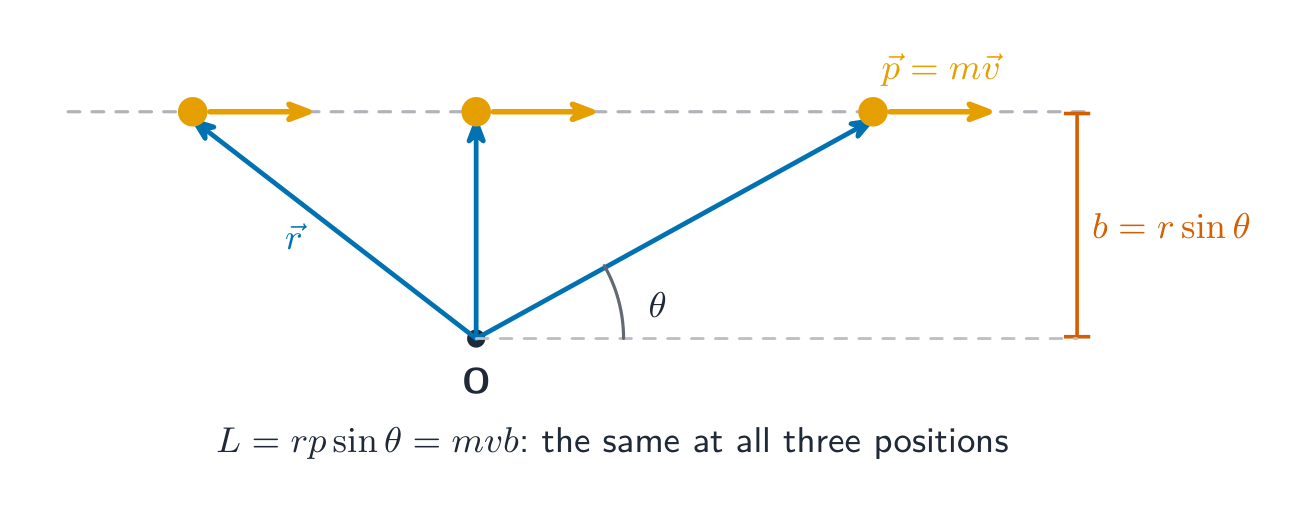
- About a chosen point, $\vec L=\vec r\times\vec p$, where $\vec r$ runs from the point to the object. Magnitude: $L=rmv\sin\theta$, with $\theta$ the angle between $\vec r$ and $\vec v$. So $L$ depends on the mass, the speed, the distance and the angle, and on which point you choose.
- For straight-line motion, $r\sin\theta=b$, the perpendicular distance from the point to the line of motion, so $L=mvb$ stays constant. In circular motion about the centre, $\theta=90°$ and $L=mvr$.
Angular momentum
Angular momentum is rotational inertia times angular speed.
A $2\ \text{kg}$ ball moves at $3\ \dfrac{\text{m}}{\text{s}}$ in a circle of radius $4\ \text{m}$. Find its angular momentum magnitude about the axis through the circle center perpendicular to its plane (in kg·m²/s).
الصعوبة 2/5 · 140 عملة + مكافأة صغيرة عند الإنجاز الأول اليوم
$L = mvr = 2 \times 3 \times 4 = 24\ \text{kg}\cdot\text{m}^2/\text{s}$.
To state an object's angular momentum meaningfully, you must also give the...
الصعوبة 1/5 · 100 عملة + مكافأة صغيرة عند الإنجاز الأول اليوم
Angular momentum is defined relative to an axis; different axes give different $L$.
A 0.50 kg ball moves at 6.0 m/s. At one instant it is 2.0 m from point P, and its velocity makes an angle of 30° with the line from P to the ball. Find its angular momentum about P, in $\text{kg}\cdot\text{m}^2/\text{s}$.
الصعوبة 2/5 · 140 عملة + مكافأة صغيرة عند الإنجاز الأول اليوم
$L=rmv\sin\theta=(2.0)(0.50)(6.0)\sin30°=3.0\ \text{kg}\cdot\text{m}^2/\text{s}$.
A puck slides at constant velocity in a straight line that misses point P. Its angular momentum about P stays constant.
الصعوبة 1/5 · 100 عملة + مكافأة صغيرة عند الإنجاز الأول اليوم
$L=mvb$, and $m$, $v$ and the perpendicular distance $b$ to the line are all constant.
Angular impulse and the impulse–momentum theorem
- Angular impulse is torque times time: $\int\tau\,dt$, or $\tau\Delta t$ for a constant torque. It points the same way as the torque, and equals the area under a torque–time graph.
- The rotational impulse–momentum theorem: the angular impulse equals the change in angular momentum, $\Delta L=L-L_0$. In derivative form, $\tau_\text{net}=\dfrac{dL}{dt}$.
A wheel ($I=3\ \text{kg}\cdot\text{m}^2$) spins at 2 rad/s, so $L_0=6\ \text{kg}\cdot\text{m}^2/\text{s}$. A torque of $4\ \text{N}\cdot\text{m}$ acts in the direction of spin for 3 s: angular impulse $=12$, so $L=18$ and $\omega=18/3=$ 6 rad/s.
A constant net torque of $3\ \text{N}\cdot\text{m}$ acts about a fixed axis for $5\ \text{s}$. Find the change in angular momentum about that axis (in kg·m²/s).
الصعوبة 2/5 · 140 عملة + مكافأة صغيرة عند الإنجاز الأول اليوم
$\Delta L = \tau\,\Delta t = 3 \times 5 = 15\ \text{kg}\cdot\text{m}^2/\text{s}$.
Torque equals the rate of change of angular momentum, $\tau = dL/dt$.
الصعوبة 1/5 · 100 عملة + مكافأة صغيرة عند الإنجاز الأول اليوم
This is Newton's second law for rotation in momentum form.
A torque rises steadily from 0 to $8\ \text{N}\cdot\text{m}$ over 3 s, then drops to zero. A wheel with $I=2.0\ \text{kg}\cdot\text{m}^2$ started at rest. Find its final angular speed, in rad/s.
الصعوبة 2/5 · 140 عملة + مكافأة صغيرة عند الإنجاز الأول اليوم
Angular impulse = area of the triangle $=\tfrac12(3)(8)=12$. $\omega=L/I=12/2.0=6$ rad/s.
Worked FRQ with a varying torque
A disk with $I=0.50\ \text{kg}\cdot\text{m}^2$ starts at rest. A torque $\tau(t)=4t-t^2$ (in N·m, $t$ in s) acts on it from $t=0$ to $t=4$ s.
(A) Find the angular impulse delivered.
(B) Find the angular speed at $t=4$ s. $L=0+10.7$, so $\omega=L/I=10.7/0.50\approx$ 21 rad/s.
(C) At what time is the angular speed greatest? Justify. At $t=4$ s. $\tau\ge0$ for $0\le t\le4$, so $L$ never decreases; $\omega$ keeps increasing until the torque stops.
- Why it scores: write the integral with limits and units; in (C), argue from the sign of $\tau=dL/dt$, not from where $\tau$ is largest (that is the greatest angular acceleration, at $t=2$ s).
A torque $\tau(t)=6t^2$ (in $\text{N}\cdot\text{m}$) acts from $t=0$ إلى $t=2$ s on a disk initially spinning with $L_0=4\ \text{kg}\cdot\text{m}^2/\text{s}$ in the same direction. Find the final angular momentum, in $\text{kg}\cdot\text{m}^2/\text{s}$.
الصعوبة 2/5 · 140 عملة + مكافأة صغيرة عند الإنجاز الأول اليوم
$\int_0^2 6t^2\,dt=[2t^3]_0^2=16$. $L=4+16=20\ \text{kg}\cdot\text{m}^2/\text{s}$.
- Always name the point or axis. The same object has different $L$ about different points.
- Use $r\sin\theta$, the perpendicular distance, not $r$ itself, when $\vec v$ is not perpendicular to $\vec r$.
- Largest torque ≠ largest $\omega$. Torque sets how fast $L$ changes; $L$ keeps growing while $\tau>0$.
Rigid body: $L=I\omega$. Single object about a point: $\vec L=\vec r\times\vec p$, $L=mvr\sin\theta$, which depends on the chosen point; for straight-line motion $L=mvb$ is constant. Angular impulse $\int\tau\,dt$ (area under $\tau$–$t$) has the torque's direction and equals $\Delta L$; equivalently $\tau_\text{net}=dL/dt$.