Types of immunity and vaccination
مُقدَّم| English | المعنى |
|---|---|
| vaccine/vækˈsiːn/ | لقاح |
| active immunity/ˈæktɪv ɪˈmjuːnɪti/ | المناعة النشطة |
| memory cell/ˈmeməri sel/ | خلية ذاكرة |
| passive immunity/ˈpæsɪv ɪˈmjuːnɪti/ | المناعة السلبية |
| herd immunity/hɜːd ɪˈmjuːnɪti/ | مناعة القطيع |
Training the body's defences
- Immunity can be active or passive, and natural or artificial.
- A vaccine 疫苗 gives you immunity without the illness.
- Vaccinate enough people and you protect the whole community.
A vaccine gives a person which kind of immunity?
الصعوبة 1/5 · 100 عملة + مكافأة صغيرة عند الإنجاز الأول اليوم
A vaccine makes the body respond itself, so it builds active, long-lasting immunity.
Active vs passive
- Active immunity 主动免疫: your own body meets an antigen and makes its own antibodies and memory cells 记忆细胞. Slow to start, but long-lasting.
- Passive immunity 被动免疫: ready-made antibodies are given from outside. Works at once, but does not last (no memory cells).
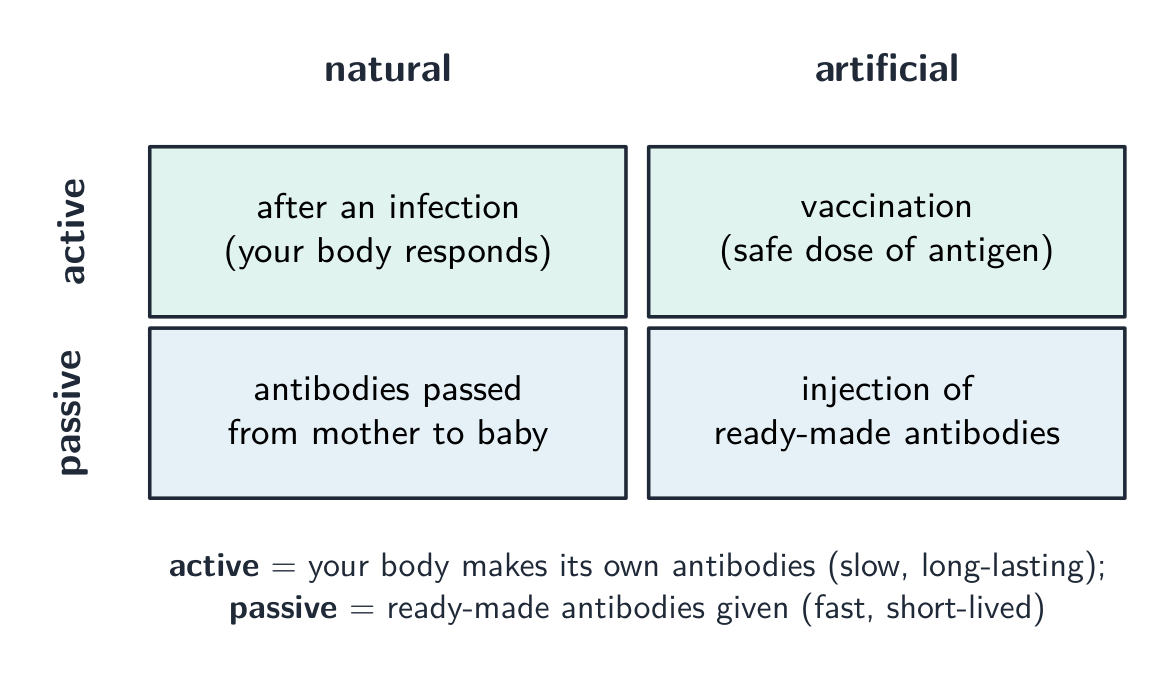
The four kinds of immunity
Passive immunity lasts for life because memory cells are made.
الصعوبة 1/5 · 100 عملة + مكافأة صغيرة عند الإنجاز الأول اليوم
False. Passive immunity gives ready-made antibodies that act fast, but no memory cells are made, so it is short-lived.
Natural vs artificial
| Natural | Artificial | |
|---|---|---|
| active | after an infection | a vaccine |
| passive | antibodies from mother to baby | injection of ready-made antibodies |
Match each type of immunity to its example.
الصعوبة 2/5 · 140 عملة + مكافأة صغيرة عند الإنجاز الأول اليوم
Active = your own response (infection / vaccine); passive = ready-made antibodies (mother-to-baby / injection).
Vaccination and herd immunity 群体免疫
- A vaccine contains antigens (a dead/weakened pathogen, or part of one).
- They trigger a primary response and make memory cells — long-term immunity without illness.
- If enough people are vaccinated, the pathogen cannot spread easily — protecting even the unvaccinated. This is herd immunity.
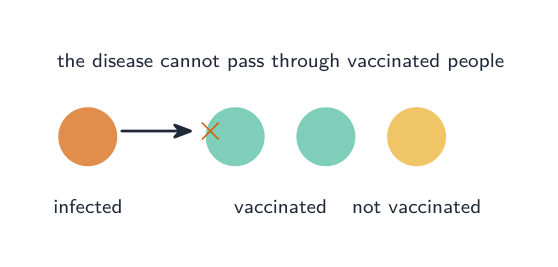
When most of a population is vaccinated, the pathogen can't spread, protecting the few who aren't
How a vaccine works
Step through it. A vaccine triggers a primary response and memory cells, so the real pathogen meets a fast, strong defence.
A vaccine gives immunity without illness because it:
الصعوبة 1/5 · 100 عملة + مكافأة صغيرة عند الإنجاز الأول اليوم
The antigens in a vaccine cause a primary response and memory cells — immunity, but without the disease.
Put how a vaccine protects you in order.
الصعوبة 3/5 · 200 عملة + مكافأة صغيرة عند الإنجاز الأول اليوم
The vaccine trains the immune system in advance, so the real infection is destroyed quickly.
Herd immunity protects unvaccinated people because:
الصعوبة 1/5 · 100 عملة + مكافأة صغيرة عند الإنجاز الأول اليوم
With enough of the population immune, the pathogen has too few hosts to spread, protecting everyone.
When enough of a population is vaccinated that the pathogen cannot spread, the unvaccinated are protected by ______ immunity.
الصعوبة 1/5 · 100 عملة + مكافأة صغيرة عند الإنجاز الأول اليوم
Herd immunity protects those who cannot be vaccinated (e.g. babies, the ill) by stopping the pathogen spreading.
Worked example: four ways to be protected
Classify each: (a) a baby receives antibodies in breast milk; (b) a child recovers from measles; (c) a hiker bitten by a snake is given antivenom; (d) a teenager receives the HPV vaccine.
- (a) natural passive: ready-made antibodies from the mother, so protection is immediate but lasts only weeks. (b) natural active: the child's own B cells made antibodies and memory cells, so immunity is long-lasting.
- (c) artificial passive: injected antibodies act at once, which the hiker needs, but no memory cells form. (d) artificial active: the vaccine's antigens trigger a primary response and memory cells, without the illness.
Why is antivenom, not a vaccine, given after a snake bite?
الصعوبة 1/5 · 100 عملة + مكافأة صغيرة عند الإنجاز الأول اليوم
A vaccine takes days to weeks to produce protection.
Passive immunity produces memory cells.
الصعوبة 1/5 · 100 عملة + مكافأة صغيرة عند الإنجاز الأول اليوم
The antibodies come from outside, so the body's own B cells are not activated.
You've got it
- active = your own antibodies + memory cells (slow, lasting); passive = ready-made antibodies (fast, short)
- natural (infection / mother-to-baby) vs artificial (vaccine / injection)
- a vaccine = antigens → memory cells → immunity without illness
- herd immunity: enough vaccinated → pathogen can't spread → protects everyone
Write from this case
- A person is injected with a harmless form of an antigen.
- The person later makes memory cells.
What kind of immunity is this?
The exposure is deliberate, and the immune system does the work.
What kind of immunity is a vaccine?
الصعوبة 1/5 · 100 عملة + مكافأة صغيرة عند الإنجاز الأول اليوم
The body makes its own memory after a planned exposure.