Transient conduction: when the inside lags
引入| English | 释义 | 拼音 |
|---|---|---|
| Biot number | 毕渥数 | bì wò shù |
| lumped capacitance | 集总热容 | jí zǒng rè róng |
| Fourier number | 傅里叶数 | fù lǐ yè shù |
How long in the bath?
- A hardened shaft is quenched from 850 °C. How long it must stay in the bath, and whether the centre cools in time, are transient questions.
- The Biot number $Bi = hL_c/k$, with $L_c = V/A_s$, compares the inside conduction resistance with the surface convection resistance.
A Biot number below 0.1 means the body is nearly uniform inside.
难度 1/5 · 今日首次完成可获 100 金币及少量额外奖励
Internal resistance is small compared with the surface.
The lumped model
- If $Bi < 0.1$, the body is nearly uniform inside, and lumped capacitance holds: $(T - T_\infty)/(T_i - T_\infty) = e^{-t/\tau}$, with $\tau = \rho cV/(hA_s)$.
- It comes from one balance: heat lost at the surface empties the stored energy.
Lumped or not?
Decide which transient model each body needs.
A quenched bearing ball
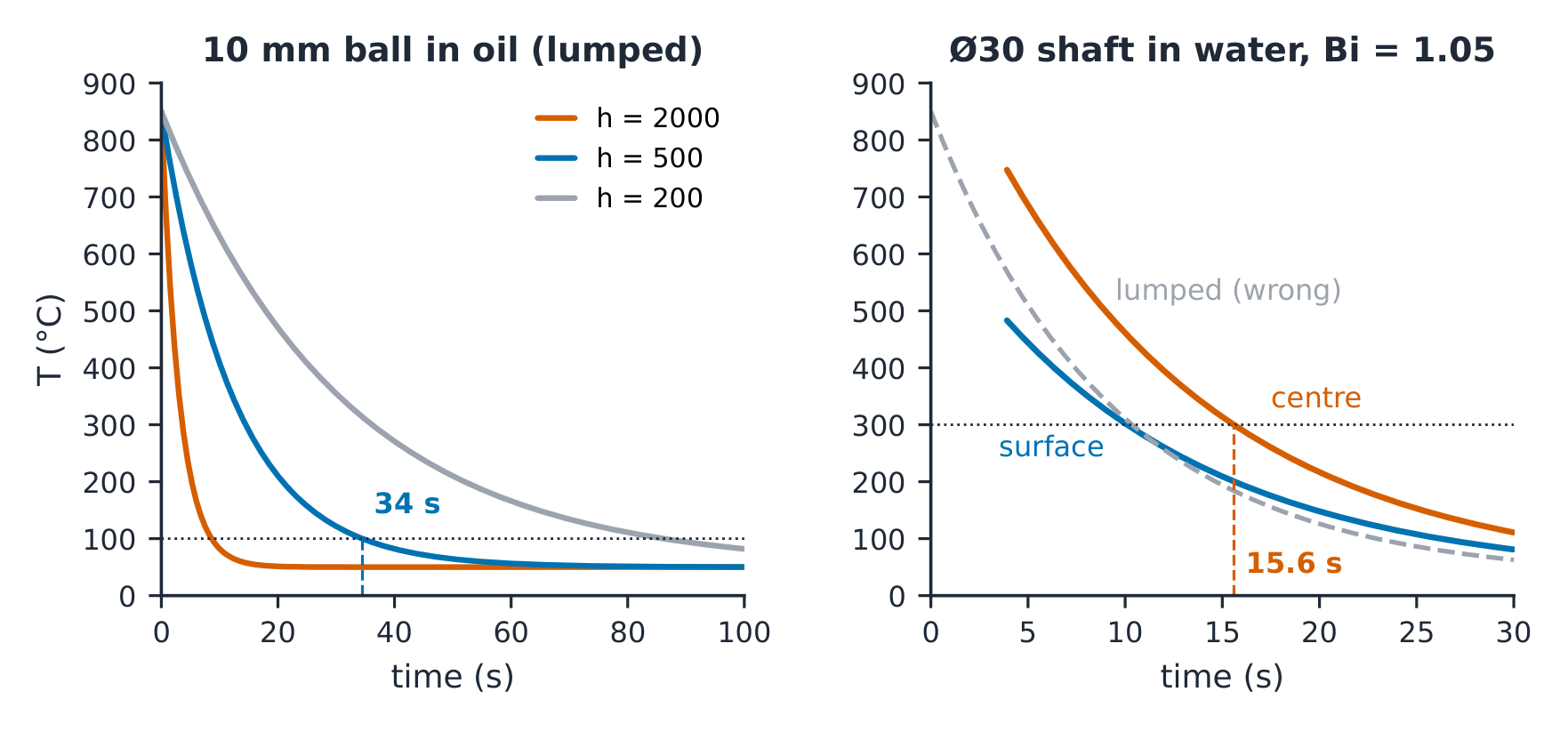
- A 10 mm steel ball in oil at 50 °C with $h = 500$: $L_c = r/3 = 1.67$ mm and $Bi = \mathbf{0.019}$, so lumped is valid.
- $\tau = \mathbf{12.4}$ s, and cooling from 850 to 100 °C takes $12.4\ln(800/50) = \mathbf{34}$ s.
- A still bath ($h = 200$) takes 86 s; a violent one ($h = 2000$) 8.6 s.
Biot number of a 10 mm steel ball, k = 43, h = 500 (three decimals)?
难度 2/5 · 今日首次完成可获 140 金币及少量额外奖励
h (r/3) over k.
Its time constant, rho = 7850, c = 475 (one decimal, s)?
难度 2/5 · 今日首次完成可获 140 金币及少量额外奖励
rho c L_c over h.
Time to cool from 850 to 100 degrees C in 50 degrees C oil (s, whole number)?
难度 2/5 · 今日首次完成可获 140 金币及少量额外奖励
tau ln(800/50).
The shaft is not lumped
- A 30 mm shaft in water with $h = 3000$: $Bi = hr_o/k = \mathbf{1.05}$. The centre lags the surface, so use the one-term solution in $Bi$ and the Fourier number $Fo = \alpha t/L^2$.
- For the centre to reach 300 °C: $Fo = 0.80$, $t = \mathbf{15.6}$ s, with the surface near 200 °C. The lumped model would say 10.4 s: 33% too short, and blind to the 100 K difference.
Biot number of the 30 mm shaft with h = 3000, k = 43, using r_o (two decimals)?
难度 2/5 · 今日首次完成可获 140 金币及少量额外奖励
h r_o over k = 3000 x 0.015/43.
For the shaft, the lumped model:
难度 1/5 · 今日首次完成可获 100 金币及少量额外奖励
It gives 10.4 s against 15.6 s and assumes a uniform shaft.
A sensor's time constant
- A thermocouple bead is a lumped body too. A 1 mm bead ($\rho c = 8500 \times 400$) in air at $h = 100$: $\tau = \rho c D/(6h) = \mathbf{5.7}$ s.
- After one $\tau$ it shows 63% of a step change; to read within 1% it needs $4.6\tau \approx 26$ s. A fast process measured by a slow sensor looks smoother than it is.
A 1 mm thermocouple bead, $\rho = 8500$, $c = 400$, in air at $h = 100$: time constant (one decimal, s)?
难度 2/5 · 今日首次完成可获 140 金币及少量额外奖励
$\tau = \rho c V/(hA) = \rho c D/(6h) = 8500 \times 400 \times 0.001/600 = 5.7$ s.
A sensor reads a step change fully after one time constant.
难度 1/5 · 今日首次完成可获 100 金币及少量额外奖励
After one $\tau$ it has covered 63%; 99% takes about $4.6\tau$.
Worked example: what the oil must absorb
- One 10 mm ball holds $m = 7850 \times \tfrac{4}{3}\pi \times 0.005^3 = 4.11$ g. Cooling 850 to 100 °C releases $mc\Delta T = 4.11 \times 10^{-3} \times 475 \times 750 = \mathbf{1.46}$ kJ.
- A batch of 1000 balls dumps 1.46 MJ into the bath. The bath must be large or cooled, or its temperature rises and every later ball quenches more slowly.
Heat released by one 10 mm steel ball cooling from 850 to 100 °C (two decimals, kJ)?
难度 2/5 · 今日首次完成可获 140 金币及少量额外奖励
$m = 4.11 \times 10^{-3}$ kg; $4.11 \times 10^{-3} \times 475 \times 750 = 1464$ J.
Three transient slips
- Lumped with $Bi > 0.1$. The centre lags; use the one-term solution.
- The wrong $L_c$. It is $V/A_s$: $r/3$ for a sphere, $r/2$ for a long cylinder.
- One term with $Fo < 0.2$. Early times need more terms.
Recap
- $Bi = hL_c/k$; lumped when $Bi < 0.1$, with $\tau = \rho cV/hA_s$.
- Ball: $Bi = 0.019$, $\tau = 12.4$ s, 34 s to 100 °C.
- Shaft: $Bi = 1.05$, 15.6 s for the centre to reach 300 °C.