The design project: weights first, limits written down
引入| English | 释义 | 拼音 |
|---|---|---|
| design spiral | 设计螺旋 | shè jì luó xuán |
| spur gear | 直齿圆柱齿轮 | zhí chǐ yuán zhù chǐ lún |
Several answers that work
- Real design has limits on space, cost and time, and several answers that work. The project delivers one checked drive and says honestly where it stops being valid.
- Design moves round a design spiral: brief, concept, loads, sizing, drawing, review, then round again with better numbers.
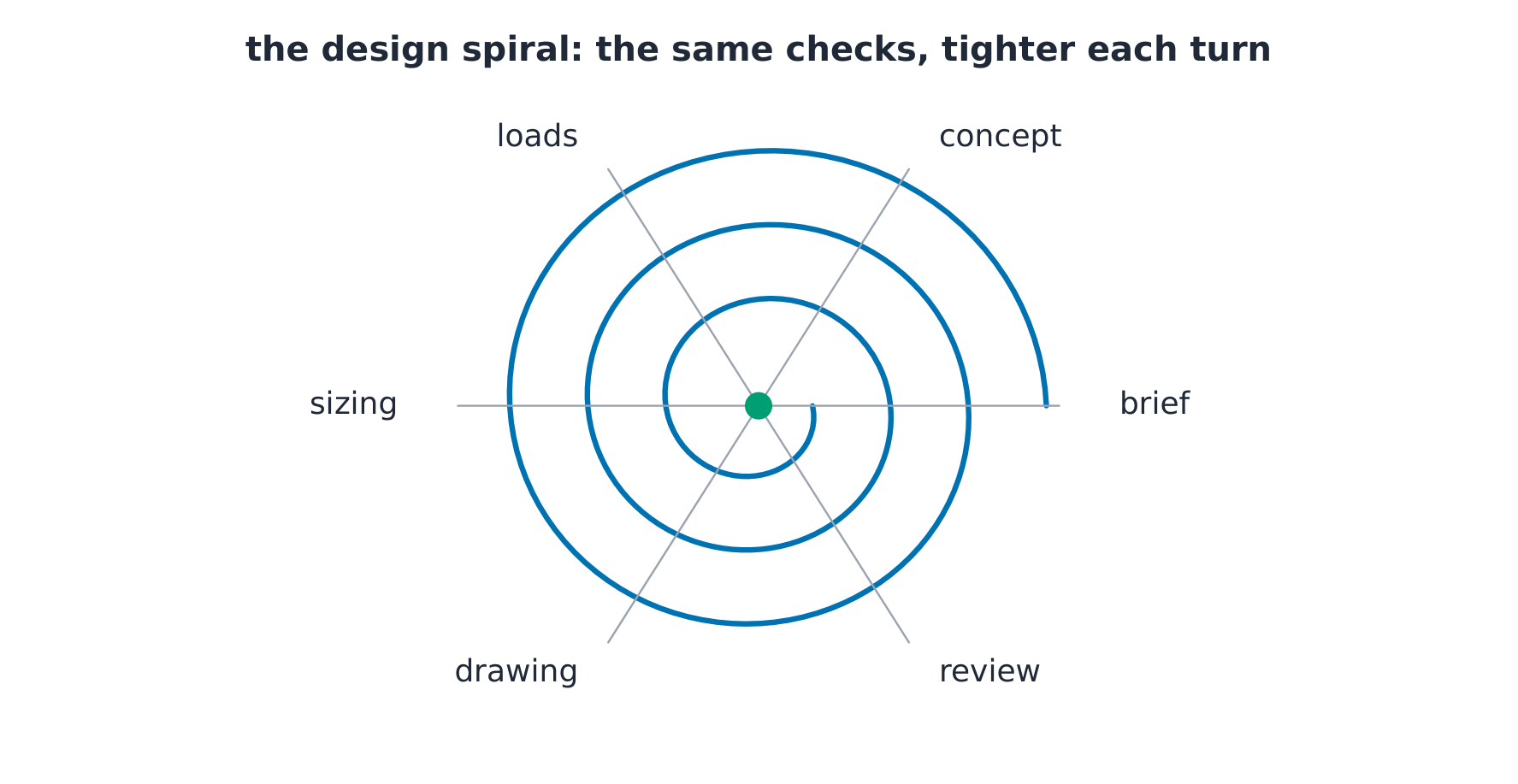
Put one turn of the design spiral in order.
难度 3/5 · 今日首次完成可获 200 金币及少量额外奖励
Each turn repeats these with better numbers.
Why the weights come first
- Choose the weights after the scores and it is easy, even without meaning to, to favour the concept you already like.
- Fix the weights from the brief first: then the decision matrix is a test, not a decoration.
Which part of the method is it?
Place each activity in the design method.
Weights in a decision matrix should be fixed:
难度 1/5 · 今日首次完成可获 100 金币及少量额外奖励
Otherwise the matrix only confirms a preference.
Choosing the drive concept
- Weights: cost 0.35, size 0.25, efficiency 0.25, maintenance 0.15.
- Spur gears (4, 3, 4, 3) score $\mathbf{3.60}$; a belt drive (5, 2, 3, 3) scores $\mathbf{3.45}$; a gearmotor unit (3, 4, 4, 5) scores $\mathbf{3.80}$.
- The gearmotor wins on this brief. The course designs the spur gears because they teach the checks, and the report must say so.
Weighted score of spur gears (4, 3, 4, 3) with weights 0.35, 0.25, 0.25, 0.15 (two decimals)?
难度 2/5 · 今日首次完成可获 140 金币及少量额外奖励
Sum of weight times score.
Belt drive (5, 2, 3, 3) (two decimals)?
难度 2/5 · 今日首次完成可获 140 金币及少量额外奖励
1.75 + 0.5 + 0.75 + 0.45.
Gearmotor unit (3, 4, 4, 5) (two decimals)?
难度 2/5 · 今日首次完成可获 140 金币及少量额外奖励
1.05 + 1.0 + 1.0 + 0.75.
The design file
- One page lists every check: shaft Goodman 2.21, yield 3.40; bearing 27 000 h against 20 000; bolts load factor 4.35, separation 34.8 kN; pinion bending 87.9 MPa, contact 633 MPa.
- It also states its limits: no shock loads, no deflection or key check yet, lubrication assumed. Those are the next turn of the spiral.
A design report should list only the checks that passed.
难度 1/5 · 今日首次完成可获 100 金币及少量额外奖励
It lists every check and every limit.
How close is the decision?
- The gearmotor's 3.80 beats spur gears' 3.60 by 0.20. Cost carries weight 0.35, so the gears would need $0.20/0.35 = \mathbf{0.57}$ of a point more on cost to draw level.
- A lead smaller than the scoring's own uncertainty is a tie. Say so, and decide on the criterion that matters most, or gather better scores.
Gearmotor 3.80, spur gears 3.60, cost weight 0.35: extra cost score the gears need to draw level (two decimals)?
难度 2/5 · 今日首次完成可获 140 金币及少量额外奖励
$0.20/0.35 = 0.57$.
Worked example: shift the weights
- A tighter budget moves the weights to cost 0.45, size 0.20, efficiency 0.20, maintenance 0.15.
- Spur gears score 3.65, the belt 3.70 and the gearmotor 3.70: the belt has caught up. When reasonable weights change the winner, the matrix has not decided; the brief must.
Belt (5, 2, 3, 3) with weights 0.45, 0.20, 0.20, 0.15 (two decimals)?
难度 2/5 · 今日首次完成可获 140 金币及少量额外奖励
$2.25 + 0.40 + 0.60 + 0.45 = 3.70$.
A concept that wins under one set of weights wins under any reasonable set.
难度 1/5 · 今日首次完成可获 100 金币及少量额外奖励
Moving cost from 0.35 to 0.45 lifts the belt level with the gearmotor at 3.70.
Three project slips
- Scoring before weighting. Weights come from the brief.
- Reporting only the checks that passed. List every one.
- A design called finished with its limits unwritten. Write them down.
Recap
- The spiral repeats the same checks with better numbers.
- Weights first: 3.60, 3.45 and 3.80 for gears, belt and gearmotor.
- The report lists every check, factor and limit.