Fatigue: the shaft that fails below yield
引入| English | 释义 | 拼音 |
|---|---|---|
| fatigue/fəˈtiːɡ/ | 疲劳 | pí láo |
| distortion energy | 畸变能理论 | jī biàn néng lǐ lùn |
| Coulomb–Mohr | 库仑–莫尔理论 | kù lún – mò ěr lǐ lùn |
| S-N curve | S-N曲线 | S-N qū xiàn |
| endurance limit | 疲劳极限 | pí láo jí xiàn |
| Marin factors | 马林修正系数 | mǎ lín xiū zhèng xì shù |
| Goodman line | 古德曼线 | gǔ dé màn xiàn |
| Miner's rule | 迈因纳法则 | mài yīn nà fǎ zé |
A hundred million reversals
- Each point on a turning shaft sees its bending stress swing from tension to compression once per turn, about $10^8$ times in its life. Parts like this fail by fatigue at stresses well below yield.
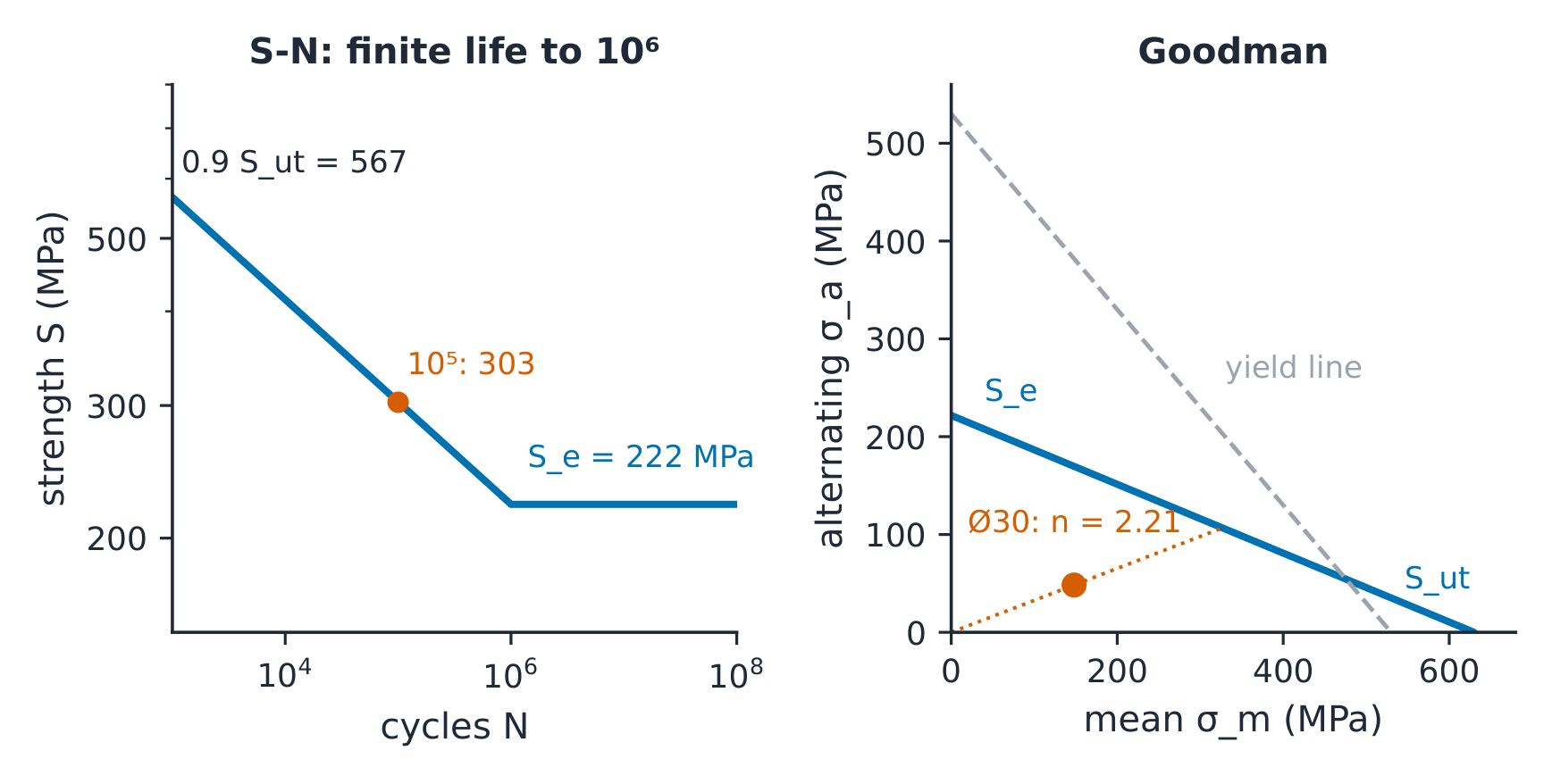
- Static loads use von Mises (distortion energy) for ductile parts and Coulomb–Mohr for brittle ones. Fatigue uses the S-N curve, which falls to the endurance limit $S_e$ for steels.
From test bar to real part
- A polished test bar lasts for ever below $S_e' \approx 0.5S_{ut}$. Marin factors reduce it for a real part: surface $k_a = 4.51S_{ut}^{-0.265}$ (machined) and size $k_b = 1.24d^{-0.107}$.
- A notch raises the local stress by $K_f = 1 + q(K_t - 1)$, where $q$ is the notch sensitivity.
Static or fatigue criterion?
Choose the criterion each case needs.
Surface factor k_a = 4.51 x 630^-0.265 (three decimals)?
难度 2/5 · 今日首次完成可获 140 金币及少量额外奖励
Machined surface constants.
K_t = 2.0 and q = 0.8: K_f (one decimal)?
难度 2/5 · 今日首次完成可获 140 金币及少量额外奖励
1 + q (K_t - 1).
The shaft's endurance limit
- C45, machined, 30 mm: $S_e' = 315$ MPa, $k_a = \mathbf{0.817}$, $k_b = \mathbf{0.862}$, so $S_e = \mathbf{222}$ MPa.
- The S-N line from 567 MPa at $10^3$ cycles to 222 MPa at $10^6$ gives $\mathbf{303}$ MPa at $10^5$ cycles, the strength for a short-life part.
Endurance limit with k_a = 0.817, k_b = 0.862 and S_e prime = 315 MPa (MPa, whole number)?
难度 2/5 · 今日首次完成可获 140 金币及少量额外奖励
Multiply the three.
Goodman at the shoulder
- $K_t = 2.0$, $q = 0.8$, so $K_f = 1.8$; $M_a = 71.2$ N·m gives $\sigma_a = \mathbf{48.4}$ MPa.
- The steady 300 N·m torque gives $\tau_m = 85.4$ MPa, a von Mises mean $\sigma_m = \sqrt3\,\tau_m = \mathbf{148.0}$ MPa.
- Goodman line: $1/n = 48.4/222 + 148.0/630$, so $n = \mathbf{2.21}$. First-cycle yield gives 3.40, so fatigue governs.
Goodman safety factor with sigma_a = 48.4, S_e = 222, sigma_m = 148.0, S_ut = 630 (two decimals)?
难度 2/5 · 今日首次完成可获 140 金币及少量额外奖励
One over the sum of the two ratios.
At the shoulder, which governs?
难度 1/5 · 今日首次完成可获 100 金币及少量额外奖励
2.21 is below the yield factor 3.40.
A steady torque adds no stress to a fatigue check.
难度 1/5 · 今日首次完成可获 100 金币及少量额外奖励
It adds a mean stress through von Mises.
Adding up damage: Miner's rule
- Real shafts see mixed amplitudes. Miner's rule 迈因纳法则 adds each block's share of its own life, $D = \sum n_i/N_i$, and predicts failure at $D = 1$.
- On the shaft's S-N line, $10^5$ cycles survive at 303 MPa and $4.17 \times 10^5$ at 250 MPa. $2 \times 10^4$ cycles at 303 plus $10^5$ at 250 give $D = 0.20 + 0.24 = \mathbf{0.44}$: 56% of the life remains.
Lives $10^5$ at 303 MPa and $4.17 \times 10^5$ at 250 MPa; applied $2 \times 10^4$ and $10^5$ cycles. Miner damage (two decimals)?
难度 2/5 · 今日首次完成可获 140 金币及少量额外奖励
$2 \times 10^4/10^5 + 10^5/4.17 \times 10^5 = 0.20 + 0.24 = 0.44$.
Miner's rule says the order of the load blocks does not matter.
难度 1/5 · 今日首次完成可获 100 金币及少量额外奖励
It adds damage linearly, so order does not enter. Real high-then-low sequences often fail sooner, which is one of the rule's known limits.
Worked example: a bigger fillet buys margin
- Open the shoulder fillet so that $K_t$ falls from 2.0 to 1.6. Then $K_f = 1 + 0.8 \times 0.6 = 1.48$, and $\sigma_a = 48.4 \times 1.48/1.8 = 39.8$ MPa.
- Goodman: $1/n = 39.8/222 + 148.0/630$, so $n = \mathbf{2.41}$, up from 2.21, for no extra material. The torque's mean stress is unchanged, so it now takes more of the budget.
$K_t = 1.6$, $q = 0.8$: the new Goodman safety factor with $\sigma_m = 148.0$, $S_e = 222$, $S_{ut} = 630$ (two decimals)?
难度 2/5 · 今日首次完成可获 140 金币及少量额外奖励
$K_f = 1.48$, $\sigma_a = 39.8$ MPa; $1/n = 0.179 + 0.235 = 0.414$; $n = 2.41$.
Three fatigue slips
- $S_e' = 0.5S_{ut}$ without Marin factors. A real part is weaker.
- $K_t$ in place of $K_f$. Fatigue uses the notch-sensitive factor.
- A steady torque ignored. It still adds a mean stress.
Recap
- $S_e = k_ak_b \cdot 0.5S_{ut} = 222$ MPa for the shaft.
- $K_f = 1 + q(K_t - 1) = 1.8$.
- Goodman $\sigma_a/S_e + \sigma_m/S_{ut} = 1/n$: $n = 2.21$.