Fluid statics: the gate, the gauge and the oil film
引入| English | 释义 | 拼音 |
|---|---|---|
| centre of pressure | 压力中心 | yā lì zhōng xīn |
| viscosity/vɪˈskɒsɪti/ | 黏度 | nián dù |
| kinematic viscosity | 运动黏度 | yùn dòng nián dù |
| Reynolds number/ˈrenəldz ˈnʌmbə/ | 雷诺数 | léi nuò shù |
| buoyancy/ˈbɔɪənsi/ | 浮力 | fú lì |
Why the latch sits low
- A tank gate does not feel its load at its middle. Pressure in a fluid at rest grows with depth, $p = p_0 + \rho g h$, so the lower half of the gate is pushed harder than the upper half.
- The resultant is $F = \rho g h_c A$, the pressure at the centroid depth times the area, but it acts at the centre of pressure 压力中心, which is always below the centroid. That is where the latch must hold.
Gauge pressure 2.5 m below a water surface (one decimal, kPa)?
难度 2/5 · 今日首次完成可获 140 金币及少量额外奖励
rho g h = 998 x 9.81 x 2.5.
On a submerged vertical gate, the centre of pressure is:
难度 1/5 · 今日首次完成可获 100 金币及少量额外奖励
Pressure grows with depth, so the resultant sits lower than the centroid.
The tank gate
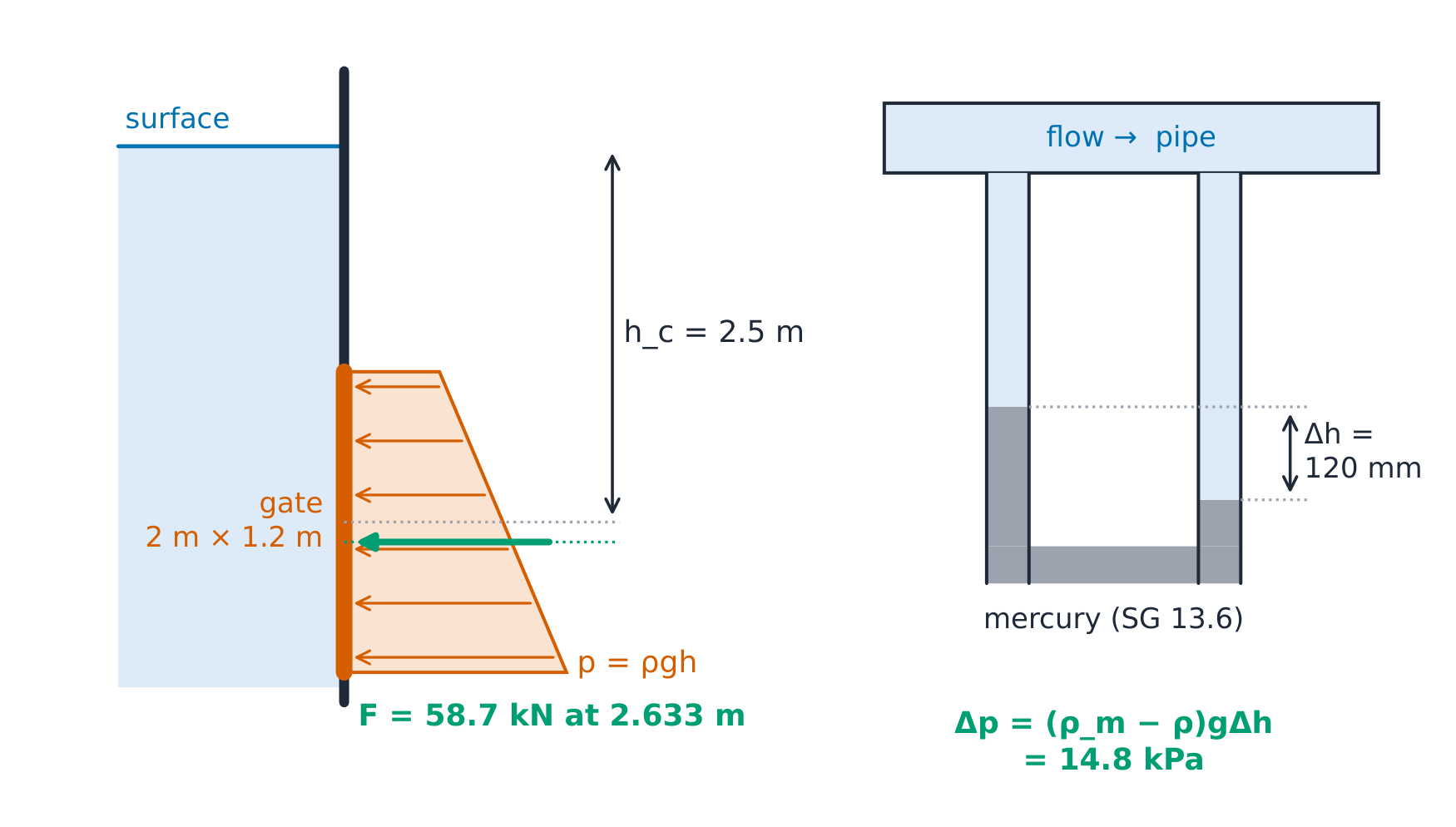
- A vertical gate $1.2\ \mathrm{m}$ wide and $2\ \mathrm{m}$ high has its top edge $1.5\ \mathrm{m}$ below the surface, so $h_c = 2.5\ \mathrm{m}$ and $A = 2.4\ \mathrm{m^2}$.
- $F = 998 \times 9.81 \times 2.5 \times 2.4 = \mathbf{58.7}$ kN.
- With $I_c = bh^3/12 = 0.8\ \mathrm{m^4}$: $y_{cp} = y_c + I_c/(y_c A) = \mathbf{2.633}$ m, which is 133 mm below the centroid.
Force on the 1.2 m by 2 m gate with its centroid 2.5 m deep (one decimal, kN)?
难度 2/5 · 今日首次完成可获 140 金币及少量额外奖励
rho g h_c A.
Its centre-of-pressure depth (three decimals, m)?
难度 2/5 · 今日首次完成可获 140 金币及少量额外奖励
y_c + I_c/(y_c A) = 2.5 + 0.8/6.
A height becomes a pressure
- A mercury U-tube (SG 13.6) across a fitting reads $\Delta h = 120$ mm. The water above the mercury cancels on both sides except over $\Delta h$, so $\Delta p = (\rho_m - \rho) g \Delta h = \mathbf{14.8}$ kPa.
- Using $\rho_m$ alone forgets that water column and overstates the reading by about 8%.
Which statics rule answers it?
Route each question to the rule that answers it.
Mercury manometer, dh = 120 mm, water above it: pressure difference (one decimal, kPa)?
难度 2/5 · 今日首次完成可获 140 金币及少量额外奖励
(13.6 - 1) x 998 x 9.81 x 0.12.
When the fluid moves: viscosity 黏度
- Statics ignores viscosity, but motion does not: $\tau = \mu\,du/dy$. A plate sliding at $2\ \mathrm{m/s}$ on a $0.5\ \mathrm{mm}$ oil film with $\mu = 0.29\ \mathrm{Pa\,s}$ feels $\tau = \mathbf{1160}$ Pa.
- The kinematic viscosity 运动黏度 $\nu = \mu/\rho$ is the one that appears in Reynolds numbers 雷诺数: $1.004 \times 10^{-6}\ \mathrm{m^2/s}$ for water.
Plate at 2 m/s on a 0.5 mm oil film, mu = 0.29 Pa s: shear stress (Pa)?
难度 2/5 · 今日首次完成可获 140 金币及少量额外奖励
mu times the velocity gradient 2/0.0005.
The same law floats things
- Pressure that grows with depth pushes harder on a body's underside than its top. The net is the buoyancy 浮力 force, $\rho g V$: the weight of the displaced fluid (Archimedes).
- A 0.2 m³ float of 50 kg, held fully under water, feels $998 \times 9.81 \times 0.2 = 1958$ N up against 491 N of weight: its tether must hold $\mathbf{1468}$ N.
A 0.2 m³, 50 kg float held under water: tether tension (N, nearest whole)?
难度 2/5 · 今日首次完成可获 140 金币及少量额外奖励
Buoyancy $998 \times 9.81 \times 0.2 = 1958$ N; minus weight $50 \times 9.81 = 491$ N gives 1468 N.
Worked example: hinge on top, latch below
- Hinge the 2 m gate along its top edge, 1.5 m deep, and latch it at the bottom. The 58.7 kN acts $2.633 - 1.5 = 1.133$ m below the hinge.
- Moments about the hinge: $R_{latch} \times 2 = 58.7 \times 1.133$, so $R_{latch} = \mathbf{33.3}$ kN, and the hinge takes the other 25.5 kN. The centre of pressure is what loads the latch more.
The gate hinged at its top edge (1.5 m deep), latched at the bottom: latch force (one decimal, kN)?
难度 2/5 · 今日首次完成可获 140 金币及少量额外奖励
Moments about the hinge: $58.7 \times (2.633 - 1.5)/2 = 33.3$ kN.
The hinge and the latch each carry half of the 58.7 kN.
难度 1/5 · 今日首次完成可获 100 金币及少量额外奖励
The force acts below the centroid, at the centre of pressure, so the bottom latch carries more: 33.3 kN against 25.5 kN.
Three statics slips
- The force at the centroid. It acts lower, at the centre of pressure.
- Gauge and absolute in one equation. Choose one reference and keep it.
- The missing water column. A manometer reads $\rho_m - \rho$, not $\rho_m$.
A fluid at rest can carry a shear stress.
难度 1/5 · 今日首次完成可获 100 金币及少量额外奖励
With no motion there is no velocity gradient, so pressure acts equally in all directions.
Recap
- $p = p_0 + \rho g h$; $F = \rho g h_c A = 58.7$ kN on the gate, acting at $y_{cp} = 2.633$ m.
- $\Delta p = (\rho_m - \rho) g \Delta h = 14.8$ kPa for a 120 mm mercury reading.
- $\tau = \mu\,du/dy$; $\nu = \mu/\rho$.