磁路与变压器
引入| English | 释义 | 拼音 |
|---|---|---|
| transformer/trænsˈfɔːmə/ | 变压器 | biàn yā qì |
| flux/flʌks/ | 磁通 | cí tōng |
| magnetomotive force | 磁动势 | cí dòng shì |
| reluctance | 磁阻 | cí zǔ |
| air gap | 气隙 | qì xì |
| copper loss | 铜损 | tóng sǔn |
| core loss | 铁损 | tiě sǔn |
| eddy currents/ˈedi ˈkʌrənts/ | 涡流 | wō liú |
| open-circuit test | 空载试验 | kōng zài shì yàn |
| short-circuit test | 短路试验 | duǎn lù shì yàn |
A transformer smaller than a coin
- A phone charger contains a transformer smaller than a coin. A grid substation contains one bigger than a house.
- Both work because magnetic flux flows in loops through iron, much as current flows round a circuit. This lesson builds that picture.
The magnetic circuit
- A coil of $N$ turns carrying current $I$ makes a magnetomotive force 磁动势 $F = NI$ (ampere-turns). It drives flux 磁通 $\Phi$ round the iron.
- The iron opposes it with reluctance 磁阻 $R_{m} = \dfrac{l}{\mu A}$, so $\Phi = \dfrac{F}{R_{m}}$: Ohm's law for magnetism.
A coil gives 150 At of magnetomotive force round a core of reluctance 75 000 At/Wb. What is the flux, in mWb?
难度 2/5 · 今日首次完成可获 140 金币及少量额外奖励
$\Phi = F/R_{m} = 150/75\,000 = 0.002$ Wb = 2 mWb.
Flux density and the air gap
- The flux density $B = \Phi/A$ (tesla) is what the iron feels. Power-frequency cores work between about 1.0 and 1.5 T.
- Air has $\mu_{r} = 1$, thousands of times lower than iron. A thin air gap 气隙 can carry most of the loop's reluctance.
Match each magnetic quantity to its electric twin.
难度 2/5 · 今日首次完成可获 140 金币及少量额外奖励
The magnetic circuit is Ohm's law with new names, so series reluctances add like series resistors.
Worked example: a core, then a gap
- Core: $l = 0.5$ m, $A = 10^{-3}$ m², $\mu_{r} = 4000$, 200 turns at 0.5 A. $F = 100$ At and $R_{m} = 99\,472$ At/Wb, so $\Phi = 1.005$ mWb and $B = 1.005$ T.
- Cut a 0.5 mm gap: it adds 397 887 At/Wb, four times the core. The flux falls to 0.201 mWb, one fifth.
The 0.5 mm gap adds four times the core's reluctance. What happens to the flux for the same coil current?
难度 1/5 · 今日首次完成可获 100 金币及少量额外奖励
The total reluctance becomes 1 + 4 = 5 times the core alone, so the flux is one fifth: 1.005 mWb becomes 0.201 mWb.
The transformer
- A transformer 变压器 links two windings through one flux. Ideally $\dfrac{V_{1}}{V_{2}} = \dfrac{N_{1}}{N_{2}}$ and $\dfrac{I_{1}}{I_{2}} = \dfrac{N_{2}}{N_{1}}$: volts trade against amps, and power stays the same.
- A real one loses copper loss 铜损 $I^{2}R$ in the windings and core loss 铁损 in the iron, from hysteresis and eddy currents 涡流.
A 2000 V / 400 V transformer carries 5 A on its HV side. What current flows on the LV side, in A (ideal transformer)?
难度 2/5 · 今日首次完成可获 140 金币及少量额外奖励
The current ratio is the inverse of the voltage ratio: 5 × 2000/400 = 25 A. Both sides carry 10 kVA.
Two tests, two branches
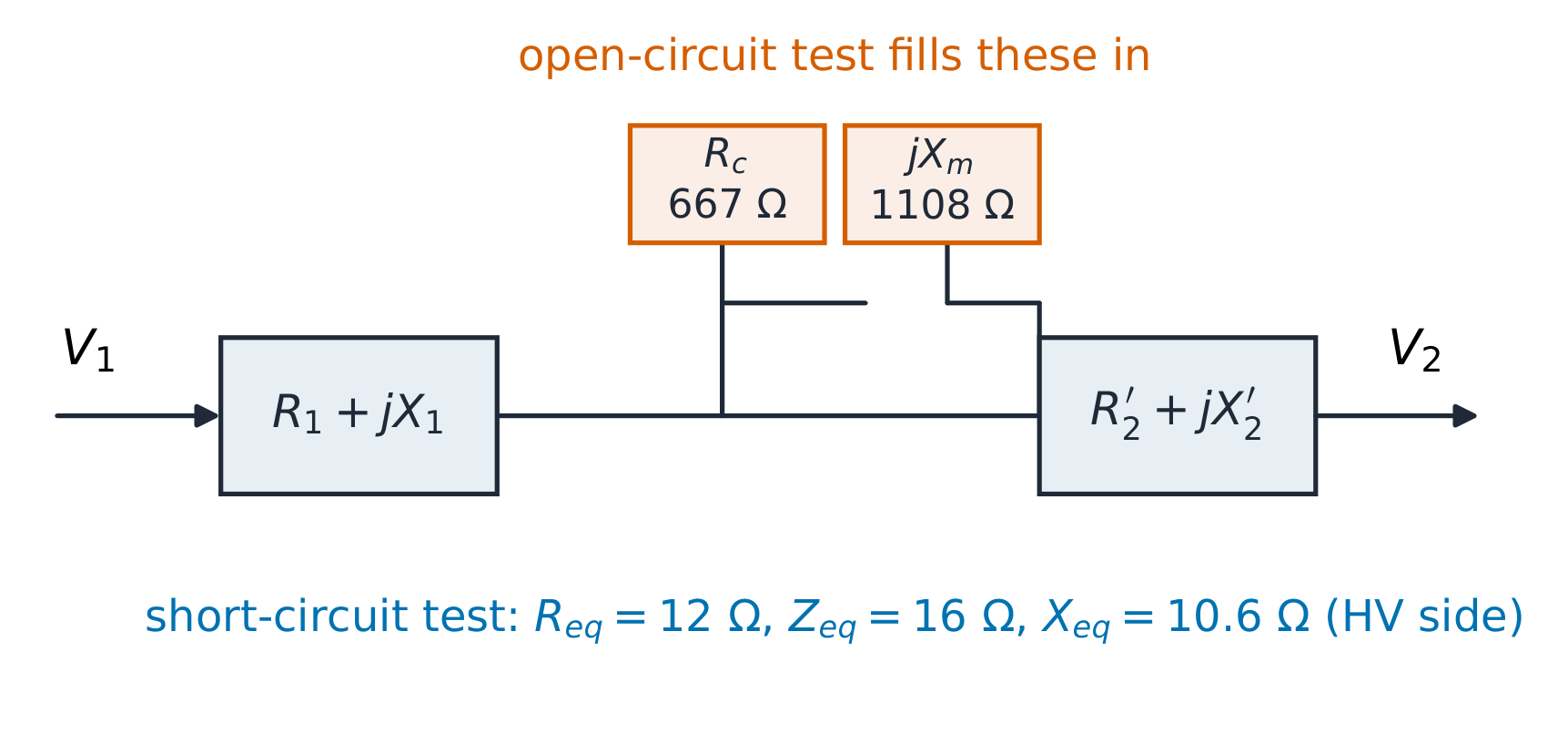
- The open-circuit test 空载试验 at rated voltage measures core loss: 400 V, 0.7 A, 240 W gives $R_{c} = 667\ \Omega$ and $X_{m} = 1108\ \Omega$.
- The short-circuit test 短路试验 at rated current measures copper loss: 80 V, 5 A, 300 W gives $R_{eq} = 12\ \Omega$ and $X_{eq} = 10.6\ \Omega$.
The power drawn in the open-circuit test is almost all core loss.
难度 1/5 · 今日首次完成可获 100 金币及少量额外奖励
With no load, only the small magnetising current flows, so the copper loss is negligible and the 240 W is core loss. The short-circuit test is the opposite.
Worked example: efficiency
- At full load and unity power factor, 10 kVA gives $\eta = \dfrac{10\,000}{10\,000 + 240 + 300} = 94.9\%$. At power factor 0.8 the output is 8000 W and $\eta = 93.7\%$.
- Efficiency peaks where copper loss equals core loss: at $\sqrt{240/300} = 0.894$ of full load.
The same 10 kVA transformer (core loss 240 W, full-load copper loss 300 W) runs at half load, unity power factor. What is its efficiency, in %? Give 1 decimal place.
难度 2/5 · 今日首次完成可获 140 金币及少量额外奖励
Copper loss scales with current squared: 300 × 0.25 = 75 W. $\eta = 5000/(5000 + 240 + 75) = 94.1\%$.
Three common slips
- Forgetting $\mu_{0}$. $\mu = \mu_{0}\mu_{r}$; leaving out $\mu_{0}$ is an error of about a million.
- Mixing sides. Moving an impedance across a transformer multiplies it by the turns ratio squared.
- Ignoring the gap. A gap as thin as a hair can hold four fifths of the reluctance.
A transformer has 100 W core loss and 400 W copper loss at full load. At what fraction of full load is it most efficient?
难度 2/5 · 今日首次完成可获 140 金币及少量额外奖励
Peak efficiency is where $x^{2} \times 400 = 100$, so $x = \sqrt{100/400} = 0.5$.
Recap
- $F = NI$, $\Phi = F/R_{m}$, $R_{m} = l/(\mu A)$; keep $B$ under about 1.5 T.
- Open circuit gives the core branch; short circuit gives the copper branch.
- Efficiency peaks where copper loss equals core loss.