拉普拉斯电路分析
引入| English | 释义 | 拼音 |
|---|---|---|
| initial-condition source | 初始条件源 | chū shǐ tiáo jiàn yuán |
| poles/pəʊlz/ | 极点 | jí diǎn |
| final-value theorem | 终值定理 | zhōng zhí dìng lǐ |
A switch, mid-story
- A relay coil already carries current when a switch changes the circuit around it. The new response starts from where the old one left off.
- Writing and solving a differential equation each time is slow. The Laplace transform turns the whole problem, starting state included, into algebra.
Elements in the s-domain
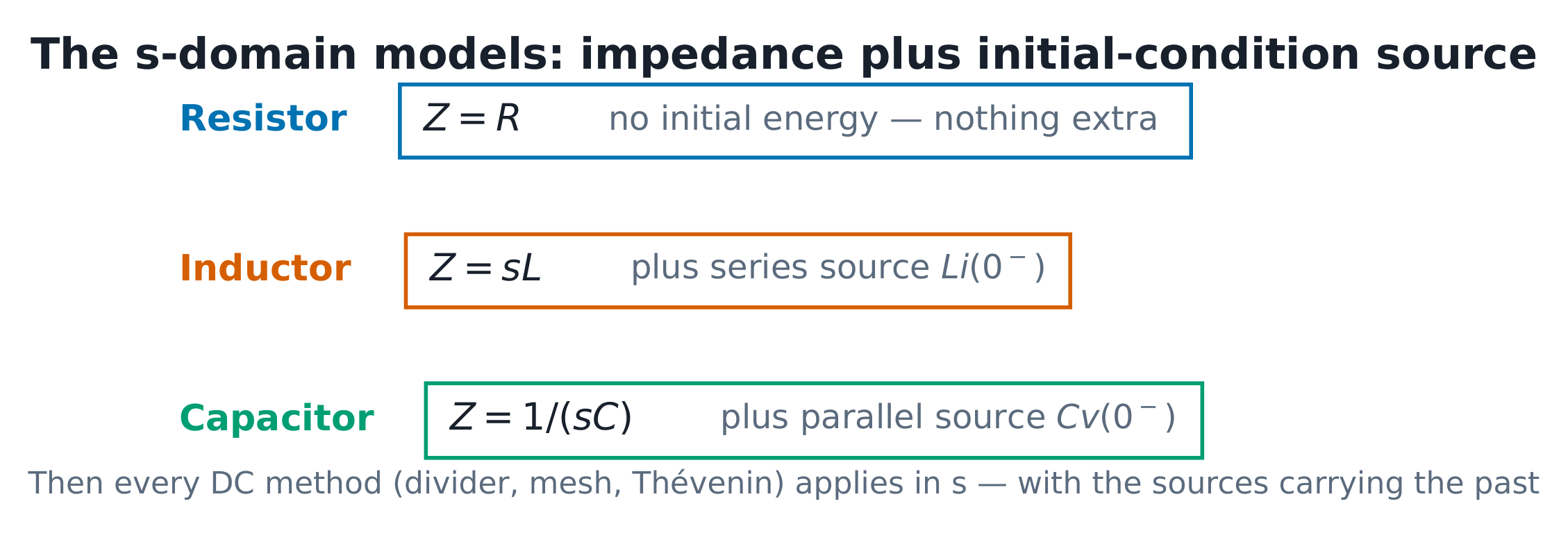
- Transformed, each element is an impedance in $s$: $Z_{R} = R$, $Z_{L} = sL$, $Z_{C} = \dfrac{1}{sC}$. They are the phasor impedances with $j\omega$ replaced by $s$.
- Series, parallel, dividers, nodal and mesh analysis then work in $s$ exactly as in DC.
Match each element to its s-domain impedance.
难度 2/5 · 今日首次完成可获 140 金币及少量额外奖励
Put $s = j\omega$ and these become the phasor impedances: the s-domain covers the steady state and the transient together.
The inductor's starting current
- An inductor carrying $i(0^{-})$ becomes $sL$ in series with a voltage source of $L\,i(0^{-})$. The equivalent is $sL$ in parallel with a current source $\dfrac{i(0^{-})}{s}$.
- This initial-condition source 初始条件源 carries the stored energy into the new circuit. Leave it out and the inductor starts empty.
In the s-domain, an inductor with initial current i(0) becomes
难度 1/5 · 今日首次完成可获 100 金币及少量额外奖励
The initial condition enters as a source: $L\,i(0)$ volts in series, or $\dfrac{i(0)}{s}$ in parallel. Drop it and every answer claims the circuit starts at rest.
The capacitor's starting voltage
- A capacitor charged to $v(0^{-})$ becomes $\dfrac{1}{sC}$ in parallel with a current source $C\,v(0^{-})$, or in series with a voltage source $\dfrac{v(0^{-})}{s}$.
- Choose the form that suits the method: series sources for mesh analysis, parallel sources for nodal.
A 47 µF capacitor starts at 10 V. In its parallel s-domain model, what is the strength C·v(0) of the current source, in µC?
难度 2/5 · 今日首次完成可获 140 金币及少量额外奖励
$C\,v(0) = 47 \times 10^{-6} \times 10 = 470\,\mu\text{C}$: the stored charge, released as an impulse of current in the time domain.
Worked example: RC from a non-zero start
- $R = 10\,\text{k}\Omega$, $C = 100\,\mu\text{F}$ ($\tau = 1$ s), a 9 V step, and $v_{C}(0) = 1\,\text{V}$. KVL in $s$: $\dfrac{9}{s} = IR + \dfrac{1}{s} + \dfrac{I}{sC}$.
- Solving gives $V_{C}(s) = \dfrac{9}{s} - \dfrac{8}{s + 1}$, so $v_{C}(t) = 9 - 8e^{-t}$ V. Check: $v_{C}(0) = 1$ and $v_{C}(\infty) = 9$.
V_C(s) = 9/s − 8/(s + 1). What is v_C(t)?
难度 1/5 · 今日首次完成可获 100 金币及少量额外奖励
$\dfrac{9}{s}$ is the step 9, and $\dfrac{8}{s+1}$ is $8e^{-t}$. Check: it starts at $9 - 8 = 1$ V and ends at 9 V, as the circuit requires.
Worked example: the RLC's poles
- Series RLC, $R = 2\,\Omega$, $L = 0.2\,\text{H}$, $C = 0.05\,\text{F}$, with $i(0) = 1\,\text{A}$ and an empty capacitor. Mesh KVL: $\left(0.2s + 2 + \dfrac{20}{s}\right)I = 0.2$.
- So $I(s) = \dfrac{s}{s^{2} + 10s + 100}$, with poles 极点 $-5 \pm j8.66$: exactly $\alpha = 5$ and $\omega_{d} = 8.66$ from the time-domain lesson.
A source-free series RLC (R = 2 Ω, L = 0.2 H, C = 0.05 F, i(0) = 1 A) gives I(s) = s/(s² + 10s + 100). The poles are
难度 1/5 · 今日首次完成可获 100 金币及少量额外奖励
$s = -5 \pm \sqrt{25 - 100} = -5 \pm j8.66$. The poles are the time-domain numbers: $\alpha = \dfrac{R}{2L} = 5$ and $\omega_{d} = \sqrt{100 - 25} = 8.66$.
What the poles tell you
- The circuit's own poles give the transient: their real parts set the decay, their imaginary parts the ringing. The input's poles give the steady state.
- The final-value theorem 终值定理 $f(\infty) = \lim_{s \to 0} sF(s)$ checks the end point, but only when all poles of $sF(s)$ lie in the left half-plane.
Use the final-value theorem: what is the final value of f(t) when F(s) = 12/(s(s + 3))?
难度 2/5 · 今日首次完成可获 140 金币及少量额外奖励
$\lim_{s \to 0} sF(s) = \dfrac{12}{3} = 4$. The only remaining pole, at −3, is in the left half-plane, so the theorem applies.
Three common slips
- Dropping the initial-condition sources. The answer then describes a circuit starting at rest.
- Cancelling $s$ carelessly. A factor of $s$ above and below can hide an impulse.
- Final-value theorem on an oscillator. Poles on the $j\omega$ axis mean there is no final value.
The final-value theorem gives the correct final value of F(s) = s/(s² + 100).
难度 1/5 · 今日首次完成可获 100 金币及少量额外奖励
The poles $\pm j10$ sit on the $j\omega$ axis: $f(t) = \cos 10t$ oscillates for ever and has no final value, though the formula would give 0.
Recap
- In $s$: $R$, $sL$, $\dfrac{1}{sC}$, each with its initial-condition source.
- Then every DC method applies; partial fractions return the waveform.
- The circuit's poles are its $\alpha$ and $\omega_{d}$; check the end points.