标准英语规范
引入| English | 释义 | 拼音 |
|---|---|---|
| subject/ˈsʌbdʒekt/ | 主语 | zhǔ yǔ |
| independent clause/ˌɪndɪˈpendənt klɔːz/ | 独立分句 | dú lì fēn jù |
| comma splice/ˈkɒmə splaɪs/ | 逗号拼接错误 | dòu hào pīn jiē cuò wù |
One comma too many
- A sentence on the test reads: "The trial ended on Friday, the team published its results on Monday."
- Each half has its own subject 主语 and verb, so a comma alone cannot join them. Standard English Conventions tests sentence boundaries, punctuation and grammar like this.
What this domain tests
- Boundaries: how to join or separate clauses with full stops, semicolons, colons, commas and dashes.
- Form, structure and sense: subject–verb agreement, pronouns, verb tense and form, modifiers and plurals/possessives.
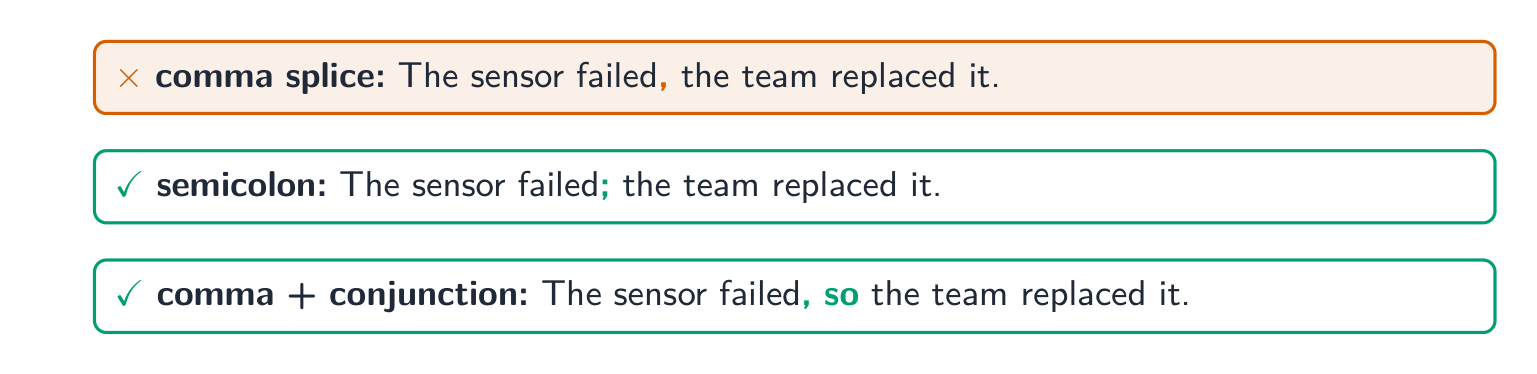
Independent clauses 独立分句
- An independent clause has a subject and a finite verb and can stand alone: "The team published its results."
- Two independent clauses can be joined by a full stop, a semicolon, or a comma + and / but / so. A comma alone between them is a comma splice 逗号拼接错误.
The sensor failed; the team replaced it. ✓ — The sensor failed, so the team replaced it. ✓ — The sensor failed, the team replaced it. ✗ (comma splice)
它能独立成句吗?
区分独立分句、从属分句和短语。
“The museum closed for repairs ___ it will reopen in May.” Which choice completes the text correctly?
难度 1/5 · 今日首次完成可获 100 金币及少量额外奖励
Both parts are independent clauses with no conjunction, so a semicolon is needed. A comma alone would be a comma splice.
Joining two independent clauses with only a comma creates a comma ____.
难度 1/5 · 今日首次完成可获 100 金币及少量额外奖励
A comma splice is a punctuation error on the SAT.
Agreement: find the real subject
- Cross out phrases between the subject and the verb: "The box (of old tools) is heavy." Box is singular, so is.
- "Each of the students has a laptop": each is singular. "The researchers, along with their adviser, are presenting": the subject is researchers.
“The collection of rare stamps ___ kept in a locked cabinet.” Which choice is correct?
难度 1/5 · 今日首次完成可获 100 金币及少量额外奖励
The subject is collection (singular); “of rare stamps” does not change its number.
Traps
- Nearest noun: the verb agrees with the subject, not the noun closest to it.
- Colon after a fragment: a colon normally follows a complete clause: "She needed three things: time, money and luck." Not "She needed: time, money and luck."
“The kit contains three items: a map, a torch and a whistle.” uses the colon correctly.
难度 1/5 · 今日首次完成可获 100 金币及少量额外奖励
True. A complete clause (“The kit contains three items”) comes before the colon, and the list explains it.
Recap
- Join two independent clauses with a full stop, a semicolon, or a comma + conjunction — never a comma alone.
- Make the verb agree with its real subject; put a colon after a complete clause.
- subject: The noun or pronoun that performs the action of the verb.
Put the boundary check in order.
难度 3/5 · 今日首次完成可获 200 金币及少量额外奖励
Decide the structure first; the punctuation follows from it.