Constructions, nets and solids · 作图、展开图与立体图形
| English | 中文 | Pinyin · 拼音 |
|---|---|---|
| edge/edʒ/ | 棱 | léng |
| scale drawing/skeɪl ˈdrɔːɪŋ/ | 比例图 | bǐ lì tú |
| net/net/ | 展开图 | zhǎn kāi tú |
| face/feɪs/ | 面 | miàn |
| prism/ˈprɪzəm/ | 棱柱 | léng zhù |
| pyramid/ˈpɪrəmɪd/ | 棱锥 | léng zhuī |
Building with ruler and compasses
- Ancient Greek geometers built every shape using just a straight edge 棱 and compasses — no rulers with markings, no protractors.
- Today, construction questions test whether you can use these tools precisely and leave your working visible.
用直尺和圆规作图
- 古希腊几何学家只用一把直边和圆规建造每个形状——没有带刻度的直尺,没有量角器。
- 今天,作图题测试你是否能精确地使用这些工具并把你的作图过程留得可见。
Construction and solid lab · 作图与立体图形实验
Classify geometry tasks by the tool or representation needed. · 根据所需工具或表示方式对几何任务进行分类。
Constructing triangles
- To construct a triangle from three sides:
- 1. Draw the base with a ruler.
- 2. Set compasses to the second side length and swing an arc from one end.
- 3. Set compasses to the third side and swing from the other end.
- 4. The intersection is the third vertex. Leave the arcs showing.
Don't erase the arcs. The examiner needs to see your construction arcs to award marks. They prove you used compasses, not guesswork.
作三角形
- 从三条边作一个三角形:
- 1. 用直尺画底边。
- 2. 把圆规设到第二条边的长度,从一端摆一条弧。
- 3. 把圆规设到第三条边,从另一端摆。
- 4. 交点是第三个顶点。留下弧显示。
不要擦掉弧。 考官需要看到你的作图弧才能给分。它们证明你用了圆规,不是猜测。
To construct a triangle from three given sides you mainly use a ruler and: · 要利用三条已知边构造三角形,主要使用直尺和:
Compasses swing arcs of the correct length for the other two sides. · 圆规可以画出符合另外两边长度的弧线。
You should erase your construction arcs to keep the drawing neat. · 擦除作图弧线可使图纸整洁。
Leave construction arcs visible — the examiner needs to see them to award marks. · 保留作图弧线可见——考官需要看到它们才能给分。
Scale drawings 比例图
- A scale drawing represents a real object at a fixed ratio (e.g. $1\text{ cm}:5\text{ m}$).
- Measure on the drawing, then multiply by the scale factor to get the real measurement.
Scale $1:200$. A room measures $3.5\text{ cm}$ on the plan. Real length $= 3.5 \times 200 = 700\text{ cm} = 7\text{ m}$.
比例图
- 一个比例图(scale drawing)以一个固定的比表示一个真实的物体(例如 $1\text{ cm}:5\text{ m}$)。
- 在图上测量,然后乘以比例因子得到真实的测量。
比例 $1:200$。一个房间在图上测量 $3.5\text{ cm}$。真实长度 $= 3.5 \times 200 = 700\text{ cm} = 7\text{ m}$。
A scale drawing uses 1:200. A room measures 3.5 cm on the plan. What is the real length in metres? · 一幅比例图为 1:200。房间在图纸上的尺寸为 3.5 cm。实际长度是多少米?
3.5 × 200 = 700 cm = 7 m. · 3.5 × 200 = 700 cm = 7 m。
Nets 展开图 and solids
- A net is a flat shape that folds up into a 3D solid — handy for surface area.
- Face 面: a flat side. Edge: where two faces meet. Vertex: a corner.
- A cube has $6$ faces, $12$ edges, and $8$ vertices.
展开图与立体
- 展开图是一种可以折叠成3维立体图形的平面图形——常用于计算表面积。
- 面(face):一个平的侧面。棱(edge):两个面相遇的地方。顶点(vertex):一个角。
- 一个立方体有 $6$ 个面、$12$ 条棱和 $8$ 个顶点。
A flat shape that folds up into a solid is called a ______. · 折叠成立体图形的平面形状称为 ______。
A net is the unfolded, flat version of a solid. · 展开图是立体图形展开后的平面形式。
How many faces does a cube have? · 正方体有多少个面?
A cube has 6 square faces (12 edges, 8 vertices). · 正方体有 6 个正方形面(12 条棱,8 个顶点)。
How many edges does a cube have? · 正方体有多少条棱?
A cube has 12 edges (where two faces meet). · 正方体有 12 条棱(两个面相交处)。
Naming solids
| Solid | Key property |
|---|---|
| cube / cuboid | box shapes (all flat faces) |
| prism 棱柱 | same cross-section all along |
| cylinder | circular prism |
| pyramid 棱锥 | comes to a point (apex) |
| cone | circular pyramid |
| sphere | perfectly round |
Coordinate grids help with accurate constructions — shapes can be placed, measured, and transformed precisely.
命名立体
| 立体 | 关键性质 |
|---|---|
| 立方体 / 长方体 | 盒子形状(全平面) |
| 棱柱 | 全长相同的横截面 |
| 圆柱 | 圆形棱柱 |
| 棱锥 | 收到一个点(顶点) |
| 圆锥 | 圆形棱锥 |
| 球 | 完全圆 |
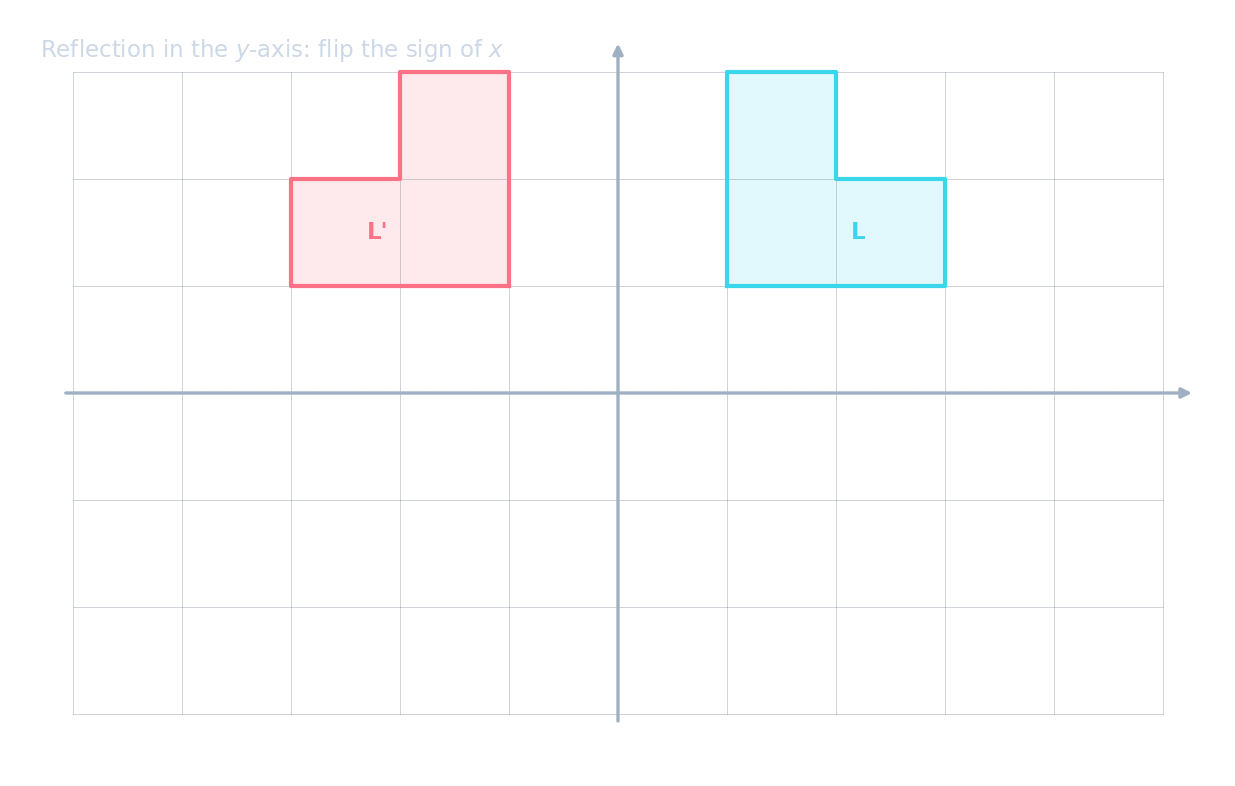
坐标网格有助于精确作图——形状能被精确地放置、测量和变换。
Use a net to calculate
- A $3\times2\times1$ cm cuboid needs two faces of each size $3\times2$, $3\times1$, $2\times1$. Surface area $S=2(6+3+2)=22\text{ cm}^2$; volume $V=3(2)(1)=6\text{ cm}^3$.
- A triangular prism net has two identical triangles and three rectangles. Their widths match the three triangle sides, and each rectangle length matches the prism length.
利用展开图进行计算
- 一个$3\times2\times1$厘米的长方体需要两对分别对应尺寸$3\times2$、$3\times1$和$2\times1$的面。其表面积为$S=2(6+3+2)=22\text{ cm}^2$;体积为$V=3(2)(1)=6\text{ cm}^3$。
- 三棱柱的展开图包含两个全等的三角形和三个矩形。矩形的宽度分别对应三角形的三条边长,每个矩形的长度则对应棱柱的高(或长)。
A cuboid is 3 cm by 2 cm by 1 cm. Find its surface area in cm². · 一个长方体的长、宽、高分别为 3 cm、2 cm 和 1 cm。求其表面积(单位:cm²)。
There are two faces of each size: 2(6+3+2) = 22 cm². · 每个尺寸有两个面:2(6+3+2) = 22 cm²。
A rhombus from two triangles
- Draw a 6 cm diagonal AB. Draw 5 cm radius arcs from A and B above and below it, meeting at C and D. Join A-C-B-D-A: all four edges are 5 cm, so the shape is a rhombus. Keep the arcs.
- For a square-based pyramid net, draw a square with one triangle attached to each edge. A base of side 4 cm and face height 3 cm has $S=b^2+4(bh/2)=16+24=40\text{ cm}^2$. Current Core and Extended construction outcomes do not require bisector constructions.
由两个三角形构成菱形
- 画一条长度为6厘米的对角线AB。以A和B为圆心,分别以5厘米为半径在AB上下方画弧,交点分别为C和D。连接A-C-B-D-A:由于四条边均为5厘米,该图形即为菱形。请保留作图弧线。
- 对于四棱锥的展开图,需画出一个正方形并在其每条边上各连接一个三角形。若底面边长为4厘米,侧面斜高为3厘米,则其展开图面积等属性为$S=b^2+4(bh/2)=16+24=40\text{ cm}^2$。现行核心课程与拓展课程的尺规作图要求中不再强制包含角平分线的作法。
You've got it
- construct with ruler + compasses; leave the construction arcs
- a net folds into a solid (good for surface area)
- a cube: $6$ faces, $12$ edges, $8$ vertices
你掌握了
- 用直尺 + 圆规作图;留下作图弧
- 一个展开图折叠成一个立体(对表面积好)
- 一个立方体:$6$ 个面,$12$ 条棱,$8$ 个顶点