| English | 释义 | 拼音 |
|---|---|---|
| program development life cycle/ˈprəʊɡræm dɪˈveləpmənt laɪf ˈsaɪkl/ | 程序开发生命周期 | chéng xù kāi fā shēng mìng zhōu qī |
| design/dɪˈzaɪn/ | 设计 | shè jì |
| analysis/əˈnæləsɪs/ | 分析 | fēn xī |
| coding/ˈkəʊdɪŋ/ | 编码 | biān mǎ |
| testing/ˈtestɪŋ/ | 测试 | cè shì |
| abstraction/əbˈstrækʃn/ | 抽象 | chōu xiàng |
| decomposition/ˌdiːkɒmpəˈzɪʃn/ | 分解 | fēn jiě |
| flowchart/ˈfləʊtʃɑːt/ | 流程图 | liú chéng tú |
| pseudocode/ˈsuːdəʊkəʊd/ | 伪代码 | wěi dài mǎ |
Building a program
- A program is built in stages — the program development life cycle 程序开发生命周期.
- We plan it with design 设计 tools, then write the algorithm.
- Every algorithm breaks into input → processing → output.
The four stages
- Analysis 分析 — study the problem and work out what's needed.
- Design — plan how the program will work.
- Coding 编码 — write the code, testing 测试 small parts as you go (iterative testing).
- Testing — run the finished program with test data to find errors.
- Two analysis skills: abstraction 抽象 (keep only the important details) and decomposition 分解 (break a big problem into smaller parts).
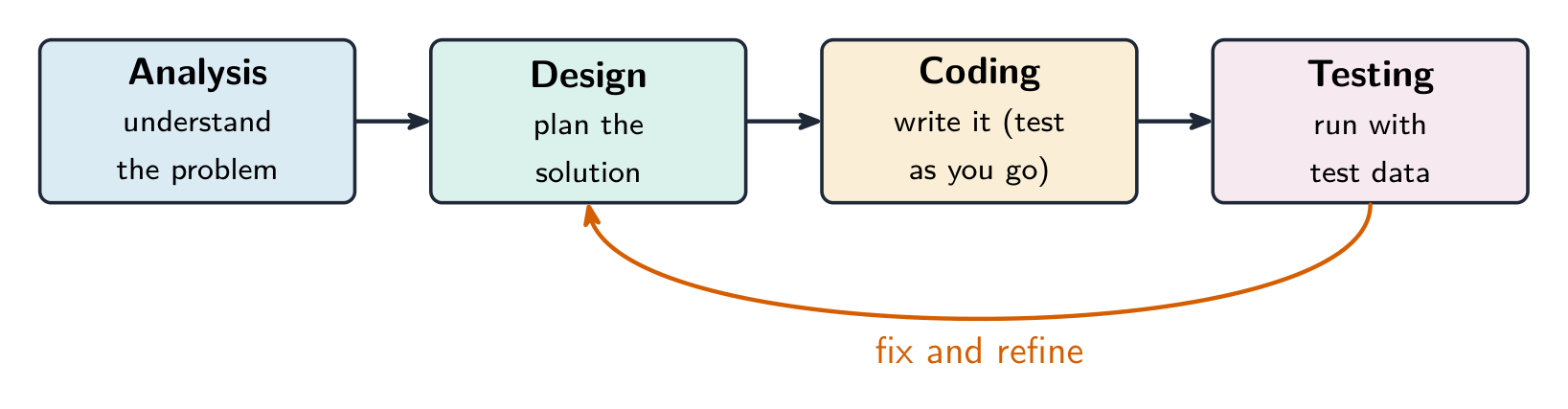
程序开发生命周期
Step through the stages every project follows — work out what's needed, plan it, build it, then check it. Getting analysis right first saves a lot of rework later.
Put the development life cycle stages in order.
难度 3/5 · 今日首次完成可获 200 金币及少量额外奖励
Analysis (what is needed) → design (plan) → coding (write) → testing (check).
Abstraction means:
难度 1/5 · 今日首次完成可获 100 金币及少量额外奖励
Abstraction simplifies; decomposition breaks a problem into parts.
Match each design concept to what it means.
难度 2/5 · 今日首次完成可获 140 金币及少量额外奖励
Abstraction simplifies, decomposition splits up, pseudocode plans the steps, and IPO is the overall flow.
Design tools
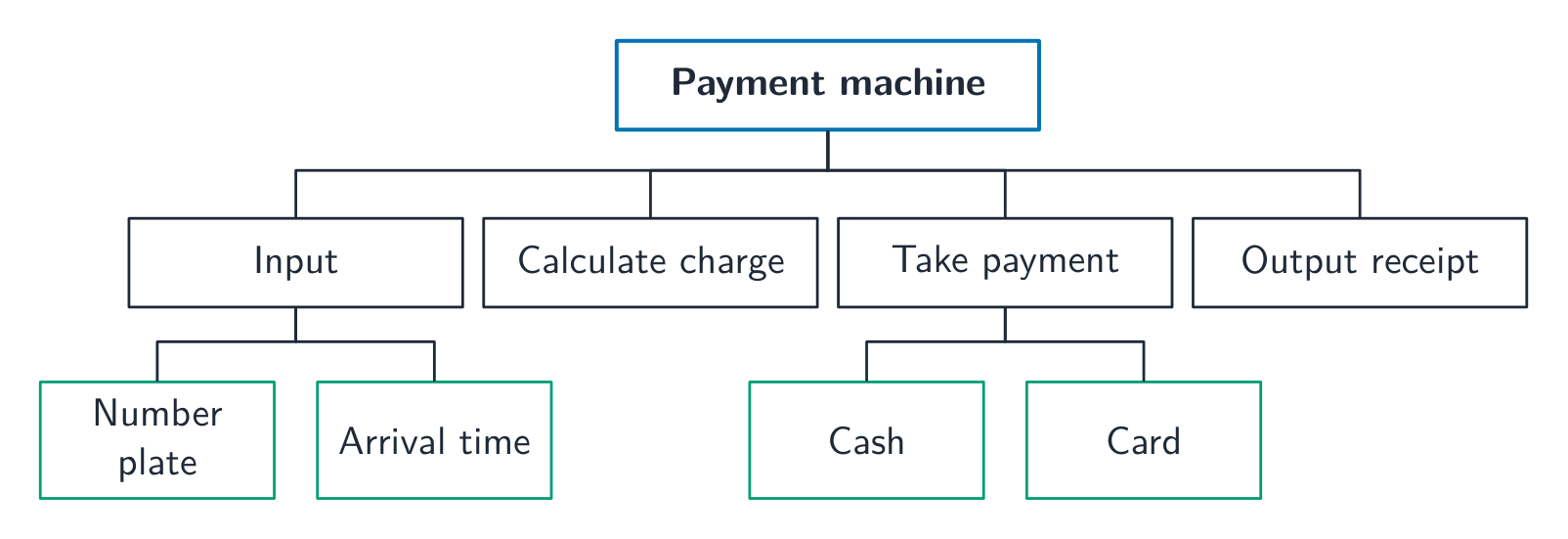
- A structure diagram — shows the parts of a system and how they fit together.
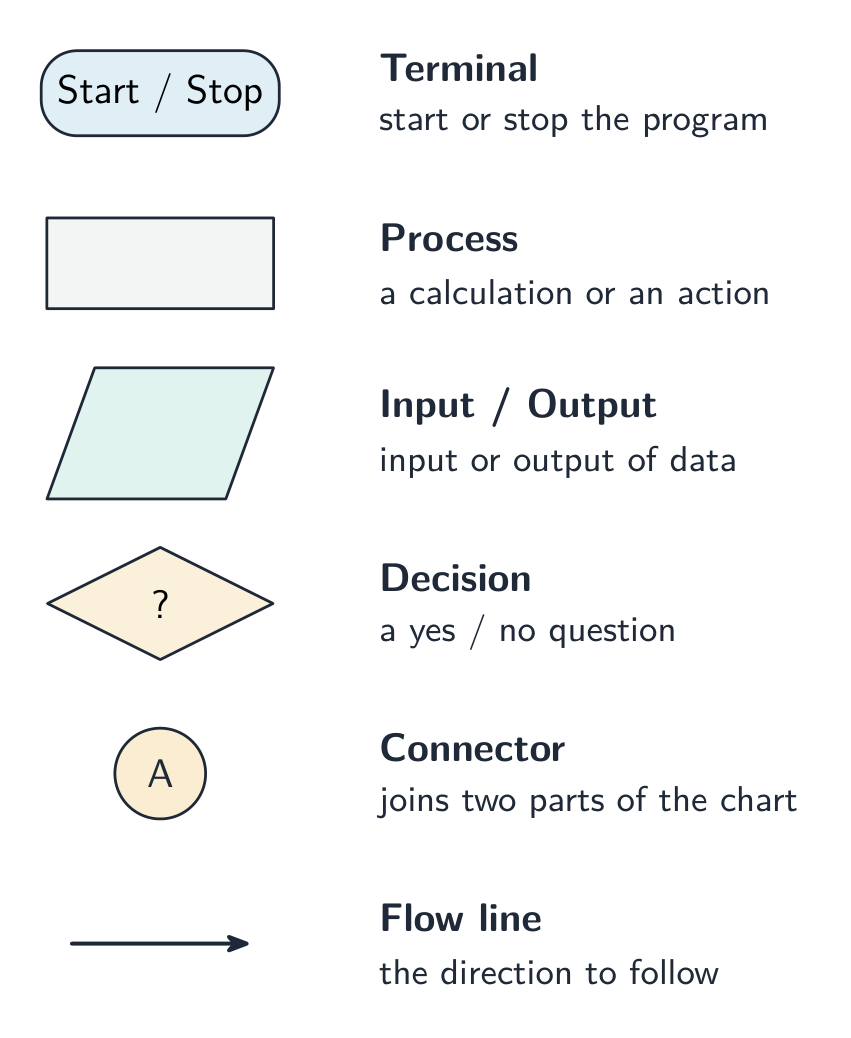
- A flowchart 流程图 — boxes and arrows showing the steps in order.
- Pseudocode 伪代码 — steps in simple, code-like English (not a real language).
Pseudocode is:
难度 1/5 · 今日首次完成可获 100 金币及少量额外奖励
Pseudocode describes an algorithm in readable, code-like English without being a real language.
Input, processing, output
- Every algorithm decomposes into input (the data in), processing (the work done), and output (the result).
- e.g. "average of three marks": input the 3 marks → add them and divide by 3 → output the average.

Every algorithm can be decomposed into:
难度 1/5 · 今日首次完成可获 100 金币及少量额外奖励
Input (data in) → processing (the work) → output (the result).
Worked example: a car-park payment machine
A car park needs a payment machine. Use decomposition and IPO to plan it.
- Decomposition splits the problem into sub-tasks: read the number plate, calculate the charge, take payment, print a receipt. Abstraction keeps only what matters: arrival time and plate matter, the car's colour does not.
- For the "calculate charge" part: input the arrival and leaving times; process: hours = leaving − arrival, charge = hours × rate; output the charge on the screen.
Removing details that are not needed to solve a problem is called:
难度 1/5 · 今日首次完成可获 100 金币及少量额外奖励
Decomposition breaks a problem into parts; abstraction removes unneeded detail.
In a flowchart, a decision is drawn as a diamond with a yes and a no exit.
难度 1/5 · 今日首次完成可获 100 金币及少量额外奖励
Processes are rectangles, input and output are parallelograms, and decisions are diamonds.
You've got it
- life cycle: analysis → design → coding → testing
- abstraction = keep what matters; decomposition = break into parts
- design tools: structure diagram, flowchart, pseudocode
- every algorithm = input → processing → output