您的已保存位置保留在此浏览器中。恢复操作不会完成课程或回答其中的问题。
"I go on Mondays" doesn't explain why cities need libraries
-
Goal: answer at the scope the question asks, develop a relevant link, and adjust when the follow-up changes. Start with the Speaking format; for long turns, see Part 2.
-
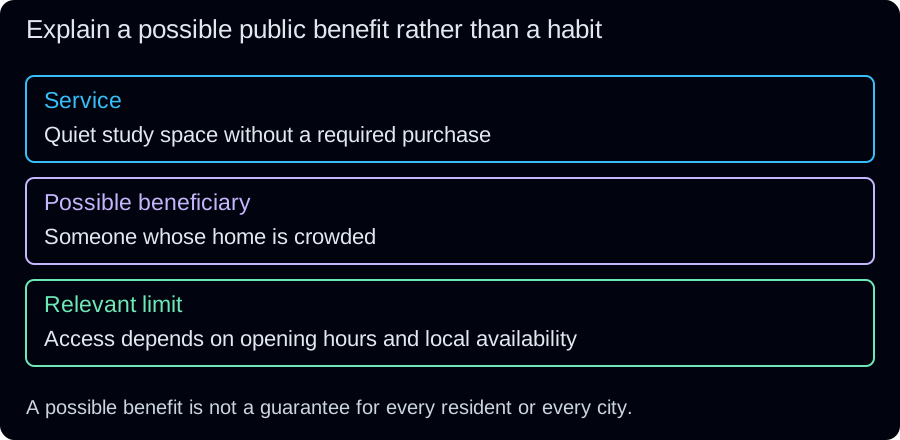
"Why might cities keep public libraries?" — "I use one on Mondays" is a personal habit. "Libraries give people a quiet place to study without having to buy anything, which helps people whose homes are crowded" explains a public benefit.
-
That answer links a service to the people it helps. It doesn't claim libraries solve everything. Your Monday visit is good evidence about you, but it cannot conduct a census of the whole city.

Do you like cooking? 哪个回答既切题,又提供了更多可供评估的语言?
难度 1/5 · 今日首次完成可获 100 金币及少量额外奖励
回答加上相关理由或例子,就能自然展开。一个词提供的语言很少;长篇回答也可能被考官打断。
Part 1: answer, then add something real
- "Do you like cooking?" — "Yes, I cook most evenings, because I enjoy choosing the ingredients." A direct answer plus a reason. "Yes" alone gives the examiner nothing to hear; a list of every dish you know loses focus.
- Answer + reason or example is a useful habit, not a sentence-count rule. Let tense follow meaning: "I used to order takeaway, but now I cook" compares past and present naturally.
Part 2: one topic, connected
- Use the minute to plan the card's points and the explanation, then speak for up to two minutes. Relevant details and reasons make a short story longer; unrelated filler doesn't.
- For a place: where it is, what you did there, and why it matters. There is no required number of "paragraphs" in a spoken turn. The examiner will stop you at the time limit and may ask a short follow-up.
把一种有用的 Part 3 展开方式排好顺序。
难度 3/5 · 今日首次完成可获 200 金币及少量额外奖励
观点、理由、例子和限定能帮助展开回答;应根据问题调整,而不是背诵这一结构。
Which fragments can introduce a tendency, condition or qualified comparison for you to develop? Choose all that apply.
难度 2/5 · 今日首次完成可获 140 金币及少量额外奖励
The selected fragments qualify the claim in different ways. I do not know can express uncertainty, but alone gives no developed tendency, condition or comparison. No phrase by itself demonstrates the full range of a response.
Part 3: explain, compare, speculate
- For the library question, link quiet space to the people who need it. If asked about limits, mention something like opening hours or staffing. Choose a view, reason, example or limit according to the question — not all four every time.
- "It can help people with crowded homes" keeps the claim to a possibility. "It depends on the opening hours" names a condition — then explain it. Use these words for meaning, not decoration; they won't raise a score by themselves.
口语考试会给更有意思的观点更高分。
难度 1/5 · 今日首次完成可获 100 金币及少量额外奖励
考官按四项标准评估英语口语,而不是观点是否新奇。回答应清楚、切题并有展开。
Which sentence preserves a possible library benefit without making a universal claim?
难度 1/5 · 今日首次完成可获 100 金币及少量额外奖励
Can and some preserve the possible benefit. The other options add unsupported guarantees or universal facts.
Clarify, rephrase, keep going
- If a question is unclear, ask: "Sorry, do you mean …?" If you didn't hear it, ask for a repeat. Then answer. Fillers like "That's a very interesting question" can't replace a reason.
- If insulation won't come, say "the material in a wall that keeps heat in." If a tense mistake changes your meaning, fix it quickly and carry on.
补全没听懂时的补救说法:Sorry, do you ___ …?
难度 1/5 · 今日首次完成可获 100 金币及少量额外奖励
问题不清楚时,可简短确认后再回答。反复要求解释则会打断讨论的流畅度。
You cannot recall insulation. Which paraphrase preserves the intended function?
难度 1/5 · 今日首次完成可获 100 金币及少量额外奖励
The description conveys the material’s function. A familiar replacement noun that means something else would not repair the message.
Try it with a park
- "How could a park benefit a neighbourhood?" Link a feature to a benefit — a safe path encourages people to walk locally — and a limit — but only if it's open when people finish work. "I went there on Tuesday" doesn't explain the wider benefit.
- Checked on 19 October 2026: IELTS Speaking format; more reading: IDP Part 3 guidance.

View the original question-scope case at full size
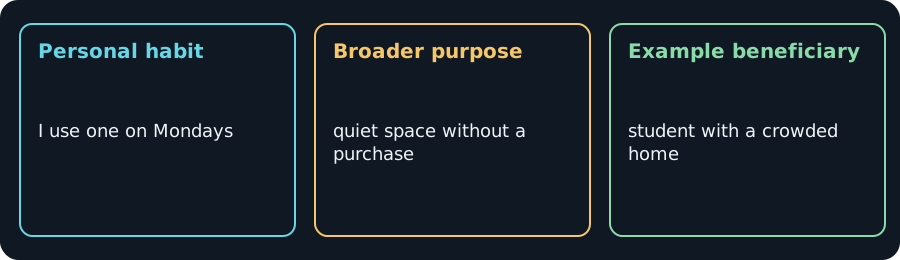
- Answer at the scope asked, explain the link, and add a limit when your meaning needs one.
Match the distinctions in this worked case.
难度 2/5 · 今日首次完成可获 140 金币及少量额外奖励
Develop it: “Libraries give people a quiet study space without requiring them to buy anything. That can help students whose homes are crowded.” The example supports a broader reason.
Which reply best develops the wider purpose of libraries?
难度 1/5 · 今日首次完成可获 100 金币及少量额外奖励
Question: “Why might cities keep public libraries?” Reply: “I use one on Mondays” is a relevant experience but not an explanation of the wider purpose. Develop it: “Libraries give people a quiet study space without requiring them to buy anything. That can help students whose homes are crowded.” The example supports a broader reason.
Which reply develops how a park could benefit a neighbourhood?
难度 1/5 · 今日首次完成可获 100 金币及少量额外奖励
The path connects a feature to a possible benefit. Tuesday identifies one visit; the universal health claim goes beyond the reason.
When the question changes, so does the answer
- "What do you do after dinner?" — "I usually go for a walk with my sister; it gives us time to talk." Follow-up: "Has that changed?" — "I used to watch TV, but now I prefer walking." Repeating your first answer would ignore the new question.
- "How might online and in-person lessons differ?" — a video can be paused and replayed; a tutor in the room can spot a mistake as it happens. Link each difference to what a learner needs. "Online is modern, so it's better for everyone" is a label, not an explanation.

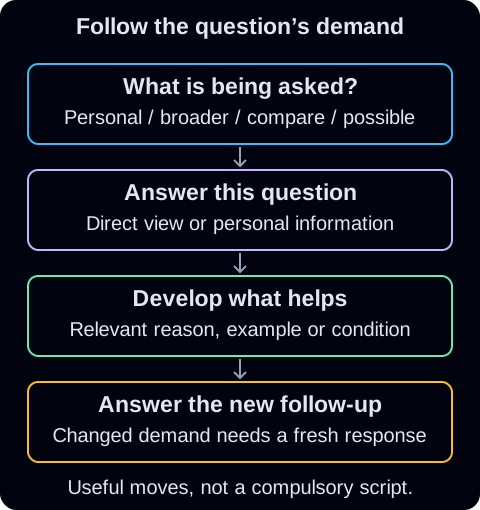
Guided choices: what job does the answer do?
- Ten written questions with hints: personal information, a wider purpose, a comparison, speculation, or clarification. Read the hint, choose, then read the explanation. A condition can sharpen a view without cancelling it.
- These are language choices, not recorded answers. "It depends" should not become a very small umbrella hiding an entire missing explanation.
原题卡问题:“晚饭后你通常做什么?” 草稿:“我散步。” 规划提示: 结合相关信息展开你自己的日常习惯。
决策: 以下哪项补充内容适用于这个问题?请选择 ONE 答案。
难度 1/5 · 今日首次完成可获 100 金币及少量额外奖励
该补充内容解释了这位说话者的日常习惯和个人原因。它不必变成公共政策演讲或固定数量的句子。
原始熟悉追问:“自从你年轻时,这个习惯有改变吗?” 之前的回答:“我通常晚饭后散步。” 计划提示: 回答关于变化的问题,而不是重复第一个答案。
决策: 哪个回复符合?选择一个答案。
难度 1/5 · 今日首次完成可获 100 金币及少量额外奖励
该答案对比了过去的习惯与现在的情况。仅重复原来的习惯并不能说明是否发生了变化。
原始更广泛的问题:“为什么社区可能会提供共享花园?” 草稿:“我有一株番茄植物。” 计划提示: 将某个特征与可能的更广泛益处联系起来。
决策: 哪个发展性回答能回应更广泛的问题?选择一个答案。
难度 1/5 · 今日首次完成可获 100 金币及少量额外奖励
该回复将共享空间与可能受益的群体联系起来。个人例子可以支持这一解释,但仅凭花盆颜色无法提供支持。
原始讨论问题:“免费课程适合所有人吗?” 草稿:“这要看情况。” 计划提示: 明确条件及其影响。
决策: 哪个补充内容能进一步阐述这一限定条件?选择一个答案。
难度 1/5 · 今日首次完成可获 100 金币及少量额外奖励
时间表的限制解释了为何仅免学费可能并不使课程易于参与。当“这要看情况”的含义被具体展开时,这种限定才具有参考价值。
原始对比:“在线学习烹饪与面对面学习有何不同?” 计划提示: 在两方面对同一维度进行比较。
决策: 哪个回复构成了有效的对比?选择一个答案。
难度 1/5 · 今日首次完成可获 100 金币及少量额外奖励
该答案比较了与学习相关的各种支持形式。它不需要假装某种方法适合所有学习者。
原题思考:“公园在未来可能会有哪些变化?” 规划提示: 区分可能的发展趋势与既定预测。
决策: 哪种表述能保持状态清晰?请选择一个答案。
难度 1/5 · 今日首次完成可获 100 金币及少量额外奖励
May(可能)和 if(如果)引入的是可能性与条件,而非有依据的预测。解释其联系时不要编造证据或确切的日期。
原题讨论:“为什么有些人更喜欢修理物品?” 草稿:“他们可能希望避免更换一件仍基本完好的物品。” 规划提示: 添加一个相关的后果。
决策: 哪个后续发展能进一步阐述原因?请选择一个答案。
难度 1/5 · 今日首次完成可获 100 金币及少量额外奖励
该后果解释了偏好修理的原因。它仍然只是一种可能的理由,而非普遍动机。
原题第 3 问使用了“共享设施”,您不确定此处 facilities(设施)的具体含义。规划提示: 简要澄清不明确的范围,然后作答。
决策: 哪个回答是有用的修复/回应?请选择一个答案。
难度 1/5 · 今日首次完成可获 100 金币及少量额外奖励
简短的澄清针对术语本身,使讨论得以继续。这并非要求考官提供论点或选择一个更简单的题目。
原题:“你喜欢买衣服吗?”你实际的情况是你很少享受这个过程。**计划提示:**诚实地回答并展开相关信息。
**决策:**哪个回答符合要求?请选择一个答案。
难度 1/5 · 今日首次完成可获 100 金币及少量额外奖励
明确的个人负面偏好可以充分展开。本题并不奖励观点的新颖性或热情程度。
原跟进问题:“免费课程会带来什么困难吗?”你之前解释过一种可能的益处。**计划提示:**回应新需求,不要将资格认定视为矛盾。
**决策:**哪个回复符合要求?请选择一个答案。
难度 1/5 · 今日首次完成可获 100 金币及少量额外奖励
跟进问题询问的是困难及可能的回应。某种条件或限制可以在不抹杀原有益处的情况下完善之前的观点。
Choices without hints
- Ten new questions and draft fragments. Read the exact demand — why, who, how has it changed, compare, every — before choosing. Personal experience can illustrate a wider point but can't prove a universal one.
- Choosing a good sentence isn't the same as saying one. Practise real answers in the recorded tasks below.
原题:“放松时你会听什么类型的音乐?”草稿:“主要是安静的吉他音乐。”
**决策:**哪项补充内容能发展所陈述的偏好?请选择一个答案。
难度 1/5 · 今日首次完成可获 100 金币及少量额外奖励
个人的实际效果可以发展这种偏好。行业分析涉及不同的范畴;重复提供的信息量极少。
原始更广泛的问题:“为什么城镇会保留公共广场?” 草稿:“我周一穿过了广场。”
决策: 什么能让答案回应更广泛的目的?选择 ONE 个答案。
难度 1/5 · 今日首次完成可获 100 金币及少量额外奖励
更广泛的目的需要对共享空间能实现的功能进行解释。个人经历或许可以作为例证,但单凭此无法解释该目的。
原始后续问题:“同样的安排是否适用于一个小村庄?” 之前的回答涉及大城市的夜间巴士服务。
决策: 哪个回应解决了语境的变化?选择 ONE 个答案。
难度 1/5 · 今日首次完成可获 100 金币及少量额外奖励
地点的改变需要重新评估需求和规模。该回应提供了一个可能的原因,而非编造实际乘客数据。
原始熟悉的问题:“你更喜欢独自学习还是与他人一起学习?” 你可能会根据不同的目的选择不同的方式。
决策: 哪个答复清晰地保留了这种偏好?选择 ONE 个答案。
难度 1/5 · 今日首次完成可获 100 金币及少量额外奖励
该条件区分了不同的活动并解释了偏好,且没有做出不必要的普遍性声明。带有条件的回答不必含糊其辞。
原始对比:“小型本地商店与大型超市有何不同?”
决策: 哪个答案在两方面比较了相关的方面?选择 ONE 个答案。
难度 1/5 · 今日首次完成可获 100 金币及少量额外奖励
该答案比较了服务与商品范围,并作出了恰当有限的陈述;其他选项仅罗列细节而未进行有信息量的比较。
原始讨论题:“什么可能导致公共自习室难以使用?”草拟回答:“这取决于开放时间。”
裁决: 以下哪项阐述解释了该条件?请选择一项。
难度 1/5 · 今日首次完成可获 100 金币及少量额外奖励
该条件关联了一组人群及准入问题;仅命名变量而不说明其后果,使解释显得单薄。
原始推测性问题:“未来会有更多人共享工具吗?”
裁决: 以下哪项回应支持一种可能性,但并未作出预测?请选择一项。
难度 1/5 · 今日首次完成可获 100 金币及少量额外奖励
该回应解释了某种可能发展的条件,并未将单一案例转化为可衡量的趋势或确定的未来。
原始熟悉追问:“你为什么不再坐公交车了?”此前回答称你如今骑车上班。
裁决: 以下哪项答复回应了所询问的原因?请选择一项。
难度 1/5 · 今日首次完成可获 100 金币及少量额外奖励
工作变动解释了出行方式的改变。再次提及当前的交通方式并不能回答为何需要变更。
原始讨论问题:“是否所有社区活动都应提供在线服务?”你认为某些活动需要共享设备或面对面练习。
决策: 哪个选项表达并阐述了这一限制?请选择一个答案。
难度 1/5 · 今日首次完成可获 100 金币及少量额外奖励
“所有”一词的涵盖范围要求考虑该主张是否适用于各类活动。一个相关的限制条件可以支持一种有保留的观点,而无需完整的反驳模板。
原始讨论后续问题:“谁可能无法从这一变化中受益?”你此前已解释过数字预订如何简化体育场馆的使用。
决策: 哪个选项回应了后续问题?请选择一个答案。
难度 1/5 · 今日首次完成可获 100 金币及少量额外奖励
新问题关注的是可能被排除的群体。针对该群体进行回应是对先前益处的细化,而非矛盾。
Record: a familiar question and its follow-up
- Record the travel question, then the follow-up about a changed routine. Talk about your real situation — you might travel differently, study from home, or have changed nothing. The models show content choices, not a life to copy.
- Listen to each recording before comparing with the examples. Audio stays on this page, isn't uploaded, and disappears if you reload. You can use your own phone recorder instead.
原始熟悉问题 1: 你通常如何从家前往工作、学习或其他常规活动的地点?
在打开书面指导前大声作答。之后继续进行下一项活动,并在同一语境下进行固定的后续提问。录制、停止并播放“我的录音”,然后将内容与书面指导对比,将实际发音与检查表对比。这是自主录制的练习,并非考官实时互动或限时考试模拟。
该对题共享同一语境。其后续问题改变了应答要求;它不是额外的独立话题,也不是自动计分的对话。
原始熟悉型后续问题 2: 自从你年轻时起,你乘坐这段常规路程的方式有改变吗?
在继续此固定后续问题之前回答第一个问题。针对其新的应答要求进行回应,而非重复之前的回答。录制、停止并播放“我的录音”,然后将内容与书面指导及实际口语与检查表进行比较。这是自主节奏的录音练习,非现场考官互动或限时考试模拟。
该对题共享同一语境。其后续问题改变了应答要求;它不是额外的独立话题,也不是自动计分的对话。
Record: a benefit, then a difficulty
- Why offer free beginner classes? then What difficulties could arise, and how might organisers respond? The second question needs a problem and a matched response — repeating the benefit doesn't answer it.
- Keep uncertain things conditional: an extra session needs a room and staff; a booking app needs an alternative for people who can't use it.
原始宽泛讨论题 1: 社区中心为什么可能提供免费入门课程?
在打开书面指导前大声回答。之后继续进行下一项活动,在同一语境下完成固定后续问题。录制、停止并播放“我的录音”,然后将内容与书面指导及实际口语与检查表进行比较。这是自主节奏的录音练习,非现场考官互动或限时考试模拟。
该对题共享同一语境。其后续问题改变了应答要求;它不是额外的独立话题,也不是自动计分的对话。
原始宽泛后续问题 2: 这些免费课程可能面临哪些困难,组织者可能会如何应对?
在继续此固定后续问题之前回答第一个问题。针对其新的应答要求进行回应,而非重复之前的回答。录制、停止并播放“我的录音”,然后将内容与书面指导及实际口语与检查表进行比较。这是自主节奏的录音练习,非现场考官互动或限时考试模拟。
该对题共享同一语境。其后续问题改变了应答要求;它不是额外的独立话题,也不是自动计分的对话。
Record: compare, then test "all"
- Compare learning a practical skill online and in person; then answer whether online classes could replace all in-person practical teaching. Compare the same aspect on both sides — feedback, equipment — rather than two unrelated details.
- You may disagree with the model, as long as you explain your view and deal with all. Don't invent research. Listen back for one confusing link or unclear sound, and record a repair.
原始对比 1: 在线学习一项实用技能与面对面学习有何不同?
在打开书面指导前,请大声作答。完成后继续下一项活动,在同一语境下进行固定的后续练习。录制、停止并播放“我的录音”,然后将内容与书面指导及实际语音与检查表进行比对。这是自主录制的练习,并非考官实时互动或限时考试模拟。
该对题共享同一语境。其后续问题改变了应答要求;它不是额外的独立话题,也不是自动计分的对话。
原始对比后续问题 2: 在线课程能否完全取代所有面对面的实践教学?
在继续此固定后续问题之前,请先回答第一个问题。针对其新要求进行回应,而非重复之前的回答。录制、停止并播放“我的录音”,然后将内容与书面指导及实际语音与检查表进行比对。这是自主录制的练习,并非考官实时互动或限时考试模拟。
该对题共享同一语境。其后续问题改变了应答要求;它不是额外的独立话题,也不是自动计分的对话。
Back to something personal
- What do you like to do during a short break? Choose real personal information — a simple preference, well explained, is fine. Don't carry on the policy discussion.
- Record before reading the guidance, then improve one thin link or unclear phrase.
原始个人转移话题: 当你有一小段休息时间时,你喜欢做什么?
在打开指导前请大声作答。录制、停止、回放,并选择一个具体的修改点。这是一个包含书面问题的自主练习页面,并非听力测试或考官实时互动。
新材料要求选择新的内容。自我审查完成并不能确立分数等级或独立听众的判断。
Speculate, another day
- On another day, answer the public-places question before rereading. It's hypothetical: explain a possible result or condition without presenting it as a fact or a certain forecast.
- Record, listen, improve one thing, then go to the clarity lab, or back to Part 2 for long turns.
Checked on 19 October 2026: IELTS Speaking format. All questions and examples here are our own; there is no automatic pronunciation score.
原始后续讨论回顾: 如果更多人在家工作或学习,公共场所可能会发生什么变化?
在打开指导前请大声作答。录制、停止、回放,并选择一个具体的修改点。这是一个包含书面问题的自主练习页面,并非听力测试或考官实时互动。
新材料要求选择新的内容。自我审查完成并不能确立分数等级或独立听众的判断。