您的已保存位置保留在此浏览器中。恢复操作不会完成课程或回答其中的问题。
Three parts, one examiner
- Goal: know what each part of the Speaking test asks you to do, and hear what a full, natural answer sounds like in each part. All model answers in this lesson were written for this site.
- Speaking lasts 11–14 minutes, face to face with a real examiner (or by video call at some centres). It is recorded. Academic and General Training use exactly the same Speaking test.
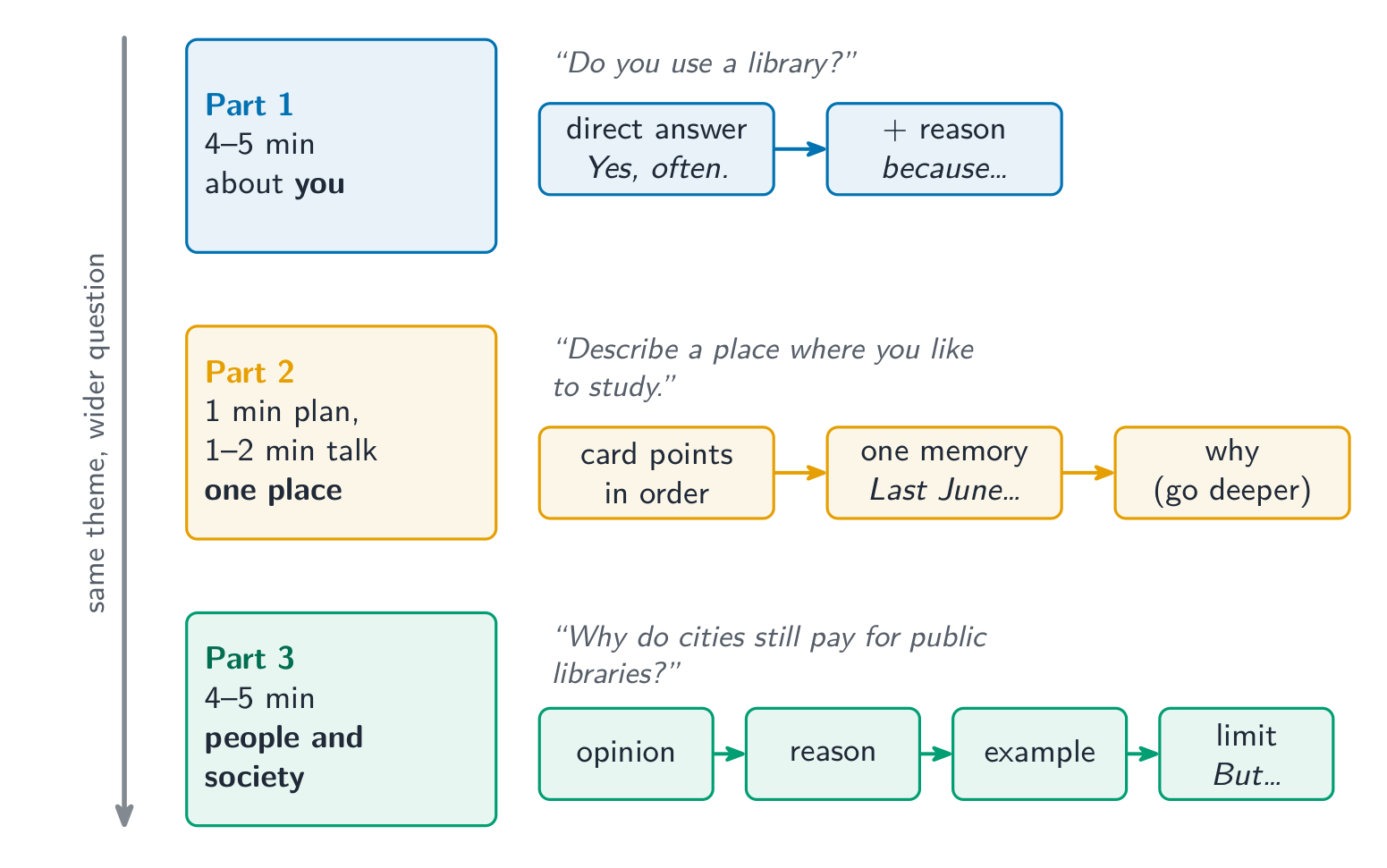
| Part | Time | What happens | A good answer |
|---|---|---|---|
| 1 | 4–5 min | Short questions about you | Answer, then a reason or detail |
| 2 | 3–4 min | Task card: 1 min to plan, 1–2 min to talk | Card points in order, one memory in detail |
| 3 | 4–5 min | Wider discussion of the Part 2 topic | Opinion, reason, example, limit |
- The examiner judges four things, each worth the same: fluency and coherence (keeping going, linking ideas), lexical resource (vocabulary), grammatical range and accuracy, and pronunciation. There is no mark for "correct opinions": a simple, honest idea explained well is enough.
口语考试大约几分钟?填这个区间的下限。
难度 2/5 · 今日首次完成可获 140 金币及少量额外奖励
11 到 14 分钟。
谁来提问?
难度 1/5 · 今日首次完成可获 100 金币及少量额外奖励
A live examiner conducts the three parts. The interview is also recorded; recording does not turn the questions into prerecorded prompts.
The IELTS Speaking test is a live interview with an examiner, which is also recorded.
难度 1/5 · 今日首次完成可获 100 金币及少量额外奖励
True. “Recorded” means the interview is captured for quality and review, not that the questions are prerecorded prompts.
Part 1: answer, then add one thing
- Part 1 questions are easy on purpose. The common problem is not a wrong answer but a closed one.
Examiner: Do you use a library?
- Too short: "Yes, I do." — Correct, but it shows the examiner almost nothing. The examiner has to rescue the conversation.
- Better: "Yes, quite often, actually. There's a public library ten minutes from my flat, and I usually go on Monday evenings because it's almost empty then. I can't really concentrate at home — my brother plays computer games in the next room."
- Why it works: a direct answer first (Yes, quite often), then a fact (ten minutes from my flat), a reason linked with because, and a personal detail. Natural phrases like actually and I can't really sound like speech, not a written paragraph. It takes about 15 seconds: Part 1 answers do not need to be long, and there is no rule that each needs three sentences.
- Too long is also a problem: a one-minute speech in Part 1 uses up time the examiner needs for other questions. Two to four sentences is a comfortable size.
Examiner: "Do you like cooking?" Which answer is the best size and shape for Part 1?
难度 1/5 · 今日首次完成可获 100 金币及少量额外奖励
It answers directly (Not really), then adds an example and a reason linked with "but" and "so". "No." closes the conversation; a two-minute talk takes time the examiner needs for other questions and does not fit a personal question.
Part 2: one minute to plan, two to talk
- The examiner gives you a task card, paper and a pencil. You have one minute to prepare, then speak for one to two minutes. The examiner stops you when time is up and may ask one or two short follow-up questions.
Describe a place where you like to study. You should say:
- where it is
- when you go there
- what you do there
and explain why you like studying there.
- Notes made in one minute (key words, not sentences): library, 10 min, 2nd floor window · Mon eve, exams · maths past papers, phone in bag · WHY: quiet, brother, "everyone working" feeling
- Model long turn (about 1 minute 40 seconds):
I'd like to talk about the public library near my flat, which is where I do most of my serious studying. It's about ten minutes' walk away, and my favourite spot is on the second floor, at a long desk next to the window.
I usually go on Monday and Thursday evenings, and almost every day before exams. Last June, for example, I practically lived there for two weeks.
What I do there is mostly the work I find hardest — maths past papers, mainly. I have a little rule: my phone goes in my bag, and I don't take it out until I've finished a whole paper. At home I'd never manage that.
As for why I like it, the obvious reason is that it's quiet. My brother plays online games at home, and he isn't quiet at all. But I think the real reason is the atmosphere. When everyone around you is working, you feel a bit embarrassed to waste time. So in a funny way, the other people there help me study, even though I've never spoken to any of them.
- Why it works: it follows the card in order, so the examiner can follow it easily. Signposts (I'd like to talk about…, What I do there is…, As for why…) link the parts. One specific memory (Last June… two weeks) and one specific habit (the phone rule) give real detail instead of general words. The last point goes beyond the obvious (the real reason is the atmosphere), which shows the speaker can explain, not just list.
- Don't write a script in the minute: there isn't time, and reading sounds flat. A memorised speech also tends to miss the card you actually get.
填空:Part 2 有 ___ 分钟准备。
难度 1/5 · 今日首次完成可获 100 金币及少量额外奖励
准备一分钟,然后讲述一到两分钟。
应该背好一篇 Part 2,不管抽到什么卡都说那一篇。
难度 1/5 · 今日首次完成可获 100 金币及少量额外奖励
A fixed speech may not answer the actual card or follow-up. Prepare relevant details and practise flexible responses rather than assuming the examiner asks for your script.
The Part 2 card gives a minute to prepare, with no required number of notes.
难度 1/5 · 今日首次完成可获 100 金币及少量额外奖励
True. Use brief cues suited to the card; there is no compulsory count of keywords.
The model long turn includes one specific memory with a time ("Last June…") to give real detail.
难度 1/5 · 今日首次完成可获 100 金币及少量额外奖励
True. A specific time, place or habit is easier to talk about for two minutes than general words like "it is very good", and it gives the examiner more language to hear.
Part 3: opinion, reason, example, limit
- Part 3 (4–5 minutes) discusses more general and abstract ideas linked to the Part 2 topic. The questions are about people and society, not about you.
Examiner: Why do you think cities still pay for public libraries, now that so much is online?
- Weak (retells Part 2): "I like my library because it is quiet and my desk is near the window." — This describes one place. It does not explain why a city pays for libraries.
- Better: "I think the main reason is that not everyone has a good place to study at home. In a big city, a lot of families live in small flats, so a library gives students a quiet space for free. For example, near me you see secondary school students there every evening before exams. Having said that, I don't think libraries can just stay the same. If they only offer books, fewer people will come, so many now run computer classes or events for older people as well."
- Why it works — four moves: opinion (I think the main reason is…), reason (families live in small flats, so…), example (students there every evening), limit or other side (Having said that…). Speaking about people in general (not everyone, families, students) matches the question. The language of opinion and contrast is what Part 3 is testing.
- Listen for the question type — why, how, compare, what might happen in future — and answer that. "What might happen…" needs future forms: libraries will probably…, they might….
Examiner: "Should children learn to cook at school?" Answer: "Yes, I think so, because many young people leave home without knowing how to make a healthy meal. For instance, a lot of students at university live on instant noodles." Which of the four Part 3 moves is missing?
难度 1/5 · 今日首次完成可获 100 金币及少量额外奖励
It has an opinion (Yes, I think so), a reason (because…) and an example (instant noodles). A limit would complete it, for example: "Having said that, schools already have full timetables, so it might work better as a club than a compulsory subject."
Which opening fits the Part 3 question "How has the way people read changed in recent years?"
难度 1/5 · 今日首次完成可获 100 金币及少量额外奖励
The question is about people in general and about change, so it needs a general statement about what is different now. The other two are personal facts that would fit Part 1, not Part 3.
Same topic, different job
- One theme can run through all three parts, but each part asks for a different kind of answer. "Do you use a library?" wants a personal fact. "Describe a place where you study" wants one place told in detail. "Why might cities keep public libraries?" wants a general explanation.
- Your favourite desk is perfect for Part 2. It cannot answer a question about city policy. When the topic stays the same, check whether the job has changed.
把每个部分和内容配对。
难度 2/5 · 今日首次完成可获 140 金币及少量额外奖励
Part 3 不是第二个 Part 1。问题更宽、更抽象。
Match each kind of answer to the question it fits.
难度 2/5 · 今日首次完成可获 140 金币及少量额外奖励
A personal routine fits the first; a developed place and experience fit the second; an explanation with examples fits the third. Keep listening to the demand as the theme develops.
Which response fits a question about how libraries serve communities?
难度 1/5 · 今日首次完成可获 100 金币及少量额外奖励
Part 1 may ask whether you use a library. A long-turn card may ask for a place you studied. A broader question may ask how libraries can serve changing communities. A personal routine fits the first; a developed place and experience fit the second; an explanation with examples fits the third. Keep listening to the demand as the theme develops.
Which development fits “How might libraries support people with crowded homes”?
难度 1/5 · 今日首次完成可获 100 金币及少量额外奖励
The service and possible beneficiary directly answer the question. The personal detail and unrelated script do not explain the requested benefit.
When you don't hear or understand
- If you didn't hear a question, just ask: "Sorry, could you repeat that?" In Part 3 you can also ask about a word: "Do you mean public libraries or university ones?" Then answer. (This won't get you an easier question.)
- If you forget a word, describe it: "the material inside a wall that stops heat escaping" for insulation. If you make a mistake, correct it once and carry on; restarting again and again is harder to follow than the mistake.
- Need a second to think? Use a real phrase, not silence: "That's an interesting question — I haven't really thought about it before, but I'd say…" Use this once or twice, not before every answer.
You forget the word "receipt" while talking about shopping. What is the best thing to do?
难度 1/5 · 今日首次完成可获 100 金币及少量额外奖励
Describing the word keeps you speaking and still shows vocabulary. Long silences and restarting both make your answer harder to follow.
Practise out loud, and listen back
- Try it now: answer the same three library questions out loud, using your own life. Record yourself. Time the Part 2 answer: if it stops before one minute, add one memory with a time and place (last June…).
- Listen back for three things: did you answer the question that was asked, did you add a reason or example, and was one particular sound clear? Then try a different card. Typed answers can practise the ideas but can't measure how you sound.
- Format checked on 2 October 2026: IELTS Speaking format; asking for clarification: IDP Part 3 advice.
- Part 1: answer, then add one reason or detail. Part 2: follow the card, tell one specific memory. Part 3: opinion, reason, example, limit — about people in general. Practise out loud and listen back.