Waves, measurement and refraction
引入| English | 释义 | 拼音 |
|---|---|---|
| frequency/ˈfriːkwənsi/ | 频率 | pín lǜ |
| wavelength/ˈweɪvleŋθ/ | 波长 | bō cháng |
What would explain this observation?
- A wave can carry energy across water while a floating marker mainly oscillates. Energy transfer and bulk transfer of matter are different.
Build the model
- Frequency 频率 is oscillations per time; wavelength 波长 is distance between successive points in phase.
- Wave speed equals frequency multiplied by wavelength.
- Transverse oscillations are perpendicular to propagation.
- wavelength: Distance between successive points in phase.
- frequency: Number of oscillations per unit time.

When a wave enters a slower medium, what stays constant?
难度 1/5 · 今日首次完成可获 100 金币及少量额外奖励
Frequency is set by the source and cannot change at the boundary - the waves arriving must equal the waves leaving. It is the speed that changes in a slower medium, and the wavelength adjusts because v = f x wavelength.
Match each technical term to its precise meaning.
难度 2/5 · 今日首次完成可获 140 金币及少量额外奖励
Use the definitions to distinguish related quantities and processes.
Choose evidence that can test it
- At a boundary, frequency stays fixed by the source.
- A change of speed changes wavelength.
- Refraction follows from speed differences; angles are measured from the normal.
In the lab: Measure several wavelengths and divide to reduce fractional reading uncertainty. Use a ray box with a normal drawn at the boundary. Keep the beam away from eyes and record incident and refracted angles clearly.
Which two habits make the investigation or model in this case more defensible?
难度 2/5 · 今日首次完成可获 140 金币及少量额外奖励
Stating the conditions and assumptions lets others repeat the work exactly, and recording the supporting evidence lets them check the conclusion. Hiding disagreeing results removes the evidence that could challenge a wrong conclusion, and one measurement can never establish a wider claim.
Work from known quantities
- Known: frequency 5 Hz and wavelength 0.40 m.
- Use v = fλ. v = 5×0.40 = 2.0 metres per second.
- If speed falls to 1.5 metres per second at the same frequency, wavelength = v/f = 1.5/5 = 0.30 m.
Your turn: Frequency is 8 Hz and wavelength is 0.25 m. Find wave speed.
频率相同,波长不同
频率为5 Hz时,2.0和1.5 m/s的波速对应0.40和0.30 m的波长。比较静止界面两侧的同步波形快照,两种介质中的频率都由同一个波源决定。
Frequency is 8 Hz and wavelength is 0.25 m. Find wave speed.
难度 2/5 · 今日首次完成可获 140 金币及少量额外奖励
The result is 2 m/s. Known: f = 8 Hz; wavelength = 0.25 m. Use v = f x wavelength. v = 8 x 0.25 = 2 metres per second. If this wave entered a slower medium, f would stay 8 Hz and the wavelength would shrink.
Check the conclusion and its limits
- The wave frequency does not change simply because the medium changes.
- A longitudinal wave has oscillations parallel to propagation.
Not true: Wave frequency always changes when a wave enters a new medium. Frequency is fixed by the source, so it stays the same across a boundary. What changes is speed, and therefore wavelength through v = f x wavelength.
- Frequency is oscillations per time; wavelength is distance between successive points in phase.
- At a boundary, frequency stays fixed by the source.
- Watch for: the wave frequency does not change simply because the medium changes.
Wave frequency always changes when a wave enters a new medium.
难度 1/5 · 今日首次完成可获 100 金币及少量额外奖励
Frequency is fixed by the source, so it stays the same across a boundary. What changes is speed, and therefore wavelength through v = f x wavelength.
Distance between successive points in phase: write the technical term.
难度 1/5 · 今日首次完成可获 100 金币及少量额外奖励
wavelength means Distance between successive points in phase.
Write from the data: find the wave speed
- Frequency is 9 Hz and wavelength is 0.80 m.
- Find the wave speed. If the speed becomes 5.4 metres per second at a stationary boundary in the linear model, find the new wavelength. Frequency stays the same.
Frequency is 9 Hz and wavelength is 0.80 m. What is the wave speed, and what is the wavelength if the speed becomes 5.4 metres per second after crossing a stationary boundary into a new medium in the linear model?
Initial speed v₁ = fλ₁ = 9 × 0.80 = 7.2 metres per second. At a stationary boundary in the linear model, source frequency stays 9 Hz. Rearrange v₂ = fλ₂: λ₂ = v₂/f = 5.4/9 = 0.60 m. Check 9 × 0.60 = 5.4 metres per second.
In the written case, the first medium has frequency 9 Hz and wavelength .80 m. What is its wave speed?
难度 1/5 · 今日首次完成可获 100 金币及少量额外奖励
9 times 0.80 is 7.2 metres per second. Other options — 2 metres per second (the lesson wave at 8 Hz and 0.25 m); 0.60 m (the wavelength after the boundary).
Separate a travelling disturbance from local motion
- A travelling wave transfers a disturbance and energy from place to place. In a simple mechanical-wave model, particles oscillate about their equilibrium positions instead of travelling all the way from source to detector. A marked point on a rope can move up and down while a crest moves horizontally. Following the mark and following the crest answer different questions.
- The numerical cases below are invented teaching models. Unless stated otherwise, boundaries and media are stationary and the waves are small-amplitude periodic waves. The ideal oscillation-only account excludes currents, breaking and the drift that real water waves can produce. “Energy transfer without net transport of medium” states this model; it is not a claim that every floating object in a real sea stays at exactly the same average position.
Compare the oscillation and propagation directions
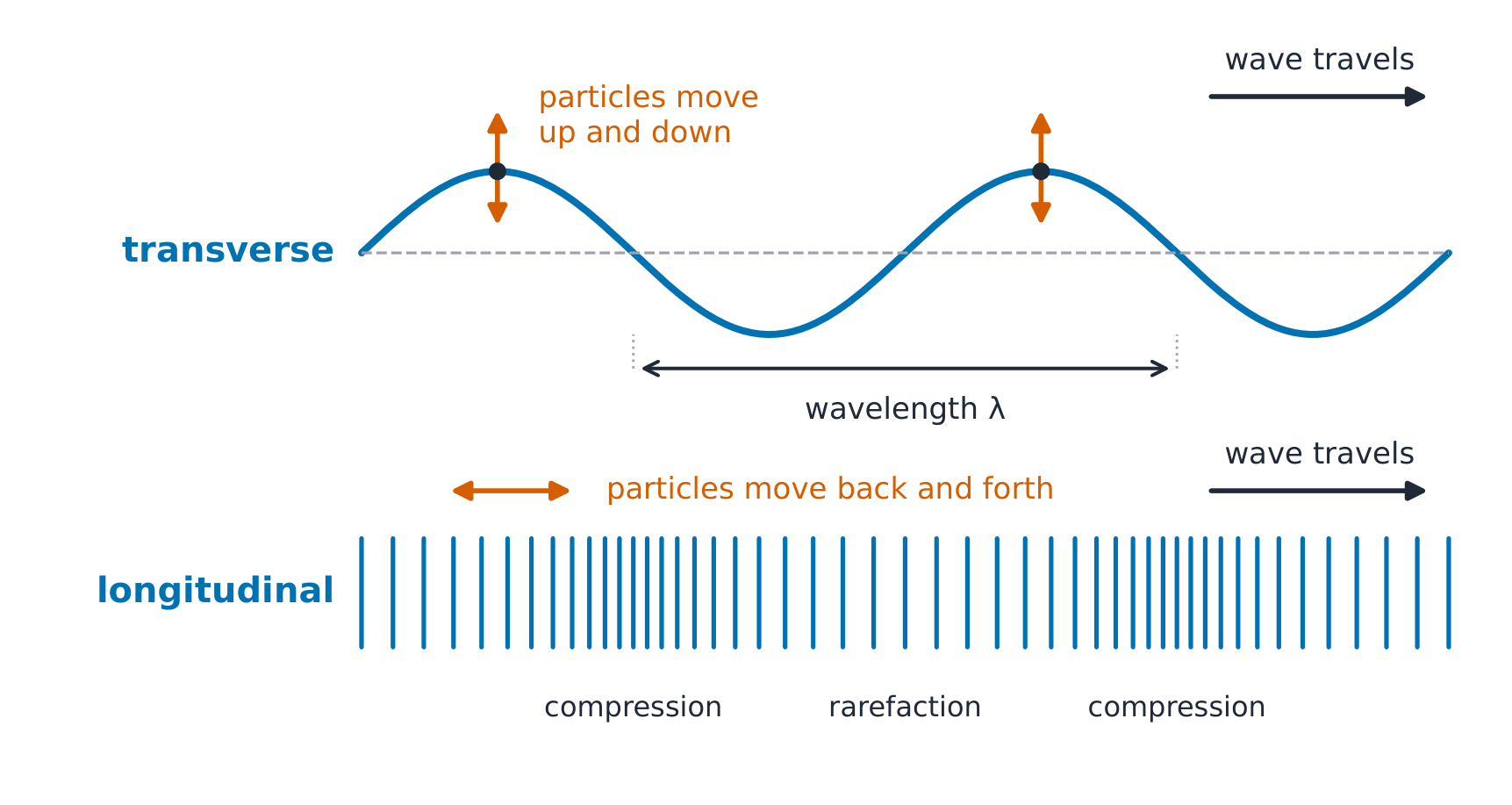
- Transverse means the oscillation is perpendicular to propagation; longitudinal means parallel to propagation. A rope wave is a mechanical transverse example, while sound in air is a mechanical longitudinal example. Compression and rarefaction describe regions of higher and lower density or pressure in the longitudinal model, rather than transverse peaks physically drawn in the air.
- In the illustration, the rightward arrow gives propagation direction, while the smaller double arrows give the possible oscillation directions. Those double arrows do not say that each particle travels both ways simultaneously or that every marked particle has maximum speed in the pictured instant. In a sinusoidal transverse wave, a particle at its greatest displacement is momentarily turning, with zero transverse velocity.
Distinguish amplitude, wavelength and period
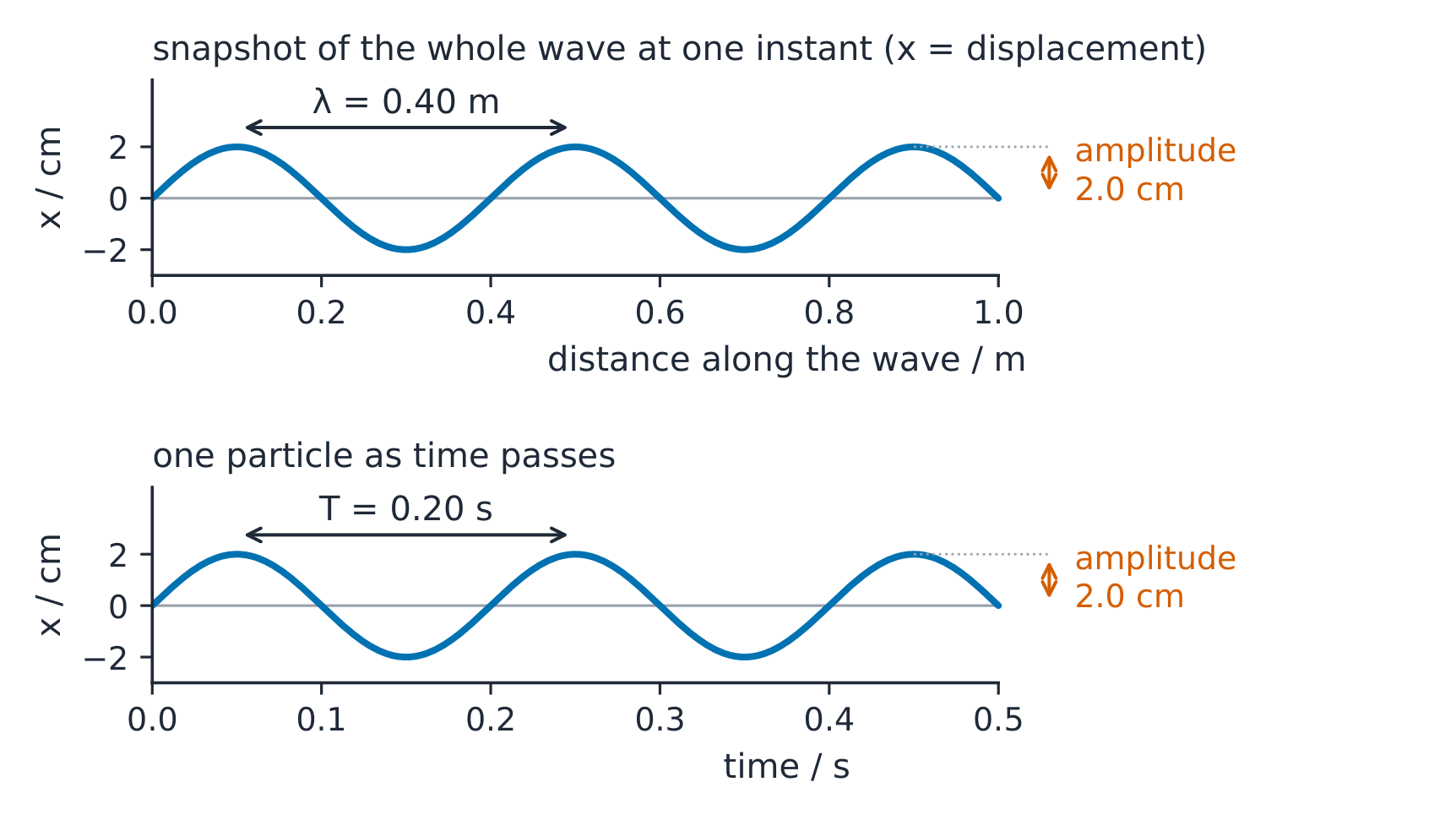
- Amplitude is the maximum displacement magnitude from equilibrium. Wavelength λ is the spatial repeat distance along propagation, such as crest to adjacent crest or compression centre to adjacent compression centre. Period T is the time for one location to complete a cycle; frequency f = 1/T counts cycles each second. A crest-to-trough separation is half a wavelength, not a whole wavelength.
- An invented sinusoidal wave ranging from −2.0 to +2.0 cm has amplitude 2.0 cm and peak-to-peak range 4.0 cm. Its wavelength might be .40 m and period .20 s; those three quantities describe different distances or times. Convert centimetres, millimetres and prefixes before substituting into an SI equation. Neither the amplitude nor the vertical height of a plotted curve directly gives its propagation speed.
Derive the wave equation from one repeating cycle
- In one period, a travelling periodic pattern advances by one wavelength. Therefore v = λ/T = fλ. For f = 5.0 Hz and λ = .40 m, propagation speed is 2.0 m/s and period .20 s. This v describes movement of the phase pattern in the simple model; it is not the instantaneous velocity of one oscillating medium particle.
- A 512 Hz sound in model air at 340 m/s has wavelength about .664 m. At 1500 m/s in model water, the same frequency gives about 2.93 m. A higher propagation speed at a fixed frequency requires a longer wavelength. Check by multiplying each wavelength by frequency rather than relying only on a rearranged equation and a plausible-looking unit.
An invented wave has frequency 5.0 Hz and wavelength .40 m. Find its period.
难度 2/5 · 今日首次完成可获 140 金币及少量额外奖励
T = 1/f = 1/5 = .20 s. Speed is separately fλ = 2.0 m/s. Neither wavelength nor amplitude is the period.
Read a spatial snapshot and a particle-time trace
- The top illustrated graph plots displacement against distance at one instant: its crest separation gives λ = .40 m. The lower graph plots one particle's displacement against time: its crest separation gives T = .20 s. Both show amplitude 2.0 cm, but only the distance graph directly gives wavelength and only the time graph directly gives period. Combining them gives speed .40/.20 = 2.0 m/s.
- The origins and chosen particle matter when matching phases between plots. For the top snapshot travelling right, a particle at .20 m could start with zero displacement moving positively and produce the pictured positive-going time trace. Do not infer propagation direction merely because a particle-time graph rises. Its gradient gives that particle's transverse velocity; the spatial snapshot gradient is displacement change per distance and has different units.
An invented displacement–distance snapshot shows four complete wavelengths spanning 2.4 m. Find wavelength.
难度 2/5 · 今日首次完成可获 140 金币及少量额外奖励
λ = total repeat distance/number of complete waves = 2.4/4 = .60 m. A time trace would instead provide the period; read the horizontal axis first.
Find particle motion by shifting the pattern
- For a right-travelling transverse pattern, a particle next takes the displacement currently just to its left. On a rising spatial slope, that neighbour has lower displacement, so the particle is moving down. On a falling spatial slope, the left neighbour has greater displacement, so the particle moves up. Reverse the propagation direction and these particle-velocity directions reverse.
- At an ideal sinusoidal crest or trough the particle's transverse velocity is momentarily zero, even while the pattern continues propagating. At equilibrium crossings, transverse speed is greatest for that sinusoidal particle motion. “Positive displacement” means position above equilibrium; it does not by itself mean moving up. Use propagation direction and local spatial slope together, or obtain velocity directly from a particle-time graph.
A transverse pattern travels right. At the instant shown, a marked particle lies on a rising displacement-against-distance slope. Which way is it moving?
难度 1/5 · 今日首次完成可获 100 金币及少量额外奖励
For a right-travelling pattern, compare with the point just to the left. On a rising spatial slope that point has lower displacement, so the marked particle is moving down. A spatial slope is not the particle-time gradient.
Locate longitudinal compression from neighbouring displacements
- In the longitudinal displacement snapshot, positive vertical graph values mean particles displaced to the right, even though the curve is drawn up the page. At the downward zero crossing near .50 m, particles on the left are displaced rightward and those on the right leftward: they crowd towards that location. At the upward zero crossing near 1.00 m, neighbouring displacements spread the particles apart.
- Thus this sinusoidal model has maximum compression at downward zero crossings and maximum rarefaction at upward zero crossings. Largest displacement is neither the centre of maximum compression nor maximum rarefaction. The top graph uses position labels for the undisturbed particle arrangement; the dots below show the displaced positions. It is the neighbouring displacement differences that change density, not a claim that every zero on every possible graph means a compression.
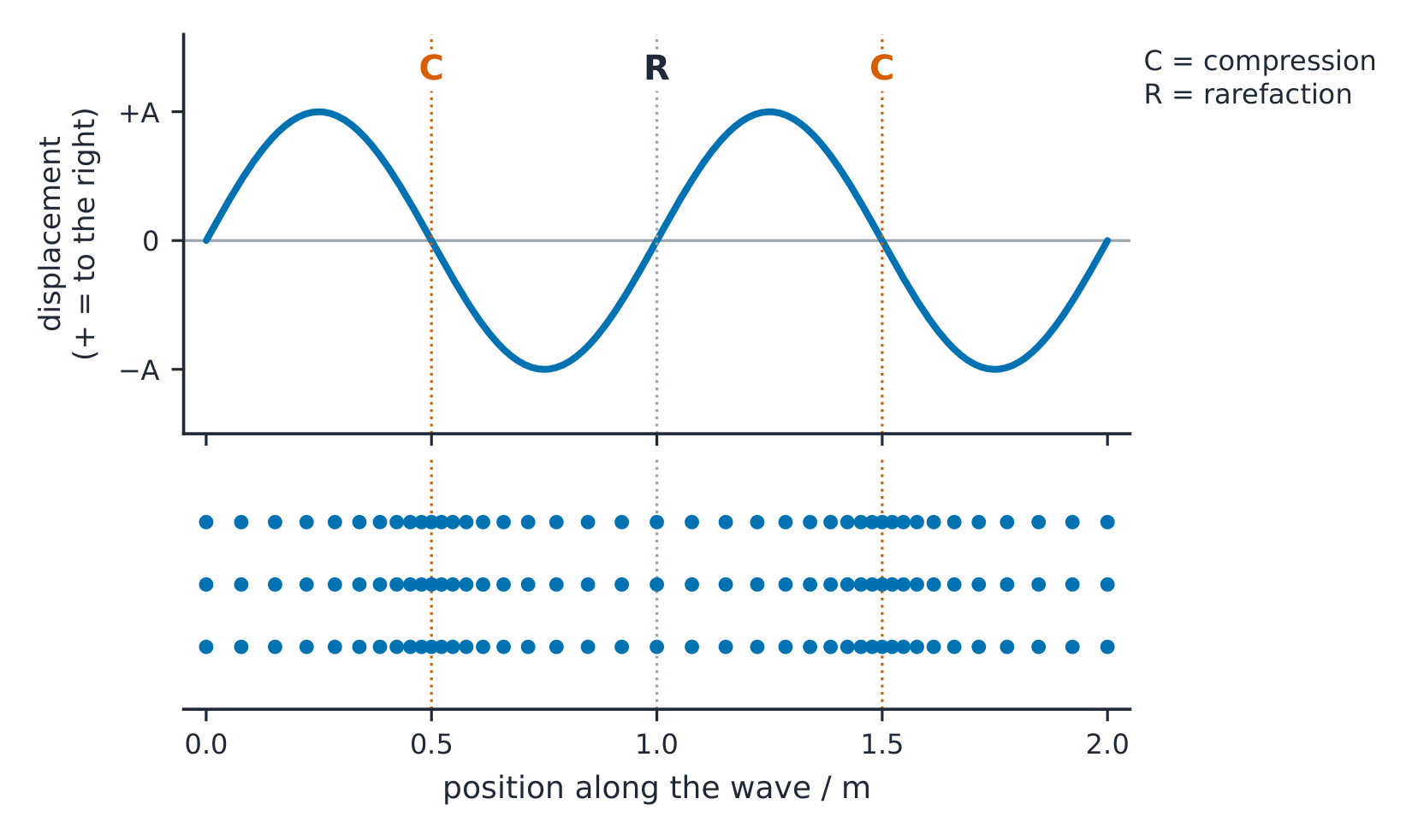
For the shown sinusoidal longitudinal displacement snapshot, positive displacement means rightward. Where is a maximum compression?
难度 1/5 · 今日首次完成可获 100 金币及少量额外奖励
Left neighbours displaced right and right neighbours displaced left crowd together. In this sinusoidal model that is the downward zero crossing. Graph height is particle displacement, not a direct pressure plot.
Keep frequency continuous across a stationary boundary
- With a steady source and a stationary boundary in the linear model, the transmitted wave repeats at the same frequency as the incident wave. Changing propagation speed therefore changes wavelength, not that driving frequency. In a model water-wave case, f = 4.0 Hz and speed .32 m/s give wavelength .080 m; in a second region with speed .20 m/s, wavelength becomes .050 m while frequency remains 4.0 Hz.
- The ratio of transmitted to incident wavelength equals the speed ratio when frequency is unchanged. Here .050/.080 = .20/.32 = .625. Do not keep both wavelength and frequency fixed while changing speed. The existing refraction introduction applies this boundary model; moving sources, observers or boundaries require additional reasoning and are not covered by an unconditional “frequency can never change” rule.
An invented 4.0 Hz wave crosses a stationary boundary into a region where wave speed is .20 m/s. In the linear boundary model, find transmitted wavelength.
难度 2/5 · 今日首次完成可获 140 金币及少量额外奖励
Frequency remains 4.0 Hz at this stationary boundary. λ = v/f = .20/4 = .050 m. Speed and wavelength change together; source frequency does not need to change.
State how the medium sets the model's speed
- Mechanical-wave speed depends on the medium's restoring response and inertia, as well as physical conditions. The supplied values 340 m/s for air, 1500 m/s for water and 5000 m/s for steel are representative model values, not a universal ordering of every gas, liquid and solid. Closer particle spacing alone is not a complete explanation of speed, and two different wave modes in the same solid can have different speeds.
- When the nondispersive approximation applies, speed in one medium is approximately constant over the frequency range used, so a higher frequency means shorter wavelength. In a dispersive medium, speed also varies with frequency; many water waves behave this way. The equation v = fλ still relates the chosen periodic wave's quantities, but it does not prove that every frequency shares one fixed v.
What condition justifies assuming the same wave speed for different frequencies in one medium?
难度 1/5 · 今日首次完成可获 100 金币及少量额外奖励
A nondispersive approximation treats speed as constant over the relevant range. Some waves, including many water waves, are dispersive. v = fλ relates a particular wave’s quantities without proving every frequency has the same speed.
Separate pitch, amplitude and travel time for sound
- In air, sound is a longitudinal pressure disturbance requiring a material medium. Increasing frequency gives a higher pitch; increasing amplitude generally increases the strength of the sound, without making amplitude the frequency. The approximate young-human hearing range 20 Hz to 20 kHz corresponds to wavelengths from 17 m to .017 m at the stated air speed. Actual hearing limits vary; the range is an approximate convention for this calculation.
- If thunder is heard 4.5 s after a visible flash, neglect light travel time and estimate distance as 340 × 4.5 = 1530 m, about 1.5 km. An echo delay instead describes an outward and return trip: a .60 s echo at 340 m/s indicates a reflector about 102 m away. Decide whether the recorded time is one-way, round-trip or a difference between two signals before multiplying by speed.
An invented sound echo returns .60 s after emission. Wave speed is 340 m/s and outward and return paths have equal length. Find distance to the reflector.
难度 2/5 · 今日首次完成可获 140 金币及少量额外奖励
The recorded time includes both outward and return travel. Distance = vt/2 = 340 × .60/2 = 102 m, about 100 m to two significant figures. Using vt alone would double the distance.
Use seismic arrival differences with explicit assumptions
- Body waves include longitudinal P-waves and transverse S-waves; the British Geological Survey describes their motions and the absence of S-wave propagation through fluids such as the liquid outer core. In an invented shared-path uniform-rock calculation, choose P speed 6.0 km/s and S speed 3.5 km/s. A 30 s S-minus-P arrival difference gives d/3.5 − d/6.0 = 30, hence d = 252 km.
- That is a model path distance, not a complete earthquake location from one station. At 500 km the same model gives about 59.5 s separation. Real analysis combines station arrival times with a velocity model, estimating source position, depth and origin time; see the USGS location explanation. An accurately solved constant-speed exercise should not be reported as a measured earthquake or a universal crustal speed law.
In an invented uniform-rock shared-path model, P speed is 6.0 km/s and S speed 3.5 km/s. S arrives 30 s later. Find path distance.
难度 2/5 · 今日首次完成可获 140 金币及少量额外奖励
Time difference is d/3.5 − d/6 = 30, so d = 30/(1/3.5 − 1/6) = 252 km, about 250 km. One path-distance estimate does not fully locate a real earthquake; the speeds here are model assumptions.
Distinguish electromagnetic fields from mechanical particles
- An electromagnetic wave can travel through vacuum, with electric and magnetic field oscillations rather than a required material medium. In the simple plane-wave vacuum model, the two fields are perpendicular to each other and to propagation, making the wave transverse. All such vacuum electromagnetic waves have speed c = 3.00 × 10⁸ m/s, while their frequencies and wavelengths differ.
- Mechanical waves need a medium: removing the air weakens transmission from a bell through that air, even though its vibration may still be visible. In an evacuated gap, light and radio can transmit signals that ordinary airborne sound cannot. This comparison does not mean a vibrating solid cannot carry a mechanical signal or that every material acts identically on every electromagnetic frequency.
Read the electromagnetic spectrum as a continuous scale
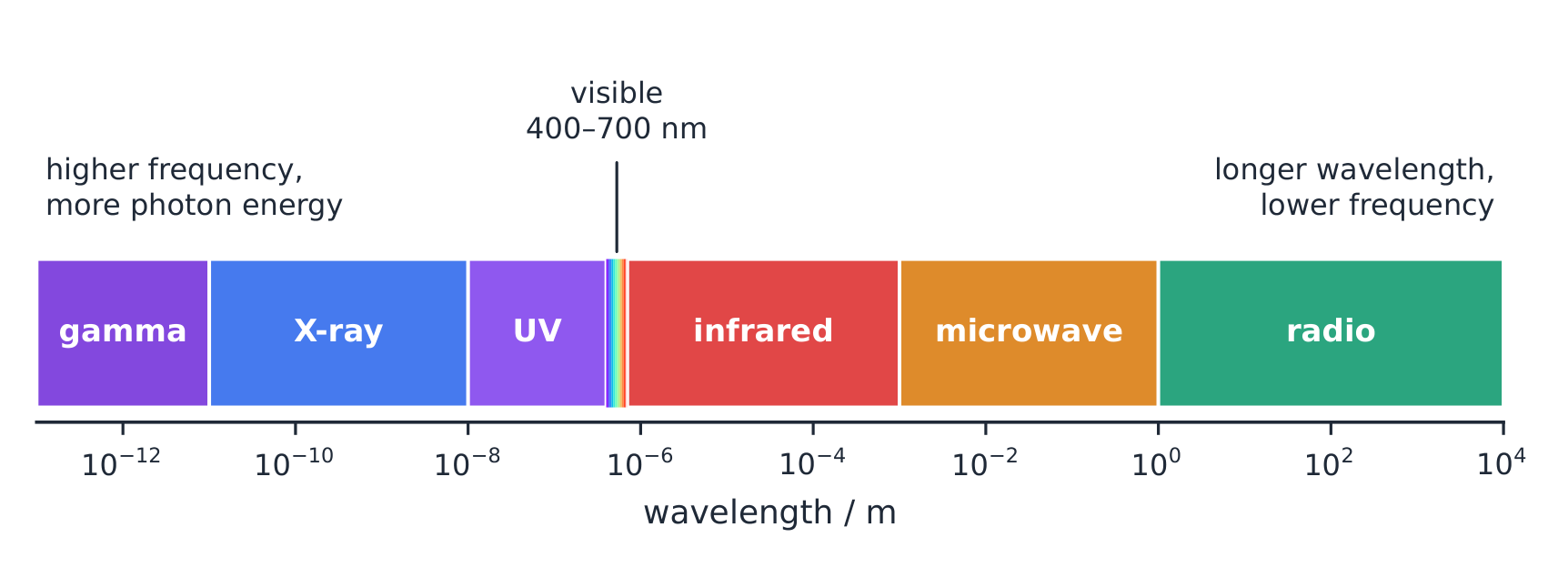
- In order of increasing wavelength, the main regions are gamma, X-ray, ultraviolet, visible, infrared, microwave and radio. Visible wavelengths around 400–700 nm occupy a narrow band. The illustrated wavelength axis is logarithmic: a step between labelled powers such as 10⁻¹² and 10⁻¹⁰ m is a factor of 100, not an equal numerical addition in metres.
- At fixed vacuum c, shorter wavelength means higher frequency. The figure's energy statement refers to energy per photon, rather than a claim that a higher-frequency beam must carry more total power regardless of its intensity or photon count. Region names and representative applications are useful, but band boundaries are conventions with some overlap; they are not seven separate propagation-speed laws.
The spectrum figure associates higher frequency with greater photon energy. Does that alone establish greater total beam power?
难度 1/5 · 今日首次完成可获 100 金币及少量额外奖励
The figure refers to energy per photon, not a complete beam-power comparison. Vacuum c is shared across the spectrum while frequency and wavelength differ; total power also depends on how many photons are delivered each second.
Convert frequency prefixes and wavelength scales first
- For an invented 98 MHz radio signal in vacuum, convert to 98 million Hz before using λ = c/f: wavelength is about 3.06 m, or 3.1 m to two significant figures. A 2.45 GHz electromagnetic signal has wavelength about .1224 m. Omitting the million or billion factor produces a number with the right written unit but the wrong physical scale.
- For model green light of wavelength 550 nm, convert to $5.50\times10^{-7}$ m, giving frequency about $5.45\times10^{14}$ Hz. Check the result by multiplying frequency and wavelength to recover c. Crossing into an ordinary stationary transparent medium changes the wavelength with the speed while the driving frequency remains continuous; do not replace the material wave speed by vacuum c without checking the stated setting.
An invented 98 MHz radio signal travels in vacuum at 3.00 × 10⁸ m/s. Find wavelength.
难度 2/5 · 今日首次完成可获 140 金币及少量额外奖励
98 MHz = 98 × 10⁶ Hz. λ = c/f = (3.00 × 10⁸)/(98 × 10⁶) ≈ 3.06 m, about 3.1 m to two significant figures. Retain the whole denominator when using powers of ten.
Model light of vacuum wavelength 550 nm travels at 3.00 × 10⁸ m/s. Find frequency in Hz, using scientific notation if needed.
难度 2/5 · 今日首次完成可获 140 金币及少量额外奖励
Convert 550 nm = 550 × 10⁻⁹ m = 5.50 × 10⁻⁷ m. From c = fλ, f = c/λ = (3.00 × 10⁸)/(5.50 × 10⁻⁷) = (3.00/5.50) × 10¹⁵ ≈ 5.45 × 10¹⁴ Hz, about 5.5 × 10¹⁴ Hz to two significant figures. Multiplying the unrounded frequency by wavelength recovers c.
Check the wave model with measurements and units
- Measure across several complete wavelengths and divide by the number of intervals, not the number of crests: five successive crests span four wavelengths. For timing, use repeated complete cycles and divide, checking the sensor's time scale. Record amplitude from equilibrium separately. Combining an independently measured period and wavelength checks speed; agreement at one point does not establish that every frequency or depth obeys the same approximation.
- State what the plotted displacement means, whether a graph is a snapshot or a time trace, and whether a time is one-way or round-trip. For compressions compare neighbouring longitudinal displacements rather than judging the drawn vertical height as air density. Check stationary-boundary and nondispersive assumptions where used, identify experimental uncertainty, and keep model data distinct from observed readings and the evidence in linked sources.
Explain how to interpret and check a travelling-wave problem, including graph axes, longitudinal compression and boundary assumptions.
A good wave account links the diagram, physical oscillation and calculated quantities without treating every graph or medium as interchangeable.
Trace a wavefront and its ray through the diagram
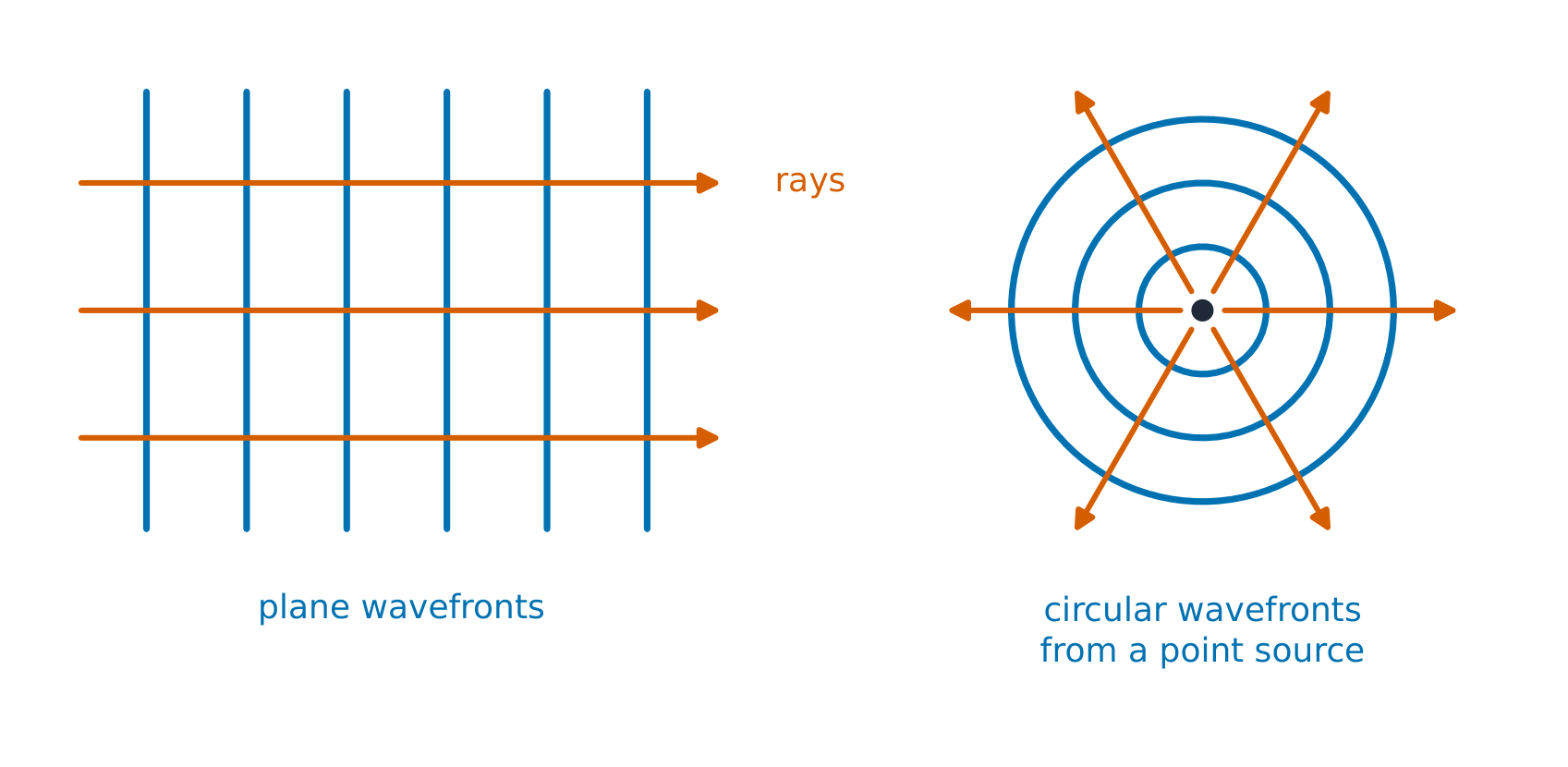
- A wavefront joins points at the same phase; adjacent crest wavefronts are separated by one wavelength. A ray marks propagation direction and is perpendicular to the wavefront in the ordinary isotropic model used here. Parallel straight wavefronts represent a plane wave. Circular wavefronts in a two-dimensional model spread from a point source, with radial rays pointing outward.
- The invented cases in this section use stationary boundaries, linear waves and the stated ideal optical models. Do not confuse a ray with a material particle's path or a wavefront with the whole region disturbed by the wave. In three dimensions a point-source wavefront is spherical; sufficiently far from a source, a small portion can be approximated as locally plane even though the entire front is not one infinite flat surface.
Separate reflection, transmission and refraction
- A boundary can partly reflect a wave and partly transmit it. Reflection returns the disturbance into the first medium; refraction describes a transmitted wave's change in speed and, for oblique incidence with a speed change, direction. Draw the normal perpendicular to the boundary. Reflection angle equals incidence angle when both are measured from that normal, rather than from the surface.
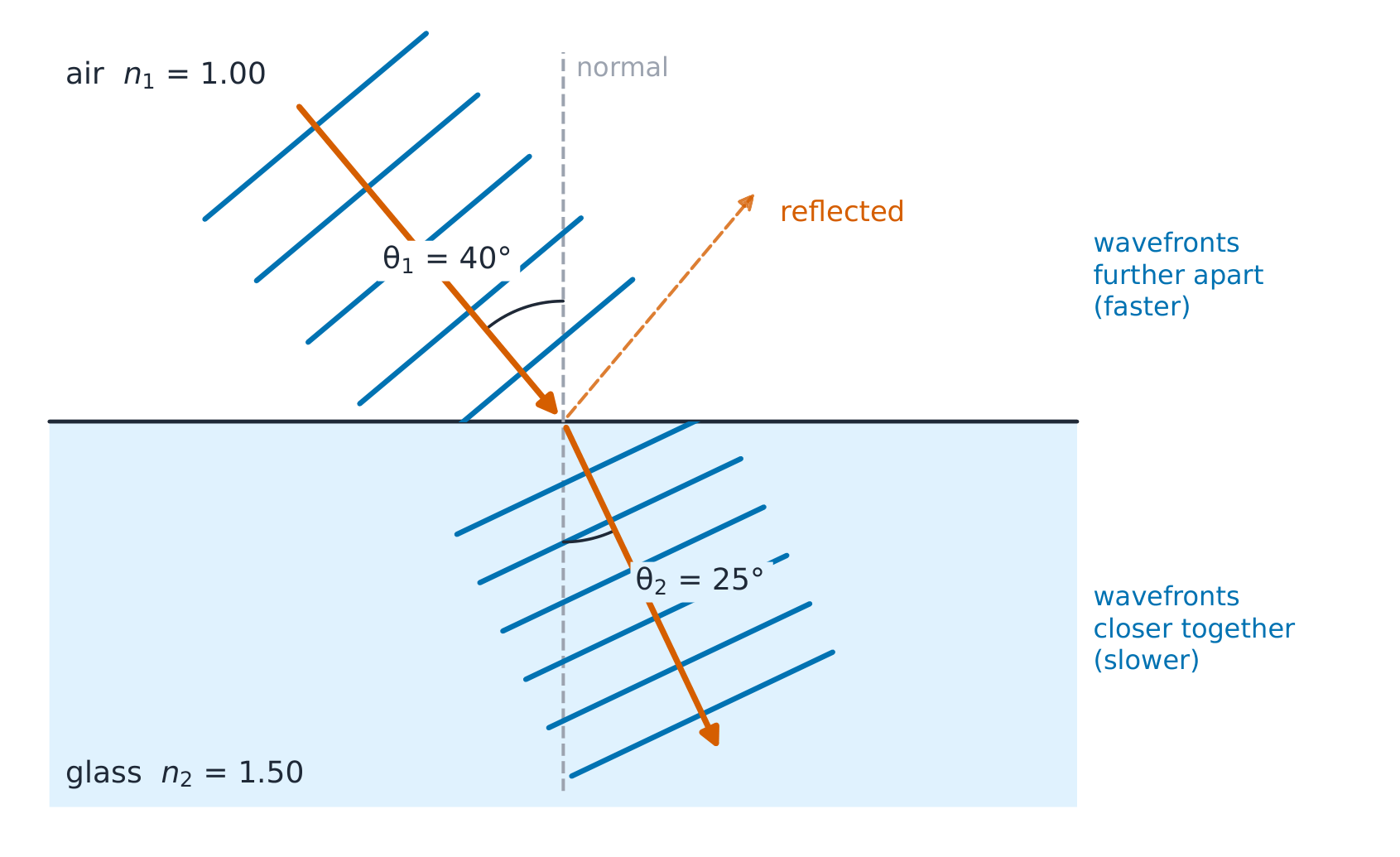
- In the illustrated air-to-glass model, the refracted wave is slower and its wavefront spacing is smaller, while frequency remains fixed at the stationary boundary. Its ray bends towards the normal. At normal incidence, speed and wavelength can change without any change in the ray's direction. A reflected component can still exist, so “it refracts” does not imply all the incident energy is transmitted.
Apply Snell's law using angles from the normal
- Refractive index is n = c/v for the model light wave. With n₁ sin θ₁ = n₂ sin θ₂, light from air of index 1.00 entering glass of index 1.50 at 40° gives θ₂ ≈ 25.4°. The same glass has model speed 2.00 × 10⁸ m/s. A larger index means a lower speed; do not confuse this with a larger refracted angle.
- For water of index 1.33 into the same glass at 50°, refraction angle is about 42.8°. Conversely, a ray in air at 30.0° refracting to 22.0° in a liquid indicates index about 1.335. Read whether an angle is given from the surface: a 35° angle to the surface is 55° to the normal. Keep angle mode in degrees for these given degree values, and test whether the result bends the correct way.
In an invented air–glass model, n₁ = 1.00 and n₂ = 1.50. Light is incident at 40° to the normal. Find refraction angle in degrees.
难度 2/5 · 今日首次完成可获 140 金币及少量额外奖励
Snell’s law gives n₁sinθ₁ = n₂sinθ₂. Hence sinθ₂ = n₁sinθ₁/n₂ = 1.00 × sin40°/1.50 ≈ .428525. Take inverse sine in degree mode: θ₂ = sin⁻¹(.428525) ≈ 25.4°, about 25° to two significant figures. The smaller angle is consistent with bending towards the normal in the slower medium.
Distinguish the critical condition from total reflection
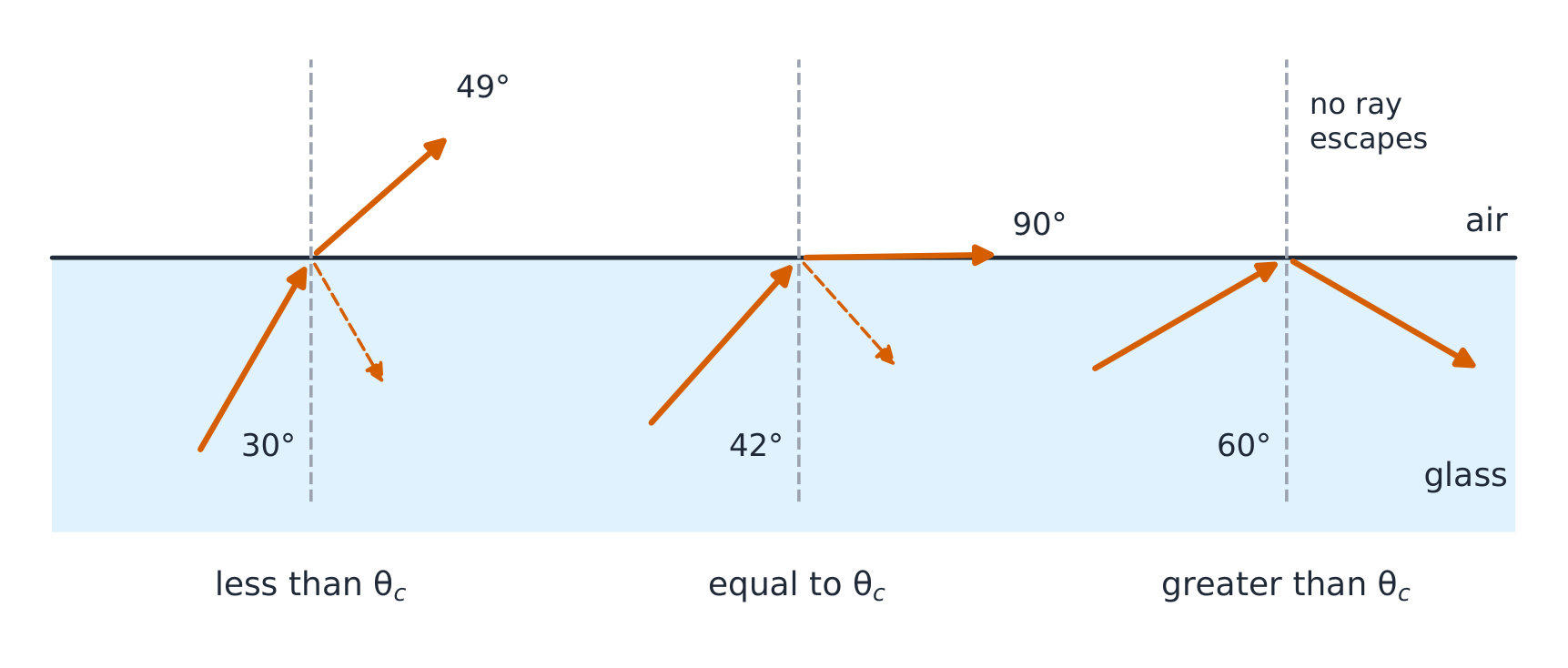
- A critical angle exists in this model when light travels from higher n₁ towards lower n₂. At that incidence angle, the limiting refracted ray is at 90° to the normal: sin θc = n₂/n₁. For glass of index 1.50 to air, θc ≈ 41.8°. Below it, a transmitted ray exists; above it, there is no propagating transmitted ray in the ideal total-internal-reflection model.
- Both requirements matter: the destination must have lower refractive index and incidence must exceed θc. At exactly θc use the grazing refracted-ray condition, not the same description as an incidence well above it. For water of index 1.33 to air, θc is about 48.8°; for model diamond of index 2.42 to air, about 24.4°. Travelling from air into glass cannot satisfy these higher-to-lower-index conditions.
Find the critical angle for the invented model of light travelling from water of index 1.33 towards air of index 1.00.
难度 2/5 · 今日首次完成可获 140 金币及少量额外奖励
sinθc = n₂/n₁ = 1/1.33, so θc ≈ 48.8°. Total internal reflection requires this higher-to-lower-index direction and incidence greater than θc, not merely the existence of a boundary.
Explain fibre guidance by a local angle condition
- In the invented fibre model, core index is 1.48 and cladding index 1.46. Their interface critical angle is about 80.6° measured from its normal. Rays travelling nearly along the fibre axis meet the side at a large angle to that normal and can be totally internally reflected. In the simple straight two-dimensional geometry, a ray 5° to the axis meets the side at 85°, satisfying this condition.
- A core with higher index than its cladding is necessary but does not trap every possible ray. A ray at too large an angle to the axis can meet the side below the critical angle. Tight bends can change the local incidence conditions and cause loss. Actual fibres also have absorption and scattering; repeated ideal total reflection is not a claim that any input light is carried indefinitely without attenuation.
Compare gap size with wavelength for diffraction
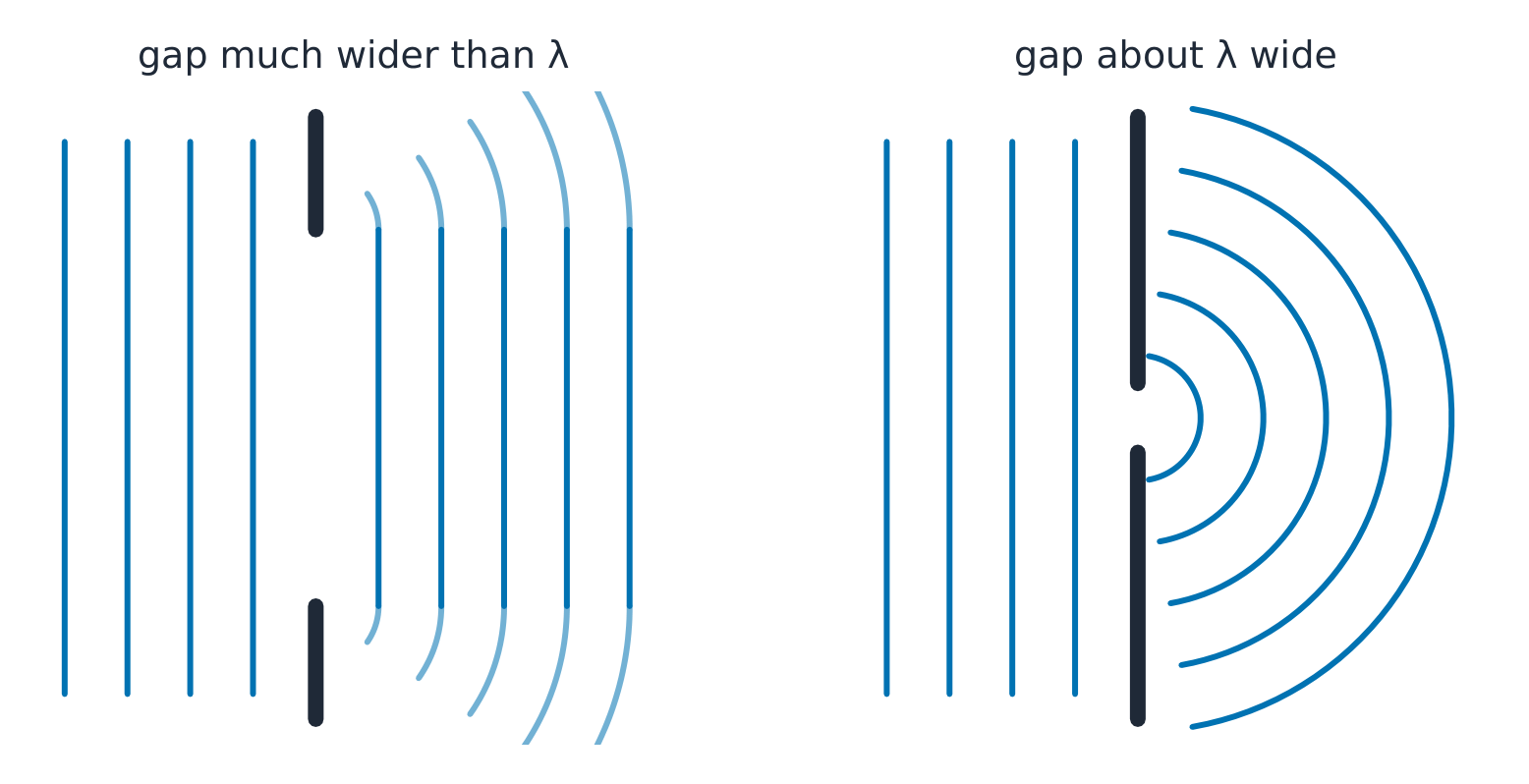
- Diffraction is spreading around an edge or after a gap. When a gap is much wider than wavelength, the emerging front is mostly plane with spreading near its edges. When the gap is comparable to wavelength or smaller, spreading is substantial. A broad angular spread does not guarantee large transmitted power: a very narrow opening can pass little of the incident wave.
- In the model comparison, a doorway is comparable to some speech wavelengths but enormous compared with visible wavelengths. Sound therefore spreads far enough around it to be heard, while visible-light diffraction does not form a useful view around the same corner. Long radio wavelengths can likewise spread more broadly around a hill than much shorter ones; reception also depends on power, terrain and other propagation effects, so diffraction is a comparison rather than a guarantee of reception.
Add signed displacements without destroying the waves
- In a linear wave model, superposition adds the individual displacements at the same place and time. A +3 mm crest contribution and −1 mm trough contribution give +2 mm, rather than adding their magnitudes to 4 mm. Equal +4 and −4 mm pulse contributions can make a rope momentarily flat during exact overlap, after which the pulses continue propagating.
- A flat instantaneous displacement does not mean the system has lost all energy or that every part has zero velocity. The velocity and strain fields also matter; energy conservation is compatible with destructive superposition at a point. The rule that pulses continue unchanged belongs to the linear ideal model, not every high-amplitude breaking or nonlinear wave interaction.
In a linear model, two waves contribute +3 mm and −1 mm displacement at the same point and instant. Find resultant signed displacement.
难度 2/5 · 今日首次完成可获 140 金币及少量额外奖励
Superposition adds signed contributions: +3 + (−1) = +2 mm. This is not addition of the absolute heights, and it does not mean either wave is destroyed.
State coherence before using path difference
- A stable interference pattern requires the same frequency and a constant relative phase over the observation time. Splitting one suitable light source can produce coherent paths; two independent ordinary lamps do not maintain a stable optical phase relationship. Equal frequency alone is not a complete coherence condition, and useful light interference also requires overlapping compatible field components.
- For coherent sources initially in phase in a common medium, path difference equal to an integer number of wavelengths gives constructive interference. A half-integer difference gives antiphase arrival and destructive interference. If sources have an additional initial phase difference, include it too: a half-wavelength propagation difference can compensate for sources initially in antiphase. The familiar path rules must retain their in-phase-source assumption.
Two coherent equal-amplitude sources are initially in antiphase. One path is half a wavelength longer than the other. What happens at the observation point in the common-medium model?
难度 1/5 · 今日首次完成可获 100 金币及少量额外奖励
Include both initial source phase and propagation phase. Two half-cycle differences cancel modulo a full cycle, giving in-phase arrival. Coherent sources need a constant phase difference, which need not be zero.
Check interference using both path and amplitude
- Two in-phase model speakers emit wavelength .50 m. Paths of 4.0 and 5.0 m differ by 1.0 m, or 2λ, so their arriving contributions reinforce. Paths of 4.0 and 4.75 m differ by .75 m, or 1.5λ, so the contributions arrive in antiphase. In a separate .40 m wavelength case, distances 3.0 and 3.6 m also differ by 1.5λ and give a destructive-interference condition.
- Complete cancellation requires equal arriving amplitudes as well as antiphase. Different distances, attenuation or source strengths can leave a nonzero minimum. For example, equal-frequency contributions of amplitudes 4 mm and 2 mm combine to amplitude 6 mm in phase but 2 mm in antiphase. “A quiet point” is a relative minimum in the model, not automatically absolute silence or proof that wave energy has vanished.
Calculate double-slit fringe separation
- For coherent monochromatic light and small observation angles, double-slit fringe separation is $s=\lambda D/d$, with slit separation d and screen distance D much greater than d. For invented light of wavelength 633 nm, d = .50 mm and D = 2.0 m, s ≈ .002532 m or 2.53 mm. Convert both the nanometres and millimetres before substituting.
- The central bright fringe has zero path difference for the in-phase equal-path setup. The fine spacing depends on slit separation, rather than the width of each slit. The drawing is schematic: it is not a scale measurement from which to infer λ or actual path lengths. Compare its labelled dimensions with the stated formula and the conditions needed for approximately equally spaced screen fringes.
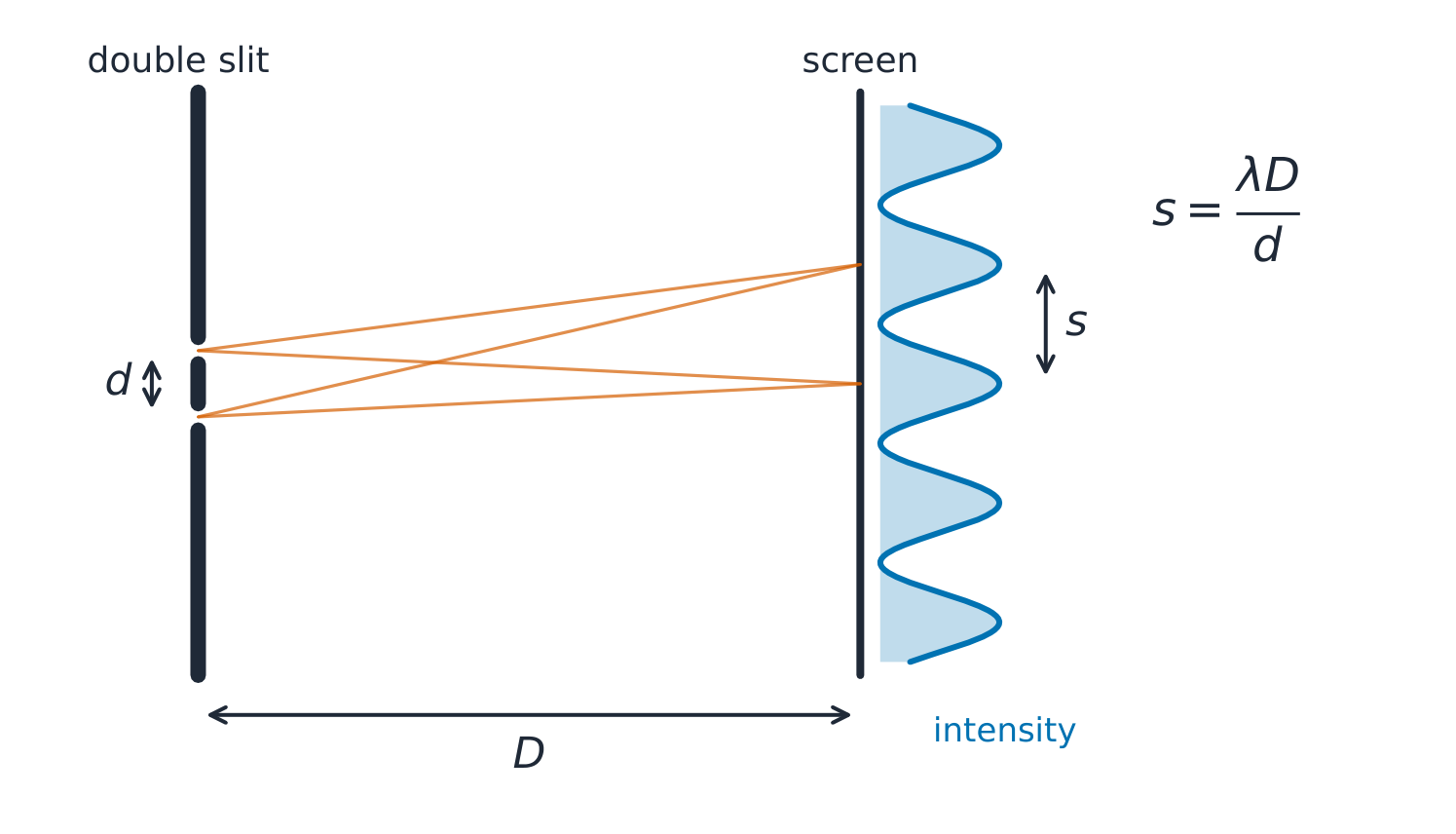
An invented small-angle double-slit experiment has bright-fringe separation 1.8 mm, screen distance 1.5 m and slit separation .40 mm. Find wavelength in nm.
难度 2/5 · 今日首次完成可获 140 金币及少量额外奖励
λ = sd/D = (.0018 × .00040)/1.5 = 4.8 × 10⁻⁷ m = 480 nm. The denominator d in s = λD/d is slit separation, not slit width.
Predict changes and count fringe intervals correctly
- At fixed wavelength and screen distance, halving slit separation doubles fringe separation. At fixed d and λ, doubling D doubles s. An invented measured s = 1.8 mm at D = 1.5 m with d = .40 mm gives λ = sd/D = 480 nm. Moving the screen to 3.0 m would give 3.6 mm spacing in the same small-angle approximation.
- For measurement, ten successive bright centres span nine fringe intervals, whereas a distance covering ten intervals spans eleven centres. If ten intervals span 25.0 mm, mean separation is 2.50 mm. State the interval count and uncertainty, keep the screen and slit geometry aligned, and use the light source only within the approved classroom arrangement. A ruler distance between a bright and adjacent dark centre is half the bright-to-bright separation.
An invented double-slit pattern initially has bright-fringe separation 2.0 mm. Slit separation is halved at fixed wavelength and screen distance. Find the new fringe separation.
难度 2/5 · 今日首次完成可获 140 金币及少量额外奖励
s = λD/d is inversely proportional to slit separation. Halving d doubles s from 2.0 to 4.0 mm; wavelength and D are explicitly unchanged.
In an invented measurement, the first and tenth successive bright-fringe centres are 22.5 mm apart. Find their mean neighbouring bright-fringe separation.
难度 2/5 · 今日首次完成可获 140 金币及少量额外奖励
Ten centres span nine intervals. Mean separation = 22.5/9 = 2.50 mm. Dividing by ten would count centres instead of separations.
Test the wave-phenomena account against its assumptions
- Draw normals and identify both media before calculating reflection or refraction. Check the direction of bending and both total-reflection conditions, rather than applying a critical angle to the wrong direction of travel. For diffraction compare wavelength with the relevant opening or obstacle size. For interference specify source phase, coherence and arriving amplitudes before interpreting a minimum as zero.
- Use the correct length in each formula: wavelength is a wave property, slit separation controls fine fringes, screen distance sets their scale and slit width controls each slit's diffraction spread. Keep the linear, stationary-boundary and small-angle assumptions where they are used. Verify numerical results independently with a ratio, limiting case, physical direction or interval count instead of accepting the first inverse-trigonometric value displayed.
AHL: obtain the first single-slit minimum
- For a uniformly illuminated slit of width b in the far-field model, the first minimum satisfies sin θ = λ/b. At small θ in radians, this becomes θ ≈ λ/b. With invented λ = 600 nm and b = .10 mm, the first minima are at about ±.0060 rad. Halving slit width doubles the small-angle spread, while doubling slit width halves it.
- The illustrated curves are independently normalized to peak one, comparing shape rather than absolute brightness. A narrower slit does not therefore appear taller or dimmer in this normalized graph even though transmitted power can change at fixed incident illumination. The first-zero position follows from cancellation across different parts of one slit; it is not a double-slit path difference using the slit separation d.
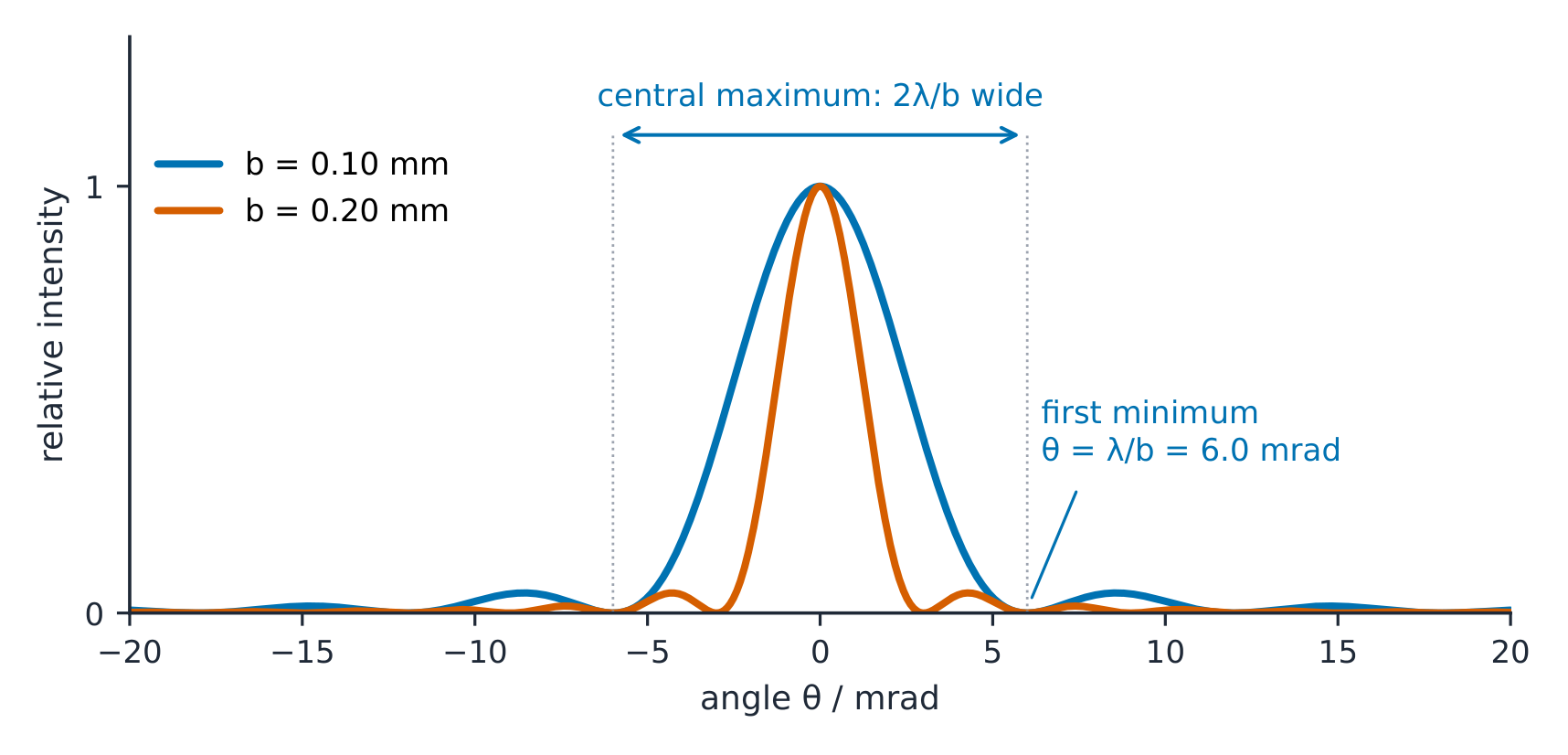
AHL: distinguish a half-width from a full central maximum
- On a distant screen at small angles, the distance from the centre to the first minimum is approximately Dλ/b. The central maximum extends from the negative first minimum to the positive first minimum, so its full width is about 2Dλ/b. For 500 nm light through b = .050 mm at D = 1.2 m, θ ≈ .010 rad, half-width is .012 m and full width .024 m, or 24 mm.
- For 600 nm through b = .10 mm at D = 2.0 m, the half-width is again 12 mm and full width 24 mm. The equal full widths come from equal Dλ/b, not equal wavelengths or slit widths separately. The central region spans the two first minima; side regions span neighbouring minima on one side. Use the stated small-angle model when comparing widths rather than treating angular and screen distances as interchangeable units.
Invented 500 nm light passes through a .050 mm slit, with a screen 1.2 m away. In the small-angle far-field model, find the full central-maximum width in mm.
难度 2/5 · 今日首次完成可获 140 金币及少量额外奖励
First-minimum angle ≈ λ/b = .010 rad. Distance from centre to first minimum is Dθ = .012 m. The full central maximum spans both sides, so width = .024 m = 24 mm.
AHL: place fine fringes under a diffraction envelope
- Each finite-width slit diffracts, so a two-slit interference pattern is modulated by the single-slit shape. Separation d controls fine-fringe angle spacing about λ/d, while width b controls envelope first minima about λ/b. A double-slit intensity envelope is not an absolute upper bound equal to the intensity of one isolated slit; coherent addition and the chosen normalization affect absolute peak heights.
- For invented d = .50 mm and b = .10 mm, d/b = 5. The fifth interference order coincides with the first envelope minimum and is missing. Inside the central envelope the bright orders are 0, ±1, ±2, ±3 and ±4, giving nine. The same ratio applies to d = .30 mm and b = .060 mm. Count both sides and the central order, excluding the envelope zeros rather than counting them as faint bright fringes.
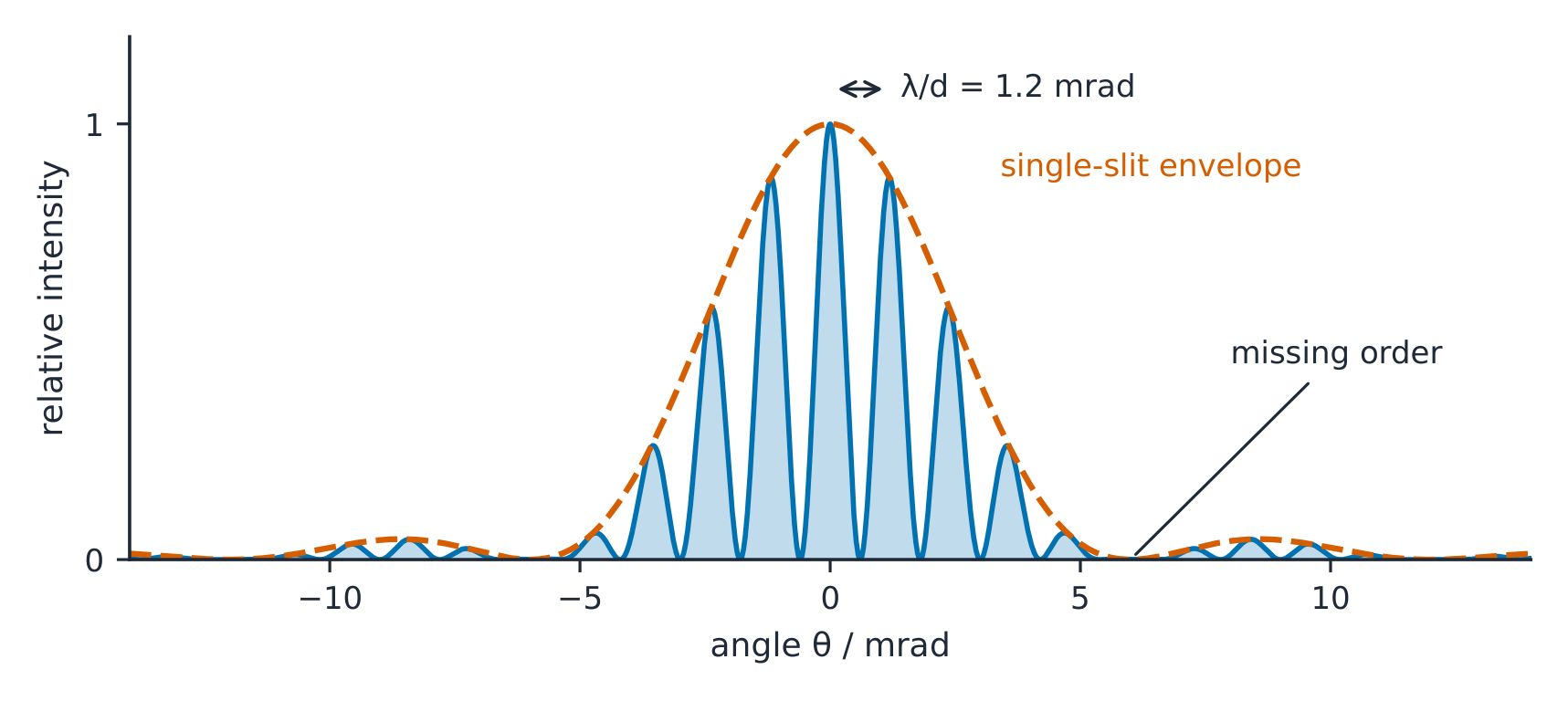
An invented double slit has separation .30 mm and each slit width .060 mm. How many bright interference orders lie inside the central diffraction envelope, excluding its zero-intensity edges?
难度 2/5 · 今日首次完成可获 140 金币及少量额外奖励
d/b = 5, so order ±5 meets the first envelope zeros and is missing. Inside are orders −4 through +4: nine, including the central order. The envelope edges are not additional bright fringes.
AHL: calculate grating angles without a small-angle shortcut
- For a normally incident monochromatic wave on a regular grating, principal maxima satisfy mλ = d sin θ, where integer m is the diffraction order. Use exact sine for potentially large angles. A grating of 600 lines/mm has spacing 1/(600,000) m, about 1.667 micrometres. With 600 nm light, first and second orders are about 21.1° and 46.1°; a third order would require sin θ = 1.08 and cannot form.
- More equally illuminated coherent slits narrow the principal peaks while keeping their ideal angles fixed at the same d and λ. At fixed illumination per slit their peak brightness increases; the plotted two- and ten-slit curves are normalized for shape comparison. Source/slit width, coherence and real apparatus resolution also matter when deciding whether a narrow maximum can actually be resolved.
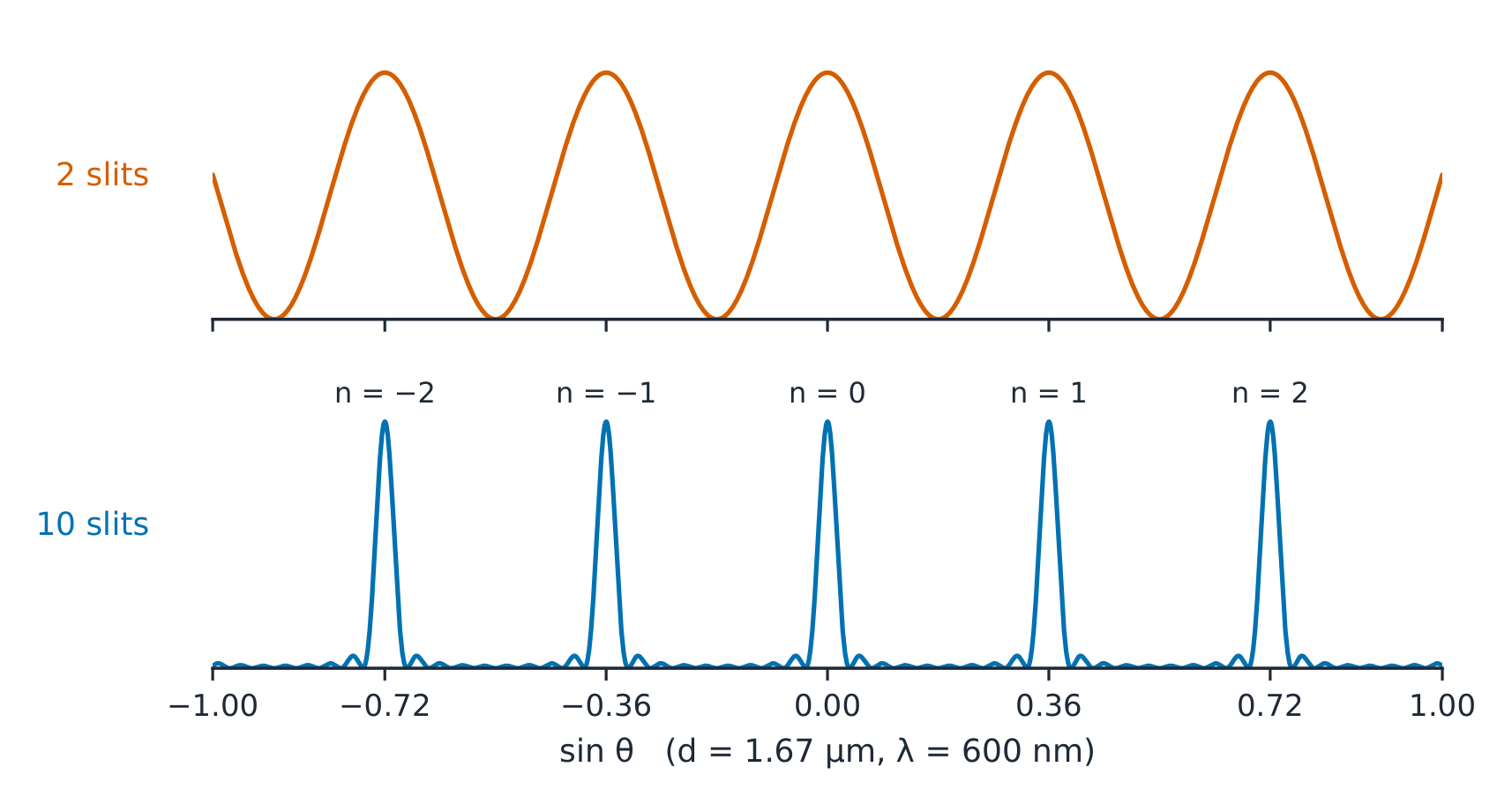
AHL: check allowed orders and overlapping spectra
- A model grating of 300 lines/mm giving second order at 20.0° implies λ = d sin(20.0°)/2 ≈ 570 nm. The ratio d/λ is about 5.85, so order 5 is allowed while order 6 would need sine greater than one. Check mλ/d for the proposed next order. An order satisfying the geometric condition may still be weak or missing because of the slit envelope or experimental limits.
- White illumination produces a white zero order and separated colours in other orders; at a given positive m, shorter wavelength has the smaller angle. For 600 lines/mm, model violet at 400 nm has orders near 13.9°, 28.7° and 46.1°, while 700 nm red has first and second orders near 24.8° and 57.1°. Third-order 400 nm and second-order 600 nm share mλ = 1200 nm and overlap at the same angle. An overlapping colour is not a new diffraction order.
Explain how to analyse reflection, refraction, diffraction and interference with the assumptions needed for each equation.
Each wave phenomenon has a physical model as well as an equation. A consistent diagram, source-phase account and unit check make the calculated answer meaningful.
An invented normally illuminated grating has 300 lines/mm and a second-order maximum at 20.0°. Find wavelength in nm.
难度 2/5 · 今日首次完成可获 140 金币及少量额外奖励
Convert line density to 300000 per metre, so d = 1/300000 m. λ = d sin20°/2 ≈ 570 nm. Use sine rather than replacing a 20° angle directly by its radian value.
For the same invented 300 lines/mm grating whose second-order maximum is at 20.0°, find the highest geometrically allowed integer order.
难度 2/5 · 今日首次完成可获 140 金币及少量额外奖励
d/λ = 2/sin20° ≈ 5.85. The highest integer is 5; order 6 would require sinθ greater than one. A geometrically allowed order may still be weak or suppressed by the slit envelope.