Thermal measurements and particle models
引入| English | 释义 | 拼音 |
|---|---|---|
| specific heat capacity/spəˈsɪfɪk hiːt kəˈpæsɪti/ | 比热容 | bǐ rè róng |
| latent heat/ˈleɪtənt hiːt/ | 潜热 | qián rè |
What would explain this observation?
- Two equal masses receive the same energy but show different temperature rises. Material properties determine how energy transfer changes temperature.
Build the model
- Specific heat capacity 比热容 is energy needed to raise the temperature of unit mass by one degree.
- Specific latent heat 潜热 relates energy to change of state without temperature change for the idealized process.
- specific heat capacity: Energy per mass per temperature rise.
- latent heat: Energy associated with a change of state.

Why can temperature stay constant while a pure substance melts?
难度 1/5 · 今日首次完成可获 100 金币及少量额外奖励
During melting the incoming energy does work separating particles against their attractions - the latent heat - rather than raising kinetic energy, so temperature stays constant. Energy is still entering; it changes arrangement, not temperature.
Match each technical term to its precise meaning.
难度 2/5 · 今日首次完成可获 140 金币及少量额外奖励
Use the definitions to distinguish related quantities and processes.
Choose evidence that can test it
- Temperature relates to particle motion in a model; internal energy includes kinetic and potential contributions.
- During a change of state, energy can change particle arrangements rather than temperature.
In the lab: Measure mass, electrical input and temperature change for an insulated block. Ensure the temperature sensor has good contact, allow time for equilibration, and consider energy transferred to the surroundings.
Which two habits make the investigation or model in this case more defensible?
难度 2/5 · 今日首次完成可获 140 金币及少量额外奖励
Stating the conditions and assumptions lets others repeat the work exactly, and recording the supporting evidence lets them check the conclusion. Hiding disagreeing results removes the evidence that could challenge a wrong conclusion, and one measurement can never establish a wider claim.
Work from known quantities
- Known: a 0.50 kg block gains 2,000 J and rises 10 °C.
- Use E = mcΔT.
- Rearranging gives c = E/(mΔT). c = 2,000/(0.50×10) = 400 J per kilogram per degree.
- Heat loss would make the value inferred from electrical input too large.
Your turn: A 2 kg sample with c=500 J per kilogram per degree warms by 3 °C. Find energy gain.
热损失会改变推算出的比热容
从0.50 kg物块获得2000 J能量、升温10 °C的例子开始,比较物块吸收的热量与电输入能量,并观察为何忽略热损失会使推算出的比热容偏大。
A 2 kg sample with c=500 J per kilogram per degree warms by 3 °C. Find energy gain.
难度 2/5 · 今日首次完成可获 140 金币及少量额外奖励
The result is 3000 J. Known: mass 2 kg; c = 500 J per kilogram per degree; temperature rise 3 degrees C. Use E = mc x temperature change. E = 2 x 500 x 3 = 3,000 J. This is the energy gained by the sample, ignoring losses.
Check the conclusion and its limits
- A flat section of a heating curve can show a phase change, not absence of energy transfer.
- Do not substitute temperature for a temperature difference in E = mcΔT.
Not true: A temperature plateau always means zero energy transfer. During an ideal pure-substance phase change at fixed pressure, energy can change particle arrangement while temperature stays constant. A measured plateau can also occur when input balances losses; the temperature record alone does not prove zero transfer or a phase change.
- Specific heat capacity is energy needed to raise the temperature of unit mass by one degree.
- Temperature relates to particle motion in a model; internal energy includes kinetic and potential contributions.
- Watch for: A flat section of a heating curve can show a phase change, not absence of energy transfer.
A temperature plateau always means zero energy transfer.
难度 1/5 · 今日首次完成可获 100 金币及少量额外奖励
During an ideal pure-substance phase change at fixed pressure, energy can change particle arrangement while temperature stays constant. A measured plateau can also occur when input balances losses; the temperature record alone does not prove zero transfer or a phase change.
Energy per mass per temperature rise: write the technical term.
难度 1/5 · 今日首次完成可获 100 金币及少量额外奖励
specific heat capacity means Energy per mass per temperature rise.
Write from the data: find the energy gain
- A 0.20 kg sample with specific heat capacity 1500 J per kilogram per degree warms by 6 degrees.
- Find the energy gain. A temperature plateau can still transfer energy.
A 0.20 kg sample with specific heat capacity 1500 J per kilogram per degree warms by 6 degrees. What energy does it gain, and why can a temperature plateau still mean energy transfer?
No phase change during the stated warming: Q = mcΔT = 0.20 × 1500 × 6 = 1800 J. A rise of 6 Celsius degrees is 6 K. During a phase-change plateau at fixed pressure, additional heating changes interaction potential energy while temperature stays constant; use Q = mL for that stage.
For the written sample of .20 kg with c = 1,500 warming 6 degrees, what is its energy gain in joules?
难度 1/5 · 今日首次完成可获 100 金币及少量额外奖励
0.20 times 1500 times 6 is 1800 J. Other options — 3000 J (the lesson sample of 2 kg warming by 3 degrees); 6 degrees (the temperature change).
Connect particle arrangement with bulk properties
- A solid keeps its shape because particles remain near fixed positions while vibrating. Crystalline solids have a regular long-range pattern, but amorphous solids do not. Liquid particles remain close together yet rearrange, allowing flow; dilute gas particles are much farther apart and move freely between collisions. A gas is readily compressed mainly because of its large interparticle spacing, not because each particle shrinks.
- Density is mass divided by volume. All numerical examples below are invented teaching models or stipulated material values. A 0.54 kg block measuring 0.10 m by 0.10 m by 0.020 m has volume 0.00020 m³ and density 2,700 kg/m³. A 7.7 g ring occupying 0.40 cm³ has density 19,250 kg/m³. Convert both mass and volume: 1 cm³ is one millionth of a cubic metre, not one hundredth.
A model ring has mass 7.7 g and volume 0.40 cm³. Find density in kg/m³.
难度 2/5 · 今日首次完成可获 140 金币及少量额外奖励
Mass = .0077 kg; volume = .40 × 10⁻⁶ m³. Density = .0077/(.40 × 10⁻⁶) = 19,250 kg/m³, about 1.9 × 10⁴ to two significant figures.
Separate temperature from internal energy
- Temperature determines the direction of spontaneous net thermal transfer between bodies. Internal energy includes microscopic random kinetic energy and interaction potential energy, not the body's overall translational kinetic energy. A large cool body can contain more internal energy than a small hot body; total internal energy alone does not set the direction of spontaneous thermal transfer.
- In the classical ideal-gas model, mean translational kinetic energy per particle is $\overline E_k=\dfrac32 k_BT$. With $k_B=1.38\times10^{-23}$ J/K, at 300 K this is about $6.21\times10^{-21}$ J. The expression concerns translational motion, not every possible rotational/vibrational or interaction-energy contribution in any material. Equal temperatures therefore do not require two different bodies to have equal total internal energies.
Use absolute temperature and temperature change correctly
- Kelvin temperature equals Celsius temperature plus 273.15; questions often use the rounded offset 273. For example, 27°C is about 300 K and −196°C about 77 K. A rise from 20°C to 50°C is 30 K, because one kelvin and one Celsius degree have the same interval size. Do not add 273 to a temperature difference.
- Use kelvin in equations containing absolute T, including ideal-gas translational energy and thermal radiation. Doubling from 300 to 600 K doubles the classical mean translational kinetic energy; doubling 20°C to 40°C does not. Absolute zero is the lower bound of the ordinary thermodynamic temperature scale; it does not justify claiming every microscopic motion vanishes, since the classical particle model has limits.
A sample warms from 20°C to 50°C. Find the temperature rise in kelvin.
难度 2/5 · 今日首次完成可获 140 金币及少量额外奖励
ΔT = 50 − 20 = 30 Celsius degrees = 30 K. The Kelvin offset cancels in a temperature difference.
Match specific heat capacity to the energy received
- Specific heat capacity c links a temperature rise to energy received when the material stays in the same phase: $Q=mc\Delta T$. Its units are J/(kg K). Heat capacity of a particular sample is mc in J/K, so mass matters even if both samples are made of the same material. A 0.50 kg sample receiving 2,000 J and rising 10 K has c = 400 J/(kg K).
- For 1.5 kg of water heated from 20°C to 100°C with c = 4,200 J/(kg K), Q is 504,000 J. A 2.2 kW heater needs about 229 s if all input reaches that water. With 80% of input usefully heating the water, time increases to about 286 s. This calculation ends at the boiling point; it does not include turning the water into steam.
In an invented model, 1.5 kg of water warms from 20°C to 100°C without changing phase. Use c = 4,200 J/(kg K). Find its energy gain.
难度 2/5 · 今日首次完成可获 140 金币及少量额外奖励
Q = mcΔT = 1.5 × 4,200 × 80 = 504,000 J. Vaporization has not yet occurred, so no latent stage is included.
Infer heat capacity while accounting for losses and the apparatus
- In an insulated-block experiment, measure mass, electrical input and temperature against time, allowing the sensor to equilibrate. For steady heater power and a nearly constant temperature-rise rate, $c=P/(m\,\text{gradient})$ if other energy transfers and apparatus heat capacity are negligible. A model 0.80 kg oil sample warmed 50 K by a 2.0 kW heater over 40 s gives an apparent c of 2,000 J/(kg K).
- If some input warmed the container or escaped to the surroundings, assigning all of it to the sample overestimates c. Insulate, improve thermal contact, measure the container contribution where significant, repeat comparable trials and examine the temperature–time curve. Starting a little below room temperature can help balance early environmental gains and later losses, but does not automatically eliminate them. Use a longer measurement interval to reduce fractional timing uncertainty while checking that loss rates have not changed substantially.
A heater warms an oil sample and its container while some input escapes to the room. An investigator assigns all electrical input to the oil. What is the likely bias in the inferred specific heat capacity?
难度 1/5 · 今日首次完成可获 100 金币及少量额外奖励
Using all input in Pt/(mΔT) overestimates the oil’s gain. Container heating and environmental losses must be measured or reduced; repeated readings alone do not remove this systematic bias.
Balance mixing energies rather than averaging temperatures blindly
- For a thermally isolated mixture with no phase change, energy lost by hotter components equals energy gained by colder components, including a container if its heat capacity matters. Equal material masses have a simple average final temperature only when the relevant heat capacities match and other transfers are negligible. Temperature itself is not a conserved quantity.
- A model 0.20 kg copper sample with c = 390 J/(kg K) at 100°C enters 0.30 kg water with c = 4,200 at 20°C. The balance is $78(100-T)=1260(T-20)$, giving T about 24.7°C. For 0.30 kg water at 80°C mixed with 0.20 kg water at 20°C, the same-material balance gives 56°C. Check that a no-phase-change equilibrium temperature lies between the starting temperatures.
In an isolated model, mix .30 kg water at 80°C with .20 kg water at 20°C. Both have the same constant specific heat capacity; neglect the container and phase changes. Find final temperature.
难度 2/5 · 今日首次完成可获 140 金币及少量额外奖励
Energy lost equals energy gained: .30c(80 − T) = .20c(T − 20). Cancel the shared c and expand: 24 − .30T = .20T − 4. Thus 28 = .50T and T = 28/.50 = 56°C. Unequal masses prevent a simple arithmetic mean of the initial temperatures.
Read a phase change as an energy transfer
- For a pure substance changing phase at fixed pressure, temperature can stay constant while energy changes interparticle arrangements and interactions. Melting or vaporizing usually raises interaction potential energy rather than the modeled average translational kinetic energy. This does not mean chemical bonds inside water molecules are broken when ice melts or water boils.
- Specific latent heat L is energy per kilogram for a stated phase change; use $Q=mL$. With stipulated water values $L_f=334{,}000$ J/kg and $L_v=2{,}260{,}000$ J/kg, melting 0.10 kg requires 33.4 kJ and vaporizing it 226 kJ. Freezing and condensation release corresponding energy under the same conditions. A plateau is evidence to interpret with the experiment, not proof by itself: a steady temperature may also result from heating input balancing losses.
A measured temperature stays steady while a heater remains on. Which conclusion is justified from this observation alone?
难度 1/5 · 今日首次完成可获 100 金币及少量额外奖励
A phase change is one explanation under suitable pure-substance/fixed-pressure conditions. Steady temperature alone neither proves that explanation nor proves zero transfer.
Sum each stage of a heating curve
- For an illustrative 0.10 kg ice sample starting at −20°C, use ice c = 2,100 J/(kg K). Reaching 0°C takes 4.2 kJ, melting takes 33.4 kJ, warming the water to 100°C takes 42 kJ, and vaporizing takes 226 kJ. The cumulative energy to finish vaporization is 305.6 kJ. Do not use the liquid's heat capacity for the ice stage or omit a latent stage because its temperature change is zero.
- On temperature against supplied-energy axes, the rising-section gradient is $1/(mc)$ and a phase-change plateau's horizontal extent is mL. On temperature against time axes with constant net heating power, the rising gradient is P/(mc) and the plateau duration mL/P. With a useful 500 W reaching this sample, vaporization alone lasts 452 s. Read the horizontal-axis quantity before comparing slopes or widths.
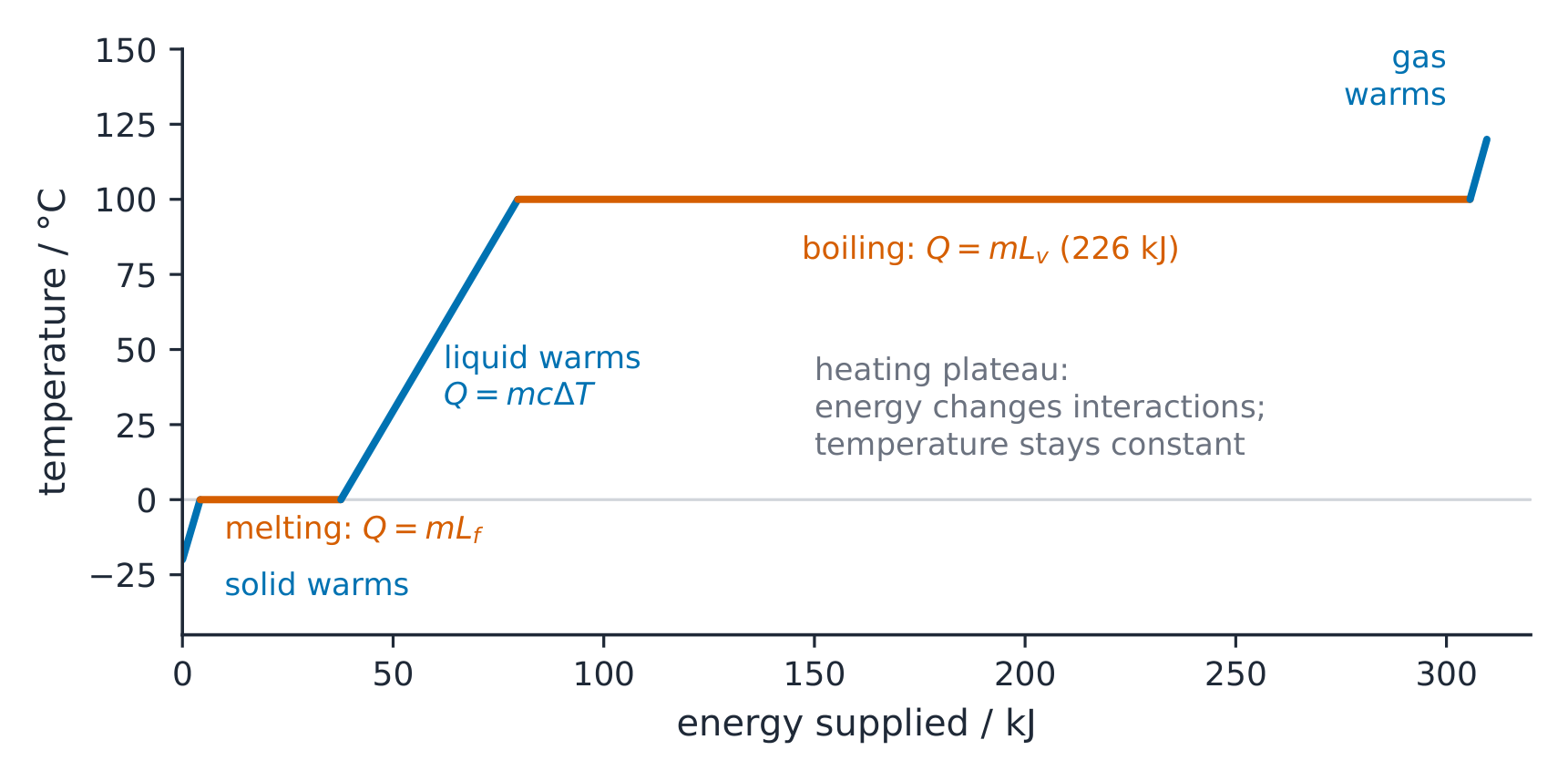
For the model .10 kg ice sample starting at −20°C, use ice c = 2,100, water c = 4,200 J/(kg K), fusion L = 334,000 and vaporization L = 2,260,000 J/kg. Find energy in kJ to finish vaporization at 100°C. Give the answer to three significant figures.
难度 2/5 · 今日首次完成可获 140 金币及少量额外奖励
Warm the ice: mcΔT = .10 × 2,100 × 20 = 4,200 J = 4.2 kJ. Melt it: mLf = .10 × 334,000 = 33.4 kJ. Warm the water: .10 × 4,200 × 100 = 42.0 kJ. Vaporize it: mLv = .10 × 2,260,000 = 226 kJ. Total = 4.2 + 33.4 + 42.0 + 226 = 305.6 kJ, or 306 kJ to three significant figures. Latent stages require energy even at constant temperature.
Test whether all the ice can melt before solving for temperature
- Add 0.050 kg ice at 0°C to 0.25 kg water at 30°C in an isolated model. Water could release 31,500 J by cooling to 0°C, exceeding the 16,700 J required to melt the ice. All ice can therefore melt, and the melted water must also warm to the final temperature. The full balance gives T = 14,800/1,260, about 11.75°C.
- In a separate model, 0.20 kg water at 10°C can supply only 8,400 J before reaching 0°C. This melts about 0.0251 kg of an added 0.050 kg ice sample at 0°C, leaving about 0.0249 kg ice and an equilibrium mixture at 0°C under the stated conditions. A negative answer from an “all ice melted” equation would signal that the assumed final state was wrong, not a valid subzero liquid-water equilibrium for this model.
In an isolated model, .20 kg water at 10°C meets .050 kg ice at 0°C. Use water c = 4,200 J/(kg K) and fusion L = 334,000 J/kg. Find the mass of ice melted.
难度 2/5 · 今日首次完成可获 140 金币及少量额外奖励
Cooling water to 0°C supplies .20 × 4,200 × 10 = 8,400 J. Melted ice mass = 8,400/334,000 ≈ .0251 kg, below .050 kg, so ice remains and the equilibrium model is at 0°C.
Distinguish evaporation from boiling
- Evaporation occurs at a liquid's surface over a range of temperatures. Escaping particles generally remove more than the average energy per particle, so the remaining liquid can cool unless energy is replenished. Increasing exposed area, reducing surrounding vapour concentration or moving air across the surface can increase evaporation. An energy supply from the surroundings can let evaporation continue without a large measured temperature fall.
- Boiling involves vapour bubbles forming within the liquid as well as the surface. Its temperature depends on pressure and composition; 100°C is the familiar approximation for pure water at standard atmospheric pressure, not a universal boiling temperature. A lid reduces evaporation and some convective transfer, but does not eliminate all heat transfer from a drink. Distinguish the transfer mechanism from the final temperature trend.
Relate conduction to the temperature gradient
- Conduction transfers thermal energy through microscopic interactions without bulk transport of the material. Mobile electrons help metals conduct; a gas with widely separated particles generally conducts less effectively. For a uniform slab at steady state, the magnitude of conduction power is $P=kA\Delta T/\Delta x$, where ΔT is the temperature difference between its faces. The direction is from hot to cold; the displayed positive form uses difference magnitude.
- For a copper rod of length 0.50 m, cross-section 0.00010 m², k = 390 W/(m K), and end temperatures 100°C and 20°C, P is 6.24 W. Doubling the rod length halves P if the face temperatures, area and k remain fixed. A glass-only window calculation is not automatically a room's loss rate: air films and other layers can take much of the total indoor–outdoor temperature difference.
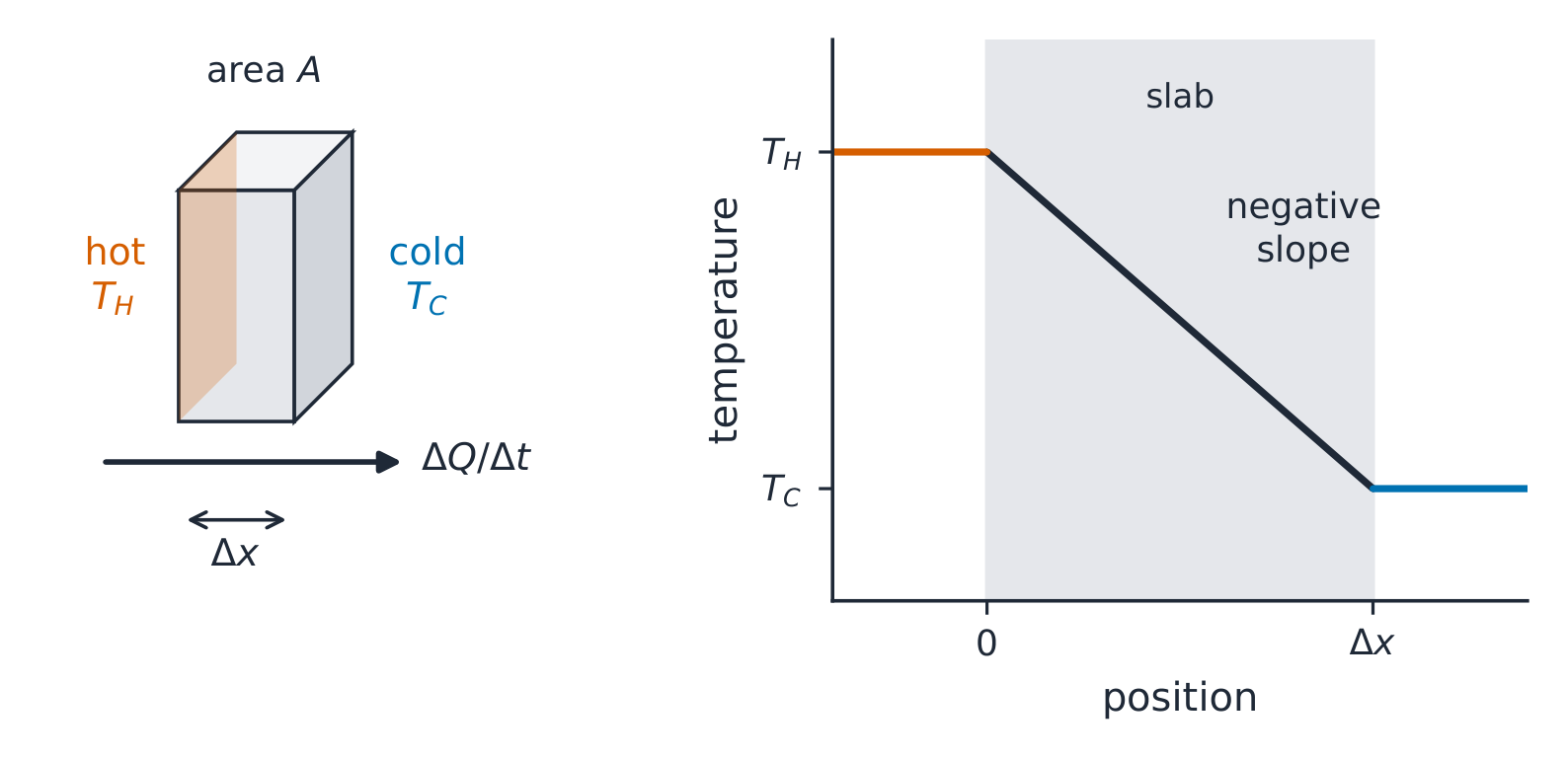
A model copper rod has length .50 m, area .00010 m² and k = 390 W/(m K). Its ends are at 100°C and 20°C in steady state. Find conduction power magnitude.
难度 2/5 · 今日首次完成可获 140 金币及少量额外奖励
P = kAΔT/length = 390 × .00010 × 80/.50 = 6.24 W. The temperature difference belongs to the rod faces; direction is from hot to cold.
Explain convection as movement of a fluid
- Convection transports energy through bulk motion of a liquid or gas. In a typical gravitational setting, warmed fluid expands, becomes less dense and rises while cooler surrounding fluid replaces it. Forced circulation by a fan or pump also transfers energy; it does not require the rising motion of free convection. Solids can conduct but cannot form an internal bulk fluid circulation while remaining solid.
- A radiator can establish circulating air, and unequal daytime heating of land and sea can help drive a sea breeze. Explain the density and pressure response rather than saying “heat rises” as though all energy must move upward. An insulated cavity suppresses bulk circulation only if its geometry and operating conditions do so; conduction and radiation can still carry energy across it.
Separate emitted radiation from net radiative loss
- Thermal radiation is electromagnetic transfer and needs no material medium. An ideal black body absorbs all incident radiation and has emitted power $P=\sigma AT^4$, with T in kelvin and surface area A. For σ = $5.67\times10^{-8}$ in SI units, a black surface of area 0.040 m² at 500 K emits 141.75 W. At 1,000 K it emits 16 times as much, about 2,268 W.
- A surface also absorbs radiation. In an ideal black-surface enclosure model, net outward power is $\sigma A(T^4-T_{\rm surroundings}^4)$, not just the emitted term. A 0.040 m² surface at 500 K surrounded by 300 K emits 141.75 W, absorbs about 18.37 W and loses about 123.38 W net. At equal temperatures these transfers balance, even though emission continues. State the black-body and geometry assumptions when using this simple comparison.
In the ideal black-surface enclosure model, a .040 m² surface at 500 K is surrounded by 300 K surfaces. Use sigma = 5.67 × 10⁻⁸ in SI units. Find net outward radiative power to three significant figures.
难度 2/5 · 今日首次完成可获 140 金币及少量额外奖励
Net power = sigma A(500⁴ − 300⁴) = 141.75 − 18.3708 = 123.3792 W, reported 123 W to three significant figures. Emission alone is 141.75 W and would overstate net loss.
Connect a black-body spectrum with absolute temperature
- A black-body spectrum is continuous. Raising temperature increases spectral emission at every fixed wavelength and shifts the wavelength-spectrum peak shorter. Wien's displacement law is $\lambda_{\max}T=2.9\times10^{-3}$ m K. For 5,000 K the peak is 580 nm; for 3,000 K it is about 967 nm. The plotted peak describes the wavelength version of the spectrum; do not assume any representation has the same numerical peak location.
- A stipulated star peaking at 290 nm has black-body temperature 10,000 K. A 2,900 K filament peaks near 1.0 micrometre and a 310 K surface near 9.35 micrometres. Radiation exists away from the peak as well: a peak outside the visible band does not imply zero visible emission. Use metres for wavelength when substituting the stated SI constant.

Combine luminosity, brightness and radius consistently
- Luminosity L is total emitted power; apparent brightness b is received power per area. For an isotropic source without intervening absorption, $b=L/(4\pi d^2)$. Doubling distance quarters brightness; it does not change the source's luminosity. With L = $3.8\times10^{28}$ W and b = $2.0\times10^{-9}$ W/m², the inferred distance is about $1.23\times10^{18}$ m.
- With a spherical black-body source, $L=4\pi R^2\sigma T^4$. Two sources with equal luminosity but a factor-two temperature ratio therefore have a radius ratio of 1/4 for the hotter relative to the cooler source. For another model with luminosity 100,000 times a reference star and temperatures 3,500 K versus 5,800 K, radius ratio is about 868.4. State isotropic emission, spectral/black-body approximations and negligible absorption before inferring distance or radius from observations.
Two ideal spherical black-body stars have equal luminosity. Star X has twice the surface temperature of Y. Find radius ratio RX/RY.
难度 2/5 · 今日首次完成可获 140 金币及少量额外奖励
Equal luminosity gives RX² TX⁴ = RY² TY⁴. Therefore RX/RY = (TY/TX)² = (1/2)² = 1/4, not 1/2.
Build a complete thermal explanation and check the model
- Identify the bodies, initial/final states, mass, phase and transfer path. Choose mcΔT for a same-phase temperature change, mL for a phase change, or a staged mixing balance if both occur. For rates, distinguish conduction, fluid transport and radiation. Check that actual surface temperatures, net useful heating power and relevant heat capacities match the equation's assumptions.
- Recalculate one result using a graph gradient, a cumulative energy account or a ratio. Check whether enough energy exists to complete a phase change, whether equilibrium is physically allowed, whether emission or net radiation was requested, and whether a brightness is power per area. Report uncertainty and repeatability separately from systematic losses. A measured plateau, large apparent heat capacity or unexpected star radius needs an explanation of the model limits, not just a substituted number.
Explain how to select and test a thermal-energy model. Include phase changes, measurement bias and one rate or radiation distinction.
A model must explain both the energy transfers and the measured temperature/rate evidence, rather than treating a plateau or a substituted number as proof.