Forces, momentum and safe stopping
引入| English | 释义 | 拼音 |
|---|---|---|
| momentum/məʊˈmentəm/ | 动量 | dòng liàng |
| resultant force/rɪˈzʌltənt fɔːs/ | 合力 | hé lì |
What would explain this observation?
- A passenger continues moving when a vehicle brakes. The seat belt provides the force needed to change the passenger momentum 动量.
Build the model
- Resultant force 合力 causes acceleration, not motion itself.
- Momentum is mass multiplied by velocity.
- For an isolated system, total momentum is conserved even when kinetic energy is not.
- momentum: Mass multiplied by velocity.
- resultant force: The vector sum of forces on an object.

For fixed momentum change, which reduces average stopping force?
难度 1/5 · 今日首次完成可获 100 金币及少量额外奖励
For a fixed momentum change, average force = momentum change / time, so a longer stopping time divides the same change by a larger number and gives a smaller force. Crumple zones and airbags apply exactly this.
Match each technical term to its precise meaning.
难度 2/5 · 今日首次完成可获 140 金币及少量额外奖励
Use the definitions to distinguish related quantities and processes.
Choose evidence that can test it
- Impulse equals momentum change.
- Increasing stopping time for the same momentum change reduces average force.
- Identify external forces before applying momentum conservation.
In the lab: Draw a free-body diagram containing only forces on the selected object. For spring measurements, add loads in steps within the elastic range and measure extension from the unloaded position.
Which two habits make the investigation or model in this case more defensible?
难度 2/5 · 今日首次完成可获 140 金币及少量额外奖励
Stating the conditions and assumptions lets others repeat the work exactly, and recording the supporting evidence lets them check the conclusion. Hiding disagreeing results removes the evidence that could challenge a wrong conclusion, and one measurement can never establish a wider claim.
Work from known quantities
- Known: a 60 kg passenger slows from 10 to 0 metres per second in 0.50 s. Δp = m(v-u) = 60(0-10) = -600 kg metres per second.
- Average F = Δp/Δt = -600/0.50 = -1,200 N.
- The sign shows the force opposes the initial motion.
Your turn: A 2 kg trolley travels at 3 metres per second. Find its momentum.
冲量相同,停止时间不同
从60 kg乘客以10 m/s运动、在0.50 s内停止的例子开始,比较更长的停止时间;有符号动量变化不变,平均力随之改变。
A 2 kg trolley travels at 3 metres per second. Find its momentum.
难度 2/5 · 今日首次完成可获 140 金币及少量额外奖励
The result is 6 kg·m/s. Known: mass 2 kg; velocity 3 metres per second. Use momentum p = mv. p = 2 x 3 = 6 kg metres per second. Momentum is a vector; the value is in the direction of travel.
Check the conclusion and its limits
- Balanced forces do not require the object to be at rest.
- Mass and weight have different units and meanings.
Not true: An object moving at constant velocity must have a nonzero resultant force. By Newton's first law, constant velocity - including steady motion - means zero RESULTANT force. Forces can be present, but they balance; a nonzero resultant would change the velocity.
- Resultant force causes acceleration, not motion itself.
- Impulse equals momentum change.
- Watch for: balanced forces do not require the object to be at rest.
An object moving at constant velocity must have a nonzero resultant force.
难度 1/5 · 今日首次完成可获 100 金币及少量额外奖励
By Newton's first law, constant velocity - including steady motion - means zero RESULTANT force. Forces can be present, but they balance; a nonzero resultant would change the velocity.
Mass multiplied by velocity: write the technical term.
难度 1/5 · 今日首次完成可获 100 金币及少量额外奖励
momentum means Mass multiplied by velocity.
Write from the data given
- A 4 kg trolley travels at 8 metres per second and stops in 0.40 s.
- Find the momentum magnitude and the average stopping-force magnitude. Constant velocity needs zero resultant force.
A 4 kg trolley travels at 8 metres per second and stops in 0.40 s. What are its momentum and the average stopping-force magnitude, and what resultant force does constant velocity need?
Find initial and final momentum before dividing their difference by the stopping time: |Favg| = |0 − 32|/0.40 = 80 N. This is a resultant force averaged over the whole stop, not necessarily the peak force.
The HL written trolley has mass 4 kg and velocity +8 m/s. What is its momentum?
难度 1/5 · 今日首次完成可获 100 金币及少量额外奖励
4 times 8 is 32 kilogram metres per second. Other options — 6 kilogram metres per second (the lesson trolley); 80 newtons (the stopping force).
Select one body before summing its forces
- A free-body diagram includes forces acting on the selected body, not forces it exerts elsewhere. A book's weight and table normal force both act on the book, so they are not a third-law pair. Their partners are the book's gravitational pull on Earth and its contact force on the table, acting on different bodies.
- Newton's first law permits rest or constant velocity with zero resultant external force. The second law connects resultant force to momentum change; for constant mass, F = ma. A third-law pair is equal and opposite on two interacting bodies, so it does not cancel within the free-body diagram of only one. All numerical cases here are invented teaching models, with g = 9.8 metres per second squared where used.
A book rests on a table. Which force is the third-law partner of Earth’s gravitational pull on the book?
难度 1/5 · 今日首次完成可获 100 金币及少量额外奖励
A third-law pair belongs to one interaction and acts on two different bodies. Weight and normal on the book can balance, but are not that pair.
Resolve contact forces without double-counting weight
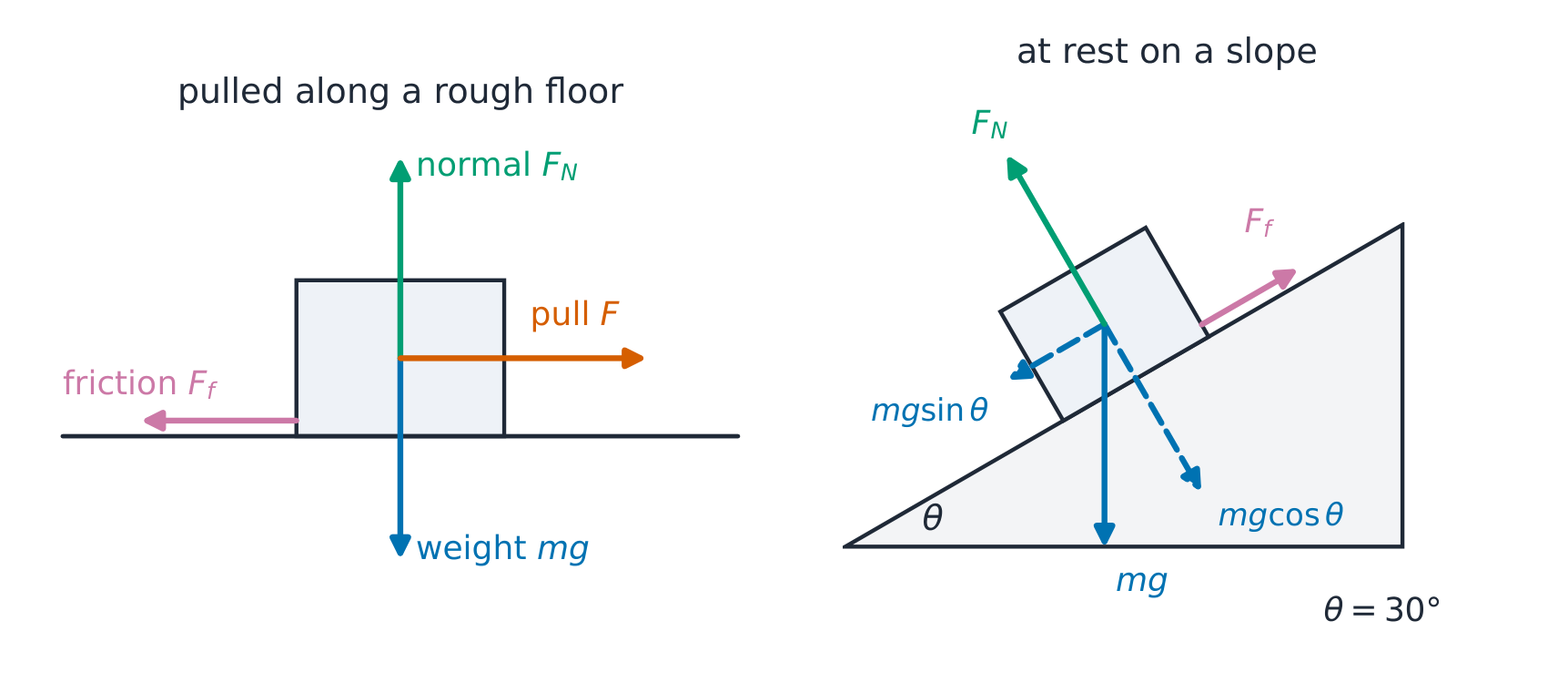
- Normal force acts perpendicular to a surface; friction acts along it, while tension follows a taut string and a spring force restores its natural configuration. Weight is a field force, distinct from mass and measured in newtons. Gravitational, electric and magnetic forces provide field-interaction examples.
- On an ordinary fixed slope, with no extra perpendicular force or perpendicular acceleration, normal force is mg cos θ and the downhill weight component is mg sin θ. Draw the actual weight or replace it by components when calculating, rather than counting both as extra forces. On a horizontal surface, normal equals mg only when the perpendicular balance justifies it; it is not a definition applying to every setup.
Let static friction adjust before using its limiting value
- For a model 5.0 kg box on a horizontal floor, normal force is 49 N. With static coefficient 0.50, maximum static friction is 24.5 N. A horizontal 20 N push can be balanced by 20 N friction, not automatically 24.5 N. Static friction takes the required value up to the limit.
- With a 30 N horizontal pull exceeding that limit, use the stated sliding coefficient 0.40: friction is 19.6 N, resultant 10.4 N and acceleration 2.08 metres per second squared. Coefficients have no unit and depend on the surfaces/model. A stationary box on a 30-degree slope needs at least tan30°, about 0.577, for the static coefficient under the stated force balance.
A model 5.0 kg box on a horizontal floor has static coefficient 0.50 and g = 9.8 metres per second squared. A 20 N horizontal push acts while it remains at rest. Find friction magnitude.
难度 2/5 · 今日首次完成可获 140 金币及少量额外奖励
Vertical balance gives N = mg = 5.0 × 9.8 = 49 N. Maximum static friction = μsN = .50 × 49 = 24.5 N. Since 20 N is below this limit, horizontal balance requires 20 N friction opposite the push. Static friction is not automatically at its maximum.
For the separate model 5.0 kg box sliding along a horizontal floor in the pull direction, horizontal pull is 30 N and sliding coefficient is 0.40. Use g = 9.8 metres per second squared to find acceleration in the pull direction.
难度 2/5 · 今日首次完成可获 140 金币及少量额外奖励
On a horizontal floor with no vertical pull, N = mg = 5.0 × 9.8 = 49 N. Sliding friction = μkN = .40 × 49 = 19.6 N. Resultant force = 30 − 19.6 = 10.4 N, so a = Fnet/m = 10.4/5.0 = 2.08 metres per second squared, about 2.1 to two significant figures.
Connect a spring force to extension and a valid measurement range
- Hooke's law gives a restoring force opposite displacement from natural length; its magnitude is k times extension within the model's valid range. A 0.50 kg mass on a vertical spring of stiffness 200 N/m has equilibrium extension 4.9/200 = 0.0245 m. Equilibrium extension is not the whole loaded length of the spring.
- Measure each extension from an unloaded reference with a fixed pointer, add loads in suitable steps and remain within the elastic range. Force-versus-extension gradient gives stiffness, whereas reversing axes changes the gradient's meaning. Repeats do not remove parallax or an incorrect zero; record the loading/unloading procedure and check whether the linear model fits.
Balance weight, buoyancy and drag at a terminal fall
- Buoyancy equals the weight of displaced fluid, using fluid density and displaced volume. For a slowly moving small sphere in the Stokes model, drag magnitude is 6πηrv. At downward terminal motion, weight equals buoyancy plus drag, rather than weight equalling drag alone when buoyancy matters.
- A model steel sphere of radius 1.0 mm and density 7,800 kg/m³ falls in fluid of density 1,260 kg/m³ and viscosity 1.4 Pa s. The balance predicts speed about 0.0102 m/s. Use radius in metres and the model's slow-flow conditions. Timing after terminal speed is established can support a viscosity estimate; near-wall effects or unsettled speed can invalidate a naive calculation.
Give rebound velocities signs before finding impulse
- Momentum is mass times velocity and is a vector. Impulse equals momentum change; the average resultant force is impulse divided by contact time. For a 0.058 kg ball arriving at −20 m/s and rebounding at +15 m/s, change is +2.03 kilogram metres per second, giving average +203 N over 0.010 s, about 200 N at two significant figures.
- A force–time area gives impulse even if force varies. A triangular pulse with peak 400 N and full duration 0.020 s gives 4.0 N s; an initially stationary 0.080 kg ball then reaches 50 m/s if this is its net impulse. Do not use peak force as average force or subtract speed magnitudes while ignoring a reversal.
A model 0.058 kg ball has initial velocity −20 m/s and final velocity +15 m/s. Find its signed momentum change.
难度 2/5 · 今日首次完成可获 140 金币及少量额外奖励
Δp = .058[15 − (−20)] = +2.03 kg m/s. The reversal requires adding speed magnitudes within this signed difference, not subtracting 20 − 15.
Connect stopping time with average force at fixed momentum change
- For an invented fixed impulse of 600 N s, times 0.25, 0.50, 1.0 and 2.0 s require average force magnitudes 2,400, 1,200, 600 and 300 N. Longer stopping time reduces average force for the same momentum change; it does not by itself specify the peak force or the distribution of force on a body.
- Seat belts, airbags, crumple zones or moving hands back while catching can lengthen stopping time and change how force is applied. Retain the sign when reporting a directed force, and state magnitude when only a positive size is requested. The model is mechanical reasoning, not a guarantee of safety under every impact.

Define the system boundary for momentum conservation and mass flow
- Total momentum is conserved when external impulse on the chosen system is negligible over the interval. Internal interaction forces exchange momentum between its parts. For colliding trolleys on a suitable track, a short collision can make external friction impulse small even if friction is not literally absent.
- Steady mass flow instead needs momentum transferred across the boundary per unit time. A model jet delivering 2.0 kg/s at 15 m/s and stopping at a wall transfers 30 N of directed force; a 3.0 kg/s jet at 20 m/s gives 60 N under the stated incoming/outgoing assumptions. Do not insert a changing mass into F = ma without accounting for the momentum carried by entering or leaving material.
Test momentum and kinetic energy as separate collision questions
- A 2.0 kg trolley at 3.0 m/s sticks to a stationary 1.0 kg trolley. Conserved momentum gives common speed 2.0 m/s. Kinetic energy changes from 9.0 to 6.0 J, transferring 3.0 J to other stores. Momentum conservation does not imply kinetic-energy conservation.
- Elastic collisions conserve kinetic energy as well as momentum under the system assumptions. In the usual passive inelastic model, some kinetic energy becomes internal energy, sound or deformation; sticking gives the greatest loss for the fixed initial total momentum and final total mass. Total energy remains conserved. If kinetic energy increases, energy must come from another store, as in an explosion; the word collision alone is not a universal energy prohibition.
An invented 3,000 kg truck at +2.0 m/s couples with a stationary 2,000 kg truck. Neglect external impulse. Find their common velocity.
难度 2/5 · 今日首次完成可获 140 金币及少量额外奖励
Initial momentum = 3,000 × 2.0 + 2,000 × 0 = +6,000 kg m/s. Coupling gives total mass 3,000 + 2,000 = 5,000 kg. With negligible external impulse, 5,000v = 6,000, so v = 6,000/5,000 = +1.2 m/s. Momentum conservation does not require kinetic-energy conservation.
For the same 3,000 kg truck at 2.0 m/s coupling with a stationary 2,000 kg truck, their common final speed is 1.2 m/s. Find the kinetic energy transferred to other stores.
难度 2/5 · 今日首次完成可获 140 金币及少量额外奖励
Initial KE = 6,000 J; final = ½ × 5,000 × 1.2² = 3,600 J. Difference = 2,400 J, despite conserved system momentum.
Apply the zero-momentum explosion model only when initially at rest
- Two model skaters of 60 and 40 kg start at rest and push apart with negligible external impulse. If the first moves at +2.0 m/s, the other moves at −3.0 m/s. Total momentum remains zero while kinetic energy rises to 300 J, supplied from internal chemical energy.
- Equal and opposite momenta do not imply equal speeds or energies. A 4.0 kg rifle and 0.010 kg bullet, initially at rest, give recoil −1.0 m/s if bullet velocity is +400 m/s in the stated frame; their kinetic energies are 2.0 and 800 J. A system already moving can also explode, but its conserved total momentum need not be zero. Always specify initial state and reference frame.
Explain constant-speed circular motion through changing velocity direction
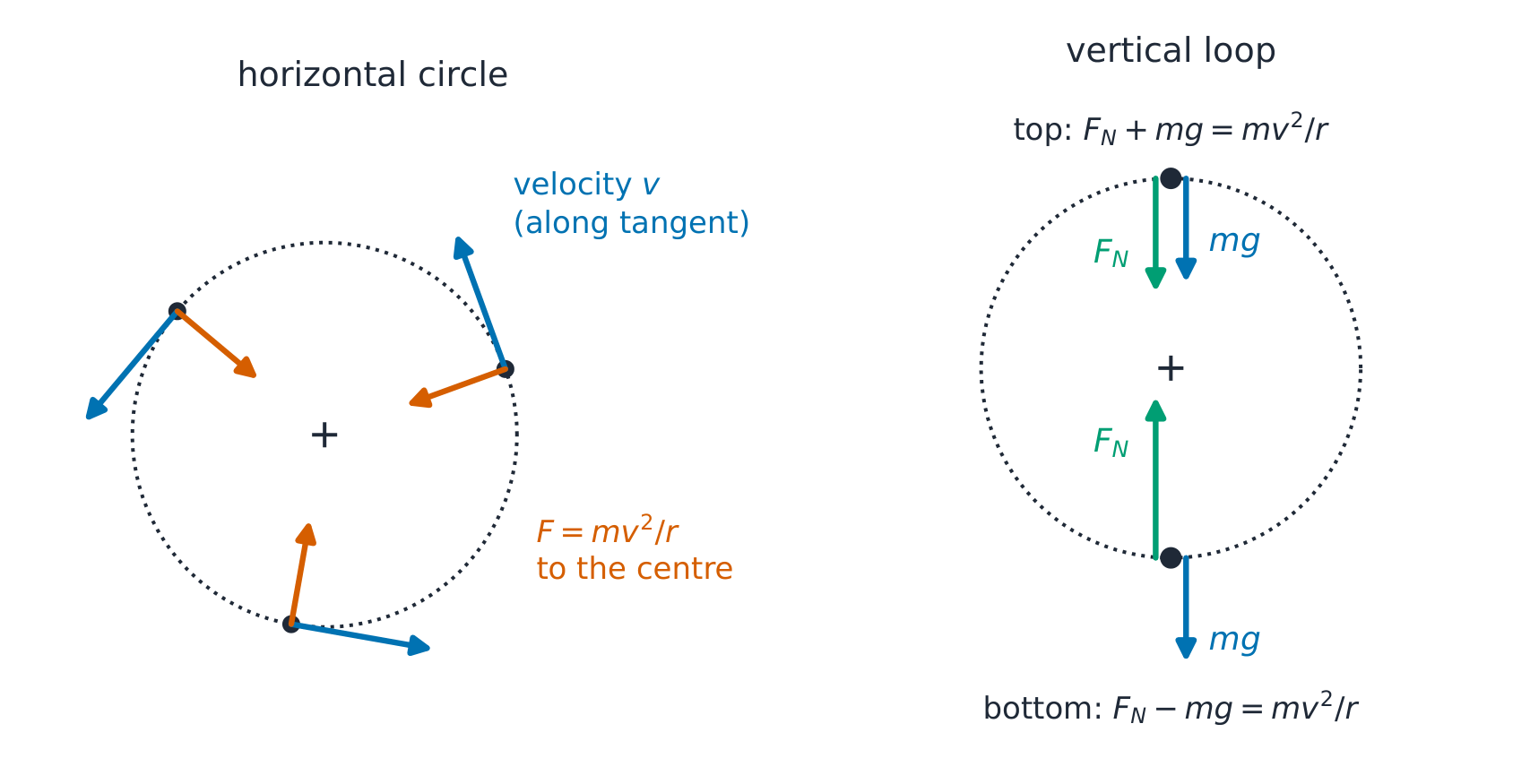
- A circular path of radius r and period T has speed 2πr/T and angular speed 2π/T. The inward acceleration is v²/r, requiring an inward resultant mv²/r. Centripetal force names that resultant role; tension, friction, gravity or their combination supplies it, rather than an additional mysterious force on the diagram.
- In uniform circular motion the inward resultant is perpendicular to velocity, changing direction without changing speed or doing work. For a model 1,200 kg car at 10 m/s on a 20 m bend, inward force is 6,000 N; horizontal-road friction requires a static coefficient at least about 0.510. With inadequate friction the intended circular path cannot be maintained; exactly force-free motion would continue along the instantaneous tangent.
A model 1,000 kg car moves at 15 m/s around a horizontal bend of radius 50 m. Find the required inward resultant force.
难度 2/5 · 今日首次完成可获 140 金币及少量额外奖励
mv²/r = 1,000 × 15²/50 = 4,500 N. Friction can supply this role; centripetal is not an additional interaction force.
Put the inward direction first at the top and bottom of a loop
- Inside a vertical loop, inward is upward at the bottom and downward at the top. Thus normal minus weight equals mv²/r at the bottom, while normal plus weight equals mv²/r at the top. A model 500 kg car at 20 m/s in a 10 m bottom radius requires normal force 24,900 N, much greater than its weight.
- At the minimum top speed for contact in this ideal inside-track model, normal force is zero, giving speed √(gr). For a 1.0 m radius this is about 3.13 m/s. Over a road hump the normal direction differs: mg minus normal equals mv²/r. Conditions of contact, track geometry and speed must be stated; not every circular trajectory uses the same sign equation.
Check radial balance without assuming every force is radial everywhere
- A 0.20 kg ball on a 0.50 m string has speed 4.0 m/s at the top of its vertical circle. Tension plus weight supplies inward force, giving tension 4.44 N. At other points gravity can have a tangential component and change speed; inward mv²/r describes radial balance, not necessarily the entire resultant.
- A model horizontal circle of radius 0.80 m completed twice per second has period 0.50 s, angular speed about 12.57 rad/s, speed about 10.05 m/s and inward acceleration about 126.3 metres per second squared. Keep radius and diameter separate, and compare the actual interaction forces with the required resultant rather than drawing both as independent extra forces.
Build a force-and-momentum explanation with independent checks
- Select the body or system, time interval, reference frame and positive directions. Draw actual forces and justify an equilibrium, acceleration or negligible-external-impulse assumption. Use signs for momentum, area for impulse and a separate energy calculation to classify a collision. Label any stated force as average or peak.
- For springs or falling-sphere measurements, calibrate scale/timing, control relevant conditions and test the valid model range. For circular motion, resolve radial and tangential components where needed. Verify units, total momentum and energy accounting independently. A plausible speed does not validate a diagram with the wrong body, doubled forces or an inappropriate system boundary.
Explain how to choose between equilibrium, acceleration, impulse and momentum conservation in a mechanical problem. Include a force diagram, a sign choice and an independent energy or unit check.
The boundary and time interval determine which conservation or force equation applies.
AHL: Conserve two momentum components rather than scalar speeds
- In the model collision, a 0.20 kg puck moving east at 3.0 m/s hits a stationary 0.30 kg puck. Afterwards the first moves at 1.5 m/s, 60 degrees north of east. Initial momentum is 0.60 east; the first final momentum has components 0.15 east and about 0.260 north.
- The second must therefore carry 0.45 east and about −0.260 north, giving velocity components 1.50 east and about −0.866 north in m/s. Its speed is about 1.732 m/s at 30 degrees south of east. Kinetic energy changes from 0.90 to 0.675 J, so the model collision is inelastic despite vector momentum conservation.
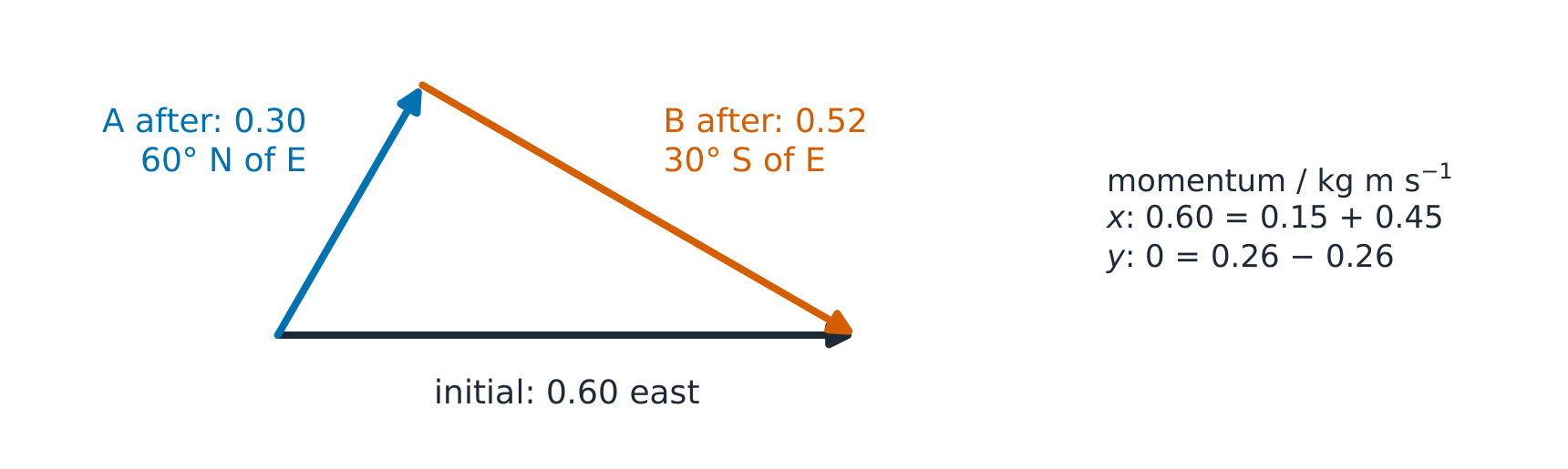
AHL: A 0.20 kg puck initially moves east at 3.0 m/s. After hitting a stationary 0.30 kg puck, the first moves at 1.5 m/s at 60 degrees north of east. Find the second puck’s northward velocity component, with north positive.
难度 2/5 · 今日首次完成可获 140 金币及少量额外奖励
Initial north momentum is zero. The first ends with .20 × 1.5 sin60° ≈ +.260 kg m/s, so the second component is −.260/.30 ≈ −.866 m/s, directed south.
AHL: Use a second collision to test the vector method independently
- A 2.0 kg ball moving east at 5.0 m/s hits a stationary 3.0 kg ball. If the first ends moving north at 2.0 m/s, the second has momentum 10 east and −4 north, giving velocity components 10/3 and −4/3 m/s. Speed is about 3.59 m/s at 21.8 degrees south of east.
- Kinetic energy is initially 25 J and finally about 23.33 J: four joules in the first ball and about 19.33 in the second. For an initially stationary multi-part explosion with negligible external impulse, final momentum vectors instead sum to a closed polygon with zero resultant. Two perpendicular equations or a correct vector construction are essential; adding different-direction speeds cannot replace either method.
AHL: A model 2.0 kg ball initially moves east at 5.0 m/s and hits a stationary 3.0 kg ball. The first ends moving north at 2.0 m/s. Neglect external impulse and find the second ball’s speed.
难度 2/5 · 今日首次完成可获 140 金币及少量额外奖励
Second momentum components are 10 east and −4 north kg m/s, so velocity components are 10/3 and −4/3 m/s. Their magnitude is √116/3 ≈ 3.59 m/s, at about 21.8 degrees south of east.
AHL: In that second collision, final velocities are 2.0 m/s for the 2.0 kg ball and components 10/3, −4/3 m/s for the 3.0 kg ball. Calculate total final kinetic energy.
难度 2/5 · 今日首次完成可获 140 金币及少量额外奖励
First KE = 4 J; second = ½ × 3[(10/3)² + (4/3)²] = 58/3 J. Total = 70/3 ≈ 23.33 J, below the initial 25 J; the model collision is inelastic.
Read the stopping comparison as an inverse relationship
- The plotted stops each have momentum-change magnitude 600 N s. Average force magnitude is $|F_{\mathrm{avg}}|=|\Delta p|/\Delta t$, so a duration of 0.75 s gives $600/0.75=800$ N. Use the smooth inverse curve; joining the 0.50 s and 1.00 s points with a straight segment would incorrectly give 900 N at 0.75 s.
- Each point represents a different complete stopping event. The curve is not the time history of force during one collision. Area gives impulse under a force-versus-time history for that event, not under this graph comparing average force with total stopping duration.
Invented stops each have momentum-change magnitude 600 N s. Use the inverse relationship to find average force magnitude for a stopping duration of 0.75 s.
难度 2/5 · 今日首次完成可获 140 金币及少量额外奖励
Average force magnitude = momentum-change magnitude / stopping duration = 600 / 0.75 = 800 N. A straight chord between 0.50 s and 1.00 s would incorrectly give 900 N. These points compare separate stopping events rather than the changing force during one event.