Arguments, identity and personhood
引入| English | 释义 | 拼音 |
|---|---|---|
| arguments/ˈɑːɡjuːmənts/ | 论证 | lùn zhèng |
| conclusion/kənˈkluːʒn/ | 结论 | jié lùn |
| premise/ˈpremɪs/ | 前提 | qián tí |
| valid | 有效的 | yǒu xiào de |
| sound/saʊnd/ | 可靠的 | kě kào de |
| sufficient condition | 充分条件 | chōng fèn tiáo jiàn |
| necessary condition | 必要条件 | bì yào tiáo jiàn |
| thought experiment/θɔːt ekˈsperɪmənt/ | 思想实验 | sī xiǎng shí yàn |
| validity/væˈlɪdɪti/ | 有效性 | yǒu xiào xìng |
The man with a seven-second memory, 1985
- In 1985 the British musician Clive Wearing caught a brain infection that destroyed his ability to form new memories. Every few seconds he felt he had just woken up, yet he still recognised his wife and could play the piano.
- Is he the same person he was before? To answer, philosophers build careful arguments 论证 and test what personal identity really depends on.
Premises and conclusions
- An argument gives reasons — premises 前提 — for a conclusion 结论. Write them out in order: P1, P2, therefore C.
- An argument is valid 有效的 if the conclusion must be true whenever the premises are true. It is sound 可靠的 if it is valid and its premises really are true.
"Animals feel pain. Causing needless pain is wrong. So causing animals needless pain is wrong." Which sentence is the conclusion?
难度 1/5 · 今日首次完成可获 100 金币及少量额外奖励
The word "so" marks the conclusion; the first two sentences are premises.
"All cats are mammals; Tom is a mammal; so Tom is a cat." This argument is valid.
难度 1/5 · 今日首次完成可获 100 金币及少量额外奖励
Tom could be a dog. The premises can be true while the conclusion is false.
Necessary and sufficient conditions
- A sufficient condition 充分条件 guarantees the result; a necessary condition 必要条件 is required for it. Being a square is sufficient for having four sides, but not necessary.
- Many bad arguments treat a sufficient condition as if it were necessary. Losing one route to a result does not mean losing the result.
Classify each condition.
难度 2/5 · 今日首次完成可获 140 金币及少量额外奖励
Sufficient guarantees; necessary is required.
Worked example: testing a memory argument
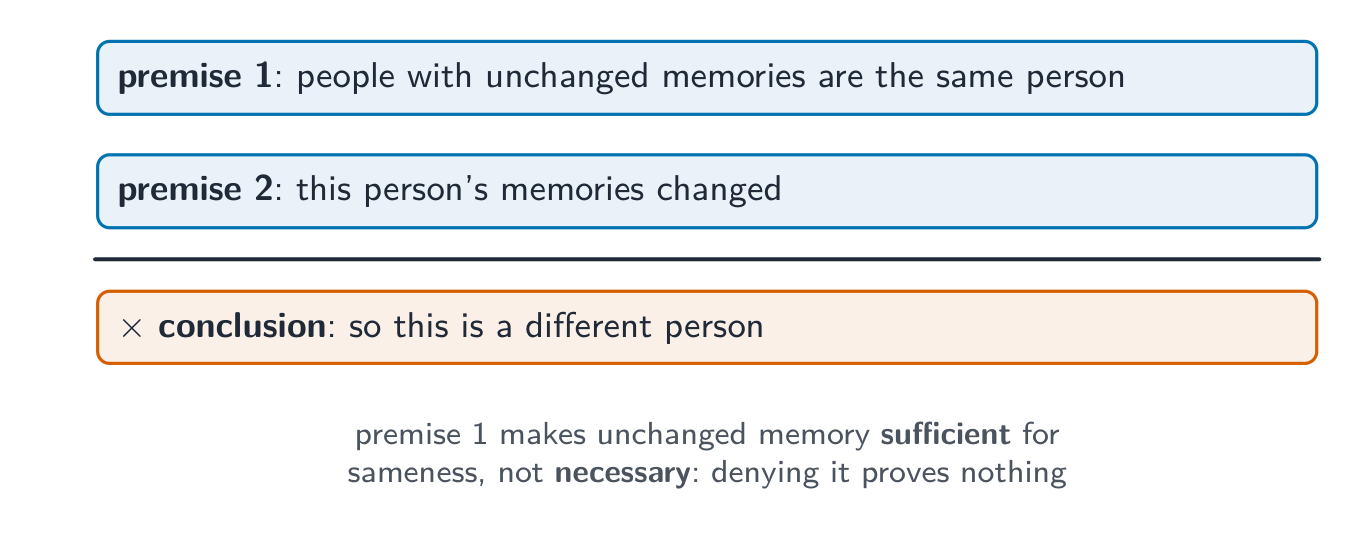
P1: People whose memories are unchanged are the same person. P2: Clive Wearing's memories have changed. C: So Clive Wearing is a different person. Is this valid?
- Form: P1 says unchanged memory is sufficient for identity. It does not say it is necessary.
- Test with a counterexample: someone who forgets a holiday has changed memories but is clearly the same person. The premises can be true while the conclusion is false.
- Verdict: invalid. To reach C you would need P1*: "only people with unchanged memories are the same person" — and that premise is very doubtful.
Which extra premise would make the memory argument valid?
难度 1/5 · 今日首次完成可获 100 金币及少量额外奖励
Making unchanged memory necessary lets the conclusion follow — though the premise itself is doubtful.
Theories of personal identity
- John Locke (1689) said a person is the same as far as their consciousness — memory — reaches back. The bodily view says you are the same living organism.
- Derek Parfit (1984) imagined a teletransporter that destroys you and builds an exact copy on Mars. If two copies were made, which one is you? Parfit concluded that identity matters less than psychological connection.
Match each thinker or view to its claim.
难度 2/5 · 今日首次完成可获 140 金币及少量额外奖励
Each theory picks a different feature as what makes you you.
Thought experiments
- A thought experiment 思想实验 is an imagined case that tests a concept. The ship of Theseus has every plank replaced over the years: is it still the same ship? What if the old planks are rebuilt into a second ship?
- Good thought experiments isolate one feature at a time, so your intuition about the case shows what the concept depends on.
What makes a thought experiment useful in philosophy?
难度 2/5 · 今日首次完成可获 140 金币及少量额外奖励
Thought experiments need to be coherent, not technologically possible.
"Valid means true" is wrong. "All fish can fly; a shark is a fish; so a shark can fly" is valid — the conclusion follows — but it is unsound, because the first premise is false. Check the logic and the premises separately.
A sound argument always has a true conclusion.
难度 1/5 · 今日首次完成可获 100 金币及少量额外奖励
Sound means valid with true premises, so the conclusion must be true.
Set out an argument as premises and a conclusion, then ask two questions: does it follow (validity), and are the premises true (soundness)? Watch for sufficient conditions treated as necessary. Theories of personal identity — memory, body, psychological connection — are tested with counterexamples and thought experiments.
Is Clive Wearing the same person after his illness? Give one argument for and one objection.
Argument, objection, response is the core of philosophical writing.