English audience, register and purposeful writing
引入| English | 释义 | 拼音 |
|---|---|---|
| text type/tekst taɪp/ | 文本类型 | wén běn lèi xíng |
| register/ˈredʒɪstə/ | 语域 | yǔ yù |
| purpose/ˈpɜːpəs/ | 目的 | mù dì |
| proposal/prəˈpəʊzl/ | 提案 | tí àn |
| tone/təʊn/ | 语气 | yǔ qì |
| conventions/kənˈvenʃnz/ | 惯例 | guàn lì |
| cohesive devices/kəʊˈhiːsɪv dɪˈvaɪsɪz/ | 衔接手段 | xián jiē shǒu duàn |
Shredding forms in Parliament Square, 1979
- In 1979 Chrissie Maher, a former factory worker from Liverpool, shredded hundreds of confusing government forms outside the UK Parliament. Her Plain English Campaign argued that people were losing money they were owed because official writing was too hard to read.
- Good writing fits its reader. In IB English B Paper 1, you choose a text type 文本类型 and a register 语域 that suit a stated audience and purpose.
Audience and purpose
- Before writing, ask: who will read this, and what should it make them do or feel? A proposal to a principal aims to persuade someone with power; a blog post for classmates aims to inform and entertain.
- The purpose 目的 decides the content: a proposal needs reasons, costs and a clear request; a review needs a judgement with evidence.
Match each task to its main purpose.
难度 2/5 · 今日首次完成可获 140 金币及少量额外奖励
Purpose decides content and structure.
Register and tone
- Formal register uses full forms, precise vocabulary and polite modal verbs ("we would recommend"). Informal register uses contractions, direct address and lively language ("you've got to try this!").
- Tone 语气 is the attitude behind the words — respectful, enthusiastic, concerned. One exclamation mark can change the tone of a whole letter.
Which sentence suits a formal email to a hotel manager?
难度 1/5 · 今日首次完成可获 100 金币及少量额外奖励
It uses a polite modal, full forms and a clear request.
Contractions such as "we've" and "can't" are a feature of informal register.
难度 1/5 · 今日首次完成可获 100 金币及少量额外奖励
Formal writing usually uses full forms such as "we have".
Worked example: one idea, two readers
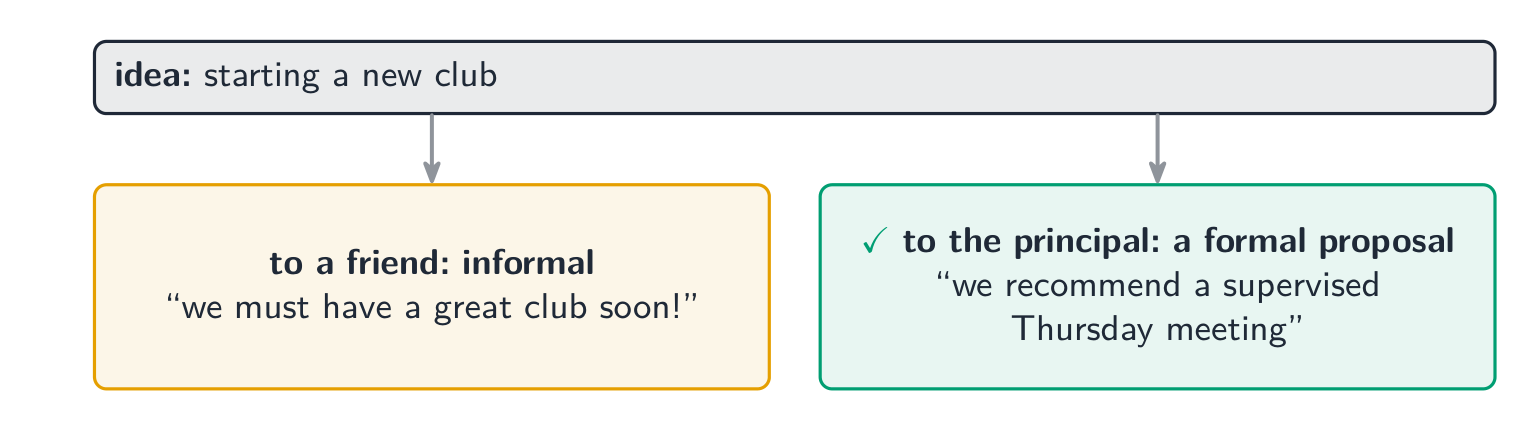
Students want to start a film club. Write the key sentence for a message to a friend and for a proposal to the principal.
- To a friend (informal): "We've got to start a film club — Thursday after school, my place for snacks first?"
- To the principal (formal): "We would like to propose a supervised film club on Thursdays from 3.30 to 5.00 in Room 12, open to all Grade 10 and 11 students."
- What changed: contractions removed, a polite modal ("would like to propose"), exact time, place and supervision — the details a decision-maker needs.
Which is the best formal version of "We wanna do a bake sale next week, ok?"
难度 1/5 · 今日首次完成可获 100 金币及少量额外奖励
It is polite, specific and gives a purpose.
Conventions of text types
- Each text type has conventions 惯例: a formal email has a subject line, greeting and sign-off; a blog has a title, a personal voice and sometimes questions to readers; a speech addresses the audience directly and repeats key ideas.
- Use the conventions the reader expects, but do not let the layout replace the content.
Match each feature to the text type it belongs to.
难度 2/5 · 今日首次完成可获 140 金币及少量额外奖励
Readers expect the conventions of each text type.
Cohesion
- Cohesive devices 衔接手段 link ideas: "firstly", "however", "as a result", "for example". They show the reader how each point connects.
- Vary them, and use paragraphs with one main idea each. A list of good sentences with no links is hard to follow.
Which are cohesive devices that show contrast?
难度 2/5 · 今日首次完成可获 140 金币及少量额外奖励
"Furthermore" adds a point; the others contrast.
"Formal writing means long, difficult words" is wrong. Formal writing is precise and polite, not complicated. "We request that you commence utilisation of the facility" is worse than "We would like to start using the room". The Plain English Campaign won by making official writing clear.
"We request that you commence utilisation of the facility" is better formal writing than "We would like to start using the room".
难度 1/5 · 今日首次完成可获 100 金币及少量额外奖励
Formal writing should be precise and clear, not complicated.
Start every task by naming the audience and purpose. Choose the text type and its conventions, set the register and tone to fit the reader, and link ideas with cohesive devices. Clear and precise beats long and complicated.
Write the opening paragraph of a formal proposal to your principal asking for water fountains on every floor.
Audience, purpose, register.