Inquiry, evidence and methodological reflection
引入| English | 释义 | 拼音 |
|---|---|---|
| historical investigation/hɪˈstɒrɪkl ɪnˌvestɪˈɡeɪʃn/ | 历史调查 | lì shǐ diào chá |
A miller on trial, 1599
- In the 1970s the Italian historian Carlo Ginzburg read the Inquisition's records of Menocchio, a village miller who was tried for heresy and executed in 1599. Menocchio had told the judges that the world began like cheese, with worms appearing in it.
- Ginzburg's book The Cheese and the Worms (1976) used one man's trial to show how ordinary people read and thought in the 16th century. A narrow question about one case can open a big window.
A researchable question
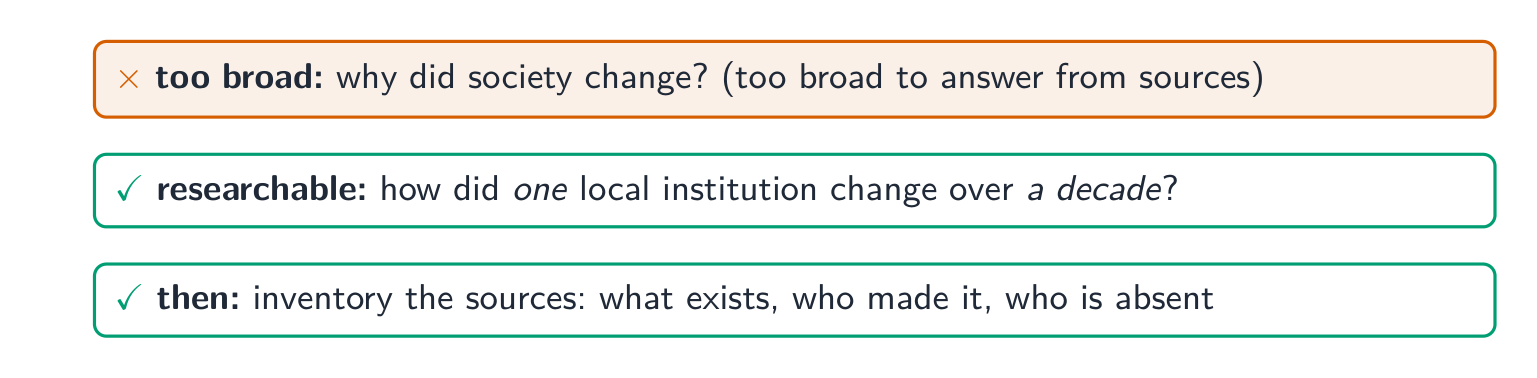
- The historical investigation 历史调查 is a 2200-word inquiry into a question you choose. A good question is narrow, has a time frame and allows argument: "How far did the opening of the railway change trade in our town, 1905–1915?"
- "Why did society change?" is too broad. Narrow by place, time and one institution or group.
Which is the best question for a historical investigation?
难度 1/5 · 今日首次完成可获 100 金币及少量额外奖励
It is narrow, time-bound and allows a judgement.
What is the word limit of the IB historical investigation?
难度 2/5 · 今日首次完成可获 140 金币及少量额外奖励
The investigation has a limit of 2200 words.
An inventory of sources
- Before you fix the question, list the sources that exist: archives, newspapers, photographs, interviews, books. Note who made them — and whose voices are missing.
- If no sources survive for a group, the question may need to change, or the gap becomes part of your discussion.
What should a source inventory record?
难度 2/5 · 今日首次完成可获 140 金币及少量额外奖励
The inventory shows what evidence can answer the question.
Worked example: narrowing a question
A student is interested in "education in China in the 20th century". Narrow it into a researchable question.
- Too broad: "How did education in China change in the 20th century?" — a century and a whole country.
- Narrowed: "To what extent did the 1977 reopening of the university entrance exam change who entered university, 1977–1985?" — one policy, eight years, a clear argument.
- Sources check: published admissions statistics, memoirs of the "class of 1977", newspaper reports from 1977 and a historian's study. Missing voices: those who failed the exam rarely wrote memoirs.
Order these questions from broadest to narrowest.
难度 3/5 · 今日首次完成可获 200 金币及少量额外奖励
Narrowing by event and time frame makes a question researchable.
If memoirs come only from people who passed the exam, this is a limitation worth discussing.
难度 1/5 · 今日首次完成可获 100 金币及少量额外奖励
The missing voices of those who failed can bias the picture.
Evaluating two key sources
- In section 1 of the investigation, choose two sources and analyse their origin, purpose and content, and their value and limitations for your question.
- Choose sources that matter to your argument, not the easiest ones to describe.
Reflection
- The final section asks you to reflect on what the investigation taught you about the historian's methods and challenges: missing sources, biased records, how memory changes, how the question shaped what you found.
- Use your own experience — "the memoirs all came from people who passed" — rather than general statements.
What does Ginzburg's study of Menocchio show about historical method?
难度 1/5 · 今日首次完成可获 100 金币及少量额外奖励
Microhistory uses one case to open a wider view.
A broad, famous topic does not make a better investigation. "The causes of the Second World War" has thousands of books and leaves no room for your own argument in 2200 words. A narrow, local or specific question lets you work with sources and reach a judgement of your own.
A famous, broad topic always makes a stronger investigation.
难度 1/5 · 今日首次完成可获 100 金币及少量额外奖励
Broad topics leave little room for your own work with sources in 2200 words.
Choose a narrow question with a place, a time frame and room for argument. Make an inventory of sources and missing voices first. Evaluate two key sources in depth, build an argument from evidence, and reflect honestly on the challenges historians face.
Narrow the topic "the Industrial Revolution" into a researchable question and name two sources.
Place, time, focus, sources.