Power, legitimacy and source analysis
引入| English | 释义 | 拼音 |
|---|---|---|
| power/ˈpaʊə/ | 权力 | quán lì |
| hard power/hɑːd ˈpaʊə/ | 硬实力 | yìng shí lì |
| soft power/sɒft ˈpaʊə/ | 软实力 | ruǎn shí lì |
| agenda-setting | 议程设置 | yì chéng shè zhì |
| agenda/əˈdʒendə/ | 议程 | yì chéng |
| legitimacy/ləˈdʒɪtɪməsi/ | 合法性 | hé fǎ xìng |
| sovereignty/ˈsɒvərɪnti/ | 主权 | zhǔ quán |
Small islands, big target, 2015
- At the Paris climate talks in December 2015, Tony de Brum, foreign minister of the Marshall Islands — a nation of about 50,000 people — helped build the "High Ambition Coalition" with the EU, the USA and dozens of developing countries. The final agreement included the goal of limiting warming to 1.5 °C, which many large emitters had resisted.
- In the UN climate talks every state has the same formal standing, but influence is unequal. Global politics studies power 权力: the ability to shape what others do and what gets decided.
What did the High Ambition Coalition help achieve in 2015?
难度 1/5 · 今日首次完成可获 100 金币及少量额外奖励
Small states shaped the agreement through diplomacy.
Forms of power
- Hard power 硬实力 uses force or payment — military threat, sanctions, aid. Soft power 软实力, a term Joseph Nye introduced in 1990, attracts others through culture, values and example.
- Agenda-setting 议程设置 decides which questions are discussed at all. The small islands' power in 2015 was moral and diplomatic, not military.
Match each example to the form of power.
难度 2/5 · 今日首次完成可获 140 金币及少量额外奖励
Power takes different forms.
Who introduced the term "soft power" in 1990?
难度 1/5 · 今日首次完成可获 100 金币及少量额外奖励
Nye described power through attraction.
Equal votes, unequal influence
- In the UN General Assembly each member state has one vote. Yet large states fund research, send big delegations and set agendas, so formal equality hides practical inequality.
- Ask of any decision: who had formal rights, and who had practical influence?
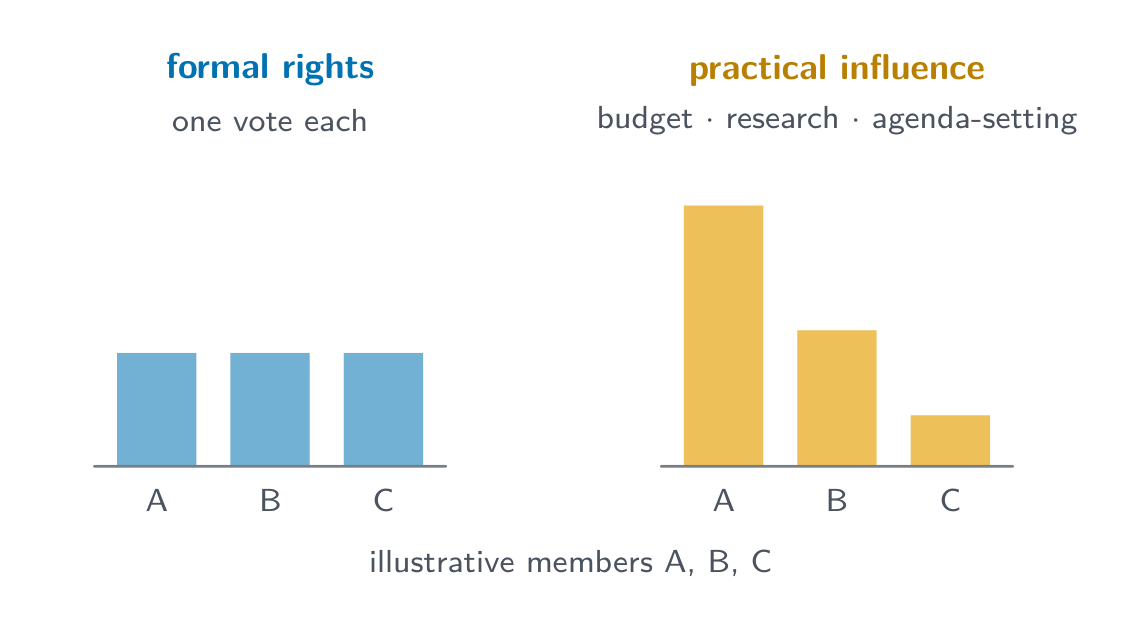
Because each state has one vote in the UN General Assembly, all states have equal influence.
难度 1/5 · 今日首次完成可获 100 金币及少量额外奖励
Formal equality hides practical inequality.
Legitimacy and sovereignty
- Legitimacy 合法性 is the acceptance that a ruler or rule has the right to be obeyed. Max Weber described three sources: tradition, charisma and legal-rational rules such as elections.
- Sovereignty 主权 is a state's supreme authority over its territory. It can be limited by treaties, international courts and economic dependence.
Which are Weber's three sources of legitimacy?
难度 2/5 · 今日首次完成可获 140 金币及少量额外奖励
Force alone does not create legitimacy.
Worked example: analysing a source
Source: the slogan small island states carried through the climate talks, "1.5 to stay alive".
- Origin and purpose: a campaign slogan of the Alliance of Small Island States, meant to win support for a stricter target.
- Power shown: soft and moral power — framing the target as survival makes opposing it look harsh; agenda-setting by moving 1.5 °C into the text.
- Limits: the slogan shows the state's aim, not whether the target will be met. Paris targets are nationally determined and not legally enforced, so the coalition's influence on the outcome had limits.
What is a limit of the small islands' slogan as evidence?
难度 1/5 · 今日首次完成可获 100 金币及少量额外奖励
Statements of aims are not outcomes.
Paper 1 skills
- Paper 1 gives short sources on a political issue. Questions ask you to explain a concept in a source, compare sources, and evaluate them with your own examples.
- Use the concept vocabulary precisely: power, sovereignty, legitimacy, interdependence.
Power is not only military strength. A tiny state with no army shaped the Paris Agreement. Always ask what kind of power is used — force, money, attraction, agenda-setting — and how it works.
Power in global politics means military strength only.
难度 1/5 · 今日首次完成可获 100 金币及少量额外奖励
Moral, diplomatic and economic power also matter.
Power is the ability to shape outcomes: hard, soft and agenda-setting. Formal equality can hide unequal influence. Legitimacy is accepted right to rule; sovereignty is supreme authority that treaties and dependence can limit. Analyse sources by origin, purpose, the power shown and its limits.
Explain how a state with little military power can still shape a global decision, using one example.
Example, form, limit.