Networks, development and global risks
引入| English | 释义 | 拼音 |
|---|---|---|
| global networks | 全球网络 | quán qiú wǎng luò |
| risk/rɪsk/ | 风险 | fēng xiǎn |
| supply chain/səˈplaɪ tʃeɪn/ | 供应链 | gōng yìng liàn |
| just-in-time/dʒʌst ɪn taɪm/ | 准时制 | zhǔn shí zhì |
| resilience/rɪˈsɪlɪəns/ | 韧性 | rèn xìng |
| global interaction/ˈɡləʊbl ˌɪntəˈrækʃn/ | 全球互动 | quán qiú hù dòng |
One ship across a canal, 2021
- On 23 March 2021 the container ship Ever Given, 400 m long, ran aground and blocked the Suez Canal for six days. Hundreds of ships queued at each end, and an estimated 9 to 10 billion US dollars of trade was held up each day.
- Factories in Europe waited for parts from Asia; prices rose. One blockage showed how global networks 全球网络 connect places — and how they spread risk 风险.
For how many days did the Ever Given block the Suez Canal in 2021?
难度 2/5 · 今日首次完成可获 140 金币及少量额外奖励
It ran aground on 23 March and was freed six days later.
Supply chains
- A supply chain 供应链 links suppliers, production, transport and sales across many countries. A phone may use minerals from Africa, chips from Taiwan, assembly in China and sales worldwide.
- Just-in-time 准时制 production keeps little stock, which saves money but leaves no buffer when transport fails.
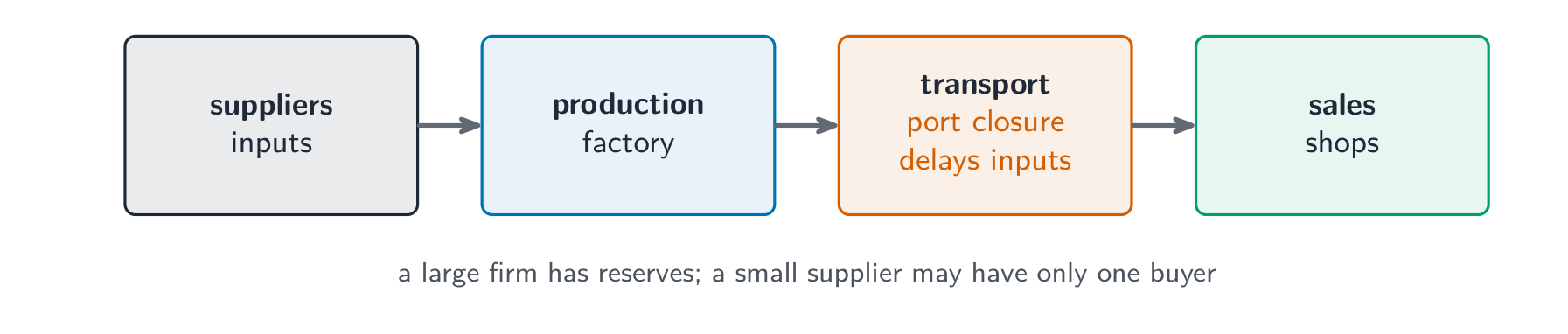
Order the stages of a supply chain.
难度 3/5 · 今日首次完成可获 200 金币及少量额外奖励
A disruption at any stage spreads along the chain.
Just-in-time production keeps large stocks as a buffer.
难度 1/5 · 今日首次完成可获 100 金币及少量额外奖励
It keeps little stock, which saves money but adds risk.
Worked example: a port closes
A major Asian port closes for two weeks. Trace the effects through a supply chain for bicycles sold in Europe.
- Suppliers: a small gear maker that sells only to one bicycle firm cannot ship its parts and receives no payment — it may lay off workers.
- Production and transport: the European bicycle firm uses just-in-time stock and has only five days of gears; its factory stops after a week.
- Resilience: a larger rival with three months of stock and suppliers in two countries keeps producing. Size, stock and diverse suppliers decide who is hurt most.
In the worked example, why does the larger rival keep producing?
难度 1/5 · 今日首次完成可获 100 金币及少量额外奖励
Stock and diverse suppliers build resilience.
Global interactions and power
- Global interactions 全球互动 include flows of goods, money, people, data and ideas. Power in networks is unequal: large firms and rich states set terms, while small suppliers and poorer countries depend on them.
- Choke points — Suez, the Strait of Malacca, the Panama Canal — give their controllers power and create shared risk.
Which are major shipping choke points?
难度 2/5 · 今日首次完成可获 140 金币及少量额外奖励
Choke points concentrate risk.
Global risks and resilience
- Global risks include pandemics, financial crises, climate disasters and cyber attacks. They spread quickly through networks.
- Resilience 韧性 is the ability to absorb a shock and recover: more stock, more than one supplier, regional production, insurance.
Which increase a firm's resilience?
难度 2/5 · 今日首次完成可获 140 金币及少量额外奖励
One port is a single point of failure.
Evaluating responses
- After 2021, some firms moved production closer to customers (reshoring) or held more stock. This raises costs, so the benefit — less risk — must be weighed against higher prices.
- Ask who gains and who loses: reshoring may protect European jobs but cut jobs in exporting countries.
What is a cost of reshoring production?
难度 1/5 · 今日首次完成可获 100 金币及少量额外奖励
Less risk must be weighed against higher costs.
"Globalisation is good" or "bad" is too simple. Networks bring cheaper goods, jobs and growth, and also shared risk and unequal power. Judge each case by who benefits, who carries the risk and how resilient each actor is.
Global networks link places through supply chains and flows of goods, money, people and data. Just-in-time systems save money but spread risk; choke points concentrate it. Resilience — stock, diverse suppliers, regional production — decides who recovers, and responses must weigh cost against risk.
Trace how one global disruption affected different actors unequally.
Disruption, actors, resilience.