Interpret results without hiding uncertainty
引入| English | 释义 | 拼音 |
|---|---|---|
| analysis/əˈnæləsɪs/ | 分析 | fēn xī |
| variable/ˈveərɪəbl/ | 变量 | biàn liàng |
| limitation/ˌlɪmɪˈteɪʃn/ | 局限 | jú xiàn |
Two sites differ, but what does that mean?
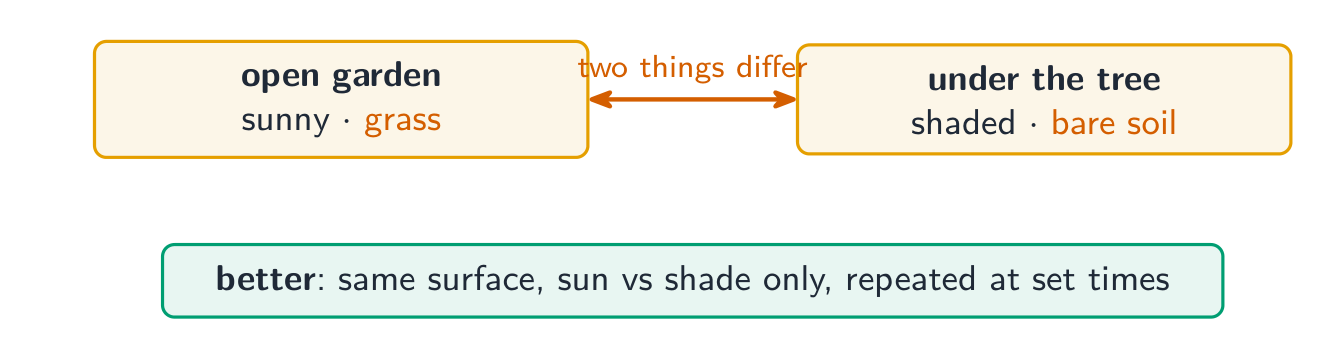
- A student measures warmer ground in an open garden than under a tree. The result may fit a shade explanation, but the sites also have different surfaces. A number alone does not tell us which factor caused the difference.
- Analysis 分析 explains patterns in evidence and tests what they mean for the research question. Record the conditions before deciding what the comparison shows.
Keep the record traceable
- Keep the original observations, units, dates, instrument details and site descriptions. Show how any summary was calculated so a reader can follow the steps.
- Do not remove a value simply because it disagrees with your expectation. Check whether a recorded error explains it, and document any exclusion rule and its effect.
What should you do with an unexpected observation?
难度 1/5 · 今日首次完成可获 100 金币及少量额外奖励
Unexpected data require investigation, not silent alteration.
Compare like with like
- A variable 变量 is a factor that can change. If shade and surface both differ between sites, your comparison cannot separate their effects.
- Where feasible and approved, compare the same surface with different shade conditions and record repeated observations at consistent times. Better comparisons reduce competing explanations; they do not make all uncertainty disappear.
Why does the paved-versus-soil comparison leave a competing explanation?
难度 1/5 · 今日首次完成可获 100 金币及少量额外奖励
A surface difference could contribute to the temperature difference attributed to shade.
More readings at mismatched sites automatically separate the effects of shade and surface.
难度 1/5 · 今日首次完成可获 100 金币及少量额外奖励
Repeating the same comparison does not isolate factors that change together.
Explain a limitation’s effect
- A limitation 局限 is a reason the evidence supports less than you would like. Explain whether it affects measurement accuracy, comparison or the range of places your conclusion can cover.
- “The sample is small” is incomplete. State what range of times or sites it misses and how that prevents a wider claim. Suggest a realistic improvement that addresses the same issue.
Which limitation statement explains its effect?
难度 1/5 · 今日首次完成可获 100 金币及少量额外奖励
The statement identifies a missing range and limits the conclusion accordingly.
Answer the question you investigated
- A defensible conclusion states the observed pattern, what explanation is supported and which competing explanation remains. Keep its scope tied to the actual method.
- If evidence is insufficient for the original question, explain the gap honestly and discuss the next step with your supervisor. Confirm the subject’s permitted method and the applicable assessment guide.
Match each record to its purpose.
难度 2/5 · 今日首次完成可获 140 金币及少量额外奖励
A reader needs both the results and the conditions that produced them.
Which conclusions fit the evidence described?
难度 2/5 · 今日首次完成可获 140 金币及少量额外奖励
The observed local pattern is supported, but the comparison does not isolate shade.
The open site is paved; the shaded site has soil. Three measurements at each site show a difference, but surface and shade changed together. The student can report that these two sites differed under the recorded conditions. To test a shade explanation more directly, an approved follow-up could compare the same surface in shaded and unshaded conditions, with consistent timing and instruments. More readings at the original mismatched sites would improve the local record without separating the two factors.
Do not turn a list of weaknesses into a conclusion. Explain which weakness changes the claim and how.
Keep a traceable record, check the comparison, explain material limits and answer only what your evidence supports.
Write from two surfaces
- Open ground is warmer than ground under a tree, but the surfaces also differ.
- Say why shade is not yet separated from surface. A small sample needs a named gap.
Open ground reads warmer than ground under a tree, and the surfaces differ too. Why can the number not yet show that shade caused the difference?
Like must be compared with like. A limitation has to say what claim it blocks.
What blocks the shade conclusion?
难度 1/5 · 今日首次完成可获 100 金币及少量额外奖励
Two changes at once cannot be separated. A warmer number is not a cause, and small needs a stated gap.