Macroeconomic activity, objectives and policy
引入| English | 释义 | 拼音 |
|---|---|---|
| gross domestic product/ɡrəʊs dəˈmestɪk ˈprɒdʌkt/ | 国内生产总值 | guó nèi shēng chǎn zǒng zhí |
| real GDP/rɪəl ˌdʒiː diː ˈpiː/ | 实际国内生产总值 | shí jì guó nèi shēng chǎn zǒng zhí |
| inflation/ɪnˈfleɪʃn/ | 通货膨胀 | tōng huò péng zhàng |
| aggregate demand/ˈæɡrɪɡeɪt dɪˈmænd/ | 总需求 | zǒng xū qiú |
| aggregate supply/ˈæɡrɪɡeɪt səˈplaɪ/ | 总供给 | zǒng gōng jǐ |
| demand-pull inflation/dɪˈmænd pʊl ɪnˈfleɪʃn/ | 需求拉动型通胀 | xū qiú lā dòng xíng tōng zhàng |
| cost-push inflation/kɒst pʊʃ ɪnˈfleɪʃn/ | 成本推动型通胀 | chéng běn tuī dòng xíng tōng zhàng |
| monetary policy/ˈmʌnɪtəri ˈpɒlɪsi/ | 货币政策 | huò bì zhèng cè |
| fiscal policy/ˈfɪskl ˈpɒlɪsi/ | 财政政策 | cái zhèng zhèng cè |
| supply-side policies/səˈplaɪ saɪd ˈpɒlɪsiz/ | 供给侧政策 | gōng jǐ cè zhèng cè |
Four trillion yuan, November 2008
- On 9 November 2008, as the global financial crisis spread, China announced a stimulus of 4 trillion yuan — about 12 % of a year's GDP — for railways, roads, housing and rebuilding after the Sichuan earthquake.
- Growth recovered to over 9 % in 2009 while most rich economies shrank. Later, local debt and empty buildings showed the costs. Macroeconomics studies the whole economy and policies like this.
Measuring the economy
- Gross domestic product 国内生产总值 (GDP) is the value of all final goods and services produced in a year. Real GDP 实际国内生产总值 removes the effect of rising prices; dividing by population gives GDP per capita.
- The four main goals are economic growth, low unemployment, low and stable inflation 通货膨胀 (often about 2 %), and a sustainable balance of payments and public debt.
Nominal GDP rises by 6 % and the price level by 4 %. Approximately what is real GDP growth, in %?
难度 2/5 · 今日首次完成可获 140 金币及少量额外奖励
Real growth ≈ nominal growth − inflation = 6 − 4 = 2 % (more exactly 1.9 %).
Aggregate demand and supply
- Aggregate demand 总需求 is total spending: $AD = C + I + G + (X - M)$. Aggregate supply 总供给 is total output firms will produce at each price level.
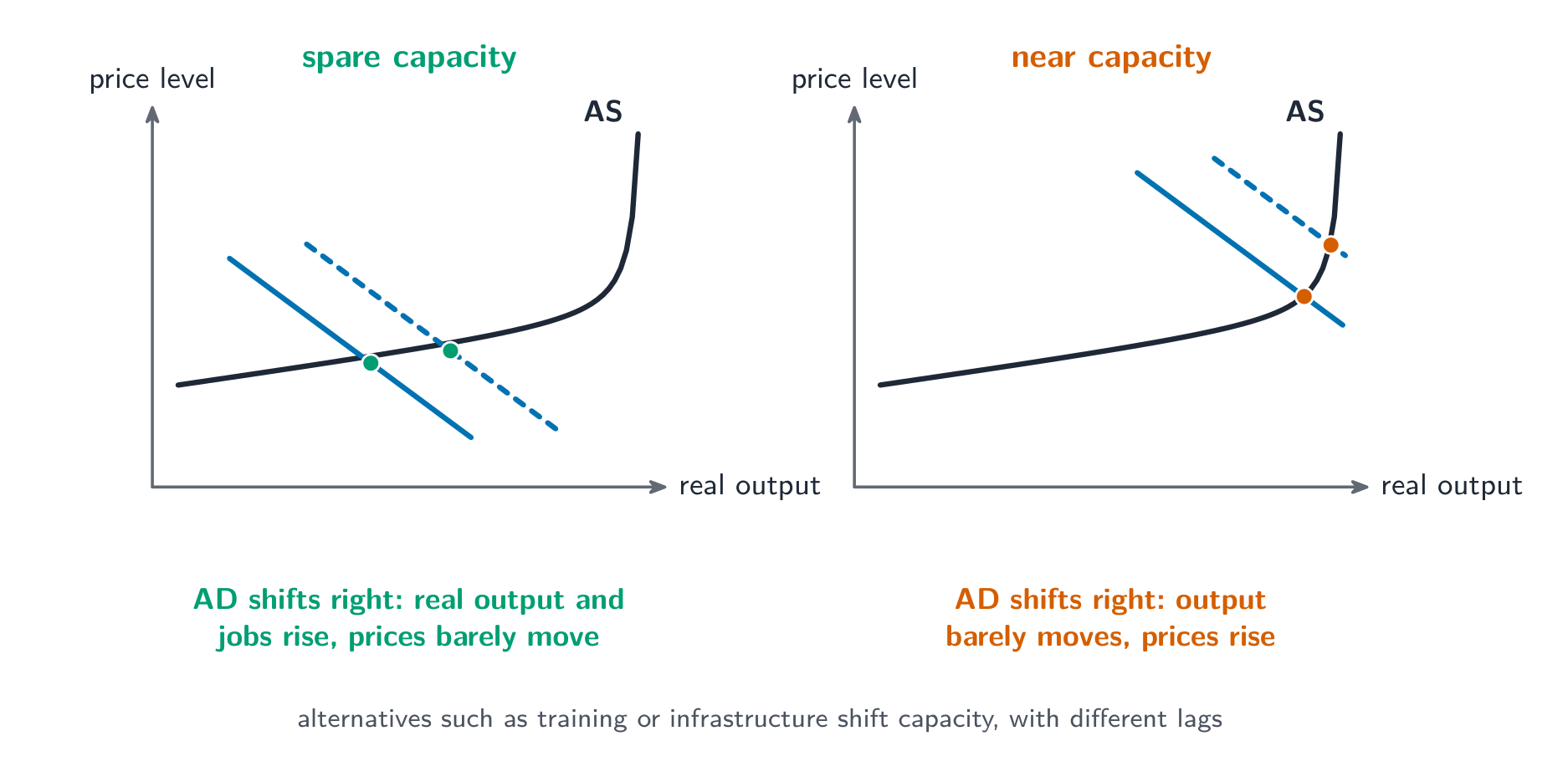
- In the short run AS slopes up. When the economy has spare capacity, a rise in AD raises real output and jobs; near full capacity, it mainly raises prices.
Match each event to the AD component it changes first.
难度 2/5 · 今日首次完成可获 140 金币及少量额外奖励
AD = C + I + G + (X − M).
Worked example: real growth and the multiplier
Nominal GDP rises from 1000 billion to 1080 billion while the price level rises by 5 %. Find real growth. Then, if the marginal propensity to consume is 0.75, find the final effect of 40 billion of new government spending.
- Real growth: real GDP $= \dfrac{1080}{1.05} = 1029$ billion, so real growth is about 2.9 %, not 8 %.
- Multiplier: $k = \dfrac{1}{1 - MPC} = \dfrac{1}{1 - 0.75} = 4$. Each yuan spent becomes someone's income, and 75 % of it is spent again.
- Total effect: $40 \times 4 = 160$ billion rise in GDP — if there are enough idle resources and none of the spending leaks into imports.
The marginal propensity to consume is 0.8. What is the multiplier?
难度 2/5 · 今日首次完成可获 140 金币及少量额外奖励
$\dfrac{1}{1 - 0.8} = 5$.
With a multiplier of 2.5, by how much does GDP rise after 30 billion of new investment?
难度 2/5 · 今日首次完成可获 140 金币及少量额外奖励
$30 \times 2.5 = 75$ billion.
Unemployment and inflation
- Unemployment can be cyclical (too little demand), structural (skills or location do not match jobs), frictional (between jobs) or seasonal. Each needs a different policy.
- Demand-pull inflation 需求拉动型通胀 comes from too much spending; cost-push inflation 成本推动型通胀 from rising costs, such as the 2022 energy price rise. Deflation can be harmful too, as people delay spending.
Match each case to its type of unemployment.
难度 2/5 · 今日首次完成可获 140 金币及少量额外奖励
The cause decides the type, and the type decides the policy.
Fiscal and monetary policy
- Fiscal policy 财政政策 changes government spending and taxes. It can target areas directly but takes time to approve and may add to public debt.
- Monetary policy 货币政策 changes interest rates and the money supply, usually through an independent central bank. Lower rates encourage borrowing and spending, but work with a lag and are weak when rates are already near zero.
A central bank cuts interest rates. What is the expected effect?
难度 1/5 · 今日首次完成可获 100 金币及少量额外奖励
Cheaper loans encourage consumption and investment.
Supply-side policies
- Supply-side policies 供给侧政策 raise long-run aggregate supply: education and training, infrastructure, research, and market reforms such as competition policy.
- They increase growth without raising inflation, but they are slow, costly and their results are uncertain.
Supply-side policies such as training work quickly to end a recession.
难度 1/5 · 今日首次完成可获 100 金币及少量额外奖励
They raise long-run capacity but take years; demand-side policy acts faster in a recession.
A rise in nominal GDP is not the same as growth. If GDP rises 8 % but prices rise 5 %, the economy produced only about 3 % more. Always adjust for inflation before saying an economy has grown.
Macroeconomics aims for growth, jobs, stable prices and sustainable finances. AD = C + I + G + (X − M); with spare capacity extra demand raises output, near capacity it raises prices. Fiscal and monetary policy manage demand, the multiplier amplifies spending, and supply-side policies raise long-run capacity.
Explain why a large fiscal stimulus might raise output a lot in one economy but cause mainly inflation in another.
Use the shape of the AS curve.