Sustained choreographic and comparative inquiry
引入| English | 释义 | 拼音 |
|---|---|---|
| motif/məʊˈtiːf/ | 动作主题 | dòng zuò zhǔ tí |
| sections | 段落 | duàn luò |
| choreographic structure/ˌkɔːrɪəˈɡræfɪk ˈstrʌktʃə/ | 编舞结构 | biān wǔ jié gòu |
| ternary | 三段式 | sān duàn shì |
| contrast/ˈkɒntræst/ | 对比 | duì bǐ |
One rhythm, one table, sixteen minutes, 1961
- In 1961 Maurice Béjart choreographed Ravel's Boléro for one dancer on a large round red table, surrounded by seated men. The music repeats one melody over a steady drum for about sixteen minutes, growing louder.
- The dancer's opening movement — a small, rhythmic hand and hip pattern — returns again and again, growing larger as the music builds. A longer work needs a structure that carries a motif 动作主题 on a journey.
In Béjart's Boléro (1961), what happens to the opening movement?
难度 1/5 · 今日首次完成可获 100 金币及少量额外奖励
The motif grows with the music.
A section map
- Plan a longer work as sections 段落: introduce the motif, transform it with purpose, return to it changed by the journey.
- The return matters: the same motif looks different after what has happened, and the audience feels the change.
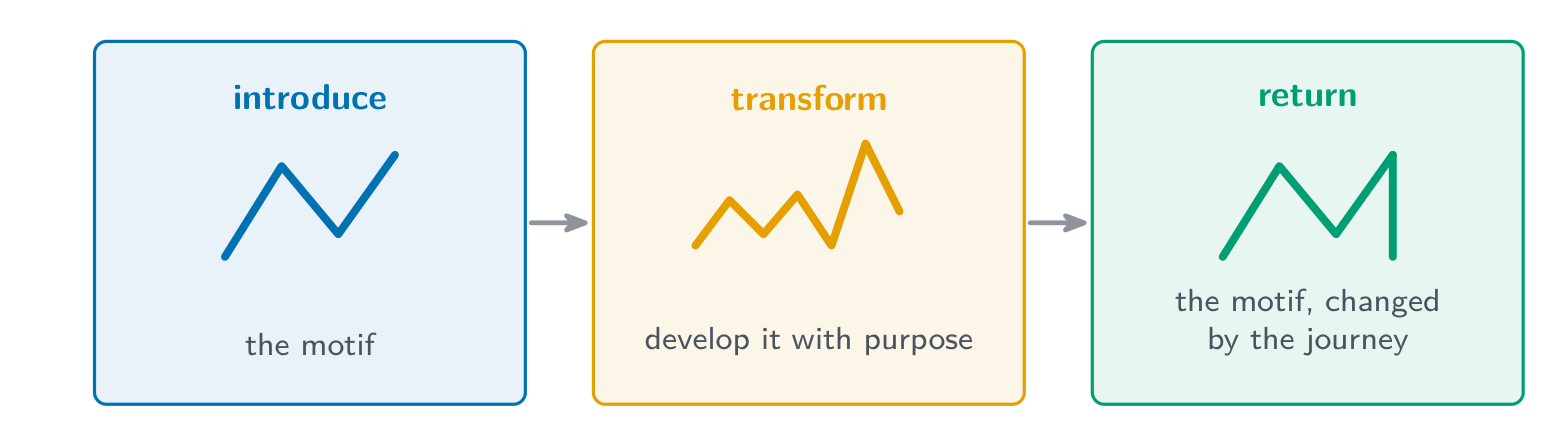
Order the section map.
难度 3/5 · 今日首次完成可获 200 金币及少量额外奖励
The return shows the journey.
Choreographic structure
- Common structures: binary (A B), ternary 三段式 (A B A), rondo (A B A C A) and narrative (a story). Choose the structure that serves your intention.
- Contrast 对比 between sections keeps the audience's attention; continuity through the motif keeps the work unified.
Match each structure to its pattern.
难度 2/5 · 今日首次完成可获 140 金币及少量额外奖励
Choose the structure that serves the intention.
Contrast between sections keeps attention, while the motif keeps the work unified.
难度 1/5 · 今日首次完成可获 100 金币及少量额外奖励
Balance contrast with continuity.
Worked example: a ternary piece about memory
Intention: a person remembers a happy place, loses it, then finds it again changed.
- A — introduce: a light, travelling motif: skip, open arms, look up. Bright, quick timing.
- B — transform: the motif is broken and slowed; the skip becomes a stumble, the arms close, the focus drops. A second dancer blocks the path.
- A' — return: the motif comes back slower and smaller, performed facing the audience. It is recognisably the same, but now gentle and calm — memory changed by loss.
In the worked example, how is the motif changed when it returns?
难度 1/5 · 今日首次完成可获 100 金币及少量额外奖励
It is recognisable but changed by loss.
Comparing choreographers
- At HL you may compare how two choreographers structure their works: how they use motifs, repetition, contrast and space.
- Béjart builds by accumulation — one motif growing; Bausch builds by collage — many separate scenes linked by a theme.
How does Béjart's structure in Boléro differ from Bausch's typical structure?
难度 1/5 · 今日首次完成可获 100 金币及少量额外奖励
Accumulation versus collage.
Explaining your choices
- For each section, state what happens to the motif and why: "In section B the motif slows to show the loss of energy."
- Link structure to intention; show that the order of sections is not accidental.
New material in every section is not development. If each section uses entirely new movement, the audience has no thread to follow. Let the motif return and change, so the journey is visible.
Using completely new movement in every section is the best development.
难度 1/5 · 今日首次完成可获 100 金币及少量额外奖励
The audience needs a motif to follow.
Structure a longer dance as sections that introduce, transform and return a motif. Choose a structure — binary, ternary, rondo, narrative — that serves your intention, balance contrast with continuity, and explain why each section changes the motif.
Plan a three-section dance on a theme of your choice, describing what happens to one motif in each section.
Introduce, transform, return.