Classical sources and research dossier
引入| English | 释义 | 拼音 |
|---|---|---|
| primary source/ˈpraɪməri sɔːs/ | 原始资料 | yuán shǐ zī liào |
| research dossier | 研究档案 | yán jiū dàng àn |
| inscriptions | 铭文 | míng wén |
| provenance/ˈpruːvnəns/ | 出处 | chū chǔ |
A birthday invitation from Roman Britain, c. AD 100
- In 1973 archaeologists at Vindolanda, a Roman fort near Hadrian's Wall, began finding thin wooden writing tablets preserved in wet ground. One, from about AD 100, is a birthday invitation from Claudia Severa to her friend Sulpicia Lepidina, and its closing lines are in Severa's own hand — among the earliest known Latin handwriting by a woman.
- A household letter like this shows Roman life that literature rarely describes. Combining kinds of primary source 原始资料 is the core of a research dossier 研究档案.
Why is Claudia Severa's Vindolanda letter important?
难度 1/5 · 今日首次完成可获 100 金币及少量额外奖励
It shows a woman's own writing and everyday life.
Three kinds of evidence
- Inscriptions 铭文: words carved or written on stone, metal, walls or tablets — tombstones, dedications, graffiti, letters.
- Literary texts: poetry, history, letters and speeches by known authors. Material culture: objects — household shrines, lamps, coins, tools.
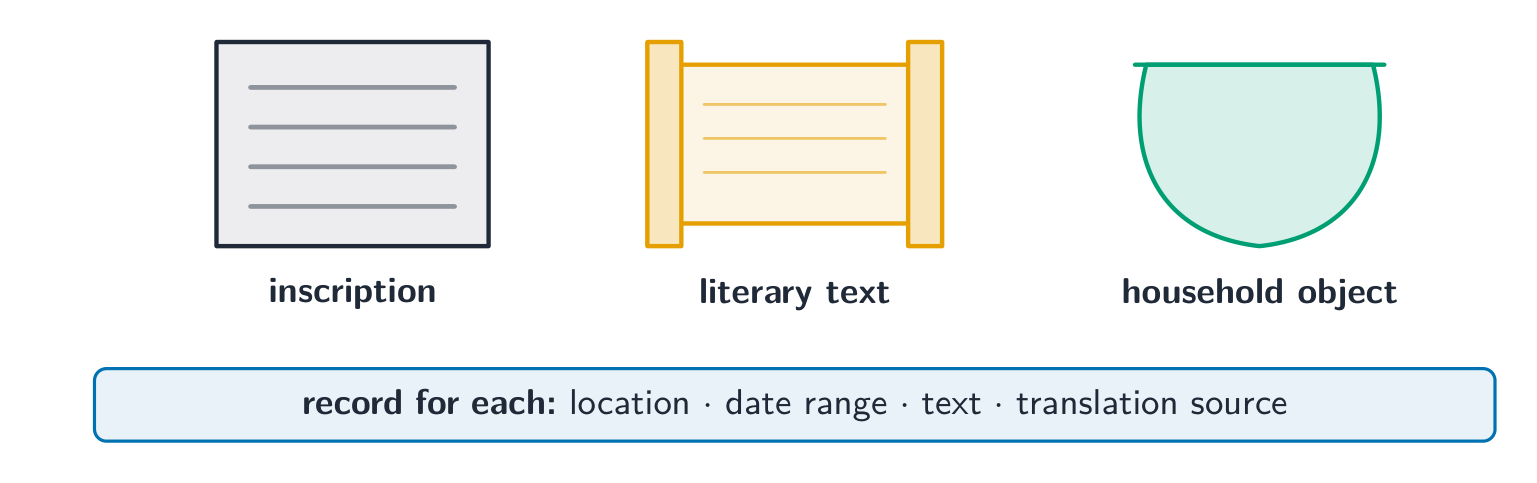
Classify each source.
难度 2/5 · 今日首次完成可获 140 金币及少量额外奖励
Varied sources show different sides of life.
Recording each source
- For each source note its provenance 出处 (where it was found or kept), date range, the Latin text, and whose translation you use.
- Say what the source can and cannot tell you: a tombstone shows how a family wanted to be remembered, not necessarily how they lived.
What should you record for each source?
难度 2/5 · 今日首次完成可获 140 金币及少量额外奖励
Records make the dossier checkable.
A tombstone shows exactly how a family lived.
难度 1/5 · 今日首次完成可获 100 金币及少量额外奖励
It shows how they wanted to be remembered.
Worked example: a dossier on Roman household religion
Question: how did ordinary Romans worship at home?
- Inscription: a Pompeian lararium (household shrine) painting with a dedication to the household gods, found in situ, before AD 79.
- Literary text: Plautus's comedy Aulularia (c. 190 BC) opens with the Lar of the house speaking about the daughter who brings it daily offerings.
- Object: a small bronze Lar statuette from a house shrine, museum record with find-spot. Synthesis: the three agree that household gods received regular offerings; the literary source adds the idea that the gods watched over family behaviour, which objects alone cannot show.
In the worked example, what does the literary source add?
难度 1/5 · 今日首次完成可获 100 金币及少量额外奖励
Literature adds beliefs that objects cannot show.
Evaluating sources
- Ask who made the source, for whom, and why. Literary texts were written mostly by and for elite men; inscriptions and objects can show other people's lives, like Claudia Severa's.
- Compare sources: agreement strengthens a conclusion; disagreement needs explaining.
Most Latin literary texts were written by and for elite men.
难度 1/5 · 今日首次完成可获 100 金币及少量额外奖励
Inscriptions and objects can show other lives.
Building the dossier
- Choose a focused question, select a small number of varied sources, translate or quote the Latin, and write commentary that connects them.
- End with a conclusion that answers the question and states its limits.
Do not treat a literary text as a simple record of daily life. Plautus wrote comedy for laughs; his speaking household god is a stage device. Use literature alongside inscriptions and objects, and say what each can show.
A comedy by Plautus is a simple, reliable record of daily life.
难度 1/5 · 今日首次完成可获 100 金币及少量额外奖励
Comedy uses stage devices for laughs.
A research dossier answers a focused question with varied primary sources — inscriptions, literary texts and objects. Record each source's provenance, date, Latin text and translation, evaluate who made it and why, and connect the sources to reach a conclusion with stated limits.
Plan a three-source dossier on a Roman practice, naming one source of each kind.
Question, three kinds, limit.