Rates, catalysts and reliable endpoints
引入| English | 释义 | 拼音 |
|---|---|---|
| rate/reɪt/ | 速率 | sù lǜ |
| activation energy/ˌæktɪˈveɪʃn ˈenədʒi/ | 活化能 | huó huà néng |
| initial rate/ɪˈnɪʃl reɪt/ | 初始速率 | chū shǐ sù lǜ |
What would explain this observation?
- A faster reaction finishes sooner, but it need not make more product. Rate 速率 and final yield answer different questions.
Build the model
- Reaction rate describes reactant used or product formed per time.
- Higher temperature increases the fraction of collisions with enough energy.
- A catalyst provides an alternative pathway with lower activation energy 活化能.
- activation energy: The energy barrier for a reaction pathway.
- rate: Change in a measured quantity per unit time.

Two reactions reach the same final gas volume. Which can still differ?
难度 1/5 · 今日首次完成可获 100 金币及少量额外奖励
The final volume depends on the amounts reacting, not on how fast they react. Two reactions with the same amounts reach the same final volume even if one is much faster; rate is about time, not about the balanced totals.
Match each technical term to its precise meaning.
难度 2/5 · 今日首次完成可获 140 金币及少量额外奖励
Use the definitions to distinguish related quantities and processes.
Choose evidence that can test it
- A product-time graph has a steeper gradient where rate is larger.
- A tangent estimates instantaneous rate; a secant gives average rate over an interval.
- The final plateau reflects the total collected product under the stated conditions.
In the lab: For gas production, check apparatus for leaks, start timing consistently and record volume at regular intervals. Keep concentration, reactant amount and surface area controlled when changing temperature.
Which two habits make the investigation or model in this case more defensible?
难度 2/5 · 今日首次完成可获 140 金币及少量额外奖励
Stating the conditions and assumptions lets others repeat the work exactly, and recording the supporting evidence lets them check the conclusion. Hiding disagreeing results removes the evidence that could challenge a wrong conclusion, and one measurement can never establish a wider claim.
Work from known quantities
- Known: gas volume increases from 10 to 34 cubic centimetres between 20 and 60 s.
- Average rate = change in volume/change in time.
- Rate = (34 - 10)/(60 - 20) = 0.60 cubic centimetres per second.
- This is not necessarily the instantaneous rate at 40 s.
Your turn: A reaction makes 24 cubic centimetres of gas in 40 s. Find average rate.
平均速率与瞬时速率
20至60 s内气体体积从10增至34 cm³,平均速率为0.60 cm³/s。比较割线与切线,再改变模型速率而保持最终气体体积不变。
A reaction makes 24 cubic centimetres of gas in 40 s. Find average rate.
难度 2/5 · 今日首次完成可获 140 金币及少量额外奖励
The result is 0.6 cm³/s. Known: 24 cubic centimetres of gas in 40 s. Use average rate = volume / time. Rate = 24/40 = 0.6 cubic centimetres per second. This average over the interval need not equal the instantaneous rate at any moment.
Check the conclusion and its limits
- A catalyst does not change the equilibrium constant at a fixed temperature.
- A mass-loss method cannot detect all reactions, and losing gas through a leak biases a collection experiment.
Not true: A faster reaction always produces a larger final amount of product. Rate measures how quickly product forms. For matched complete reactions with the same limiting-reactant amount and no side reactions or losses, a catalyst can shorten the time without increasing the final amount. A reversible reaction can reach equilibrium before complete conversion; its equilibrium yield also depends on the equilibrium constant and conditions. A catalyst does not change that constant at fixed temperature.
- Reaction rate describes reactant used or product formed per time.
- A product-time graph has a steeper gradient where rate is larger.
- Watch for: A catalyst does not change the equilibrium constant at a fixed temperature.
Write from the data given
- Gas volume rises from 12 to 36 cubic centimetres between 10 s and 40 s.
- Find the average rate. In the simple complete-reaction comparison, a faster rate alone does not increase the final amount.
Rate measures how quickly product forms.
难度 1/5 · 今日首次完成可获 100 金币及少量额外奖励
True. Rate measures how quickly product forms. For matched complete reactions with the same limiting-reactant amount and no side reactions or losses, a catalyst can shorten the time without increasing the final amount. A reversible reaction can reach equilibrium before complete conversion; its equilibrium yield also depends on the equilibrium constant and conditions. A catalyst does not change that constant at fixed temperature.
The energy barrier for a reaction pathway: write the technical term.
难度 1/5 · 今日首次完成可获 100 金币及少量额外奖励
activation energy means The energy barrier for a reaction pathway.
Gas volume rises from 12 to 36 cubic centimetres between 10 s and 40 s. What is the average rate, and what does a faster rate alone not change in a simple complete-reaction comparison?
Average rate is the volume change divided by the time change. Rate and final amount answer different questions.
Gas volume rises from 12 cm³ at 10 s to 36 cm³ at 40 s. What is the average rate over this interval?
难度 1/5 · 今日首次完成可获 100 金币及少量额外奖励
Average rate = volume change/time change = (36 − 12)/(40 − 10) = 24/30 = 0.80 cm³/s. The 24 cm³ difference is a volume, not a rate: divide it by the 30 s elapsed interval. The separate earlier worked example uses 10 to 34 cm³ over 20 to 60 s and gives 0.60 cm³/s; those are different inputs.
R2.2: Name the measured rate before calculating
- Rate describes change per time. For reactant disappearance at fixed volume, use the negative concentration slope to give a positive disappearance rate; product formation normally uses the positive slope. A gas-volume rate is in volume/time, not automatically mol/dm³/s. Identify the species or observable.
- For 2A → B, an A concentration decrease of 0.030 mol/dm³ in 5.0 s gives A disappearance 0.0060 mol/dm³/s. B forms at half that rate, 0.0030. Dividing species rates by their coefficients gives a common normalized reaction rate. Do not switch conventions while comparing data.
For 2A → B at constant volume, A disappears at 0.0060 mol/(dm³ s). What is the B formation rate in the same units?
难度 1/5 · 今日首次完成可获 100 金币及少量额外奖励
The equation consumes two A for each B formed. Hence d[B]/dt = −½d[A]/dt = 0.0060/2 = 0.0030 mol/(dm³ s). The positive disappearance magnitude must be divided by two.
For 2A → B, A disappears at 0.0060 mol/dm³/s. Give B formation rate in mol/dm³/s.
难度 2/5 · 今日首次完成可获 140 金币及少量额外奖励
The equation uses two A particles for each B formed. Therefore B forms at half the magnitude of A disappearance: 0.0060/2 = 0.0030 mol/(dm³ s). In concentration notation, d[B]/dt = −½d[A]/dt. The minus sign accounts for A decreasing; B formation has a positive rate. Do not assign both species the same concentration-change rate.
R2.2: Separate tangent and interval gradients
- An invented gas trace rises from 10.0 to 34.0 cm³ between 20 and 60 s. Its mean volume-production rate is (34−10)/(60−20) = 0.600 cm³/s. This secant averages the interval and does not necessarily describe the instantaneous rate at its midpoint.
- A tangent through chosen points (30 s,22 cm³) and (70 s,46 cm³) has gradient (46−22)/(70−30) = 0.600 cm³/s. Those points must lie on the tangent, not simply somewhere on the measured curve. Equality of these two supplied gradients is a coincidence. Draw a sufficiently long tangent and keep both axis scales.
Which points should be used to calculate a tangent gradient?
难度 1/5 · 今日首次完成可获 100 金币及少量额外奖励
A chord through curve points gives a secant rather than the required tangent.
Gas rises from 10.0 to 34.0 cm³ between 20 and 60 s. Give the mean volume rate in cm³/s.
难度 2/5 · 今日首次完成可获 140 金币及少量额外奖励
Use the change in collected volume divided by elapsed time: (34.0 − 10.0)/(60 − 20) = 24.0/40 = 0.600 cm³/s. Both differences refer to the same interval. Dividing 34.0 by 60 would mix the final reading with time from the origin. This secant gives an average rate, while an instantaneous rate needs a tangent.
R2.2: Interpret the initial slope and the plateau
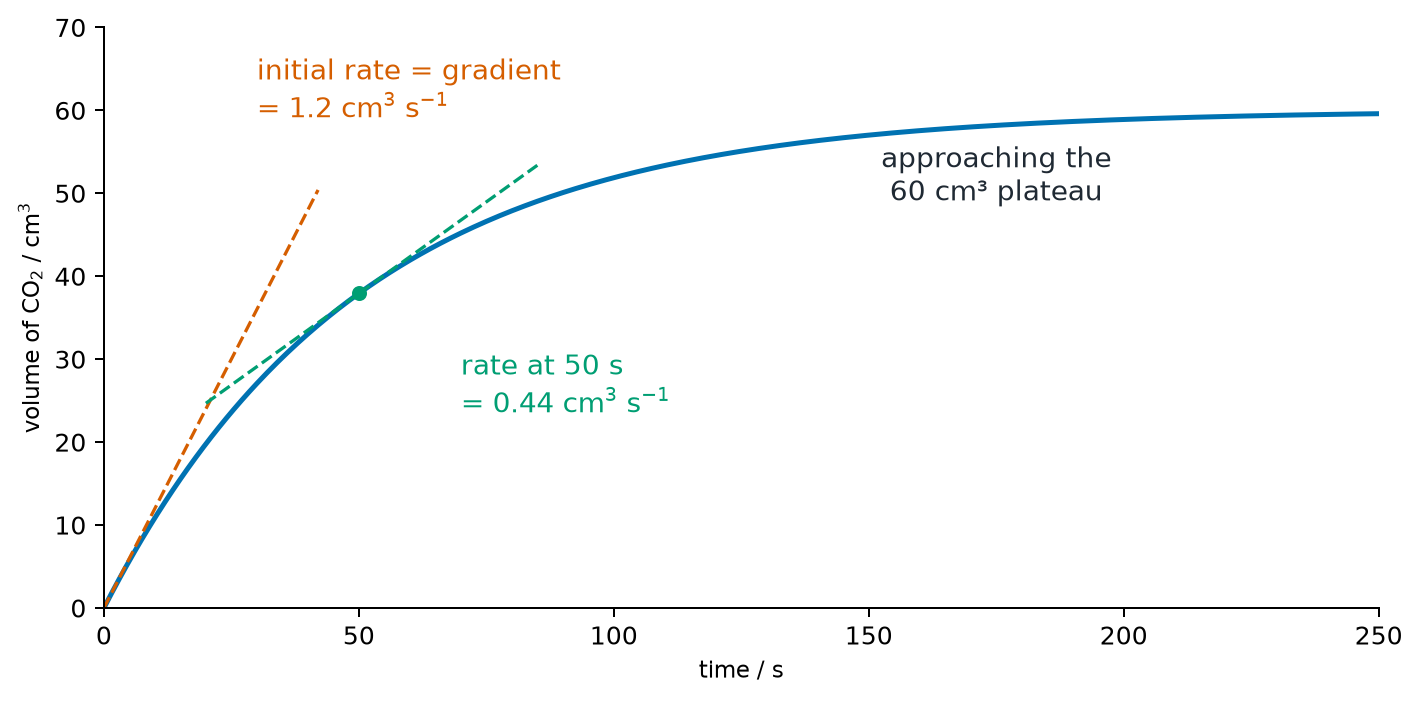
- The invented gas-collection curve has an initial tangent gradient 1.20 cm³/s and a gradient about 0.44 cm³/s at 50 s. In this example the rate falls as the reaction proceeds. Other reactions can have induction periods or autocatalytic acceleration, so initial rate 初始速率 is not always the largest rate.
- A flat observable means no detectable net change in that signal. It can reflect completion, dynamic equilibrium, a leak, sensor saturation or a change below resolution. At dynamic equilibrium, forward and reverse reactions continue. A graph alone must be combined with chemical and measurement evidence.
Does a flat product trace prove every microscopic reaction has stopped?
难度 1/5 · 今日首次完成可获 100 金币及少量额外奖励
The measured net signal is not a direct count of all microscopic events.
R2.2: Choose a signal with a valid calibration
- A gas syringe can measure volume versus time if connections are gas-tight, its motion is reliable and gas conditions are controlled. A mass-loss method needs escaping material and can be biased by evaporation or spray. Delayed collection can lose the earliest gas and underestimate initial production.
- A colorimeter needs an appropriate wavelength, path length, blank and concentration calibration within its useful range. Conductivity depends on all mobile ions, rather than just one reacting species. Because pH is logarithmic, a pH–time slope is not itself a concentration–time slope. State the relation between signal and the quantity being inferred.
Can a pH–time gradient be used directly as a concentration–time gradient?
难度 1/5 · 今日首次完成可获 100 金币及少量额外奖励
The instrument signal must be related correctly to concentration.
R2.2: Control the comparison and its start
- When changing acid concentration for a solid/acid rate experiment, control temperature, solid amount and surface characteristics, solution volume and collection setup as appropriate. When changing temperature, keep reactant amounts and concentrations comparable and allow the samples to reach the chosen temperature before starting.
- Repeat measurements to assess variability; use a consistent mixing and timing procedure. A systematic delay or leak can affect every repeat, so close results do not prove accuracy. Plan intervals short enough to resolve the early change, rather than assuming one fixed 10 s interval suits all reactions.
What does repeating a leaking gas-collection setup guarantee?
难度 1/5 · 今日首次完成可获 100 金币及少量额外奖励
Repeated measurements can retain a shared systematic error.
R2.2: Require energy and useful collision geometry
- In the school collision model, reacting particles must encounter one another with sufficient energy for the pathway and an appropriate orientation. Many collisions fail because their geometry or energy is unsuitable. A rate explanation should connect a changed condition to the number of successful events per time.
- Mean translational kinetic energy is proportional to absolute temperature in kelvin. Heating from 20 to 40 degrees Celsius changes the mean-energy factor by 313.15/293.15≈1.068, not two. A rate can increase much more strongly because the high-energy tail changes, rather than because every particle energy doubles.
What temperature ratio compares mean translational kinetic energies at 20 and 40 °C?
难度 1/5 · 今日首次完成可获 100 金币及少量额外奖励
Convert the endpoints to kelvin: T₁ = 20 + 273.15 = 293.15 K and T₂ = 40 + 273.15 = 313.15 K. Mean translational kinetic energy is proportional to T, so the factor is 313.15/293.15 = 1.068224… .
R2.2: Read an energy distribution as an area
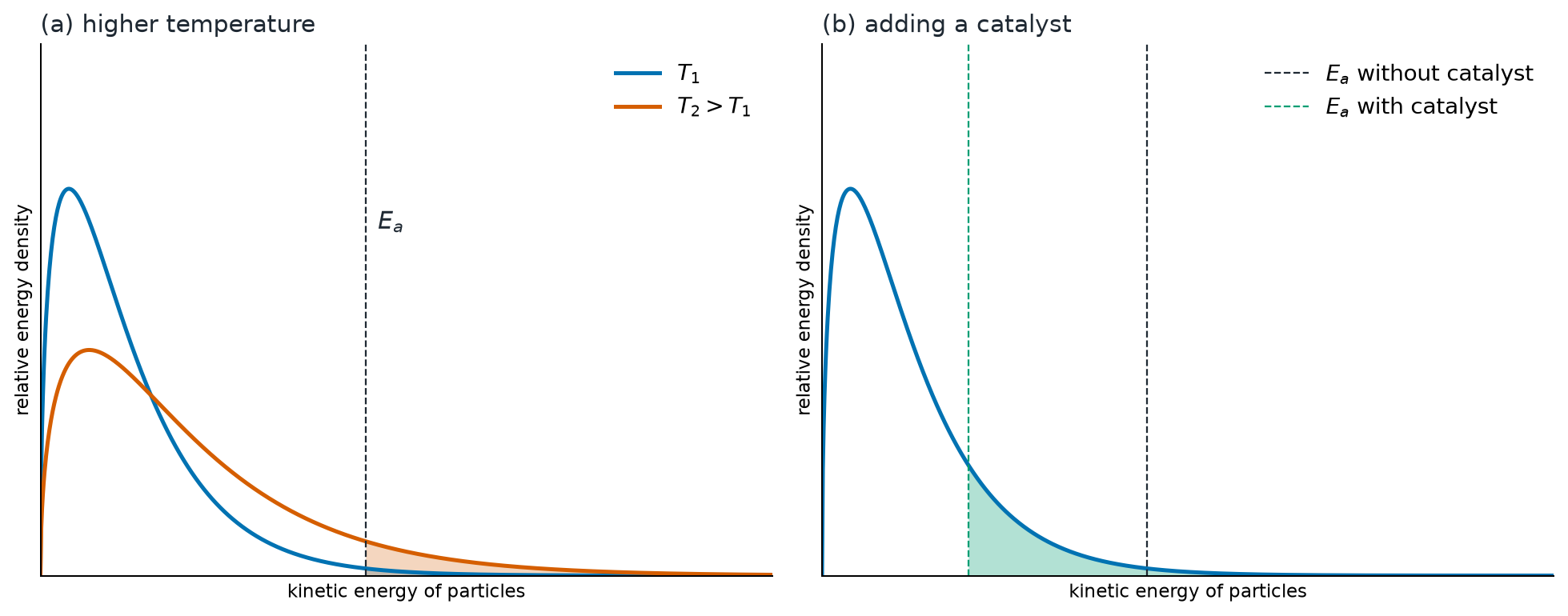
- The ideal Maxwell–Boltzmann energy density starts at zero at the origin, rises to a peak and has a long tail approaching zero. The height at one energy is a density, not the fraction above an energy threshold. Integrating an energy interval gives its particle fraction or count, according to normalization.
- For the same number of particles, a higher-temperature curve is broader with a lower peak and the same total area. Its area above a fixed activation threshold is larger. Enough energy is necessary in the model, but orientation and the actual pathway still determine which encounters lead to reaction.
What represents the fraction above the model activation threshold?
难度 1/5 · 今日首次完成可获 100 金币及少量额外奖励
A tail fraction is an area, not one ordinate.
R2.2: Distinguish compression from adding inert gas
- Compressing ideal reactant gases at fixed temperature increases their concentrations and partial pressures, often increasing relevant collision frequency. Adding inert gas at fixed volume and temperature instead raises total pressure without changing the ideal reactant partial pressures. The two operations are different.
- Higher reactant concentration often speeds a simple reaction, but measured dependence can be zero order over a range or reflect a more complex mechanism. At fixed temperature and pathway, concentration or compression does not itself lower the activation threshold or heat the thermal distribution. Use the experimental law where it is known.
Does adding inert gas at fixed volume necessarily increase the ideal reactant concentrations?
难度 1/5 · 今日首次完成可获 100 金币及少量额外奖励
Specify how pressure changed and follow the reactant partial pressures.
R2.2: Expose more solid without adding more reactant
- For the same solid mass and comparable surface composition, powdering increases exposed surface area. More sites can meet solution particles per time. This is different from increasing the amount of solid, and it does not require changing the thermal-energy distribution at the same temperature.
- In a simple complete reaction with the same limiting amount, collection conditions and no competing pathways, powder can reach the same final gas amount sooner. Changed purity, surface passivation, leaks, equilibrium or side reactions can undermine that simple comparison. State the assumptions behind a claim about identical plateaus.
Why can powder react faster than the same mass of lumps?
难度 1/5 · 今日首次完成可获 100 金币及少量额外奖励
Separate exposed surface from particle energy and total reacting amount.
R2.2: Explain heating without a universal doubling rule
- At higher temperature particles move faster and encounter rates can change. For a positive activation barrier, the larger fraction above the threshold often gives the more important rate effect. A 10 K rise sometimes roughly doubles a rate near room temperature, but its factor depends on the barrier and temperature range.
- Do not claim that heating lowers the activation barrier for the same pathway. In a real experiment very large temperature changes can alter phases, mechanisms or catalyst activity, so a simple model should be checked over its stated range. The curve and threshold represent different parts of the explanation.
What changes in the simple heating model at a fixed pathway?
难度 1/5 · 今日首次完成可获 100 金币及少量额外奖励
Heating and introducing an alternative pathway are distinct changes.
R2.2: Compare catalytic pathways in either energy direction
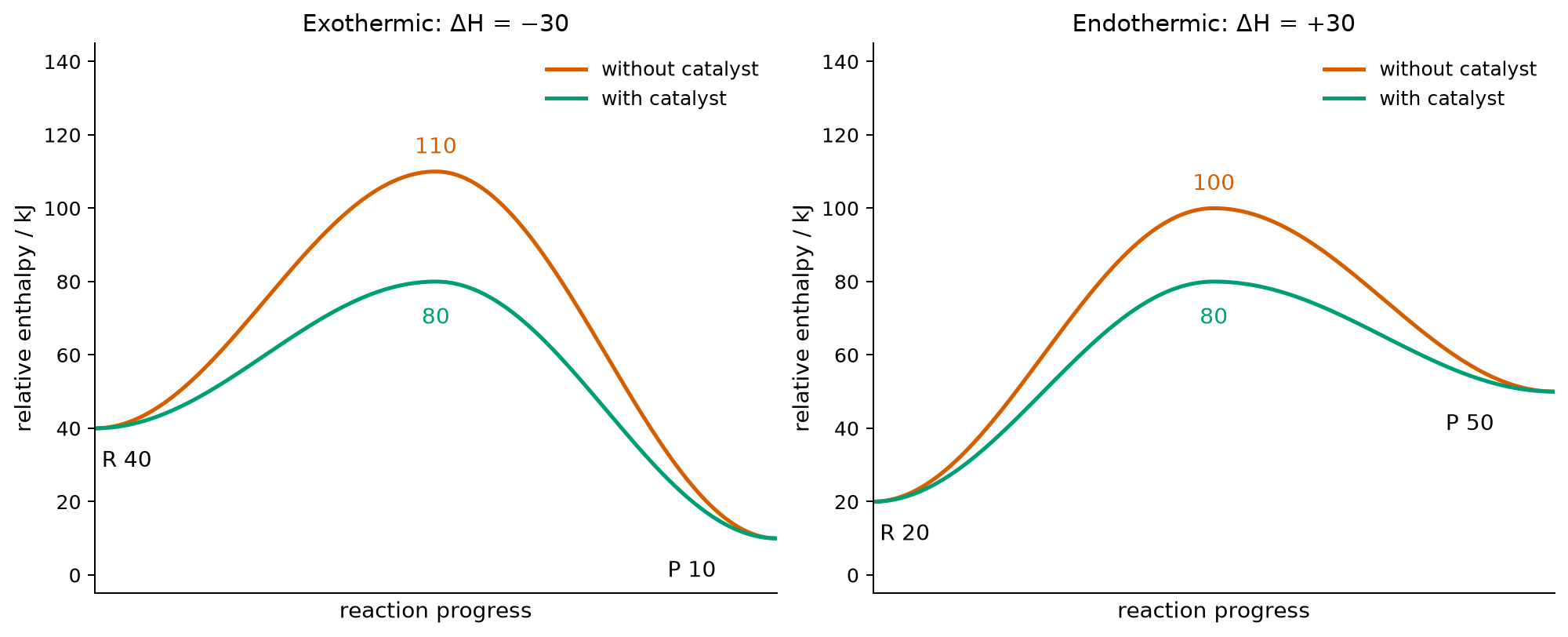
- A catalyst participates in a pathway and is regenerated overall; it is not consumed in the net equation. It can still be lost, poisoned or deactivated in practice. A lower-barrier pathway can speed an exothermic or an endothermic reaction without changing the endpoint enthalpy difference.
- In the invented endothermic profile, reactants 20, products 50 and uncatalysed peak 100 kJ give ΔH + 30, forward barrier 80 and reverse barrier 50. A catalysed peak 80 gives forward 60 and reverse 30. At the same temperature the thermal-energy distribution remains the same; the accessible pathway threshold changes.
What happens to ΔH when only the pathway changes between the same endpoints?
难度 1/5 · 今日首次完成可获 100 金币及少量额外奖励
Read product minus reactant levels, which have not changed.
For reactants 20, products 50 and peak 100 kJ, give the forward activation barrier in kJ.
难度 2/5 · 今日首次完成可获 140 金币及少量额外奖励
The forward barrier is measured from reactants to the peak: 100 − 20 = 80 kJ. Products minus reactants instead gives ΔH = 50 − 20 = +30 kJ, showing an endothermic change. The reverse barrier is 100 − 50 = 50 kJ. Keep the activation barrier separate from both the peak level itself and the overall enthalpy change.
R2.2: Keep equilibrium and a faster approach distinct
- At fixed temperature in a closed system, a catalyst speeds approach to the same equilibrium composition and does not change the equilibrium constant. Both forward and reverse processes are accelerated consistently with that equilibrium. Faster approach does not itself mean a larger equilibrium yield.
- For a simple complete reaction, the limiting amount sets the ideal maximum product. A real process can also have competing reactions, deactivation or isolation losses, so the broad statement that a catalyst can never affect an isolated product yield is too strong. Name the reaction model and what is being measured.
Does a catalyst change the equilibrium constant at a fixed temperature?
难度 1/5 · 今日首次完成可获 100 金币及少量额外奖励
Equilibrium thermodynamics and pathway kinetics are different quantities.
R2.2: Qualify a fixed threshold clock comparison
- A disappearing-cross experiment measures time to a chosen opacity. If the same amount of change gives the same observed threshold, with comparable path length and conditions,1/t can be used as an approximate relative-rate proxy. It is not directly an instantaneous concentration rate.
- For supplied times 40 and 25 s, the second proxy rate divided by the first is (1/25)/(1/40) = 1.6. Different observer thresholds, illumination, geometry or a different amount needed for opacity can invalidate that inference. Report the threshold and controlled variables rather than treating clock time alone as a complete kinetic model.
Two comparable trials reach the same fixed amount of change in 40 s and 25 s. Using 1/t as a relative-rate proxy, what is the second proxy divided by the first?
难度 1/5 · 今日首次完成可获 100 金币及少量额外奖励
For a common threshold, r₂/r₁ ≈ (1/t₂)/(1/t₁) = t₁/t₂ = 40/25 = 1.60. The shorter-time trial has the larger proxy; this is not a direct instantaneous rate measurement.
Comparable fixed-threshold times are 40 and 25 s. Give the second 1/t proxy divided by the first.
难度 2/5 · 今日首次完成可获 140 金币及少量额外奖励
For the same fixed threshold, proxy rates are r₁ = 1/40 = 0.0250 per second and r₂ = 1/25 = 0.0400 per second. Therefore r₂/r₁ = (1/25)/(1/40) = 40/25 = 1.60. The shorter-time trial has the larger proxy. This comparison requires the same endpoint amount and otherwise comparable trial conditions.