Organic structures and reaction pathways
引入| English | 释义 | 拼音 |
|---|---|---|
| functional group/ˈfʌŋkʃənl ɡruːp/ | 官能团 | guān néng tuán |
| isomer/ˈaɪsəmə/ | 异构体 | yì gòu tǐ |
| phenyl | 苯基 | běn jī |
| halogenoalkane/ˈheɪləʊdʒnəʊlkeɪn/ | 卤代烷 | lǔ dài wán |
| primary/ˈpraɪməri/ | 伯 | bó |
| secondary/ˈsekəndəri/ | 仲 | zhòng |
| tertiary/ˈtɜːʃjəri/ | 叔 | shū |
| enantiomer/eˈnæntɪəmə/ | 对映异构体 | duì yìng yì gòu tǐ |
| molecular ion/məˈlekjʊlə ˈaɪɒn/ | 分子离子 | fèn zǐ lí zi |
| chemical shift/ˈkemɪkl ʃɪft/ | 化学位移 | huà xué wèi yí |
| integration/ˌɪntɪˈɡreɪʃn/ | 积分 | jī fēn |
| chiral/ˈkaɪrəl/ | 手性 | shǒu xìng |
| racemic mixture/rəˈsiːmɪk ˈmɪkstʃə/ | 外消旋混合物 | wài xiāo xuán hùn hé wù |
| unpaired electron/ʌnˈpeəd ɪˈlektrɒn/ | 未成对电子 | wèi chéng duì diàn zi |
| homolytic fission/ˌhɒməˈlɪtɪk ˈfɪʃn/ | 均裂 | jūn liè |
| single-barbed arrow | 单钩箭头 | dān gōu jiàn tóu |
| curly arrow/ˈkɜːli ˈærəʊ/ | 弯箭头 | wān jiàn tóu |
| initiation/ɪˌnɪʃɪˈeɪʃn/ | 引发 | yǐn fā |
| nucleophile/ˈnjuːklɪɒfaɪl/ | 亲核试剂 | qīn hé shì jì |
| radical substitution/ˈrædɪkl ˌsʌbstɪˈtjuːʃn/ | 自由基取代 | zì yóu jī qǔ dài |
| propagation/ˌprɒpəˈɡeɪʃn/ | 链增长 | liàn zēng zhǎng |
| termination/ˌtɜːmɪˈneɪʃn/ | 终止 | zhōng zhǐ |
| ozone/ˈəʊzəʊn/ | 臭氧 | chòu yǎng |
| electrophile/ɪˌlektrəʊˈfaɪl/ | 亲电试剂 | qīn diàn shì jì |
| carbocation/ˌkɑːbəˈkeɪʃn/ | 碳正离子 | tàn zhèng lí zi |
| leaving group/ˈliːvɪŋ ɡruːp/ | 离去基团 | lí qù jī tuán |
| electrophilic addition/ɪˌlektrəʊˈfɪlɪk əˈdɪʃn/ | 亲电加成 | qīn diàn jiā chéng |
| nucleophilic substitution/ˌnjuːklɪəˈfɪlɪk ˌsʌbstɪˈtjuːʃn/ | 亲核取代 | qīn hé qǔ dài |
| Lewis base | 路易斯碱 | lù yì sī jiǎn |
| Lewis acid | 路易斯酸 | lù yì sī suān |
| coordination bond | 配位键 | pèi wèi jiàn |
| coordination number/kəʊˈɔːdɪneɪʃn ˈnʌmbə/ | 配位数 | pèi wèi shù |
| ligand/ˈlɪɡænd/ | 配体 | pèi tǐ |
| transition state/trænˈsɪʃn steɪt/ | 过渡态 | guò dù tài |
What would explain this observation?
- Two compounds can have the same molecular formula but different structures. Their functional groups 官能团 help predict which reactions they undergo.
Build the model
- A homologous series shares a functional group and general formula.
- Structural isomers 异构体 share a molecular formula but differ in atom connections.
- Alkenes contain a carbon-carbon double bond.
- functional group: An atom group determining characteristic reactions.
- isomer: A compound sharing a formula but differing in structure.

What happens to the carbon skeleton when bromine adds to ethene?
难度 1/5 · 今日首次完成可获 100 金币及少量额外奖励
Addition across C=C adds one bromine atom to each carbon; the two-carbon skeleton of ethene is untouched, giving 1,2-dibromoethane. No carbon-carbon bonds are broken, so no shortening or ring formation occurs.
Match each technical term to its precise meaning.
难度 2/5 · 今日首次完成可获 140 金币及少量额外奖励
Use the definitions to distinguish related quantities and processes.
Choose evidence that can test it
- Distinguish addition, substitution, oxidation and polymerization by tracing bonds before and after reaction.
- Conditions and reagents belong to the reaction arrow; they are not interchangeable labels.
In the lab: Draw displayed or structural formulae with the correct number of bonds at each carbon. Use a carbon count to check a proposed synthesis. At advanced level, track reagents and conditions through multistep routes.
Which two habits make the investigation or model in this case more defensible?
难度 2/5 · 今日首次完成可获 140 金币及少量额外奖励
Stating the conditions and assumptions lets others repeat the work exactly, and recording the supporting evidence lets them check the conclusion. Hiding disagreeing results removes the evidence that could challenge a wrong conclusion, and one measurement can never establish a wider claim.
Work from known quantities
- Known: ethene adds bromine across its double bond.
- The two-carbon skeleton stays intact and each carbon gains one bromine atom, giving 1,2-dibromoethane.
- One mole of ethene reacts with one mole of bromine in this addition reaction.
Your turn: How many moles of bromine react completely with 0.15 mol ethene?
加成改变化学键,保留全部原子
追踪乙烯与Br₂生成1,2-二溴乙烷:C=C变为单键,每个碳增加一个Br,四条C–H键全部保留。从0.15 mol乙烯出发按1:1物质的量比换算。
How many moles of bromine react completely with 0.15 mol ethene?
难度 2/5 · 今日首次完成可获 140 金币及少量额外奖励
The result is 0.15 mol. Known: 0.15 mol of ethene; the addition is C2H4 + Br2 -> C2H4Br2, a 1:1 mole ratio. Bromine amount = 1 x 0.15 = 0.15 mol. The balanced equation supplies the ratio.
Check the conclusion and its limits
- Bromine decolourization provides evidence of unsaturation in an appropriate test.
- It is not proof that an unknown sample is specifically ethene.
Not true: Compounds with the same molecular formula always have identical properties. Same molecular formula is not same compound: isomers such as butane and 2-methylpropane share C4H10 but have different structures and different physical properties. Structure, not formula alone, sets properties.
- A homologous series shares a functional group and general formula.
- Distinguish addition, substitution, oxidation and polymerization by tracing bonds before and after reaction.
- Watch for: bromine decolourization provides evidence of unsaturation in an appropriate test.
Write from 0.25 mol of bromine
- Ethene adds bromine in a 1 to 1 mole ratio.
- Find the bromine amount that reacts with 0.25 mol of ethene. The same molecular formula can belong to different compounds.
Compounds with the same molecular formula always have identical properties.
难度 1/5 · 今日首次完成可获 100 金币及少量额外奖励
Same molecular formula is not same compound: isomers such as butane and 2-methylpropane share C4H10 but have different structures and different physical properties. Structure, not formula alone, sets properties.
An atom group determining characteristic reactions: write the technical term.
难度 1/5 · 今日首次完成可获 100 金币及少量额外奖励
functional group means An atom group determining characteristic reactions.
How many moles of bromine react completely with 0.25 mol of ethene, and why can two compounds with the same molecular formula still differ?
The balanced addition supplies the 1 to 1 mole ratio. Isomers share a formula and differ in structure.
In complete addition across the double bond, how many moles of Br₂ react with 0.25 mol of ethene?
难度 1/5 · 今日首次完成可获 100 金币及少量额外奖励
C₂H₄ + Br₂ → C₂H₄Br₂ has a 1:1 mole ratio, so 0.25 mol of ethene needs 0.25 mol of Br₂. One double bond consumes one Br₂ molecule, not one per carbon atom. The 0.15 mol amount belongs to the earlier example, not the supplied 0.25 mol sample.
S3.2: Separate atom counts from connectivity
- A molecular formula gives the number of atoms of each element; an empirical formula gives the simplest whole-number ratio. Neither necessarily tells you how atoms connect. Ethanol and methoxymethane both have C₂H₆O but connect oxygen differently.
- For butan-1-ol, C₄H₁₀O has no common divisor, so it is also the empirical formula. A full single-bond drawing has fifteen atoms and fourteen bonds. Check the actual structure and valences instead of assuming every formula identifies one substance.
Does one molecular formula guarantee one connectivity?
难度 1/5 · 今日首次完成可获 100 金币及少量额外奖励
Count and connect are different operations.
Count atoms in one molecule with formula C₄H₁₀O.
难度 2/5 · 今日首次完成可获 140 金币及少量额外奖励
4+10+1=15 atoms.
Count single bonds in the connected acyclic full drawing of butan-1-ol.
难度 2/5 · 今日首次完成可获 140 金币及少量额外奖励
Write the chain as CH₃–CH₂–CH₂–CH₂–OH. It contains three C–C bonds, one C–O bond, one O–H bond and 3 + 2 + 2 + 2 = 9 C–H bonds. Total single bonds = 3 + 1 + 1 + 9 = 14. As a check, C₄H₁₀O has 15 atoms; a connected acyclic structure has one fewer atom-to-atom links than atoms. Here all links are single bonds.
S3.2: Count skeletal corners and ends
- In an ordinary skeletal drawing, each unlabelled line end and corner is carbon. Add enough carbon-bound hydrogens to complete the usual carbon valence of four; show heteroatoms and hydrogens attached to them explicitly.
- A four-carbon open zigzag has two internal corners and two ends, not four corners. For pentan-2-ol, draw five carbon positions and attach OH at the second. The OH hydrogen belongs in the label even though carbon-bound H atoms are normally omitted.
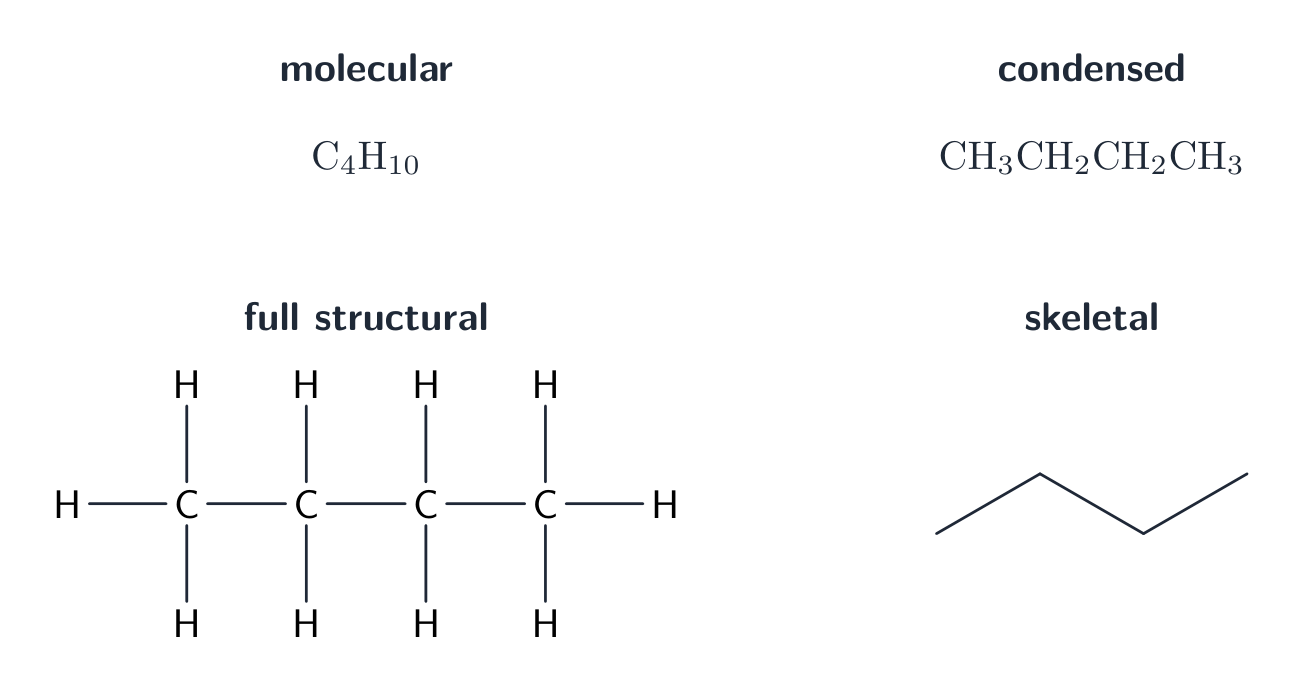
How many carbon positions does a four-carbon zigzag contain?
难度 1/5 · 今日首次完成可获 100 金币及少量额外奖励
Count every corner and end once.
S3.2: Use a three dimensional model meaningfully
- A flat displayed formula can show every connection without reproducing real bond angles. A simple sp³ carbon has four approximately tetrahedral directions, around 109.5°; alkene carbon regions are approximately planar, while an alkyne region is linear.
- Build or sketch a small model with those directions and compare views without changing connectivity. Model colours and sticks are conventions, not literal atom surfaces. A different viewing angle alone does not make a new constitutional isomer.
Does rotating an intact model change its atom connectivity?
难度 1/5 · 今日首次完成可获 100 金币及少量额外奖励
Separate viewing direction from a change in which atoms are bonded.
S3.2: Recognize complete functional group connections
- A functional group gives characteristic chemical behaviour. A hydroxyl is O–H, a carbonyl C=O, and a carboxyl combines carbonyl and OH on the same carbon. Ester and amide links differ in the atom attached beside the carbonyl: oxygen or nitrogen.
- An ether links carbon groups through oxygen; an alkoxy substituent attaches through oxygen. A phenyl 苯基 group is C₆H₅–. Do not classify every molecule containing C=O identically: an aldehyde, ketone, acid, ester and amide have different connections and characteristic reactions.
What distinguishes an amide connection from an ester connection?
难度 1/5 · 今日首次完成可获 100 金币及少量额外奖励
Inspect the whole connected functional group.
S3.2: Specify carbon carbon saturation
- A saturated carbon framework has no carbon–carbon multiple bond; an unsaturated framework contains C=C or C≡C. An alkene specifically contains a carbon–carbon double bond, not merely any double bond anywhere.
- A carbonyl C=O does not by itself make an acid or ketone an alkene. Keep the atoms in the bond explicit when identifying a group. Different functional groups can coexist in one molecule, so identify the connections before deciding what class or reaction is relevant.
Does a C=O bond alone make a compound an alkene?
难度 1/5 · 今日首次完成可获 100 金币及少量额外奖励
The identities of the bonded atoms matter.
S3.2: Identify a homologous series
- A homologous series has a characteristic group and a common general formula; successive members typically differ by CH₂. Related chemistry follows from the group, while physical properties change as molecular size and shape change.
- For the simple saturated acyclic monocarboxylic-acid series, use CₙH₂ₙO₂ when n counts all carbons. Methanoic acid is CH₂O₂ and ethanoic acid C₂H₄O₂. A different convention counting only an alkyl part needs a different written formula; state which carbons n represents.
In CₙH₂ₙO₂ for these acids, does n include the carboxyl carbon?
难度 1/5 · 今日首次完成可获 100 金币及少量额外奖励
Check the formula against the first members.
S3.2: Bound a general formula to its series
- CₙH₂ₙ₊₂ describes simple acyclic alkanes. CₙH₂ₙ describes acyclic monoalkenes, but a simple cycloalkane can share that molecular formula. A ring and an extra multiple bond change the hydrogen count relative to an acyclic saturated structure.
- A five-carbon monoalkene can be C₅H₁₀, but the formula alone does not locate its double bond or exclude a ring. General formulas are useful checks within their stated structural conditions, rather than unique structural identifications.
Does C₅H₁₀ alone prove a particular pentene structure?
难度 1/5 · 今日首次完成可获 100 金币及少量额外奖励
Use connectivity evidence as well as a general formula.
Count hydrogens in a five-carbon acyclic monoalkene.
难度 2/5 · 今日首次完成可获 140 金币及少量额外奖励
For an acyclic monoalkene, the general formula is CₙH₂ₙ. With n = 5 carbon atoms, hydrogen count = 2 × 5 = 10, giving C₅H₁₀.
S3.2: Explain comparable boiling point trends
- As comparable unbranched chains grow, polarizability and dispersion attractions generally increase, raising normal boiling points. Alcohols also form intermolecular hydrogen bonds through their OH groups, explaining much higher boiling points than comparable alkanes.
- The chart uses rounded normal boiling points, not newly measured classroom results. Compare at the same pressure. Similar relative molecular mass makes a useful comparison, but does not guarantee identical shape or every dispersion contribution in two different molecules.
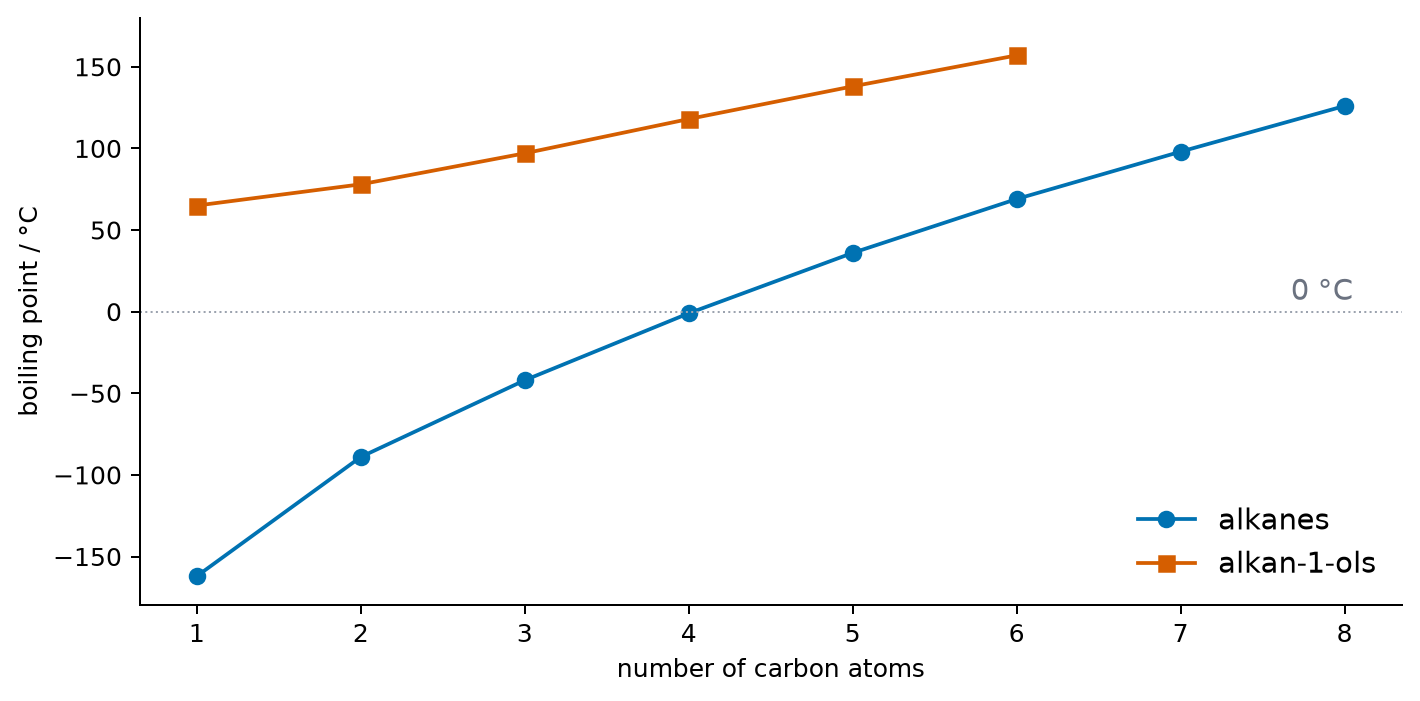
Why can butan-1-ol boil much higher than pentane despite similar mass?
难度 1/5 · 今日首次完成可获 100 金币及少量额外奖励
Vaporization separates molecules rather than normally breaking all their covalent bonds.
S3.2: Distinguish melting from boiling trends
- A solid’s melting behaviour depends on packing and symmetry as well as intermolecular attractions. Longer members often show an overall increasing melting trend, but successive values can alternate or be irregular.
- Compact branching often lowers boiling points among comparable alkane isomers by reducing effective contact. Melting need not follow the same order: a sufficiently symmetrical branched structure may pack well. Explain the actual supplied observations instead of applying one ranking to every phase change.
Must a branched isomer always melt below a straight-chain isomer?
难度 1/5 · 今日首次完成可获 100 金币及少量额外奖励
The solid arrangement adds information not contained in a liquid–vapour comparison.
S3.2: Apply parent and locant rules
- Choose a suitable parent chain containing the characteristic group, identify its suffix and number to give that group its required priority. Name carbon substituents and halogens with locants, using the requested IUPAC convention.
- CH₃CH₂CH(CH₃)CH₃ has a four-carbon parent and a methyl at carbon 2 when numbered from the nearer end: 2-methylbutane. In CH₃CH₂COOH, the COOH carbon counts in the three-carbon parent, giving propanoic acid. Do not add an extra unseen carbon to a terminal group.
What parent and substituent describe CH₃CH₂CH(CH₃)CH₃?
难度 1/5 · 今日首次完成可获 100 金币及少量额外奖励
Choose the proper parent before assigning locants.
S3.2: Distinguish constitutional isomer types
- Constitutional or structural isomers have the same molecular formula but different connectivity. A changed carbon skeleton gives chain isomerism; shifting the same group can give position isomerism; rearranging into a different characteristic group gives functional-group isomerism.
- Butane and 2-methylpropane are C₄H₁₀ chain isomers. Propan-1-ol and propan-2-ol are position isomers; ethanol and methoxymethane are functional-group isomers. A model rotated on the page retains connectivity and is not another constitutional isomer.
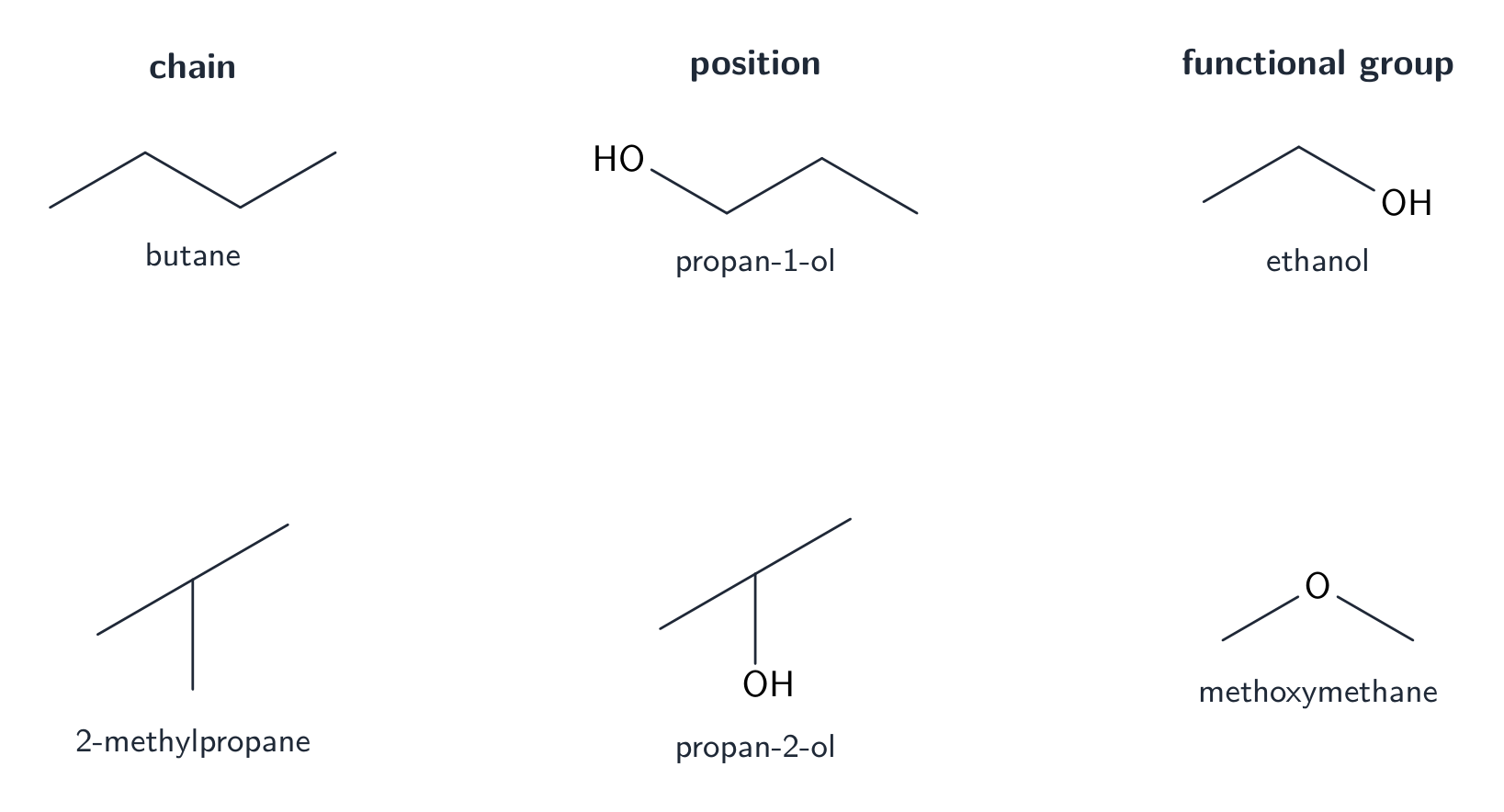
Are ethanol and methoxymethane connected identically?
难度 1/5 · 今日首次完成可获 100 金币及少量额外奖励
Compare which atoms connect, not only the atom totals.
S3.2: Classify alcohols and halogenoalkanes 卤代烷 at carbon
- For usual alkyl examples, classify the carbon bonded to OH or the halogen by its carbon neighbours: one gives primary 伯, two secondary 仲 and three tertiary 叔. Propan-2-ol and 2-bromopropane are secondary by this rule.
- The four C₄H₁₀O alcohol constitutional isomers are butan-1-ol, butan-2-ol, 2-methylpropan-1-ol and 2-methylpropan-2-ol: primary, secondary, primary and tertiary. This count excludes ethers and separate enantiomers 对映异构体. Methanol has no carbon neighbour and needs separate treatment from the usual alkyl examples.
Does the four-alcohol count include every ether and every separate enantiomer with that formula?
难度 1/5 · 今日首次完成可获 100 金币及少量额外奖励
State the class and type of isomer being counted.
Count alcohol constitutional isomers of C₄H₁₀O, excluding ethers and separate enantiomers.
难度 2/5 · 今日首次完成可获 140 金币及少量额外奖励
The unbranched four-carbon skeleton gives butan-1-ol and butan-2-ol; moving OH to carbon 3 or 4 only renumbers one of these. The branched skeleton gives 2-methylpropan-1-ol and 2-methylpropan-2-ol. Thus there are 2 + 2 = 4 alcohol constitutional isomers. The two enantiomers of butan-2-ol have the same connectivity and are counted together here. Ethers share the formula but are excluded by the question.
S3.2: Classify amines at nitrogen
- For amines, count carbon-containing groups directly attached to nitrogen: CH₃NH₂ is primary, (CH₃)₂NH secondary and (CH₃)₃N tertiary. This differs from counting carbon neighbours of the carbon carrying an alcohol or halogen.
- A tertiary amine has no N–H bond but still has a lone pair. A carbonyl directly attached to nitrogen identifies an amide connection instead. Do not transfer a carbon-based classification rule onto nitrogen or confuse absence of N–H with absence of an amine.
What is (CH₃)₃N?
难度 1/5 · 今日首次完成可获 100 金币及少量额外奖励
The counting centre for an amine is nitrogen.
S3.2: Separate hydrogen bond donation and acceptance
- Ethanol has an O–H bond and can donate hydrogen bonds to other ethanol molecules. Methoxymethane lacks O–H and cannot form that same donor network between its pure molecules, although its oxygen can accept hydrogen bonds from water.
- Thus a shared C₂H₆O formula does not give the same intermolecular behaviour. Describe the actual donor, acceptor and comparison conditions; do not say that an ether can never participate in a hydrogen bond in any mixture.
Can an ether oxygen accept a hydrogen bond from water?
难度 1/5 · 今日首次完成可获 100 金币及少量额外奖励
Donation and acceptance are different structural roles.
S3.2: Build a functional group catalogue
- Read connections explicitly: alkane C–C/C–H single bonds; alkene C=C; alkyne C≡C; halogenoalkane C–X; alcohol O–H; aldehyde R–CHO; ketone R–C(=O)–R; acid R–COOH. R denotes an appropriate carbon-containing group and X a halogen.
- Complete the common catalogue with ether R–O–R, ester R–C(=O)–O–R, amine (primary example R–NH₂), amide (primary example R–C(=O)–NH₂) and the phenyl group C₆H₅–. Secondary and tertiary amines or substituted amides need not retain the same number of N–H bonds. An aldehyde has H on its carbonyl carbon; a ketone has two carbon groups there.
Which connection identifies the simple ketone example?
难度 1/5 · 今日首次完成可获 100 金币及少量额外奖励
Inspect what is directly attached to the carbonyl carbon.
S3.2: Name a six carbon parent consistently
- Parent stems count carbons: meth 1, eth 2, prop 3, but 4, pent 5 and hex 6. For the single-functional-group examples, choose the appropriate parent containing the group and number to give its required locant priority. Count the carbonyl carbon in an aldehyde or acid.
- CH₃CH₂CH(OH)CH₂CH₂CH₃ is hexan-3-ol: six parent carbons, and OH at 3 rather than 4. CH₃COCH₂CH₃ is butan-2-one, with an internal carbonyl; CH₃CH₂CH₂CHO is butanal, with the terminal aldehyde carbon included. Draw the structure back from the name to check chain length, locants and valence.
What name follows from CH₃CH₂CH(OH)CH₂CH₂CH₃?
难度 1/5 · 今日首次完成可获 100 金币及少量额外奖励
Include the OH-bearing carbon and number from the nearer end.
AHL S3.2: Use IHD with valence assumptions
- For ordinary neutral closed-shell C/H/N/O/halogen formulas, IHD=(2c+2+n−h−x)/2. Oxygen does not enter this count. One ring or double bond contributes one; a triple bond contributes two.
- C₄H₈O₂ gives (8+2−8)/2=1. Before spectroscopy, that can represent a ring or a double bond, not necessarily C=O. The formula is supporting analysis, not a universal rule for arbitrary ions or unusual valences.
Does IHD 1 alone establish a carbonyl group?
难度 1/5 · 今日首次完成可获 100 金币及少量额外奖励
Combine the count with other structural evidence.
Find IHD of neutral closed-shell C₄H₈O₂ with usual valences.
难度 2/5 · 今日首次完成可获 140 金币及少量额外奖励
For neutral closed-shell C/H/O formulas with usual valences, IHD = (2C + 2 − H)/2; oxygen does not enter the count. Substituting C = 4 and H = 8 gives (2 × 4 + 2 − 8)/2 = 1, consistent with one ring or one double bond.
AHL S3.2: Assign molecular and isotope peaks carefully
- In electron-impact MS, ionization can form a radical molecular cation and fragments. An assigned singly charged molecular ion 分子离子 helps establish nominal molecular mass, but it can be weak or absent.
- Isotope peaks such as M+1 or M+2 can lie above the monoisotopic molecular-ion position, while the tallest base peak can be a fragment. Therefore neither highest m/z nor greatest intensity is an unconditional molecular-ion rule. Method and composition matter.
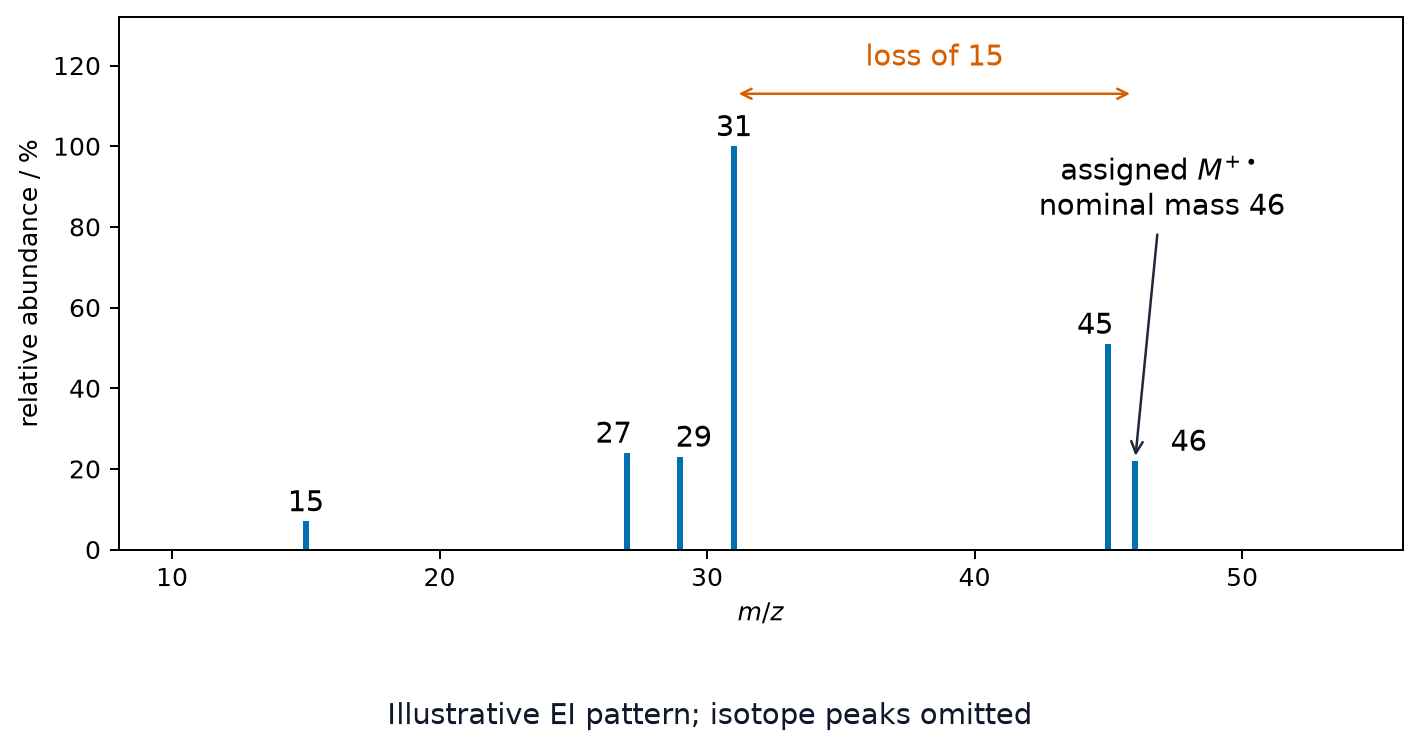
Must the tallest peak be the molecular ion?
难度 1/5 · 今日首次完成可获 100 金币及少量额外奖励
Mass position and abundance answer different questions.
AHL S3.2: Conserve mass and charge in fragmentation
- For a proposed ethanol EI pathway, a molecular radical cation at nominal 46 can give CH₂OH⁺ at 31 and a neutral methyl radical of mass 15. The charge stays with the detected ion; 46−15=31.
- A nominal mass can fit more than one elemental formula or fragmentation pathway. Use the parent composition, assigned fragments and supporting evidence rather than treating every gap as proof of a unique neutral group or every molecule as having the same losses.
What is the neutral-loss mass in the proposed 46→31 pathway?
难度 1/5 · 今日首次完成可获 100 金币及少量额外奖励
For the proposed singly charged parent-to-fragment pathway, neutral-loss nominal mass = parent mass − fragment mass = 46 − 31 = 15 mass units. A mass difference alone does not uniquely identify the neutral species.
Find the proposed neutral-loss mass from parent46 to fragment31.
难度 2/5 · 今日首次完成可获 140 金币及少量额外奖励
46−31=15.
AHL S3.2: Read infrared bands as evidence
- An IR-active vibration changes dipole moment. In a transmittance spectrum, absorption lowers transmittance and appears as a dip. Use the supplied table to identify bond ranges and distinguish broad OH features from carbonyl absorptions.
- A schematic acid spectrum combines very broad OH and C=O evidence. A group assignment does not by itself determine the whole molecule. Fingerprint comparison is useful under comparable conditions, but overlapping mixtures or limited resolution can complicate identity and purity claims.
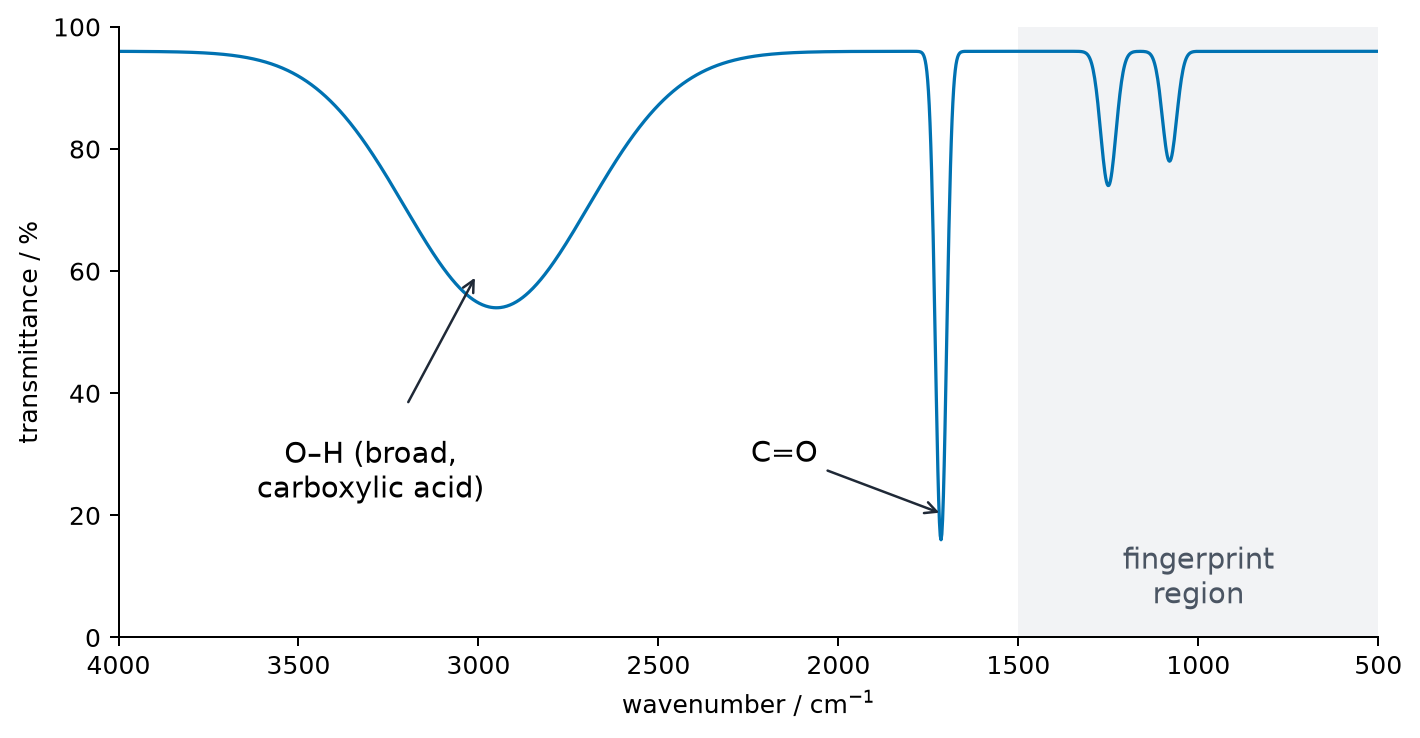
Does one carbonyl absorption uniquely identify a particular ester molecule?
难度 1/5 · 今日首次完成可获 100 金币及少量额外奖励
Combine group evidence with formula and other spectra.
AHL S3.2: Explain infrared active carbon dioxide
- CO₂ has no permanent dipole in its linear equilibrium structure, but its bending and asymmetric-stretching motions can change dipole moment and absorb IR. N₂ and O₂ lack that change in their ordinary homonuclear stretching vibration.
- Greenhouse absorption involves suitable vibrational modes and wavelengths as well as atmospheric abundance. Do not equate zero permanent dipole with zero possible infrared absorption or assume that any bond absorbs every wavelength of outgoing radiation.
Can CO₂ absorb IR despite having no permanent dipole?
难度 1/5 · 今日首次完成可获 100 金币及少量额外奖励
The change during the vibration determines this selection rule.
AHL S3.2: Separate proton signals from split lines
- A proton signal corresponds to a distinguishable hydrogen environment under the measurement conditions. At high resolution, coupling can split that signal into several lines; a quartet remains one signal rather than four separate environments.
- Chemical shift 化学位移 reflects the magnetic environment and integration 积分 compares total signal areas. TMS has twelve equivalent protons and supplies a reference at 0 ppm. Exchangeable OH positions and line shapes can vary with solvent, concentration and temperature.
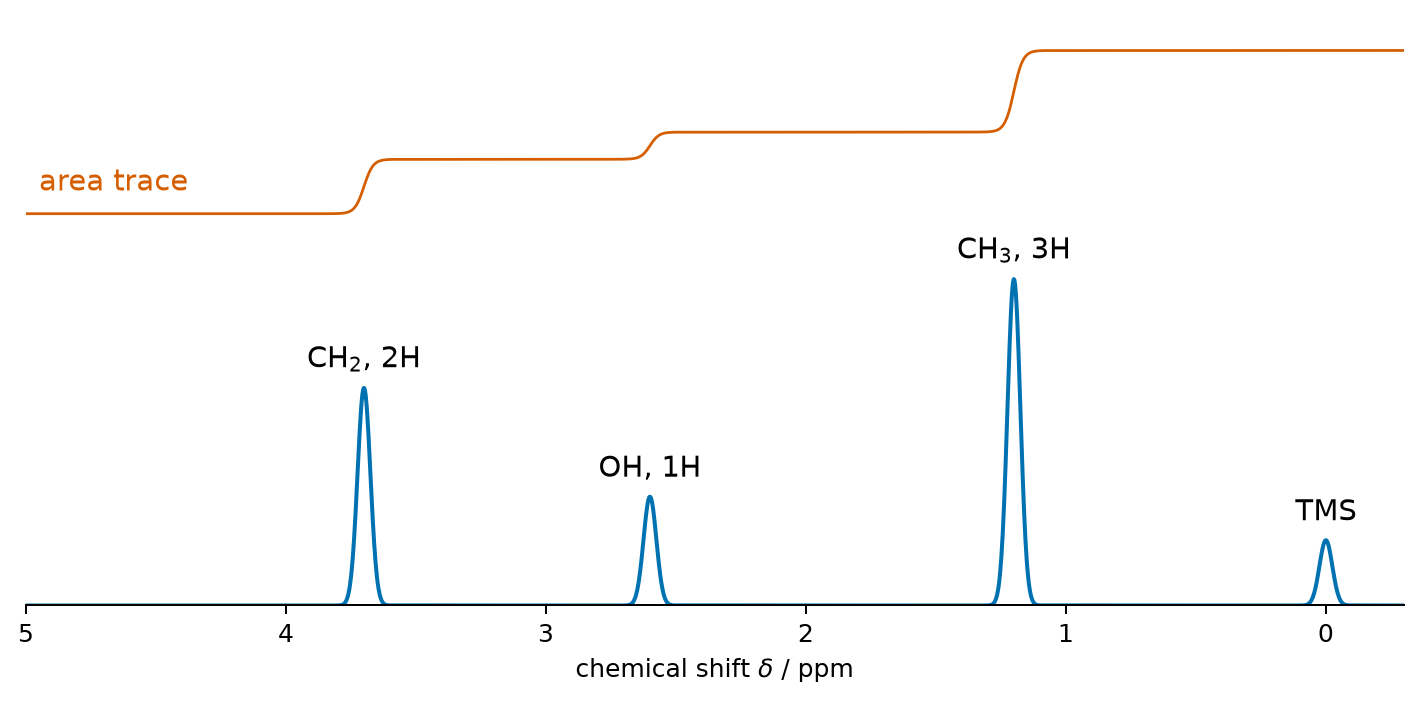
Does a quartet necessarily mean four hydrogen environments?
难度 1/5 · 今日首次完成可获 100 金币及少量额外奖励
Count signals and multiplet lines separately.
Count equivalent hydrogen nuclei in Si(CH₃)₄.
难度 2/5 · 今日首次完成可获 140 金币及少量额外奖励
4×3=12.
AHL S3.2: Use integration as an atom count check
- In the schematic ethanol spectrum, CH₃, CH₂ and OH give integrated areas in the ratio 3:2:1 under suitable conditions. Compare areas over each whole signal, not the heights of the tallest individual lines.
- A formula and integration pattern must be consistent. Integrations summing to eight H contradict a proposed six-H formula for the same simple assignment. They still require chemical shifts and other evidence to place those H groups in a specific structure.
Should a quartet’s total proton count be read from only its tallest line?
难度 1/5 · 今日首次完成可获 100 金币及少量额外奖励
Area over the full signal is the relevant comparison.
AHL S3.2: Reconcile the invented ester data
- An invented exercise gives C₄H₈O₂, assigned molecular ion 88, IR C=O without broad OH, and signals at 3.7 ppm (3H), 2.3 (2H), 1.1 (3H). The formula gives mass 4×12+8×1+2×16=88 and IHD 1.
- Methyl propanoate, CH₃CH₂COOCH₃, fits OCH₃, CH₂CO and terminal CH₃ assignments. The integrations sum to eight H. Calling it C₃H₆O₂ or mass 74 would contradict both structure and integration; atom conservation is a check on the interpretation.
For methyl propanoate CH₃CH₂C(=O)OCH₃, use nominal atomic masses C = 12, H = 1 and O = 16. Which nominal molecular mass matches the structure?
难度 1/5 · 今日首次完成可获 100 金币及少量额外奖励
Count four C atoms, eight H atoms and two O atoms, including the carbonyl carbon and OCH₃ carbon. Nominal molecular mass = 4 × 12 + 8 × 1 + 2 × 16 = 88.
Find nominal molecular mass for invented C₄H₈O₂ using C12,H1,O16.
难度 2/5 · 今日首次完成可获 140 金币及少量额外奖励
4×12+8+2×16=88.
Sum invented NMR integrations3H,2H,3H.
难度 2/5 · 今日首次完成可获 140 金币及少量额外奖励
3+2+3=8 H.
AHL S3.2: Apply first order splitting with conditions
- A simple signal coupled to one set of n equivalent neighbouring protons gives n+1 lines: singlet, doublet, triplet or quartet for n=0,1,2,3. Equivalent protons do not split one another in these simple first-order examples.
- More than one coupled set or more complex coupling can give other patterns. Rapid OH exchange commonly suppresses observable coupling, but suitable slow-exchange conditions can reveal it. Do not turn the school n+1 examples into an unconditional rule for every proton spectrum.
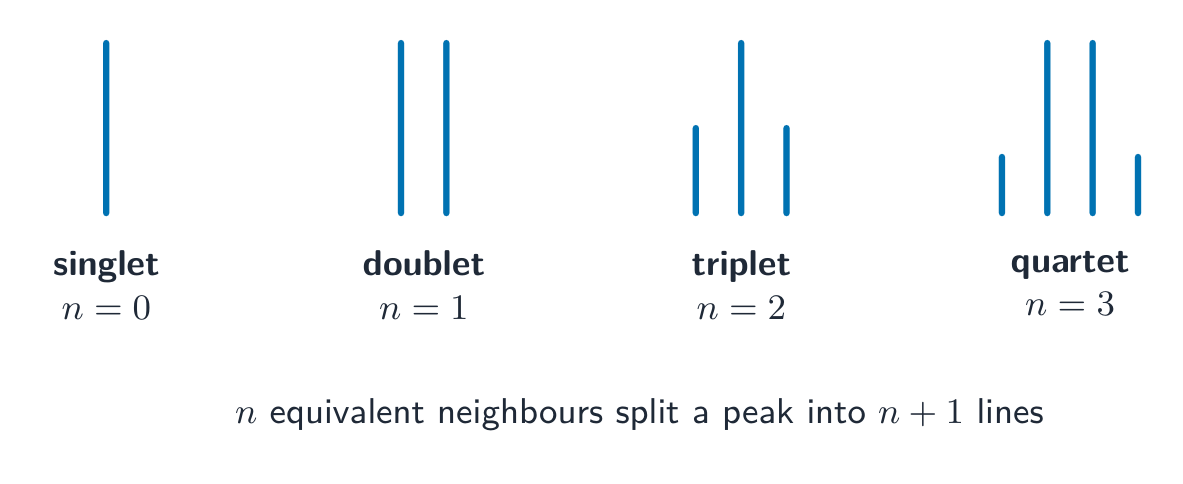
Does every alcohol OH signal have to remain a singlet under every condition?
难度 1/5 · 今日首次完成可获 100 金币及少量额外奖励
State the exchange conditions and the model’s range.
AHL S3.2: Support an ethyl group assignment
- For CH₃CH₂Cl in the simple first-order model, CH₃ is split by two adjacent H into a triplet; CH₂ is split by three H into a quartet. Total integrated areas are 3:2, and CH₂ is at the higher shift next to chlorine.
- A compatible triplet/quartet pair supports an ethyl group, but does not by itself identify the entire molecule. Ethanol similarly has an ethyl pattern, plus an exchangeable OH signal under suitable conditions. Use the formula and remaining shifts to distinguish examples.
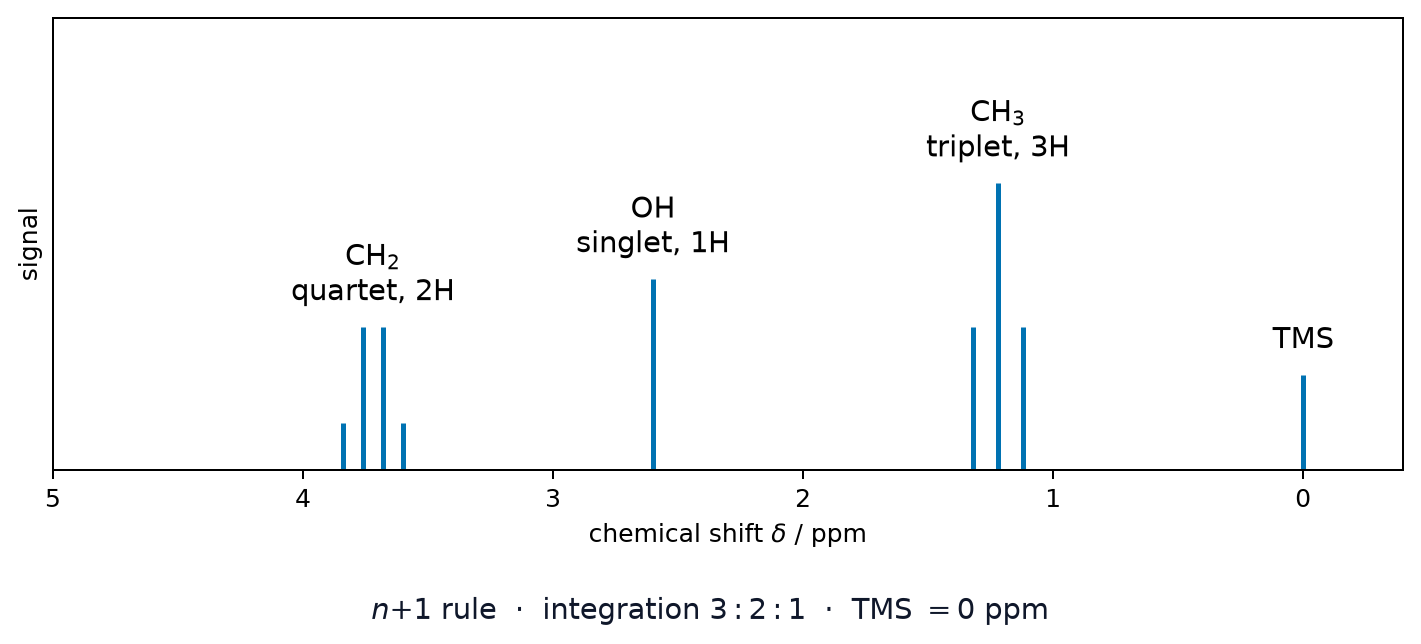
Does a triplet/quartet pair alone uniquely establish chloroethane?
难度 1/5 · 今日首次完成可获 100 金币及少量额外奖励
A local fragment assignment is not the complete structure.
AHL S3.2: Define cis trans reference groups
- A C=C with two different groups on each carbon permits geometric stereoisomerism because ordinary rotation does not freely preserve the π bond. Cis/trans uses an identical reference group on the two carbons to define same or opposite sides.
- But-2-ene has H and CH₃ on each carbon; but-1-ene has two H on one and lacks the corresponding pair. Small-ring substituents can also occupy the same or opposite faces. Ring puckering alone need not interchange those faces.
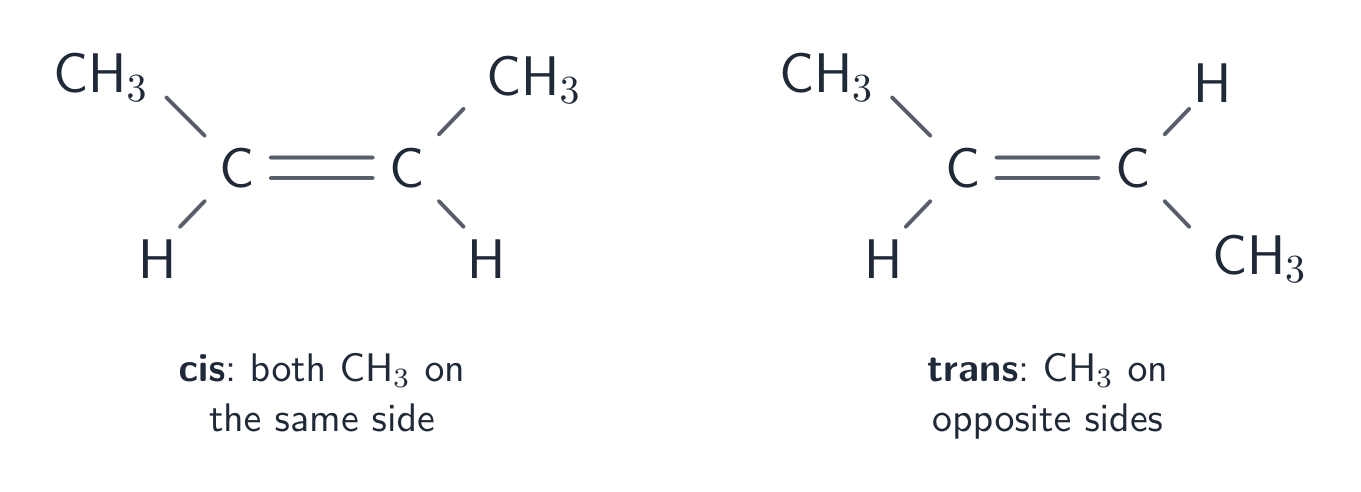
Why does but-1-ene lack the corresponding cis/trans pair?
难度 1/5 · 今日首次完成可获 100 金币及少量额外奖励
Check substituent identity on each double-bond carbon.
AHL S3.2: Read a tetrahedral mirror pair
- A carbon with four different attached groups can be a stereocentre. At carbon 2 of 2-chlorobutane, the groups are H, Cl, CH₃ and C₂H₅. Its two mirror forms cannot be superimposed without changing the stereochemistry.
- A solid tapered wedge points towards the viewer; a hashed wedge points away; ordinary lines lie approximately in the plane. Reflect all positions consistently to draw the partner, rather than swapping labels and then treating two identical models as a mirror pair.
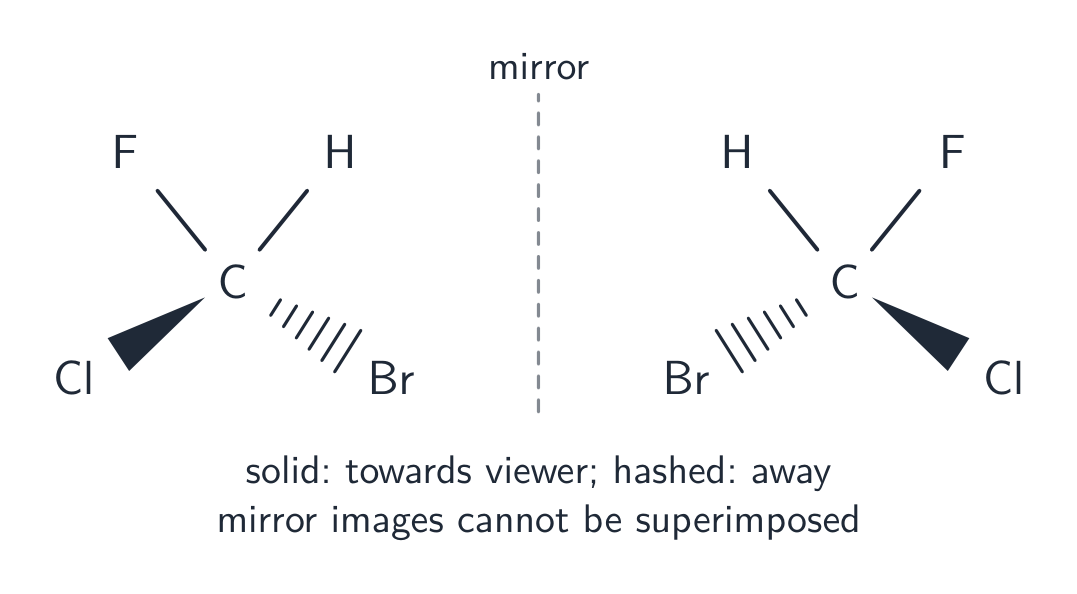
What does a solid tapered wedge indicate in this convention?
难度 1/5 · 今日首次完成可获 100 金币及少量额外奖励
The symbol communicates direction, not a universal bond-strength ranking.
AHL S3.2: Explain optical activity and a racemate
- A pure enantiomer pair has equal and opposite rotations under identical concentration, path length, temperature and wavelength conditions. Ordinary properties in an achiral environment can match, while interactions with chiral 手性 biological environments may differ.
- A 1:1 racemic mixture 外消旋混合物 cancels the rotations without making its molecules achiral. A sample with no net rotation therefore does not prove that all molecules lack stereocentres. Separate the molecular structure, mixture composition and optical measurement.
Does zero net rotation prove an absence of chiral molecules?
难度 1/5 · 今日首次完成可获 100 金币及少量额外奖励
Macroscopic cancellation need not change molecular structures.
R3.3: Identify radical character independently of charge
- A radical has an unpaired electron 未成对电子. A dot records that electron; a plus or minus sign records net charge. Cl• is a neutral atomic radical, NO• a neutral molecular radical, CH₄•⁺ a radical cation and O₂•⁻ a radical anion.
- Using atomic numbers C 6, H 1, N 7 and O 8 gives electron totals 17 for Cl•, 15 for NO•, 9 for CH₄•⁺ and 17 for O₂•⁻. Each odd total needs an unpaired electron. Cl⁻ and OH⁻ are closed-shell ions, so charge does not imply a radical.
Which statement correctly separates charge and radical character?
难度 1/5 · 今日首次完成可获 100 金币及少量额外奖励
Charge and unpaired-electron count describe different features.
R3.3: Split the bonding pair with two fishhooks
- In Cl₂ → 2Cl• under suitable UV light, each atom takes one electron from the shared pair. This is homolytic fission 均裂: the closed-shell halogen molecule gives two radicals. The reverse combination makes a covalent bond from two unpaired electrons.
- Draw one single-barbed arrow 单钩箭头 from each bonding electron towards the atom receiving it. The large straight reaction arrow separates reactants and products; it does not show electron movement. Full curly arrows 弯箭头 move pairs and belong to a different electron-transfer description.
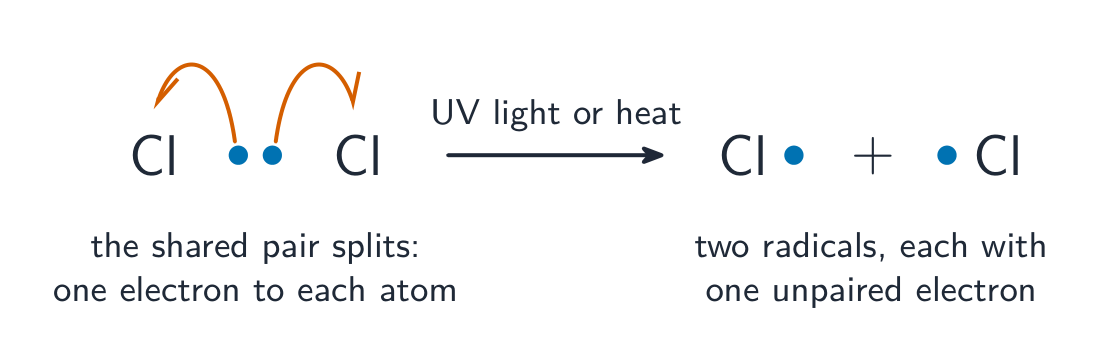
What does a fishhook arrow represent?
难度 1/5 · 今日首次完成可获 100 金币及少量额外奖励
Two single-electron movements split the shared pair one electron each way.
R3.3: Explain the light without a weakest-bond shortcut
- Bond breaking requires energy. In the usual methane/chlorine photochemical reaction, chlorine absorbs suitable light and Cl–Cl splits into radicals. Supplied bond enthalpies of 242 kJ/mol for Cl–Cl and 414 kJ/mol for C–H help compare energy costs.
- Absorption and wavelength matter too; the weakest bond is not automatically the photochemical target in every molecule. A low dark rate and a faster light-driven rate support initiation 引发 by light, but do not alone prove every proposed chain step.
Which explanation is appropriately qualified?
难度 1/5 · 今日首次完成可获 100 金币及少量额外奖励
A bond-energy comparison alone does not specify light absorption.
R3.3: Connect alkane stability to its reaction pathway
- Strong C–C and C–H bonds and little C–H polarity make alkanes resistant to common ionic reactions under ordinary conditions. They lack a strongly polar functional-group centre for the usual acid, alkali or nucleophile 亲核试剂 pathways.
- A fuel can be kinetically resistant at room temperature while combustion products are thermodynamically favoured. A barrier controls access to the pathway. Specify the reaction and conditions; alkane stability is not a claim that cracking, combustion or radical substitution 自由基取代 is impossible.
Why can an energy-releasing combustion still need initiation?
难度 1/5 · 今日首次完成可获 100 金币及少量额外奖励
Reaction endpoints and the height of the pathway barrier are different.
R3.3: Follow both propagation 链增长 steps and cancel intermediates
- In methane chlorination, Cl• + CH₄ → HCl + •CH₃, then •CH₃ + Cl₂ → CH₃Cl + Cl•. Each propagation step consumes one radical and forms another. Hydrogen transfers directly into HCl; no free H• product is released in this mechanism.
- Add the equations and cancel Cl• and •CH₃: CH₄ + Cl₂ → CH₃Cl + HCl. Radicals are regenerated, but methane and chlorine molecules are consumed. Do not add initiation once for every propagation cycle.
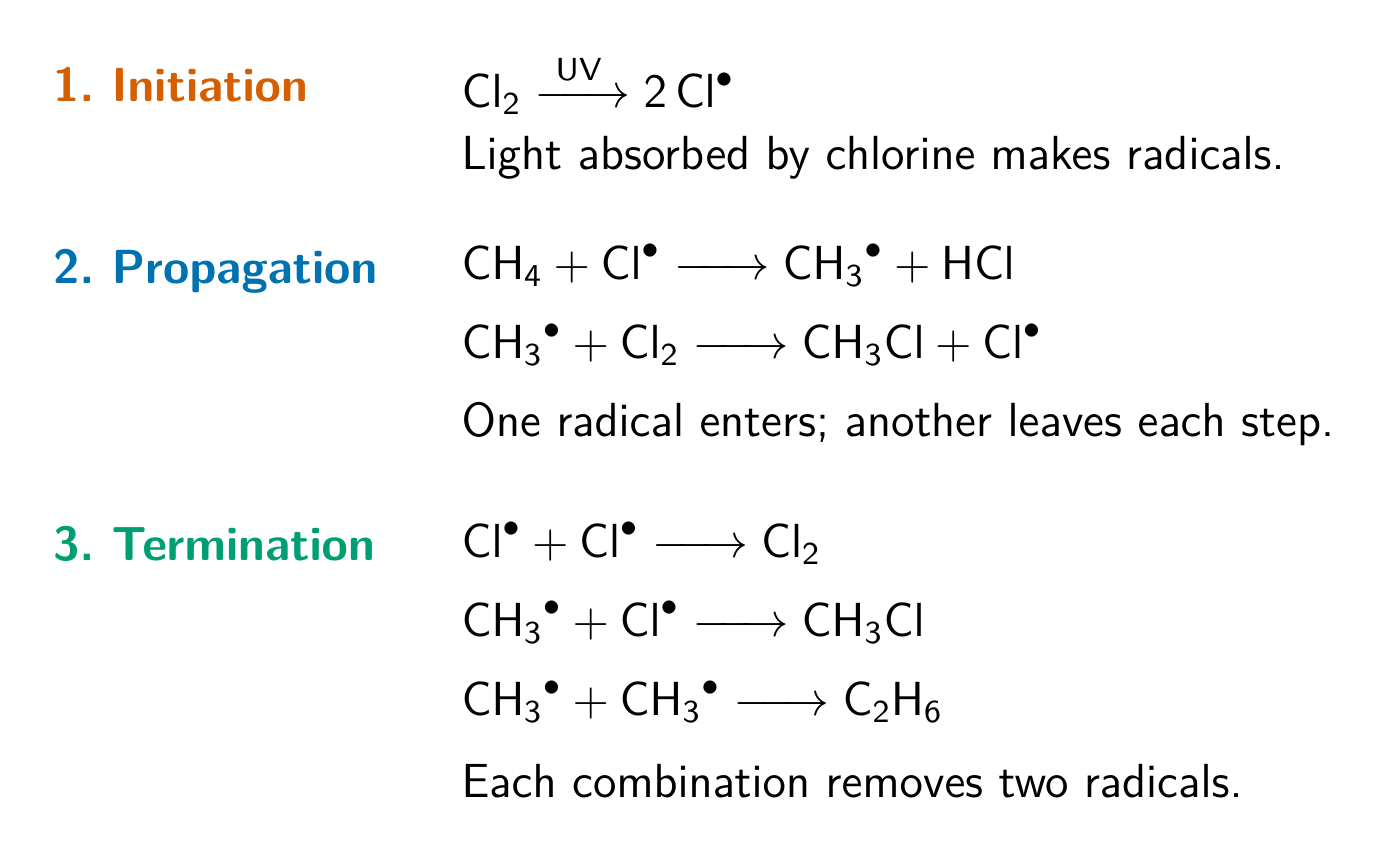
Which particle is regenerated over one complete propagation cycle?
难度 1/5 · 今日首次完成可获 100 金币及少量额外奖励
Cl• cancels, whereas Cl₂ remains a net reactant.
R3.3: Recognize termination 终止 without confusing the product
- Combination termination consumes two radicals and forms a non-radical product: 2Cl• → Cl₂, •CH₃ + Cl• → CH₃Cl, or 2•CH₃ → C₂H₆. Ethane is consistent with methyl-radical combination.
- CH₃Cl can form by propagation or by termination through different steps. Classify the full equation, not the product name. A two-to-zero radical count identifies combination termination in these examples; real radical chemistry has additional pathways.
How is •CH₃ + Cl• → CH₃Cl classified here?
难度 1/5 · 今日首次完成可获 100 金币及少量额外奖励
Use the radical count on both sides of the complete step.
R3.3: Explain mixtures and qualify control of selectivity
- CH₃Cl retains C–H bonds, so further abstraction and chlorine reaction can give CH₂Cl₂, CHCl₃ and CCl₄. Combination can add ethane. Which possible products are detectable depends on conditions, reaction progress and side reactions.
- Excess methane raises the chance that Cl• encounters methane rather than a partly chlorinated product. This can improve chloromethane selectivity without guaranteeing purity. Excess chlorine can favour further substitution. Consumed Cl₂ amount is not automatically chloromethane amount if multiple substitutions occur.
Why can excess methane improve the chloromethane proportion?
难度 1/5 · 今日首次完成可获 100 金币及少量额外奖励
A changed encounter probability is a qualitative control, not a purity guarantee.
R3.3: Count equivalent positions before different products
- Propane has equivalent end carbons. Either end gives the same constitutional product, 1-chloropropane; the middle gives 2-chloropropane. Butane similarly gives 1-chlorobutane and 2-chlorobutane as its two constitutional monochloro products.
- A reversed drawing is not a new connectivity. If counting constitutional products, do not add optical isomers as extra positions. The number of equivalent H atoms helps a statistical model, but actual per-H site reactivities need not be equal.
How many constitutional monochloro products does butane have?
难度 1/5 · 今日首次完成可获 100 金币及少量额外奖励
The two ends are equivalent, as are the two middle positions.
R3.3: Use invented site data transparently
- For propane there are six terminal H atoms and two middle H atoms. With explicitly invented per-H relative reactivities 1 and 3, the weighted contributions are 6 × 1 and 2 × 3, both six. This model predicts 50% of each constitutional monochloro product.
- If every H were equally reactive, the same counting would give 6:2, or 75% and 25%. Neither is a universal measured ratio. Use supplied reactivities and the stated single-substitution assumptions before converting site counts into proportions.
In an invented single-chlorination model for propane, six terminal H atoms have per-H reactivity 1 and two middle H atoms have per-H reactivity 3. What fraction of product is the middle-site product?
难度 1/5 · 今日首次完成可获 100 金币及少量额外奖励
Weight each site count by its per-H reactivity: terminal contribution = 6 × 1 = 6; middle contribution = 2 × 3 = 6. Middle-site fraction = 6/(6 + 6) = 0.50, or 50%. These are invented model inputs, not a universal measured distribution.
R3.3: Separate propagation enthalpy from activation energy
- Using supplied mean bond enthalpies, chlorination step one gives 414 − 431 = −17 kJ/mol, and step two gives 242 − 324 = −82 kJ/mol. Adding gives −99 kJ/mol for the overall substitution estimate.
- For bromination, the corresponding supplied estimates give +48 and −92 kJ/mol, net −44 kJ/mol. Endpoint changes do not give activation energies. Bromine abstraction commonly has a higher barrier under comparable conditions; exothermicity alone does not prove a fast rate.
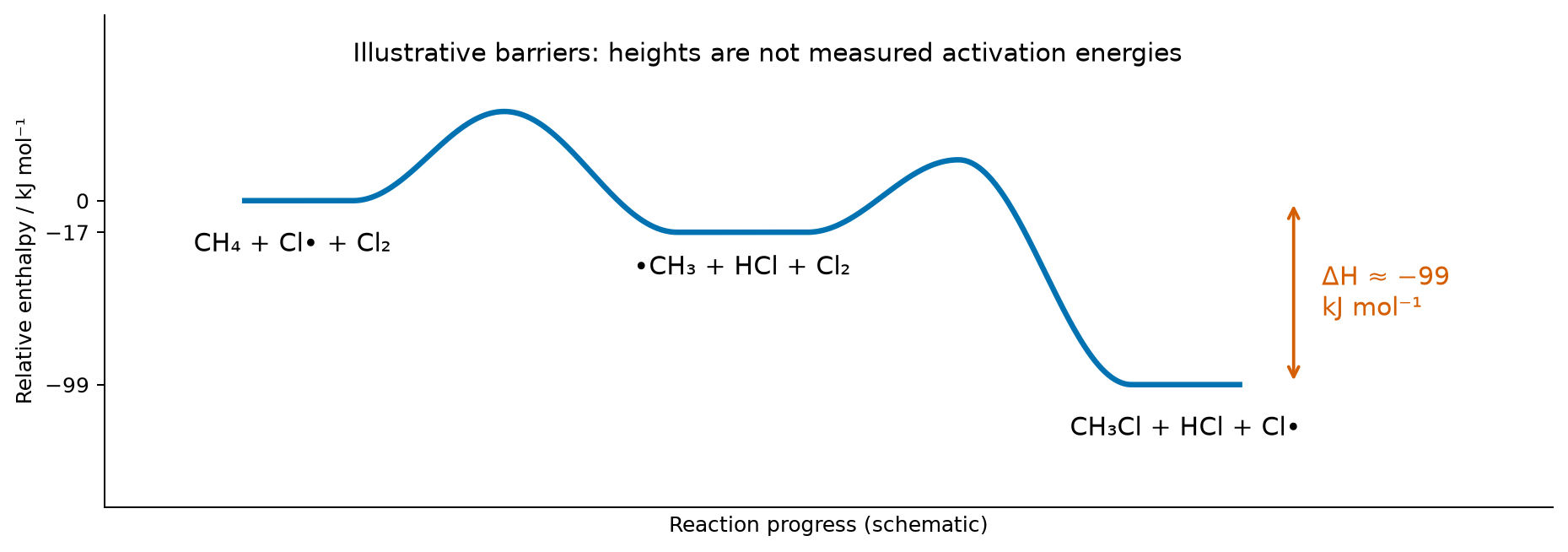
Which quantity is not obtained simply from these bond-enthalpy differences?
难度 1/5 · 今日首次完成可获 100 金币及少量额外奖励
Bond-enthalpy differences compare starting and ending bond inventories.
Using the supplied chlorine propagation changes −17 and −82 kJ/mol, give the net enthalpy in kJ/mol.
难度 2/5 · 今日首次完成可获 140 金币及少量额外奖励
Add the two propagation changes: −17 − 82 = −99 kJ/mol.
R3.3: Account for chain amplification without creating atoms
- In an invented model, 0.0020 mol Cl₂ initiates to 0.0040 mol Cl•. If each radical completes 40 propagation cycles before loss, propagation produces 0.16 mol CH₃Cl, assuming ample methane and chlorine and no side reactions.
- Those cycles also consume 0.16 mol methane and a further 0.16 mol chlorine. One initiation can support many cycles; it does not supply their product atoms. The chosen cycle count is a model input, not a fixed chain length measured in every reaction.
In an ideal methane chlorination model, propagation forms 0.16 mol CH₃Cl through CH₄ + Cl₂ → CH₃Cl + HCl. What additional chlorine amount does propagation consume, beyond that used in initiation?
难度 1/5 · 今日首次完成可获 100 金币及少量额外奖励
The net propagation equation uses one mole Cl₂ per mole CH₃Cl. Thus n(Cl₂ consumed in propagation) = 1 × 0.16 = 0.16 mol. Regenerating Cl• does not regenerate the Cl₂ reagent; initiation chlorine is counted separately.
In the invented model, 0.0020 mol Cl₂ initiates; each resulting Cl• completes 40 cycles. Give modeled CH₃Cl amount in mol.
难度 2/5 · 今日首次完成可获 140 金币及少量额外奖励
Cl₂ makes twice its amount of radicals: 2 × 0.0020 × 40 = 0.16 mol.
R3.3: Add the ozone 臭氧 cycle and state its limits
- Suitable stratospheric UV can release Cl• from a CFC. The simple steps Cl• + O₃ → ClO• + O₂ and ClO• + O → Cl• + O₂ regenerate Cl• and cancel the ClO• intermediate. The net equation is O₃ + O → 2O₂.
- This is one simplified catalytic cycle, not every atmospheric ozone-loss pathway. Atomic oxygen comes from photochemistry; other reactions and reservoirs limit radical survival. The 1987 Montreal Protocol established phase-out controls, not instant worldwide disappearance of all CFCs.
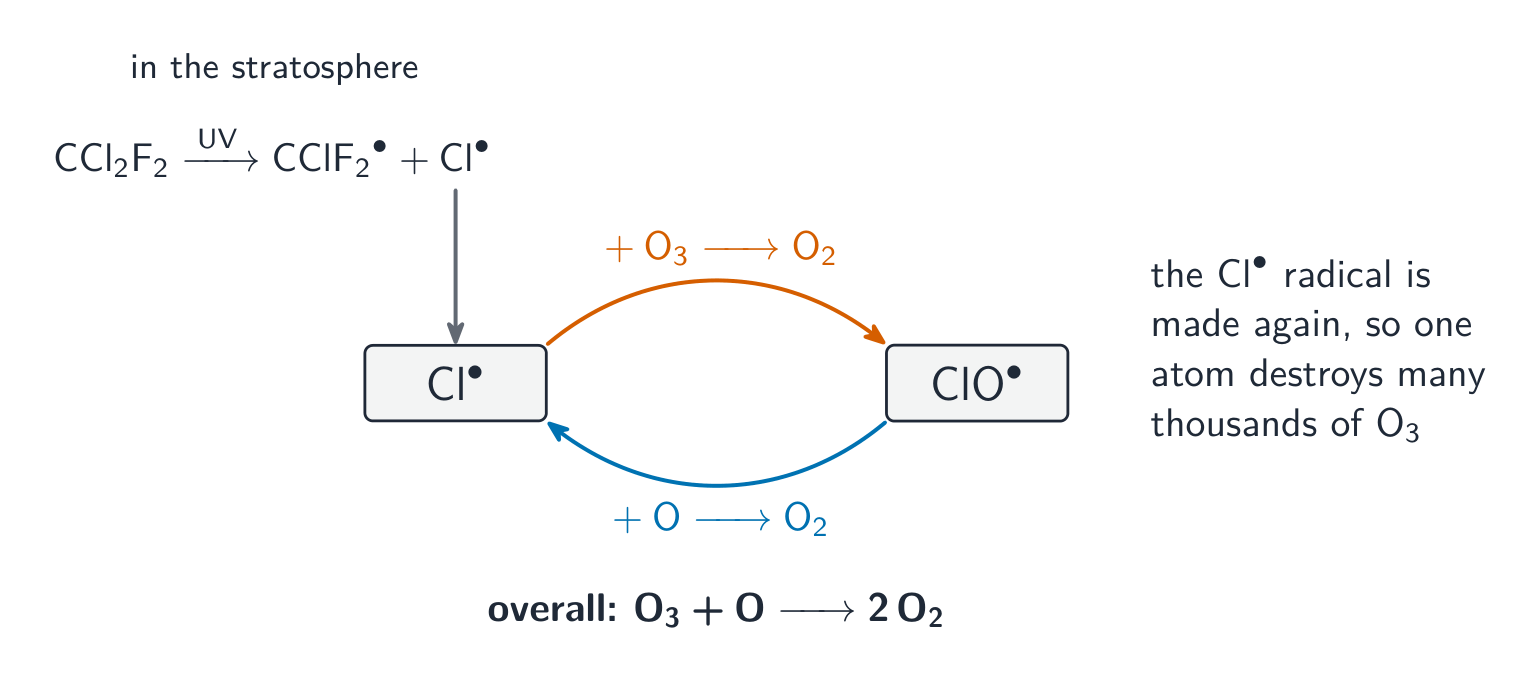
Add the supplied steps Cl• + O₃ → ClO• + O₂ and ClO• + O → Cl• + O₂. What is the net equation?
难度 1/5 · 今日首次完成可获 100 金币及少量额外奖励
Cancel both Cl• and ClO• while retaining the atomic-oxygen reactant.
R3.4: Name the electron-pair role at the reacting site
- A nucleophile forms a bond by donating both electrons of a pair. OH⁻, NH₃ and H₂O are common examples; nitrogen or oxygen supplies a lone pair. An electrophile 亲电试剂 accepts the pair: H⁺, NO₂⁺ or a polarized neutral Br₂ molecule can fill that role.
- Charge alone is insufficient: neutral NH₃ donates, whereas neutral Br₂ approaching a C=C can accept at its induced Brδ⁺ end. Identify the actual electron source and accepting centre. An alkene π pair can also act as a donor; not every donor pair must be a lone pair.
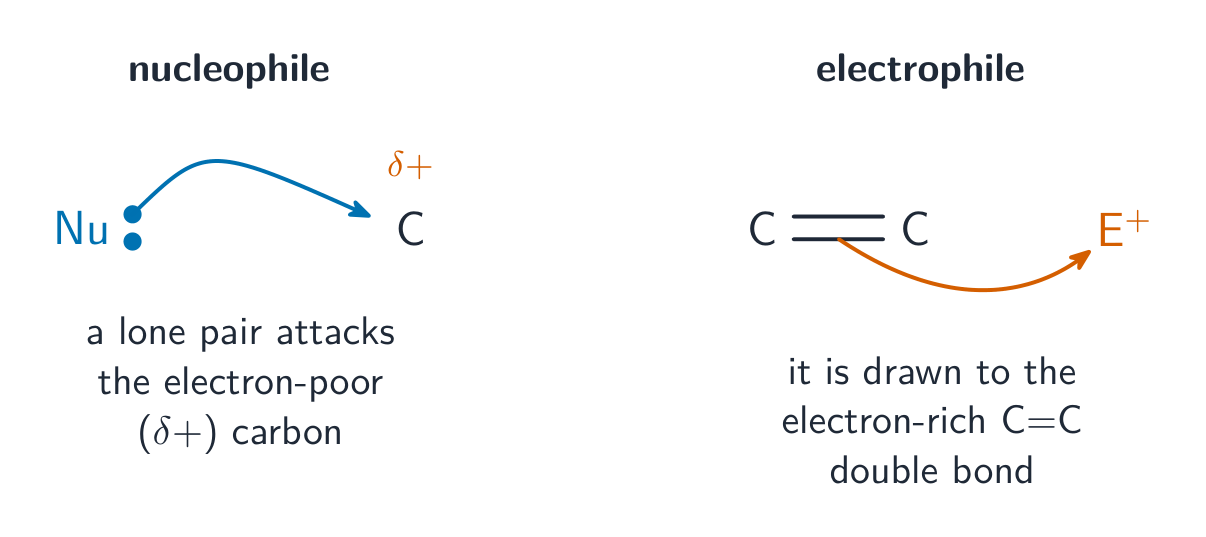
Which neutral molecule can donate an electron pair through nitrogen?
难度 1/5 · 今日首次完成可获 100 金币及少量额外奖励
NH₃ has an available N lone pair; H⁺ accepts a pair.
R3.4: Follow heterolysis and curly-arrow endpoints
- Heterolytic breaking of the illustrated neutral C–Br bond gives the full pair to Br: CH₃Br → CH₃⁺ + Br⁻. One full curly arrow starts at the bond and ends at Br. Homolysis instead divides the pair, shown with two fishhooks.
- The formal ion equation does not prove that a free methyl carbocation 碳正离子 readily forms in aqueous substitution. Every pair arrow starts at existing electrons and ends where they go. A positive charge is not an electron source, and a minus sign is not the physical position of a pair.
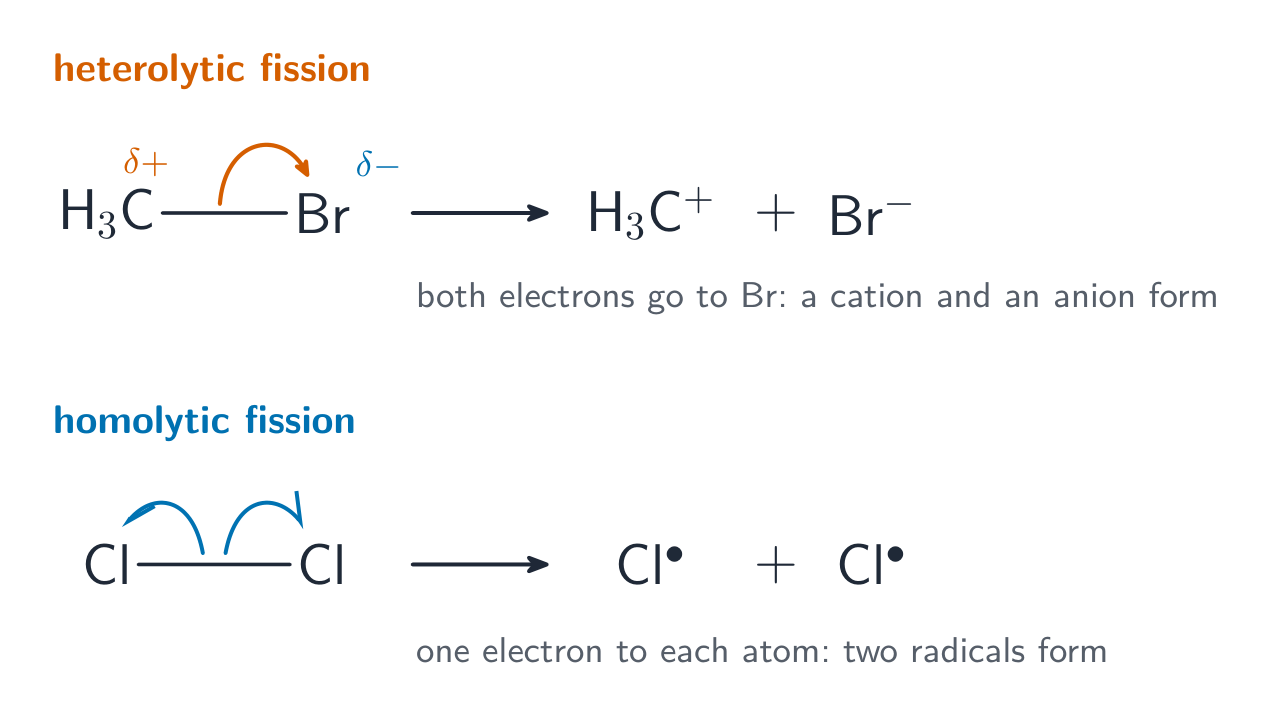
Where should the C–Br bond-breaking curly arrow point?
难度 1/5 · 今日首次完成可获 100 金币及少量额外奖励
The leaving bromine takes both electrons of the old bond.
R3.4: Substitute a leaving group 离去基团 while keeping the skeleton
- Warm aqueous hydroxide can substitute Br in 1-bromopropane: CH₃CH₂CH₂Br + OH⁻ → CH₃CH₂CH₂OH + Br⁻. Oxygen donates to the carbon bonded to Br; the old C–Br pair goes to bromine. The product is propan-1-ol.
- Br is more electronegative than carbon, so the C–Br carbon is δ⁺ and susceptible to nucleophilic attack. Three carbon atoms remain in each organic molecule. These net electron-pair changes are common content; detailed one-step and two-step mechanisms belong to Higher Level.
Which atom is attacked by hydroxide in the supplied substitution?
难度 1/5 · 今日首次完成可获 100 金币及少量额外奖励
The polarized C–Br bond identifies the reacting carbon.
R3.4: Check proton transfer after a neutral nucleophile reacts
- In the illustrative overall reaction CH₃CH₂Br + 2NH₃ → CH₃CH₂NH₂ + NH₄⁺ + Br⁻, one NH₃ makes the organic C–N bond and another accepts a proton. There are eleven H atoms on each side and net charge zero.
- Water can donate through oxygen. An initially attached R–OH₂⁺ oxygen has three bonds and positive charge; loss of H⁺ gives R–OH. Do not copy a neutral nucleophile into an uncharged product without checking valence and proton transfer.
What does the second ammonia do in the supplied net equation?
难度 1/5 · 今日首次完成可获 100 金币及少量额外奖励
One ammonia supplies product nitrogen; the other acts as a proton acceptor.
R3.4: Map three additions across the double bond
- In alkene addition, C=C becomes C–C, and each double-bond carbon gains a new bond. Ethene + Br₂ gives CH₂BrCH₂Br in a stated dibromide model; ethene + HBr gives CH₃CH₂Br; ethene + H₂O gives ethanol with acid catalysis.
- Hydration adds H and OH, with water consumed overall and acid regenerated. A steam/phosphoric-acid process is one industrial ethanol route, not the only route. For propene under usual ionic conditions, HBr gives mainly 2-bromopropane and acid-catalysed hydration mainly propan-2-ol.
Which statement distinguishes water and acid in hydration?
难度 1/5 · 今日首次完成可获 100 金币及少量额外奖励
The net equation includes water, whereas the catalytic proton is regenerated.
R3.4: Use bromine decolourization within its evidence limits
- In a suitable dark comparison, cyclohexene rapidly decolourizes orange bromine water while cyclohexane shows no rapid change. Keep reagent amount, temperature and light exposure comparable. A radical alkane reaction under UV is a different situation.
- Decolourization is consistent with unsaturation but is not unique proof of an alkene or specifically ethene: other substances can consume bromine. Aqueous product competition also means an observation alone does not identify every organic product. Practical handling follows approved teacher-controlled procedures.
What can decolourization alone establish about an unknown?
难度 1/5 · 今日首次完成可获 100 金币及少量额外奖励
A chemical observation supports a hypothesis without uniquely identifying the sample.
R3.4: Calculate substitution amount before isolated yield
- For an invented example, 0.0200 mol 1-bromopropane reacts with excess OH⁻. The balanced substitution has a 1:1 substrate/alcohol ratio, so the theoretical propan-1-ol amount is 0.0200 mol. The three-carbon skeleton stays within each molecule.
- If isolated yield is 68.0%, actual amount = 0.0200 × 0.680 = 0.0136 mol. Reaction stoichiometry predicts the maximum; work-up losses or competing reactions can lower isolated amount. Do not multiply moles by three because the molecule contains three carbons.
In CH₃CH₂CH₂Br + OH⁻ → CH₃CH₂CH₂OH + Br⁻, 0.0200 mol 1-bromopropane reacts with excess hydroxide. What is the theoretical alcohol amount?
难度 1/5 · 今日首次完成可获 100 金币及少量额外奖励
The balanced equation gives one mole propan-1-ol per mole substrate. Theoretical amount = 0.0200 × 1/1 = 0.0200 mol. Three carbons per molecule do not multiply the molecule or mole count by three.
Give actual alcohol amount in mol from 0.0200 mol substrate at 68.0% isolated yield, using a 1:1 substitution.
难度 2/5 · 今日首次完成可获 140 金币及少量额外奖励
The 1:1 substitution gives theoretical alcohol amount = 0.0200 mol. Actual amount = theoretical amount × percentage yield/100 = 0.0200 × 68.0/100 = 0.0136 mol.
R3.4: Use a stated single-addition model for bromine amount
- For 0.0120 mol but-2-ene, the supplied single-addition model consumes 0.0120 mol Br₂ to form 2,3-dibromobutane. One double bond consumes one bromine molecule, not one bromine molecule per carbon atom.
- With Br₂ molar mass 159.8 g/mol, mass = amount × molar mass = 0.0120 × 159.8 = 1.9176 g, or 1.92 g to three significant figures. This is a calculated requirement for the model, not a recommended practical dose.
Which product connectivity follows in the dibromide model?
难度 1/5 · 今日首次完成可获 100 金币及少量额外奖励
Each of the original double-bond carbons gains a Br atom.
Give mass in grams of 0.0120 mol Br₂, using molar mass 159.8 g/mol.
难度 2/5 · 今日首次完成可获 140 金币及少量额外奖励
Use mass = amount × molar mass: m = nM = 0.0120 × 159.8 = 1.9176 g. Round only the final result to three significant figures: 1.92 g.
R3.4: Choose reagents for a two-step route
- Ethene + HBr → bromoethane is electrophilic addition 亲电加成 under the usual ionic conditions. Bromoethane + warm aqueous OH⁻ → ethanol + Br⁻ is nucleophilic substitution 亲核取代. Both steps preserve the two-carbon skeleton.
- A route needs the actual reacting bond, reagent and conditions, not only an arrow between compound names. HBr addition and OH⁻ substitution change different bonds. Direct acid-catalysed hydration is another route to ethanol and uses a different net reagent.
Which second step converts bromoethane to ethanol in the proposed route?
难度 1/5 · 今日首次完成可获 100 金币及少量额外奖励
Bromoethane has a C–Br bond for substitution, not an alkene C=C.
AHL R3.4: Connect Lewis roles with proton transfer
- A Lewis base 路易斯碱 donates an electron pair; a Lewis acid 路易斯酸 accepts it. NH₃ donates its N lone pair to H⁺ to form NH₄⁺, so it is also a Brønsted–Lowry proton acceptor in this reaction.
- NH₃ also donates to electron-deficient B in BF₃, forming an adduct without proton transfer. Draw N lone pair → B. A coordination bond 配位键 records that both original bonding electrons came from one donor; it is not a universally weaker class of covalent bond.
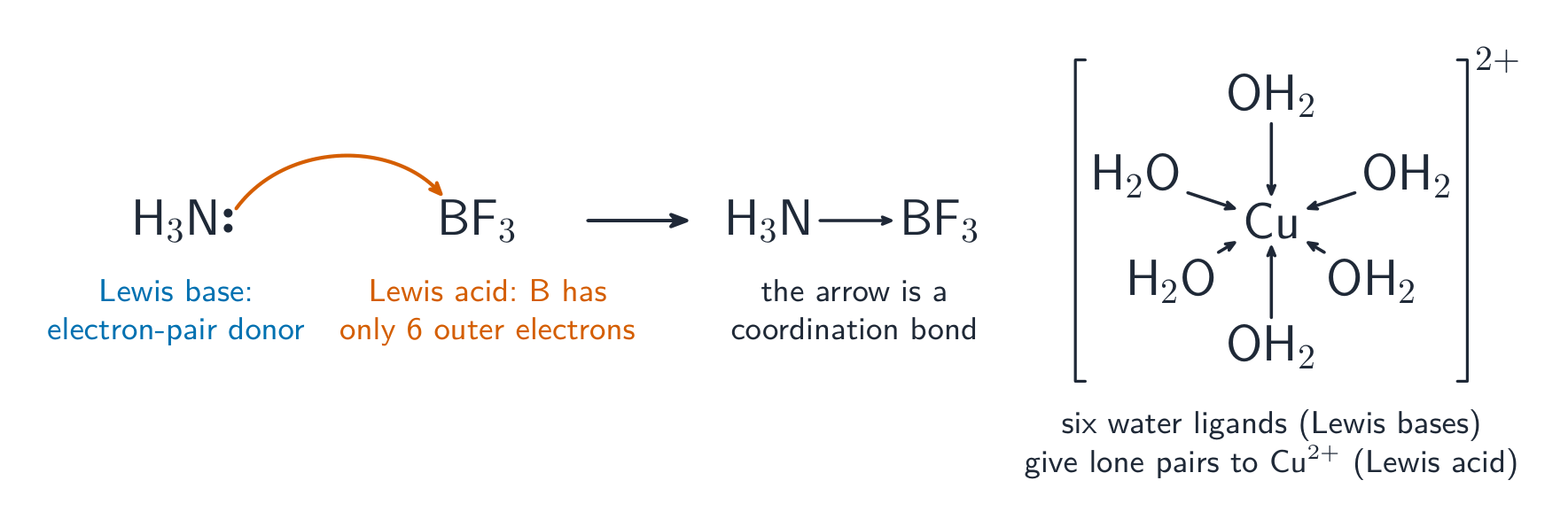
Which reaction demonstrates Lewis acid–base behaviour without proton transfer?
难度 1/5 · 今日首次完成可获 100 金币及少量额外奖励
The BF₃ adduct extends acid–base reasoning beyond proton transfer.
AHL R3.4: Separate complex charge from coordination number 配位数
- For a complex, total charge = metal-ion charge + sum of ligand 配体 charges. H₂O and NH₃ are neutral; CN⁻ and Cl⁻ each contribute −1. In [Fe(CN)₆]⁴⁻, x − 6 = −4 gives Fe +2.
- For [Co(NH₃)₅Cl]²⁺, x − 1 = +2 gives Co +3. With the given monodentate ligands, each complex has six donor atoms and coordination number six. Multidentate ligands can supply several donor atoms, so ligand count alone is not always coordination number.
What is the metal oxidation state in [Co(NH₃)₅Cl]²⁺?
难度 1/5 · 今日首次完成可获 100 金币及少量额外奖励
The coordinated chloride contributes −1 to the total +2 charge.
Give the metal oxidation state in [Fe(CN)₆]⁴⁻.
难度 2/5 · 今日首次完成可获 140 金币及少量额外奖励
Each CN⁻ ligand contributes −1. Let Fe oxidation state be x: x + 6(−1) = −4. Thus x − 6 = −4 and x = +2. This metal state differs from the total complex charge.
AHL R3.4: Describe a concerted substitution without a carbocation
- For the primary bromoethane/OH⁻ SN2 model, the O lone pair attacks from the side opposite Br as the C–Br pair goes to Br. Bond formation and breaking occur in one event. Rate = k[RBr][OH⁻] in the simple bimolecular model.
- One transition-state 过渡态 peak appears on the energy profile, without a carbocation valley. Partial bonds in the transition state are not exactly half bonds or a stable intermediate. The model describes a tested pathway, not proof that every primary substrate has the same rate under all conditions.
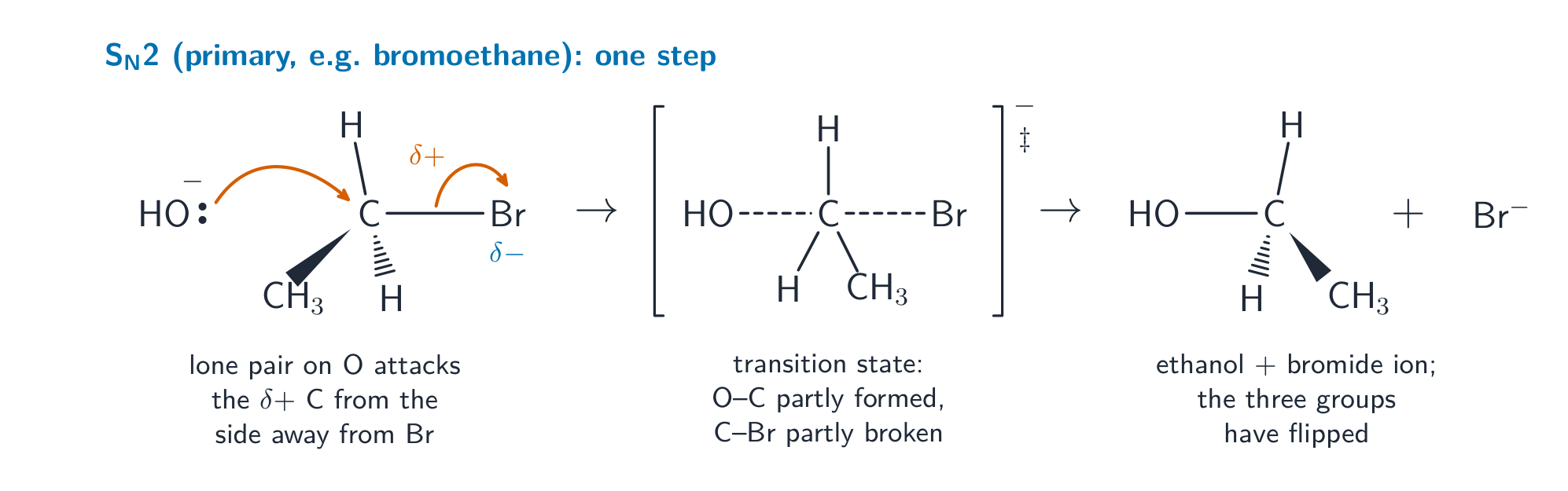
How many carbocation intermediates are in the simple SN2 model?
难度 1/5 · 今日首次完成可获 100 金币及少量额外奖励
An SN2 transition state is not an isolated carbocation intermediate.
AHL R3.4: Explain the two steps of the tertiary substitution model
- For tertiary 2-bromo-2-methylpropane in the SN1 model, slow C–Br heterolysis gives a carbocation and Br⁻. Hydroxide then donates its O lone pair to the positive carbon in a faster step. Rate = k[RBr] in the simple model.
- Three alkyl groups stabilize the positive carbon and hinder backside attack. A two-step profile has two peaks separated by an intermediate valley. Secondary halogenoalkanes can use either model; substrate classification is not an unconditional statement about every possible reaction condition.
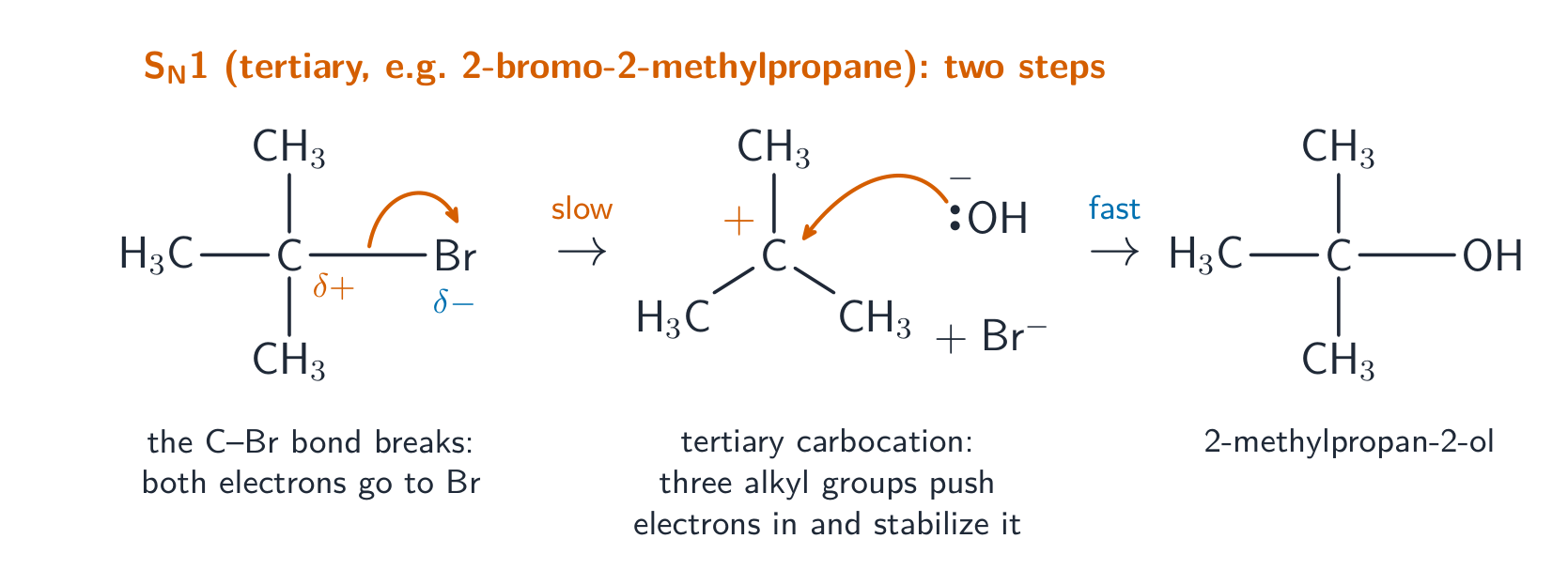
Why can the rate be independent of OH⁻ in this SN1 model?
难度 1/5 · 今日首次完成可获 100 金币及少量额外奖励
Kinetic order describes rate sensitivity, not whether a species participates overall.
AHL R3.4: Use invented kinetic data rather than overall coefficients
- In invented data, doubling [RBr] alone doubles rate and doubling [OH⁻] alone also doubles rate. At 0.020 mol/dm³ RBr and 0.100 mol/dm³ OH⁻, rate is 4.0 × 10⁻⁵ mol/(dm³ s). The tested model is rate = k[RBr][OH⁻].
- Thus k = rate/([RBr][OH⁻]) = 0.020 dm³/(mol s). Doubling both concentrations multiplies rate by four to 1.6 × 10⁻⁴ mol/(dm³ s). An overall reaction equation alone cannot supply these experimental orders.
For the stated rate law r = k[RBr][OH⁻] at fixed temperature, how does doubling both reactant concentrations change the rate?
难度 1/5 · 今日首次完成可获 100 金币及少量额外奖励
The law is first order in each reactant. Rate factor = (2[RBr]/[RBr]) × (2[OH⁻]/[OH⁻]) = 2 × 2 = 4, so rate increases fourfold while k stays constant.
Invented rate is 4.0 × 10⁻⁵ mol/(dm³ s) at [RBr] 0.020 and [OH⁻] 0.100 mol/dm³. For r=k[RBr][OH⁻], give k in dm³/(mol s).
难度 2/5 · 今日首次完成可获 140 金币及少量额外奖励
k = 4.0 × 10⁻⁵/(0.020 × 0.100) = 0.020.
AHL R3.4: Describe inversion without calling different compounds enantiomers
- Backside SN2 attack inverts the arrangement at the reacting carbon. A stated SN2 conversion of chiral 2-bromobutane can give butan-2-ol with inverted spatial arrangement. R/S priorities must be reassigned for the new groups.
- The alcohol and halogenoalkane differ in composition and cannot be enantiomers of each other. In an SN1 case, a planar intermediate can permit both faces of attack if a chiral product centre forms; exact 50:50 proportions are not guaranteed by the simple model.
Which statement is correct for the stated SN2 transformation?
难度 1/5 · 今日首次完成可获 100 金币及少量额外奖励
Enantiomers must have the same composition and connectivity.
AHL R3.4: Compare leaving groups under matched conditions
- Otherwise matched iodoalkanes commonly substitute faster than bromoalkanes and chloroalkanes. C–I is weaker than C–Br and C–Cl, and I⁻ is a better leaving group than Cl⁻. The least polar C–I bond does not mean the slowest substitution.
- Mean homolytic bond enthalpies support a qualitative bond-strength comparison; they are not numerical activation energies for heterolysis. Keep substrate structure and conditions matched. Detailed solvent and mechanism effects on this rate comparison are not assessed in the objective.
Which explanation fits faster matched iodoalkane substitution?
难度 1/5 · 今日首次完成可获 100 金币及少量额外奖励
The bond-strength/leaving-group trend differs from the polarity trend.
AHL R3.4: Use the bromonium model for bromine addition
- The alkene π pair attacks the induced Brδ⁺. The Br–Br pair leaves with the far bromine, while a lone pair on the near Br bonds to the other carbon. This forms a three-membered bromonium ion and Br⁻.
- Bromide attacks a carbon as the corresponding bridge C–Br pair returns to Br. The bridge opens, giving the dibromide. Aqueous water can compete and form bromohydrins; specify the reaction medium and the stated model rather than inferring every product from decolourization.
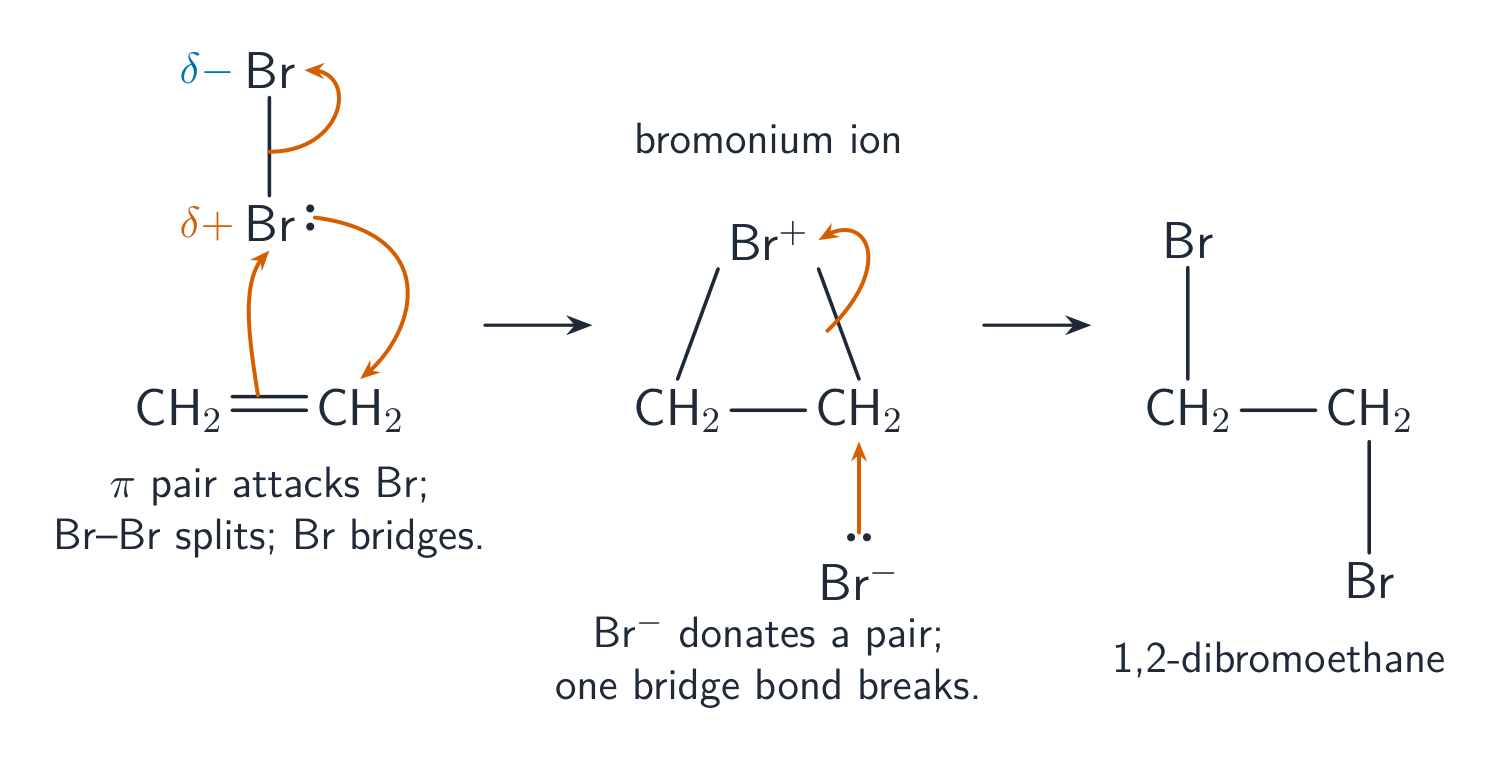
Which intermediate is appropriate for usual Br₂ addition to ethene?
难度 1/5 · 今日首次完成可获 100 金币及少量额外奖励
The bromonium bridge distinguishes this pathway from the hydrogen-halide carbocation model.
AHL R3.4: Include the charged oxygen stage in acid hydration
- Ethene π electrons accept H⁺ to give CH₃CH₂⁺ in the simple model. Water donates an O lone pair to the positive carbon, giving CH₃CH₂OH₂⁺. A base removes H⁺ as the O–H pair returns to oxygen, forming ethanol.
- The acid is regenerated overall. The oxonium oxygen has three bonds and +1 charge before deprotonation. Water is the nucleophile in the acidic mixture; directly adding OH⁻ describes different conditions. For propene, the favoured secondary-carbocation route leads mainly to propan-2-ol.
What follows water attack before the neutral alcohol appears?
难度 1/5 · 今日首次完成可获 100 金币及少量额外奖励
Deprotonation restores two oxygen bonds and regenerates the acid.
AHL R3.4: Explain the major hydrogen-halide product
- For usual ionic HBr addition to propene, the π pair bonds to H and the H–Br pair moves to Br. Protonation at the terminal carbon gives a secondary carbocation at the middle carbon; Br⁻ attack then gives mainly 2-bromopropane.
- Alkyl groups help stabilize the carbocation. The Markovnikov pattern describes the favoured ionic orientation, not every possible radical or rearranging addition. Distinguish an overall product prediction from a complete curved-arrow mechanism.
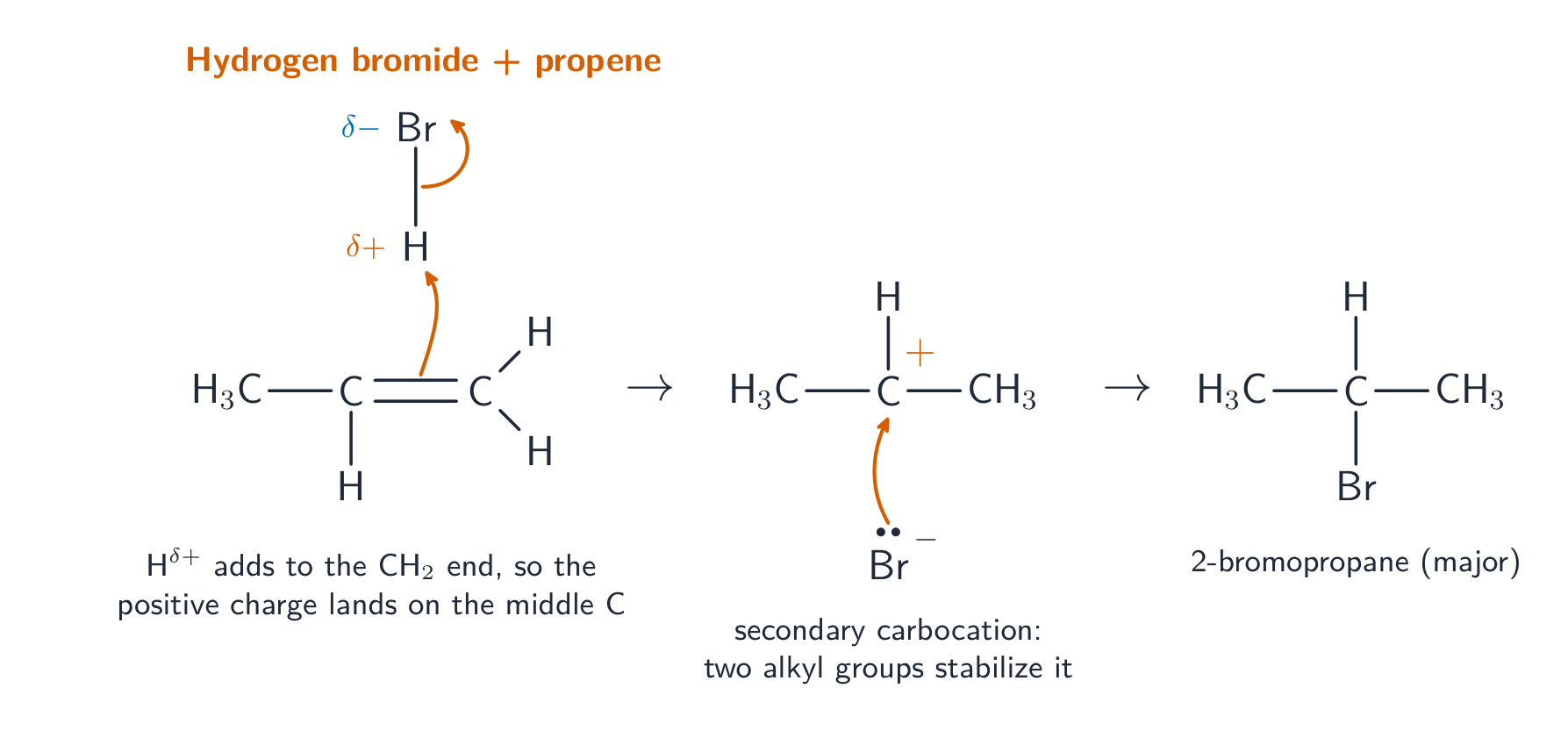
Which carbocation route supports the usual major product?
难度 1/5 · 今日首次完成可获 100 金币及少量额外奖励
The more stable secondary route favours 2-bromopropane under the stated conditions.
AHL R3.4: Restore aromaticity in benzene substitution
- Begin the required mechanism with supplied E⁺. A ring π pair bonds to E, temporarily interrupting aromatic delocalization and giving a positively charged intermediate. A base then removes H⁺ while the C–H pair returns into the ring.
- C₆H₅E regains aromaticity, so the overall change is substitution. Addition would not restore that original aromatic system. Nitration with NO₂⁺ illustrates the pattern, but formation of the electrophile is not assessed in this objective.
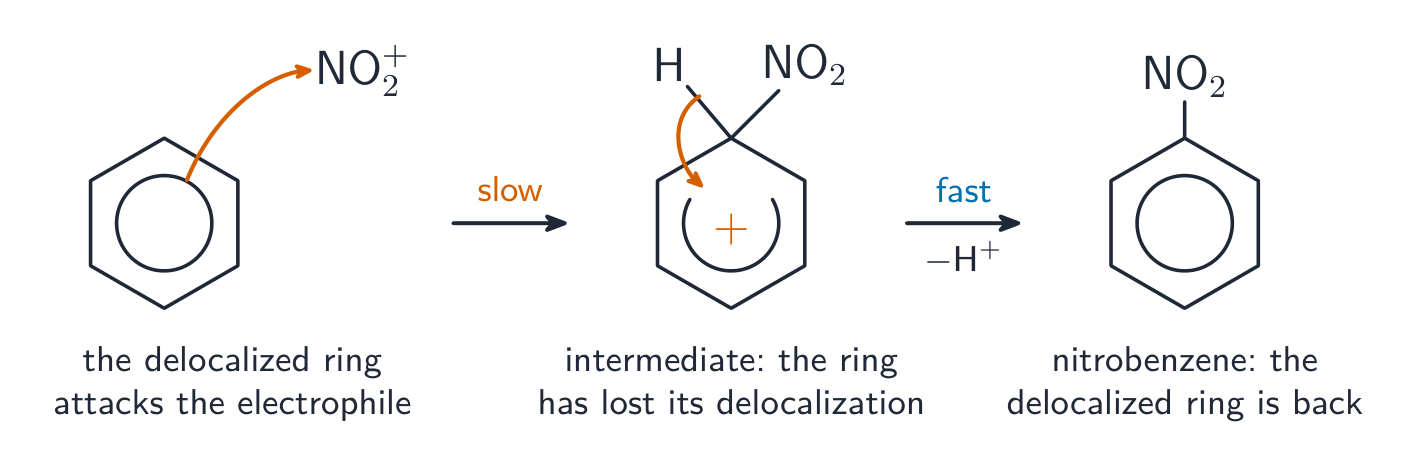
Which electron-pair movement restores the aromatic ring?
难度 1/5 · 今日首次完成可获 100 金币及少量额外奖励
C–H electron return repairs the aromatic π system.