Operations and break-even decisions
引入| English | 释义 | 拼音 |
|---|---|---|
| job production/dʒɒb prəˈdʌkʃn/ | 单件生产 | dān jiàn shēng chǎn |
| batch production/bætʃ prəˈdʌkʃn/ | 批量生产 | pī liàng shēng chǎn |
| mass production | 大规模生产 | dà guī mó shēng chǎn |
| lean production/liːn prəˈdʌkʃn/ | 精益生产 | jīng yì shēng chǎn |
| kaizen/ˈkaɪzn/ | 持续改善 | chí xù gǎi shàn |
| quality assurance/ˈkwɒlɪti əˈʃʊərəns/ | 质量保证 | zhì liàng bǎo zhèng |
| break-even point/breɪk ˈiːvən pɔɪnt/ | 盈亏平衡点 | yíng kuī píng héng diǎn |
| contribution/ˌkɒntrɪˈbjuːʃn/ | 边际贡献 | biān jì gòng xiàn |
| margin of safety/ˈmɑːdʒɪn ɒv ˈseɪfti/ | 安全边际 | ān quán biān jì |
| capacity utilisation/kəˈpæsɪti ˌjuːtɪlaɪˈzeɪʃn/ | 产能利用率 | chǎn néng lì yòng lǜ |
When the parts stopped coming, March 2011
- Toyota's "just-in-time" system kept almost no spare parts: suppliers delivered exactly what was needed, hours before it was used. It made Toyota one of the most efficient car makers in the world.
- On 11 March 2011 an earthquake and tsunami hit north-east Japan. With no stock to fall back on, Toyota lost production of hundreds of thousands of cars over the following months. Operations decisions trade efficiency against risk.
Production methods
- Job production 单件生产 makes one-off items to order (a wedding dress); batch production 批量生产 makes groups of identical items (bread); mass production 大规模生产 makes huge quantities on a line (phones).
- Mass production gives the lowest unit cost but needs high demand and costly machines; job production is flexible but expensive per unit.
Match each product to its usual production method.
难度 2/5 · 今日首次完成可获 140 金币及少量额外奖励
The size of demand and how standard the product is decide the method.
Lean production and quality
- Lean production 精益生产 cuts waste of time, stock and materials. Just-in-time keeps stock low; kaizen 持续改善 means small, continuous improvements suggested by workers.
- Quality control inspects finished goods; quality assurance 质量保证 builds quality into every stage, so fewer faults are made in the first place.
销售预测能覆盖固定成本吗?
$Q_{BE}=\frac{F}{p-v};\quad \pi=(p-v)Q-F$
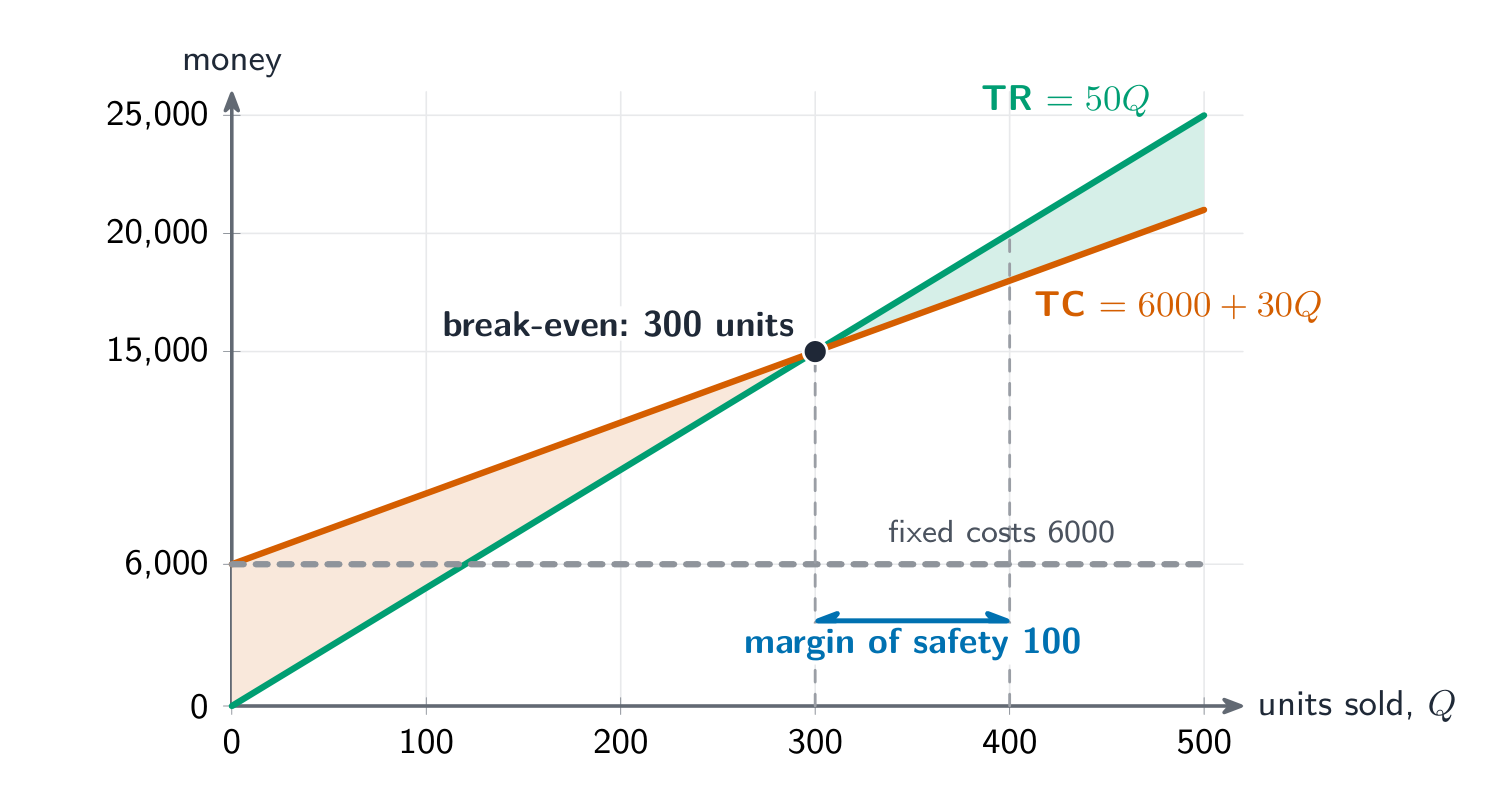
例题的盈亏平衡产量为 300 件;销售 400 件时安全边际为 100 件。
What are the risks of just-in-time stock control?
难度 2/5 · 今日首次完成可获 140 金币及少量额外奖励
JIT reduces stock, so money tied up in stock and storage waste are low — but delays hit at once.
Break-even analysis
- The break-even point 盈亏平衡点 is the output where total revenue equals total cost: no profit and no loss. Break-even output $= \dfrac{\text{fixed costs}}{\text{price} - \text{variable cost per unit}}$.
- Price minus variable cost is the contribution 边际贡献 per unit: each unit sold contributes that amount towards fixed costs, then profit.
Fixed costs are 12 000, price 25 and variable cost 15 per unit. What is the break-even output?
难度 2/5 · 今日首次完成可获 140 金币及少量额外奖励
Contribution 10, so $\dfrac{12\,000}{10} = 1200$ units.
Worked example: the break-even chart
A firm sells a product for 50. Variable cost is 30 per unit and fixed costs are 6000 a month. It expects to sell 400 units. Find the break-even output, the margin of safety and the profit.
- Contribution: $50 - 30 = 20$ per unit. Break-even: $\dfrac{6000}{20} = 300$ units.
- Margin of safety 安全边际: $400 - 300 = 100$ units — sales can fall by a quarter before the firm makes a loss.
- Profit at 400: $400 \times 20 - 6000 = 2000$. Check: $TR = 20\,000$, $TC = 6000 + 12\,000 = 18\,000$.
Break-even is 1200 units and the firm sells 1500. What is the margin of safety, in units?
难度 2/5 · 今日首次完成可获 140 金币及少量额外奖励
1500 − 1200 = 300 units.
Price 25, variable cost 15, fixed costs 12 000. What is the profit at 1500 units?
难度 2/5 · 今日首次完成可获 140 金币及少量额外奖励
$1500 \times 10 - 12\,000 = 3000$.
If a firm cuts its price, its break-even output falls.
难度 1/5 · 今日首次完成可获 100 金币及少量额外奖励
A lower price cuts contribution per unit, so more units are needed to cover fixed costs.
Location and supply chains
- Location depends on costs (land, labour, transport), access to markets and suppliers, and government incentives. Many firms moved production to China for lower costs and huge supplier networks.
- Long, lean supply chains are cheap but fragile. After 2011, and again in the 2020–21 chip shortage, many firms kept more safety stock and found second suppliers.
Capacity and make-or-buy (HL)
- Capacity utilisation 产能利用率 $= \dfrac{\text{actual output}}{\text{maximum possible output}} \times 100\,\%$. High utilisation spreads fixed costs, but leaves no room for extra orders or maintenance.
- In a make-or-buy decision, compare the cost of making a part with the price of buying it, and then the control, quality and risk.
A factory can make 8000 units a month and makes 6000. What is its capacity utilisation?
难度 2/5 · 今日首次完成可获 140 金币及少量额外奖励
$\dfrac{6000}{8000} \times 100 = 75\,\%$.
"Break-even means the firm has made enough money" is wrong. At break-even the profit is zero. The firm has only covered its costs; it needs sales above break-even — the margin of safety — to make any profit, and the analysis assumes the price and unit costs stay constant.
Production methods range from job to mass, trading flexibility for low unit cost. Lean production cuts waste but makes supply chains fragile. Break-even output is fixed costs ÷ contribution per unit; sales above it, the margin of safety, earn profit, as long as prices and unit costs hold.
After the 2011 earthquake, should a car maker abandon just-in-time? Discuss.
Weigh efficiency against resilience.