Social-enterprise action planning
引入| English | 释义 | 拼音 |
|---|---|---|
| social enterprise/ˈsəʊʃl ˈentəpraɪz/ | 社会企业 | shè huì qǐ yè |
| cooperatives | 合作社 | hé zuò shè |
| action plan/ˈækʃn plæn/ | 行动计划 | xíng dòng jì huà |
| key performance indicators | 关键绩效指标 | guān jiàn jì xiào zhǐ biāo |
Loans of 27 dollars, 1976
- In 1976 the economist Muhammad Yunus lent 27 dollars of his own money to 42 women in a Bangladeshi village who made bamboo stools. They repaid every cent.
- He founded Grameen Bank in 1983 to lend small sums to poor people, mainly women, without collateral. Yunus and the bank won the 2006 Nobel Peace Prize. Grameen is a social enterprise 社会企业: a business that trades to achieve a social mission.
What makes a social enterprise
- A social enterprise earns most of its income by selling goods or services, like any business, but reinvests its surplus in its mission rather than paying it all to owners.
- Forms include cooperatives 合作社 owned by members, community interest companies and non-profits. Mondragon in Spain, founded in 1956, is a federation of worker cooperatives employing about 70 000 people.
What distinguishes a social enterprise from a charity that depends on donations?
难度 1/5 · 今日首次完成可获 100 金币及少量额外奖励
Social enterprises trade, and reinvest the surplus in their mission.
Match each organisation to its form.
难度 2/5 · 今日首次完成可获 140 金币及少量额外奖励
Ownership and the use of surplus decide the form.
From mission to action plan
- A good mission is clear: who is helped, how, and how you will know. An action plan 行动计划 turns it into specific tasks, people responsible, deadlines and a budget.
- Tools from the IB toolkit help: SWOT for the starting position, STEEPLE for the outside environment, a Gantt chart for timing and a cash-flow forecast for money.
Match each planning need to a tool.
难度 2/5 · 今日首次完成可获 140 金币及少量额外奖励
Each tool answers a different planning question.
Worked example: a bicycle-repair cooperative
Students plan a repair café charging 20 per repair. Parts cost 8 per repair; fixed costs (rent of a stall, tools, insurance) are 600 a month. They expect 80 repairs a month and want a reserve of two months' fixed costs. Plan the numbers.
- Break-even: contribution $20 - 8 = 12$, so $\dfrac{600}{12} = 50$ repairs a month.
- Surplus at 80 repairs: $80 \times 12 - 600 = 360$ a month, to reinvest or lower prices for those in need.
- Reserve: $2 \times 600 = 1200$ before opening — about three to four months of surplus, so they should raise it from a grant or crowdfunding first.
A community café charges 6 per meal; ingredients cost 2.5 per meal; fixed costs are 1400 a month. What is break-even, in meals?
难度 2/5 · 今日首次完成可获 140 金币及少量额外奖励
Contribution 3.5, so $\dfrac{1400}{3.5} = 400$ meals.
The café sells 520 meals. What is its monthly surplus?
难度 2/5 · 今日首次完成可获 140 金币及少量额外奖励
$520 \times 3.5 - 1400 = 1820 - 1400 = 420$.
People and governance
- Volunteers need training, a rota and recognition, or they leave; paid staff bring reliability. In a cooperative, members vote on major decisions — one member, one vote.
- Social enterprises answer to many stakeholders: the people they serve, funders, volunteers and the community.
Measuring social impact
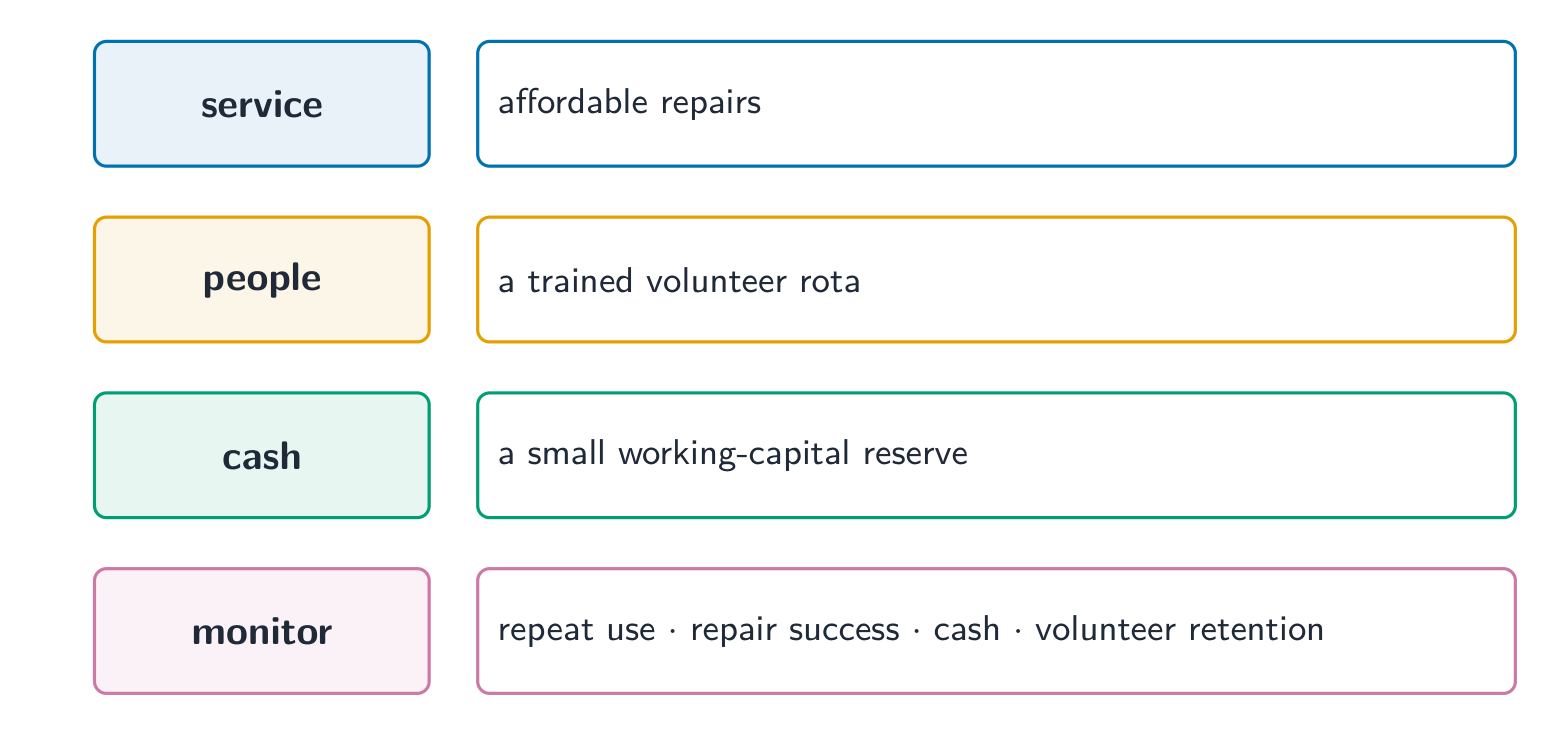
- Track key performance indicators 关键绩效指标 that match the mission: for the repair café, repairs completed, repeat customers, bikes kept out of landfill, volunteer retention and cash balance.
- Report honestly, including what did not work. Funders and members trust evidence more than stories.
Which are good indicators of social impact for a bicycle-repair cooperative?
难度 2/5 · 今日首次完成可获 140 金币及少量额外奖励
Good KPIs measure the mission and how well the enterprise keeps running.
"A social enterprise does not need to make a surplus" is wrong. It must cover its costs and build a reserve, or it will close and help no one. The difference is what it does with the surplus — reinvesting in the mission — not whether it makes one.
A social enterprise should aim to make no surplus at all.
难度 1/5 · 今日首次完成可获 100 金币及少量额外奖励
It needs a surplus to build reserves and grow its mission.
A social enterprise trades like a business but reinvests its surplus in a social mission. Turn the mission into an action plan with tasks, people, deadlines and a budget; check break-even and keep a cash reserve; and measure impact with indicators that match the mission.
Write a short action plan for a student-run second-hand uniform shop whose mission is to cut the cost of school uniforms.
An action plan is specific enough for someone else to follow.