Inheritance, variation and probability
引入| English | 释义 | 拼音 |
|---|---|---|
| allele/əˈliːl/ | 等位基因 | děng wèi jī yīn |
| genotype/ˈdʒenətaɪp/ | 基因型 | jī yīn xíng |
What would explain this observation?
- Two parents can carry a recessive allele 等位基因 without expressing the associated phenotype. Their children do not have to match the parents phenotypically.
Build the model
- An allele is a variant of a gene.
- A genotype 基因型 lists alleles; a phenotype is the expressed characteristic, influenced by genotype and sometimes environment.
- Dominant and recessive describe the relationship between alleles, not how common they are.
- allele: A variant of a gene.
- genotype: The alleles an organism carries.

What does a 25% probability in Aa × Aa mean?
难度 1/5 · 今日首次完成可获 100 金币及少量额外奖励
The 25% is a probability for each fertilization under the model: each child of Aa x Aa parents has a one-quarter chance of aa. Chance has no memory, so no fixed number of aa children is guaranteed in any family of four.
Match each technical term to its precise meaning.
难度 2/5 · 今日首次完成可获 140 金币及少量额外奖励
Use the definitions to distinguish related quantities and processes.
Choose evidence that can test it
- In a simple monohybrid cross Aa × Aa, gametes carry A or a.
- Combining independent gametes gives AA, Aa, Aa and aa.
- The predicted probabilities describe many possible fertilizations, not a fixed order of children.
In the lab: Write parental genotypes and gametes before making the grid. State the inheritance model and phenotype key. Use a pedigree to check consistency with a model; do not infer certainty from a small family alone.
Which two habits make the investigation or model in this case more defensible?
难度 2/5 · 今日首次完成可获 140 金币及少量额外奖励
Stating the conditions and assumptions lets others repeat the work exactly, and recording the supporting evidence lets them check the conclusion. Hiding disagreeing results removes the evidence that could challenge a wrong conclusion, and one measurement can never establish a wider claim.
Work from known quantities
- Known: Aa × Aa with complete dominance.
- Probability of aa = 1/4 = 25%.
- Probability of the dominant phenotype = 3/4 = 75%.
- If four children are born, there is no guarantee that exactly one has the recessive phenotype.
Your turn: In Aa × aa, what percentage of offspring are predicted to be aa?
Aa × Aa:概率而非出生顺序
简单的完全显性模型预测的是概率,不是后代出现的固定顺序。
In Aa × aa, what percentage of offspring are predicted to be aa?
难度 2/5 · 今日首次完成可获 140 金币及少量额外奖励
The result is 50 %. Known: cross Aa x aa. Gametes are A and a from one parent, a and a from the other. Offspring: Aa, Aa, aa, aa. Predicted aa proportion = 2/4 = 50%. This is a model prediction; small real families can deviate from it.
Check the conclusion and its limits
- A dominant allele can be rare.
- Mutation is a source of new variation; selection changes the relative success of existing variants rather than directing mutations toward a goal.
Not true: A dominant allele must be the most common allele in a population. Dominant describes how an allele is expressed in a heterozygote, not how common it is. A dominant allele can be rare in a population and a recessive allele can be common; frequency depends on inheritance and selection, not dominance.
- An allele is a variant of a gene.
- In a simple monohybrid cross Aa × Aa, gametes carry A or a.
- Watch for: A dominant allele can be rare.
A dominant allele must be the most common allele in a population.
难度 1/5 · 今日首次完成可获 100 金币及少量额外奖励
Dominant describes how an allele is expressed in a heterozygote, not how common it is. A dominant allele can be rare in a population and a recessive allele can be common; frequency depends on inheritance and selection, not dominance.
A variant of a gene: write the technical term.
难度 1/5 · 今日首次完成可获 100 金币及少量额外奖励
allele means A variant of a gene.
Write from an expected count of 4
- In Aa times Aa, 16 offspring are produced.
- The expected number of aa is 4. That is an expectation, not a guarantee. Dominant does not mean most common.
In a cross Aa times Aa, 16 offspring are produced. How many are expected to be aa, and why might the actual count differ?
Aa × Aa gives AA, Aa, aA and aa as four equally likely outcomes under normal segregation. P(aa) = 1/4, so expected count = 16 × 1/4 = 4. Independent offspring need not realize exactly that count; dominant describes heterozygote expression, not population frequency.
In the SL written Aa × Aa case, complete dominance applies and there are sixteen independent offspring. How many aa offspring are expected?
难度 1/5 · 今日首次完成可获 100 金币及少量额外奖励
One quarter of 16 is 4. The cross can produce a different actual count.
Separate a gene, its alleles and the genotype being described
- A gene occupies a locus, a position on a chromosome; alleles are versions of that gene. A diploid individual normally has two copies of an ordinary autosomal locus, one on each homologue. AA is homozygous, while Aa is heterozygous. A capital letter does not mean a larger chromosome or a more frequent allele.
- A gamete normally receives one allele of each autosomal pair. Fertilization joins two haploid contributions. The genotype records the alleles at the stated locus or loci; it is not a list of every visible feature. A population can contain many alleles of one gene even though an individual normally carries only two at that autosomal locus. A SNP is a single-nucleotide variant at a locus; it need not cause disease.
Which statement correctly distinguishes the genotype of one individual from allelic diversity in a population?
难度 1/5 · 今日首次完成可获 100 金币及少量额外奖励
A locus normally has two copies in a diploid autosomal pair. Dominance and letter case do not specify population frequency.
Set up a controlled plant cross before drawing its grid
- Choose the parents, state the phenotype key and write their genotypes and possible gametes. Where appropriate, remove anthers before pollen release to prevent unintended selfing, protect the receptive flower, apply chosen pollen to its stigma and label the cross. Bagging and suitable controls help reveal pollen contamination.
- The parental generation is P; its offspring are F1, and an appropriate cross or selfing of F1 produces F2. These labels describe relationships, not automatically homozygous genotypes. A Punnett-grid cell represents a possible fertilization rather than one compulsory plant. Selection for a desired inherited trait can also have costs or trade-offs.
Connect phenotype with expression and environment
- Phenotype is an observable characteristic, including biochemical measurements. Ordinary ABO type illustrates a relatively simple inherited category; an injury scar illustrates an acquired effect. Height depends on many genes and environmental conditions such as nutrition. Under complete dominance, AA and Aa can share a phenotype, so appearance need not uniquely reveal genotype.
- Phenotypic plasticity allows one genotype to develop differently in different conditions, as in sun-exposed and shaded leaves on one plant. Expression and development can change without a new inherited DNA sequence. Some changes reverse and others persist in formed structures. Plasticity alone does not establish genetic inheritance of an acquired feature.
Derive monohybrid probabilities from equally likely gametes
- For Aa × Aa with equal segregation and complete dominance, the four combinations are AA, Aa, Aa and aa. Genotype probabilities are one quarter, one half and one quarter; phenotype probabilities are three quarters dominant and one quarter recessive. Dominance describes the heterozygote phenotype, rather than health, strength or evolutionary superiority.
- For 20 independent offspring, the expected aa count is five. Two specified offspring both being aa has probability 1/16, or 6.25%, not one half. Previous outcomes do not force later offspring to complete a 3:1 ratio. Explain the assumptions before applying a model ratio to observed counts.
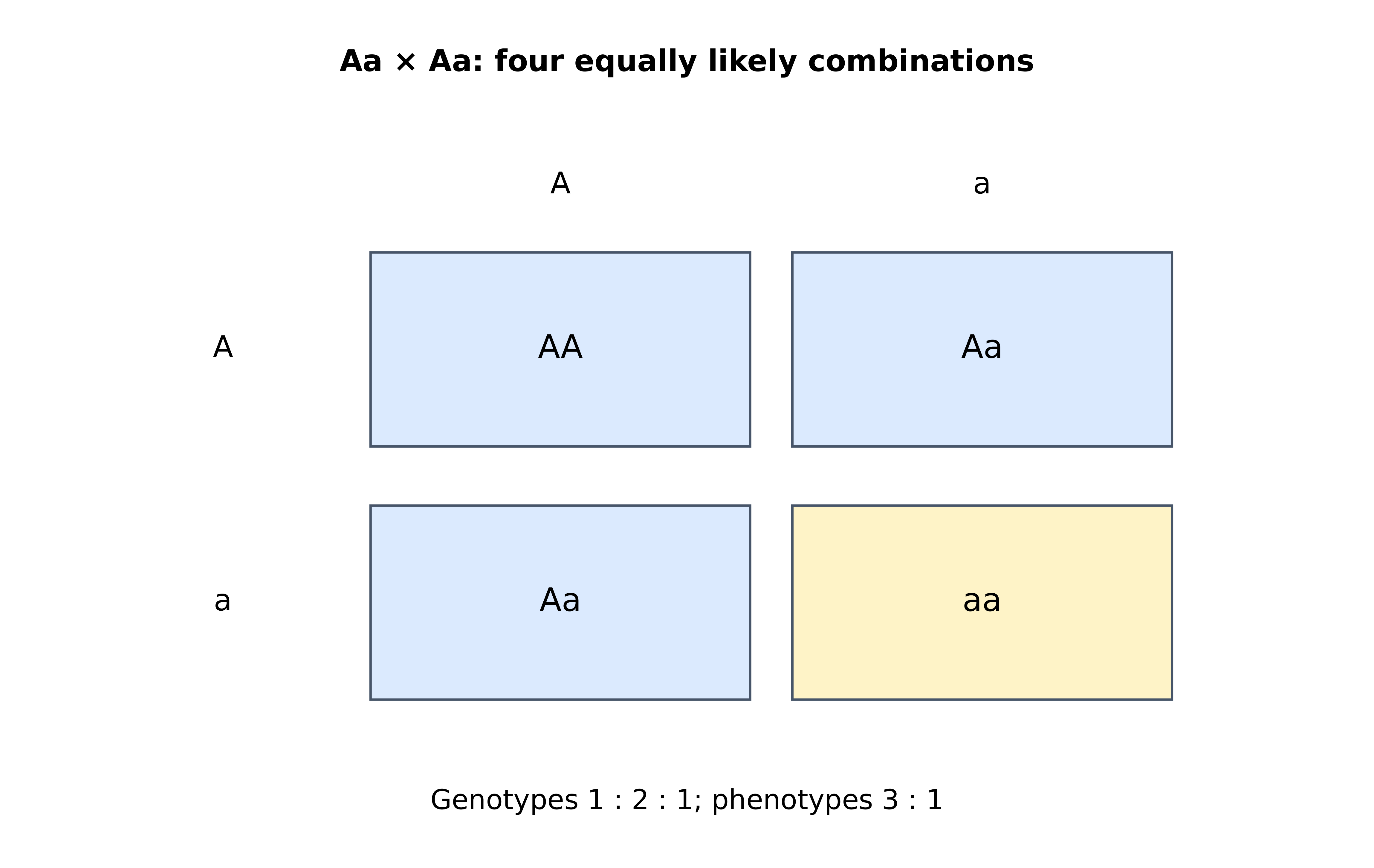
For two specified independent offspring of Aa × Aa, with normal segregation, what is the probability that both are aa? Give the percentage.
难度 2/5 · 今日首次完成可获 140 金币及少量额外奖励
(1/4) × (1/4) = 1/16 = 6.25%. Outcomes do not have to complete a fixed family ratio.
Use a test cross without treating a small sample as certainty
- Crossing a dominant-phenotype plant with aa tests whether its genotype could be AA or Aa. AA × aa predicts all Aa; Aa × aa predicts half Aa and half aa. A recessive offspring supports the heterozygous interpretation under this model, assuming correct parentage, expression and scoring.
- All dominant offspring in a small sample do not prove AA. If the tested plant is Aa, the probability that all five independent offspring are dominant is (1/2) to the power five, or 1/32 = 3.125%. For four offspring it is 1/16 = 6.25%. More suitable observations can strengthen an inference without turning it into certainty.
Assume the tested plant really is Aa and is crossed with aa. What is the percentage probability that all four independent offspring have the dominant phenotype?
难度 2/5 · 今日首次完成可获 140 金币及少量额外奖励
Each has probability one half, so (1/2)^4 = 1/16 = 6.25%. Four dominant offspring are possible even when the tested plant is heterozygous.
Link a recessive metabolic condition with genotype and environment
- In the ordinary PKU model, disease-associated PAH variants reduce phenylalanine hydroxylase activity. Phenylalanine can then accumulate to harmful levels. This connects an inherited enzyme difference to a metabolic outcome; phenylalanine is still an essential amino acid, rather than a substance with no useful role.
- Two unaffected carriers can have an affected child under an autosomal recessive model. Dietary management can alter consequences without turning aa into AA. The MedlinePlus PKU account explains this genetic mechanism and clinical variation. Classroom letters simplify multiple real variants, and a grid does not replace clinical assessment.
Distinguish multiple alleles from codominant expression
- In the ordinary ABO model, the population has alleles $I^A$, $I^B$ and $i$. A diploid individual normally carries two. A and B are each dominant over i; $I^AI^B$ expresses both antigen features and gives type AB. Codominance is distinguishable expression of both contributions, not a new intermediate “half A” antigen.
- Crossing $I^Ai$ with $I^Bi$ gives AB, A, B and O each with probability one quarter. Crossing $I^AI^B$ with ii instead gives half A and half B, with no AB or O under this model. State the actual parental genotypes; knowing only that a parent has type A does not distinguish $I^AI^A$ from $I^Ai$.
In the ordinary ABO model, which phenotypes can result from an AB parent crossed with an O parent?
难度 1/5 · 今日首次完成可获 100 金币及少量额外奖励
IᴬIᴮ supplies Iᴬ or Iᴮ, while ii supplies i. Offspring are Iᴬi or Iᴮi. This differs from Iᴬi × Iᴮi.
Explain why incomplete dominance does not permanently blend alleles
- In the four-o'clock-flower model, red and white homozygotes give pink heterozygotes. Two pink plants give one quarter red, one half pink and one quarter white. Genotype and phenotype ratios are both 1:2:1 because the heterozygote has its own intermediate category.
- Red and white reappear, so the alleles did not permanently merge into one pink allele. Contrast this with distinguishable A and B antigen features in type AB. Dominance categories refer to the defined phenotype; molecular measurements can reveal differences hidden by a simpler visible category. Use the model's phenotype key rather than assuming every heterozygote must look dominant.
Track X-linked alleles through the chromosome each parent supplies
- In the common human XX/XY model, eggs carry X while sperm carry X or Y. An affected father's X goes to daughters, while his Y goes to sons; he does not directly transmit an X-linked allele to a son. Do not invent the matching haemophilia allele on Y. Developmental variation means this simple chromosome model does not describe every individual fully.
- In a model carrier $X^HX^h$ × $X^HY$ cross, half of sons are predicted to inherit $X^hY$. Among all offspring, affected sons are one quarter if X- and Y-bearing fertilizations are equally likely. These denominators differ. MedlinePlus also explains why heterozygous females can have bleeding symptoms, including through X-inactivation effects; “carrier” does not guarantee no symptoms.
For the stated carrier XᴴXʰ × XᴴY model with equally likely X- and Y-bearing fertilizations, what percentage of all offspring are predicted to be affected sons?
难度 2/5 · 今日首次完成可获 140 金币及少量额外奖励
One of four equally likely outcomes is XʰY, giving 25% among all offspring. Among sons only, one half is predicted affected.
Infer a pedigree model before deducing a genotype
- This invented pedigree uses squares for males, circles for females and filled symbols for the studied affected phenotype. Under a fully penetrant autosomal recessive model with no new mutation, unaffected parents of an aa child must both supply a, making each Aa. State those assumptions rather than diagnosing a real family from one picture.
- An unaffected sibling is AA or Aa. Conditional on being unaffected, two of the three equally likely remaining grid outcomes are Aa, so the carrier probability is two thirds, not one half. Inferring a model from families is induction; predicting a genotype conditional on that model is deduction. Small families can fit more than one model.
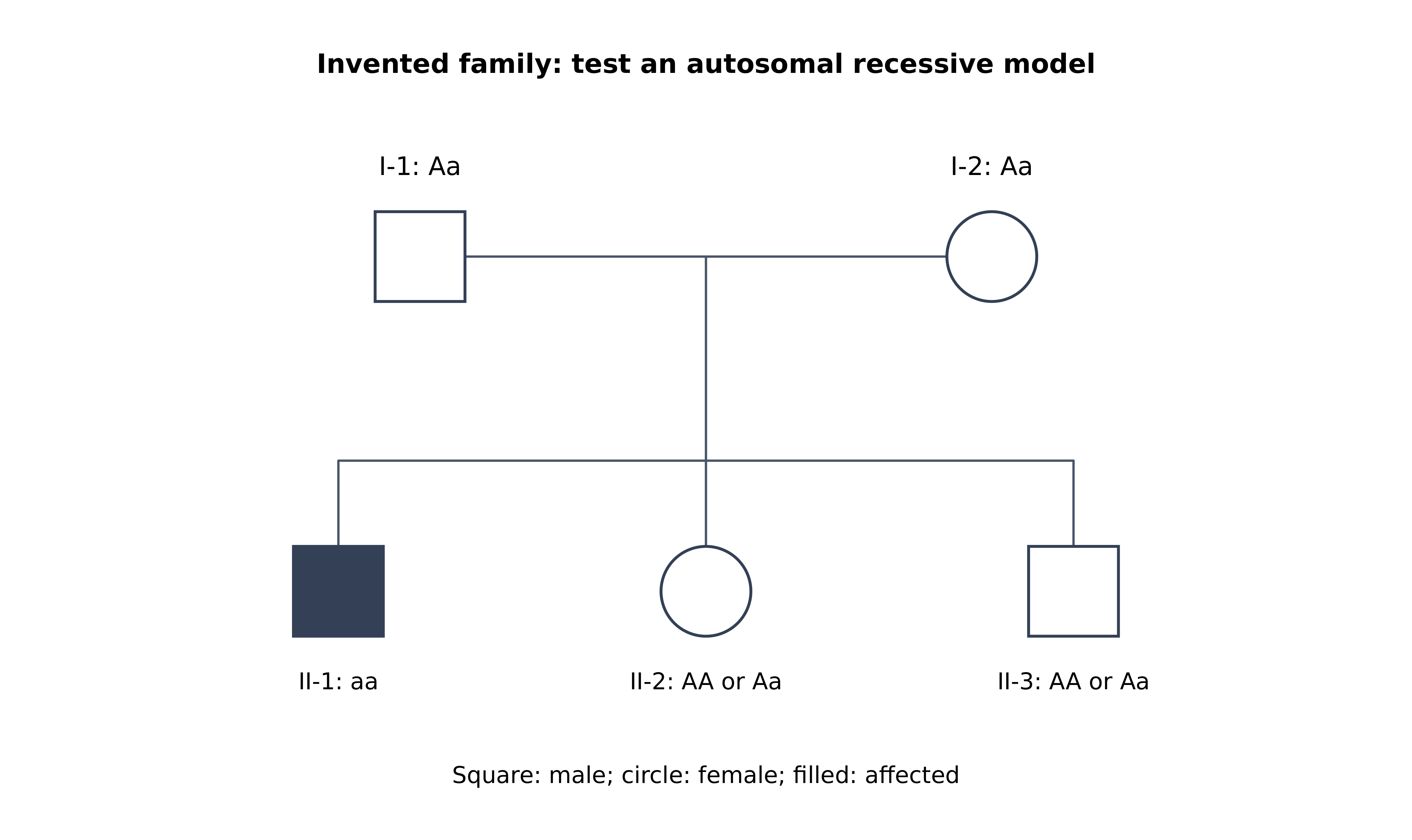
Under a fully penetrant autosomal recessive model with no new mutation, Aa × Aa parents have an unaffected child. What is that child’s carrier probability, expressed as a percentage?
难度 2/5 · 今日首次完成可获 140 金币及少量额外奖励
Condition on being unaffected: AA, Aa and aA are the three equally likely remaining outcomes. Two are carriers, giving 2/3 ≈ 66.7%, not 50%.
Bound conclusions from family patterns and shared ancestry
- An affected child of unaffected parents conflicts with a simple fully penetrant dominant model without new mutation, but new variants or incomplete penetrance can change that inference. Male-to-male transmission argues against ordinary direct X-linked inheritance; absence of such transmission in one small family does not establish X linkage.
- Relatives are more likely to share inherited variants from a recent common ancestor. This can increase the chance of both transmitting the same harmful recessive variant, but does not make every offspring affected. Use invented family data, a defined phenotype and respectful language. Genetic probability is not a judgment about an individual's worth.
Choose summaries that fit continuous or categorical variation
- ABO types are discrete categories, whereas height and skin pigmentation vary continuously. Recording height to whole centimetres does not turn the underlying trait into ABO-like categories. Pigmentation and height involve many genes and environmental influences; their observed spread is not automatically evidence for a single dominant/recessive locus.
- For numerical data, mean uses all values, median is the sorted middle and mode is the most frequent value if one exists. Arbitrarily coding blood types as 1, 2, 3 and 4 does not make their numerical mean a useful biological quantity. Match the measurement scale to the question before choosing a calculation.
Distinguish a box-plot whisker from the sample maximum
- Invented heights are 150, 152, 154, 156, 158, 160, 162, 164, 166 and 190 cm. Their sum is 1612, mean 161.2 and median 159 cm; there is no mode. Under the median-of-halves convention, quartiles are 154 and 164 cm, giving IQR 10 cm. State the convention because software can differ for small samples.
- Fences at 1.5 IQR below/above the quartiles are 139 and 179 cm. The 190 observation is plotted separately; whiskers reach actual non-outlying observations, here 150 and 166, rather than the fence values. The maximum remains 190. Check possible recording errors without deleting an inconvenient valid value, and retain the raw data because a box plot hides individual observations.
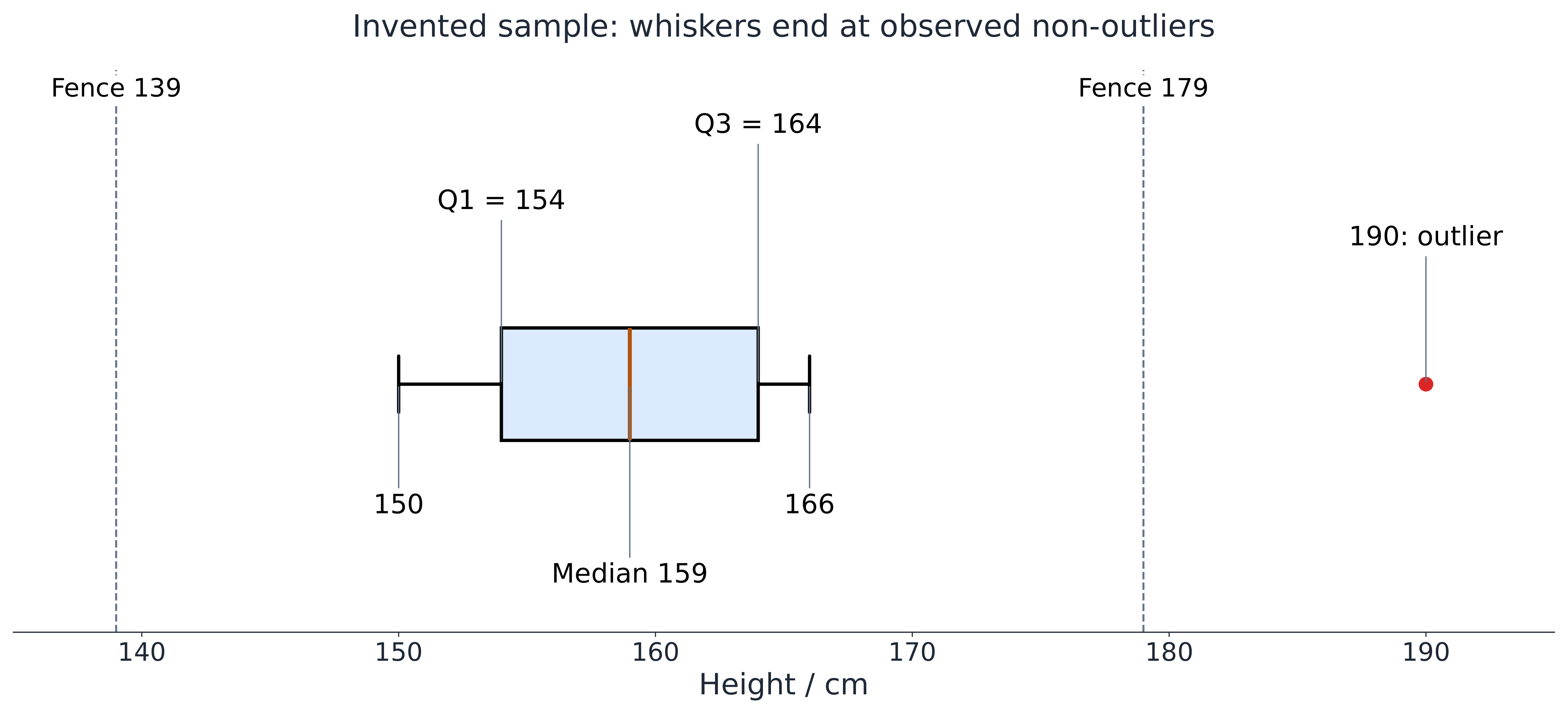
For the invented height sample 150, 152, 154, 156, 158, 160, 162, 164, 166 and 190 cm, the upper whisker ends at 166 cm. What is the observed sample maximum?
难度 2/5 · 今日首次完成可获 140 金币及少量额外奖励
The maximum observation is 190 cm even though it is plotted as an outlier. The upper whisker reaches the most extreme non-outlying observation, not necessarily the maximum.
Combine inheritance assumptions with an evidence-based conclusion
- Define alleles, parental genotypes, gametes and the phenotype key. Calculate offspring probabilities, name the denominator, and distinguish expectation from actual counts. Separate dominance, incomplete dominance and codominance; for sex-linked examples, track the actual chromosome supplied rather than applying an autosomal grid unchanged.
- For a pedigree, name the assumed inheritance model and its limits before deducing genotypes. For continuous data, give a measurement method and appropriate summaries instead of forcing a discrete ratio. Explain one observation that would challenge the proposed account and how an additional controlled cross or measurement could test it.
Explain why a Punnett-grid probability, a pedigree inference and a height box plot answer different questions. For Aa × Aa with normal segregation, calculate the expected aa count among twenty independent offspring. In a fully penetrant autosomal recessive model with no new mutation, unaffected parents have an aa child; find the carrier probability for an unaffected sibling. Heights are 150, 152, 154, 156, 158, 160, 162, 164, 166 and 190 cm. Calculate mean, median and median-of-halves IQR; distinguish the maximum from the 166 cm upper whisker. State a limit for each inference.
Select the model and measurement scale before calculating; a correct number does not remove biological assumptions.