Water movement: compare potential and net change
引入| English | 释义 | 拼音 |
|---|---|---|
| water potential/ˈwɔːtə pəˈtenʃl/ | 水势 | shuǐ shì |
| turgor/ˈtɜːɡə/ | 膨压 | péng yā |
What would explain this observation?
- Plant tissue can gain or lose mass in different solutions. The direction of net water movement depends on the water-potential 水势 difference, not on whether water molecules move at all.
Build the model
- Water moves through a water-permeable membrane from higher toward lower water potential.
- Dissolved solute lowers the tendency of water to leave a solution relative to the chosen reference.
- A plant cell wall allows pressure to develop as water enters; tissue behaviour cannot always be explained by solute concentration alone.
- water potential: A measure used to compare the tendency of water to move between systems.
- turgor 膨压: Pressure of plant-cell contents against the cell wall.

What does a zero percentage mass change support in this experiment?
难度 1/5 · 今日首次完成可获 100 金币及少量额外奖励
Zero percentage mass change means gains and losses balanced over the interval - no NET transfer. Molecules still cross in both directions, and the cells need not be identical inside.
Match each technical term to its precise meaning.
难度 2/5 · 今日首次完成可获 140 金币及少量额外奖励
Use the definitions to distinguish related quantities and processes.
Choose evidence that can test it
- A zero mass change suggests no net transfer over the measured interval under the experimental conditions.
- It does not imply that every individual cell has the same potential or that molecular exchange stops.
- Compare percentage change when initial sample masses differ.
In the lab: Use repeated equal-sized plant samples in teacher-approved solutions. Keep tissue source, temperature, volume and time consistent; blot consistently before weighing. Record initial/final mass and plot percentage change against solution concentration, retaining variation and the uncertainty of any interpolated zero-change point.
Which two habits make the investigation or model in this case more defensible?
难度 2/5 · 今日首次完成可获 140 金币及少量额外奖励
Stating the conditions and assumptions lets others repeat the work exactly, and recording the supporting evidence lets them check the conclusion. Hiding disagreeing results removes the evidence that could challenge a wrong conclusion, and one measurement can never establish a wider claim.
Work from known quantities
- Known: a 5.00 g tissue sample becomes 5.40 g.
- Percentage mass change = (5.40−5.00)/5.00×100 = +8%.
- This supports net water entry under the measured conditions.
- A separate sample with zero change is consistent with balanced net transfer, but this mass method does not independently measure cell pressure.
Your turn: A tissue sample changes from 4.00 g to 4.20 g. Calculate percentage mass change.
增重相同,百分比变化却不同
A从5.00 g变成5.40 g,增加8%。比较另一个示例:从2.00 g同样增加0.40 g,增幅为20%。用各自初始质量作为基准,探索减重和零净变化。
A tissue sample changes from 4.00 g to 4.20 g. Calculate percentage mass change.
难度 2/5 · 今日首次完成可获 140 金币及少量额外奖励
The result is 5 %. Known: 4.00 g to 4.20 g. Use percentage change = (final - initial) / initial x 100. Change = (4.20 - 4.00)/4.00 x 100 = +5%. The positive sign indicates net water entry under the measured conditions.
Check the conclusion and its limits
- This SL preparation focus uses qualitative water-potential reasoning and mass-change evidence.
- Quantitative solute/pressure equations are kept in the separate HL preparation case pending exact guide review.
- Blotting variation or tissue damage can change the observed result.
Not true: A zero net mass change proves that all movement of water molecules has stopped. Zero NET change is a balance of two continuing flows. Water molecules never stop moving; equal rates in both directions produce no net change.
- Water moves through a water-permeable membrane from higher toward lower water potential.
- A zero mass change suggests no net transfer over the measured interval under the experimental conditions.
- Watch for: this SL preparation focus uses qualitative water-potential reasoning and mass-change evidence.
Zero NET change is a balance of two continuing flows.
难度 1/5 · 今日首次完成可获 100 金币及少量额外奖励
True. Zero NET change is a balance of two continuing flows. Water molecules never stop moving; equal rates in both directions produce no net change.
A measure used to compare the tendency of water to move between systems: write the technical term.
难度 1/5 · 今日首次完成可获 100 金币及少量额外奖励
water potential means A measure used to compare the tendency of water to move between systems.
Write from a gain of 12 percent
- A tissue sample changes from 3.00 g to 3.36 g.
- Find the percentage mass change. A zero net change does not mean water molecules have stopped moving.
A tissue sample changes from 3.00 g to 3.36 g. What is the percentage mass change, and what does a zero net change mean?
Mass change = 3.36 − 3.00 = +0.36 g. Percentage mass change = 0.36/3.00 × 100 = +12%. Zero net change is consistent with balanced inward and outward water transfers; it does not mean molecular movement has stopped.
The SL written case changes tissue mass from 3.00 to 3.36 g. Find signed percentage mass change.
难度 1/5 · 今日首次完成可获 100 金币及少量额外奖励
Mass change = 3.36 − 3.00 = +0.36 g. Signed percentage change = 0.36/3.00 × 100 = +12%. The 5% option belongs to the different change 4.00 to 4.20 g; 3.36 g is final mass, not percentage change.
Explain solvation through water's polarity
- Water's oxygen region is partially negative and its hydrogen regions partially positive. Around dissolved sodium ions, oxygen faces inward; around chloride ions, hydrogen regions face inward. Ion–water attractions help surround and separate particles, rather than leaving all dissolved salt as intact grains.
- Glucose's polar hydroxyl groups can hydrogen-bond with water without glucose splitting into sodium-like ions. Solvation means solvent molecules surround solute particles. Ion–dipole attractions are not all hydrogen bonds, and neither interaction should be drawn as a new covalent water–solute backbone.
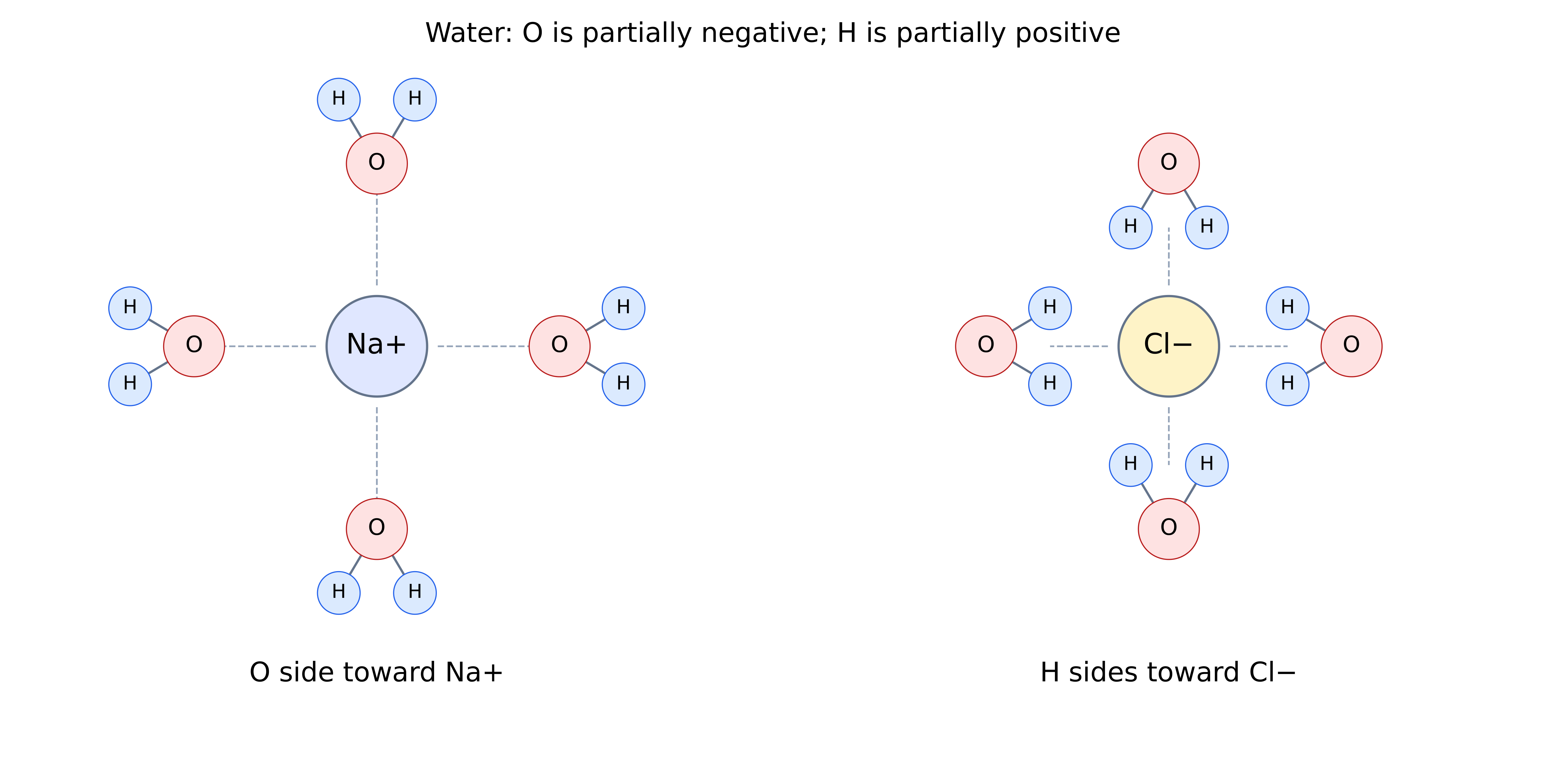
Which water orientation fits its polarity around a dissolved sodium ion?
难度 1/5 · 今日首次完成可获 100 金币及少量额外奖励
Opposite charges attract: oxygen faces sodium, while hydrogen regions face a chloride ion. Ion–water attractions are distinct from simply calling all solvation bonds hydrogen bonds.
State the membrane and pressure conditions for osmosis
- Osmosis is net water movement through a selectively permeable membrane. At equal pressure, when relevant solutes cannot cross freely, the simpler comparison predicts net movement from less to more concentrated solution. Water molecules still cross both ways; a net direction reflects unequal opposing transfers.
- Without a separating membrane, solutes can also mix, making a different experiment. Water channels permit passive movement rather than pumping water against its relevant gradient. Energy can maintain solute distributions or support water removal elsewhere, without being the direct driver of osmosis itself.
Compare tonicity relative to a particular cell
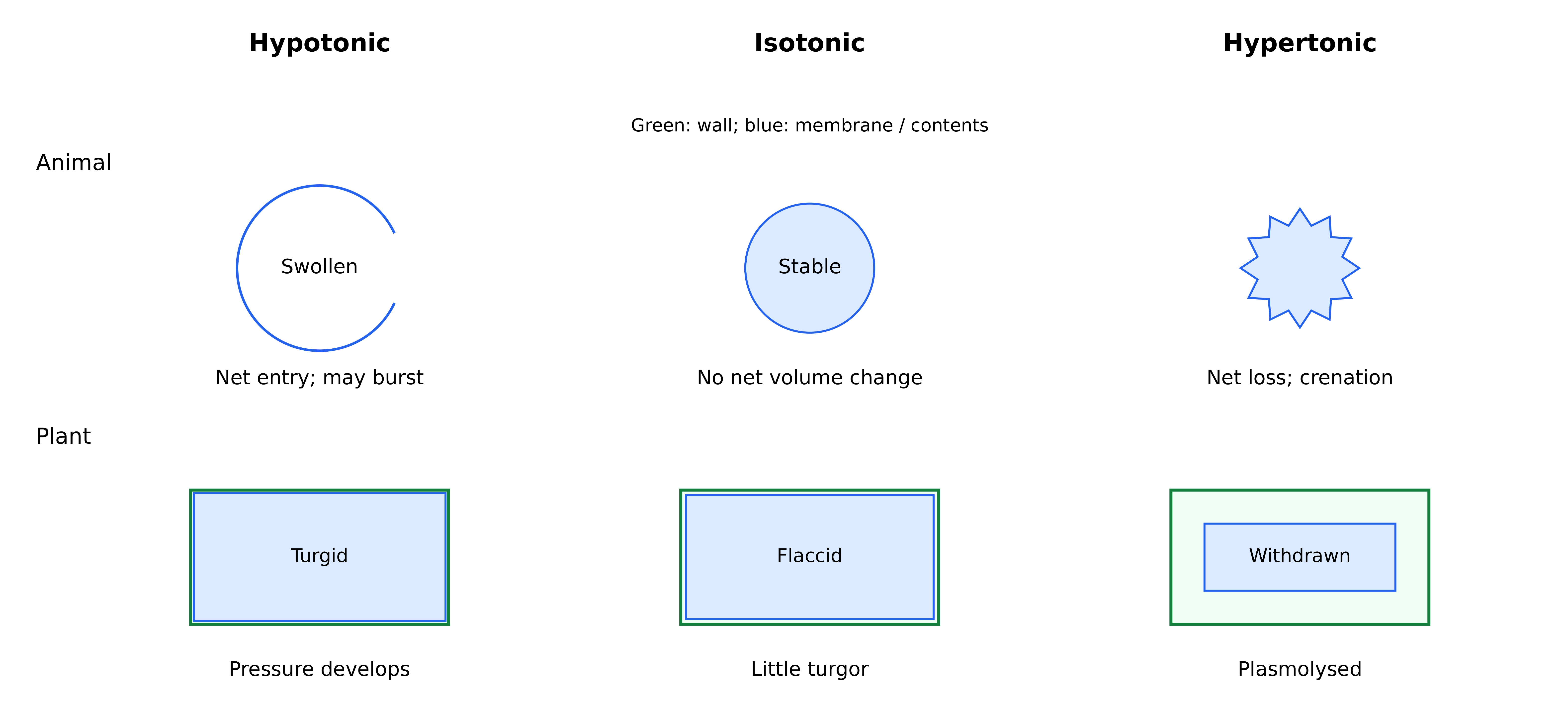
- A hypotonic exterior favours net water entry, a hypertonic exterior net loss, and an isotonic exterior no sustained volume change under specified conditions. These descriptions are relational; a solution is not simply hypertonic without a comparison and membrane context.
- Effective solutes matter. Equal total solute concentration need not give equal tonicity if one solute enters cells readily. Isotonic does not mean chemically identical to cytoplasm, and steady volume does not mean molecular motion stops. Qualitative water-potential reasoning also accommodates pressure opposing net entry in walled cells.
Distinguish lysis and crenation from plasmolysis
- An animal cell lacks a rigid wall: sufficiently hypotonic surroundings cause swelling and can cause membrane rupture, while hypertonic surroundings cause shrinkage. A shrunken red cell can show crenation. The solution does not physically slice the membrane to cause osmotic lysis.
- Plasmolysis specifically involves membrane and contents withdrawing from a cell wall, so it is not the name for every shrinking animal cell. Freshwater organisms such as Paramecium use contractile vacuoles to collect and expel excess water with energy-dependent cellular support; they have not stopped water entering by osmosis.
Explain a wall-supported pressure response
- Water entry expands a plant cell's contents and vacuole against its wall, developing turgor. The wall resists further expansion and limits net entry; it does not become a selective lid closing every pore. Turgid cells help support soft tissues, while reduced turgor can make tissue flaccid or wilted.
- In a sufficiently hypertonic exterior, water loss shrinks the contents and may pull the membrane away from the wall. The wall itself need not shrink. Returning a suitable viable cell to hypotonic conditions can restore contact and turgor, but duration and membrane damage affect recovery. The membrane, rather than the relatively permeable wall, is the main selective boundary.
Control tissue preparation and the measurement procedure
- Use comparable tissue sources and dimensions, allocate independent pieces across approved concentrations, and control exposure time, temperature and solution volume. Cover containers where evaporation could alter concentration. Record instrument resolution, initial values and a consistent final measurement method.
- Blot consistently without squeezing variable amounts of water out; surface solution can otherwise mimic tissue gain. Repeat independent pieces, rather than counting repeated weighing of one piece as biological replication. For length, use a consistent axis and account for curvature; mass and length percentages need not be equal.
Use the initial mass and retain the sign
- An invented 5.00 g piece becoming 5.40 g gains 8%; a 4.00 g piece becoming 4.20 g gains 5%. Compare proportional changes rather than absolute gains alone. A 40.0 mm strip becoming 42.0 mm gains 5% in length, but this does not automatically determine its mass change.
- A piece changing from 3.00 to 3.36 g gains 12%; the reverse change loses about 10.7% because the starting denominator is now 3.36 g. A negative signed result records loss. Do not make equal absolute forward/reverse changes have equal percentage magnitudes by reusing the wrong initial value.
An invented tissue piece changes from 4.00 g to 3.60 g. Calculate signed percentage mass change relative to its initial mass.
难度 2/5 · 今日首次完成可获 140 金币及少量额外奖励
(3.60 − 4.00)/4.00 × 100 = −10%. The negative sign indicates loss; use the initial mass rather than the final value.
Interpolate locally between opposite signed means
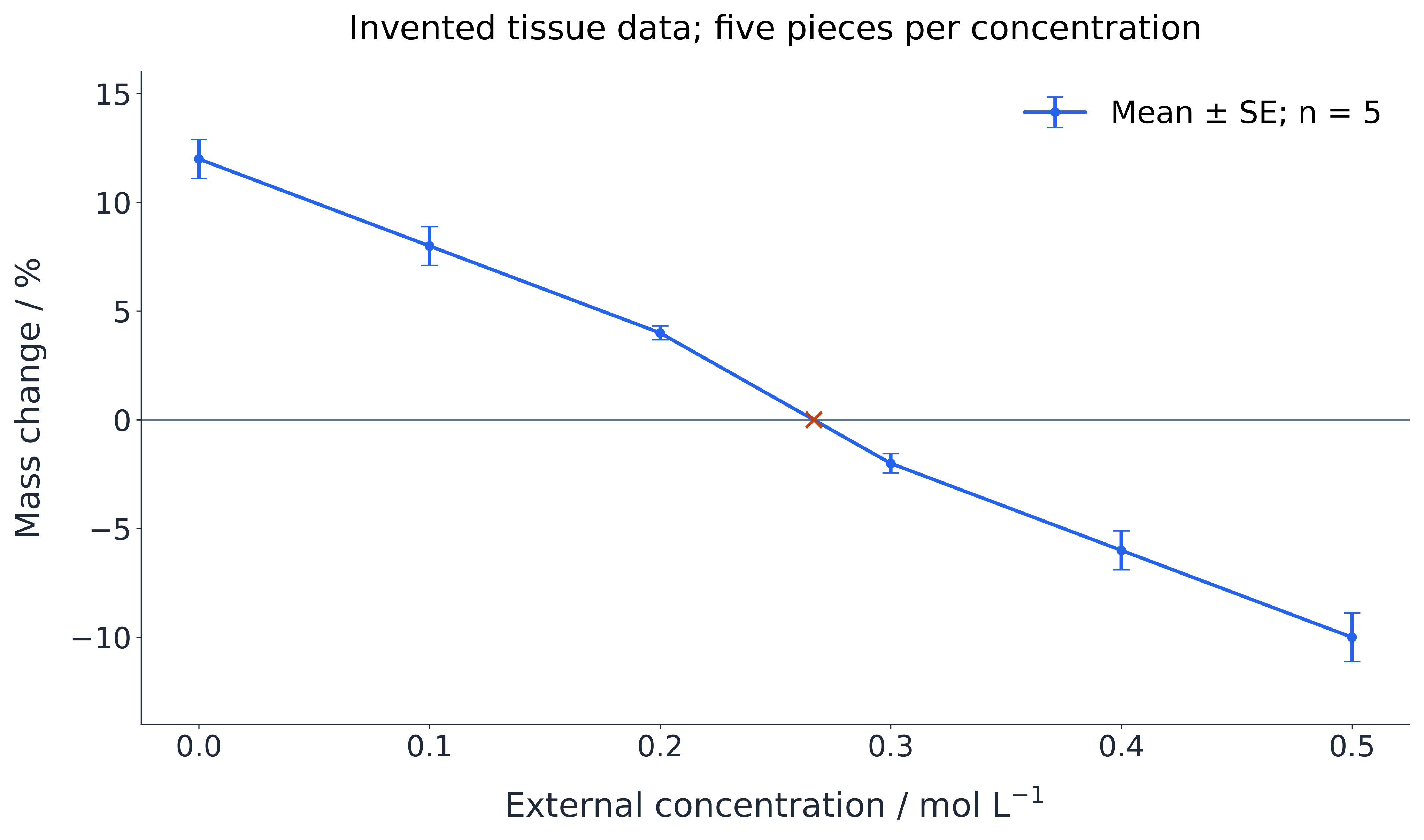
- In an invented concentration series of 0.00, 0.10, 0.20, 0.30, 0.40 and 0.50 mol/L, mean mass changes are +12, +8, +4, −2, −6 and −10%. Zero lies between 0.20 and 0.30. A locally linear interpolation gives 0.20 plus four-sixths of 0.10, about 0.267 mol/L.
- The estimate is conditional on the local shape and sampled tissue; it is not an exact universal cell concentration. Sample closer to the crossing and use more independent pieces. Do not extrapolate a straight line far outside the data or interpret a guide line as proof of a linear mechanism.
Invented mean mass changes are +0.8% at 0.20 mol/L and −1.2% at 0.40 mol/L. Assuming a locally straight relationship, estimate the zero-change concentration.
难度 2/5 · 今日首次完成可获 140 金币及少量额外奖励
0.20 + [0.8/(0.8 + 1.2)] × (0.40 − 0.20) = 0.28 mol/L. This is conditional interpolation between nearby measurements, not a universal exact cellular concentration.
Separate biological spread from uncertainty of a mean
- For invented changes 3, 4, 5, 4 and 4%, mean change is 4%, sample SD about 0.71 percentage points and SE about 0.32. SD describes variation among pieces; SE estimates uncertainty of a mean under the sampling model. Identify what the bars display rather than treating every bar as the whole observed range.
- More independent pieces can reduce SE without reducing biological spread. Nearby pieces from one source may share conditions, and more repeated readings do not erase preparation bias. Overlapping SE bars alone are not a complete significance test; report sample number, statistic and suitable inference.
Five independent invented tissue percentage changes have sample SD √0.5 percentage points. Use SE = SD/√n to find SE in percentage points.
难度 2/5 · 今日首次完成可获 140 金币及少量额外奖励
√0.5/√5 = √0.1 ≈ 0.316, about 0.32 percentage points. SD concerns spread among pieces; SE estimates uncertainty in their mean under the independence model.
Keep zero net tissue change separate from complete equilibrium evidence
- Zero net mass change is consistent with an isotonic condition for the measured tissue and interval, while exchange continues. A whole tissue contains varied cells and spaces; the result does not show identical internal concentrations everywhere or independently measure pressure and solute contributions.
- Leakage, membrane injury, inadequate exposure time and surface-water errors can also affect mass. Check the experimental model before assigning every change solely to osmosis. Explain what was measured, what assumptions connect it with water balance, and what additional evidence would discriminate alternatives.
Apply isotonicity without treating it as a complete preservation recipe
- Avoiding sustained osmotic swelling or shrinkage is relevant to clinical fluids and transplant-organ preservation. A manufacturer's isotonic sodium-chloride label illustrates the property, rather than specifying an interchangeable treatment for every purpose.
- Composition, temperature, metabolism, oxygen supply where relevant and the recipient or tissue condition also matter. Isotonicity alone neither selects a clinical treatment nor preserves an organ indefinitely. The biological application concerns controlling membrane water balance alongside those other requirements.
Connect molecular interactions, cell structure and measured evidence
- Explain the solute–water interaction, selective membrane and stated pressure conditions before predicting net movement. Then distinguish the outcomes of a wall-free cell from wall-supported turgor and plasmolysis. Equilibrium means balanced transfer, rather than every molecule becoming stationary.
- For tissue data, show signed percentage change from the initial value, identify the local zero crossing and label uncertainty. State sample independence and alternative causes of mass change. A zero crossing supports a conditional tissue-level inference, not separate direct measurements of all intracellular components.
Plan a tissue-mass osmosis comparison and explain what a zero-change concentration can and cannot establish about cells and molecular movement.
The inference depends on selective-membrane and experimental assumptions as well as arithmetic.