您的已保存位置保留在此浏览器中。恢复操作不会完成课程或回答其中的问题。
A formal report
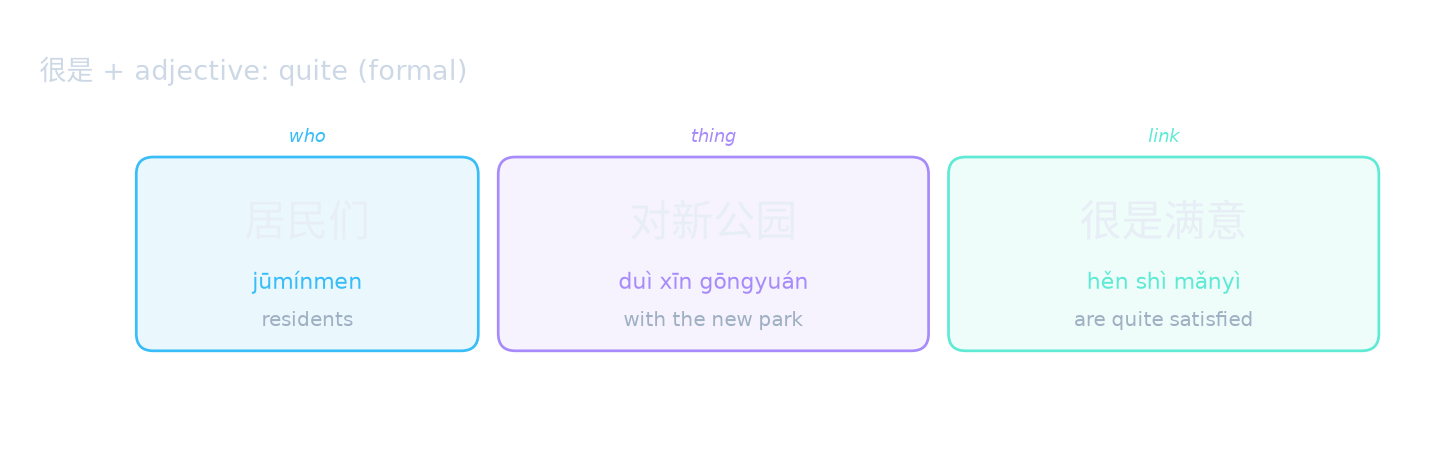
- A news report describes how residents feel about the new park.
- resident居民(plural)们to / towards / correct对new新park公园very很(really)是satisfied满意。 — "Residents are very satisfied with the new park."
very很(really)是 + Adj / feeling verb
- very很(really)是 = "very, quite", a more formal or literary very很: very很(really)是pleased高兴, very很(really)是satisfied满意, very很(really)是worried担心.
- It goes before two-syllable adjectives or feeling verbs.
hearing听到this这个news消息,he他was very很是pleased高兴。
Complete (formal): “The audience was very moved.” 观众____感动。
难度 1/5 · 今日首次完成可获 100 金币及少量额外奖励
很是 + two-syllable feeling word.
Writing and storytelling
- old man or woman老人一个人住,child孩子(plural)们very很(really)是worried担心。 — "The old man lives alone, and his children are very worried."
- It gives a measured, slightly old-fashioned tone suited to narratives and reports.
the children孩子们are very很是worried担心。
Build: “His children are very worried.”
难度 3/5 · 今日首次完成可获 200 金币及少量额外奖励
Subject + 很是 + feeling.
Two-syllable words, written tone
- very很(really)是 prefers two-syllable predicates: very很(really)是satisfied满意, not very很(really)是good好.
- In conversation, plain very很 or very非常 sounds more natural.
Which is the least natural?
难度 1/5 · 今日首次完成可获 100 金币及少量额外奖励
很是 prefers two-syllable predicates.
very很(really)是 versus (really)是 for emphasis
- very很(really)是 = very (degree). Do not confuse it with (really)是 for emphasis: he他(really)是very很busy忙 — "He really is busy (I admit)."
- Here very很(really)是 is one unit before the adjective.
he他(really)是very很busy忙。
很是 sounds more formal than 很.
难度 1/5 · 今日首次完成可获 100 金币及少量额外奖励
It suits writing and narration.
Recap
- very很(really)是 + two-syllable Adj / feeling verb = very (formal, literary).
- Spoken Chinese prefers very很 / very非常.
Read the full reference: HSK 6 grammar — Adverbs.
A news report describes how residents feel about the new park. Close the examples. Say a Mandarin response, then write it in Chinese. Explain briefly in English what the lesson’s pattern adds. Compare with the model, then change one detail and try again.
This is supported productive practice. Compare meaning and structure; your answer need not copy the model. A partner or teacher must hear the spoken response to comment on pronunciation.