无 … 可 … (have no … to …)
引入您的已保存位置保留在此浏览器中。恢复操作不会完成课程或回答其中的问题。
Nothing left to say
- After a long argument, your friend shrugs and goes quiet.
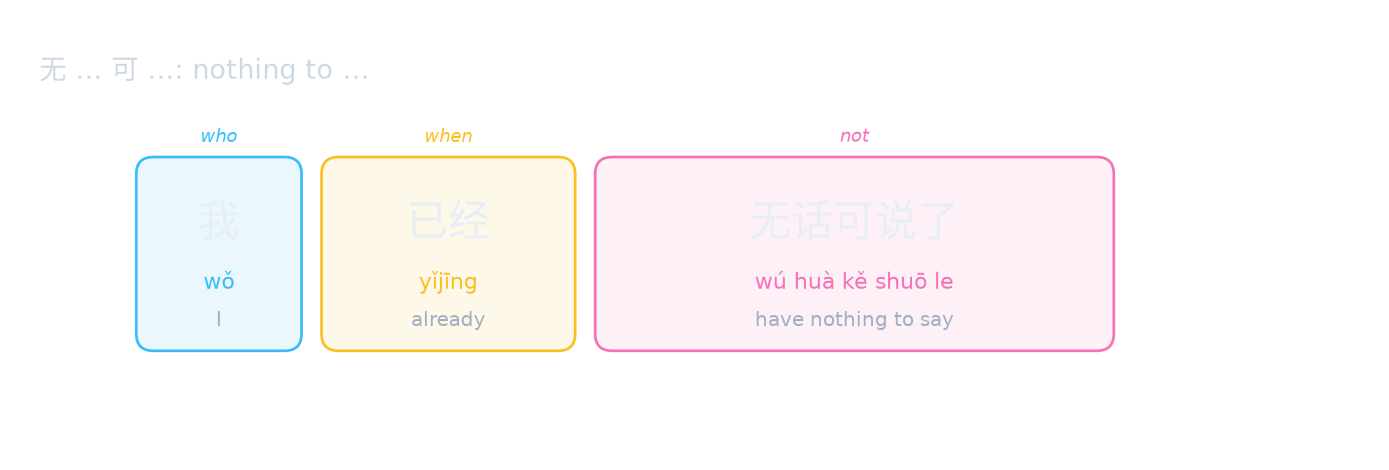
- I我already已经to have nothing to say…无话可说(completed / change)了。 — "I have nothing more to say."
- Goal: say "have nothing to …" with without无 + (prefix) can可 + verb (to have nothing to say…无话可说).
without无 + noun + (prefix) can可 + verb = have no … to …
- without无 X (prefix) can可 V = there is no X that can be V-ed: to have nothing to say…无话可说 (nothing to say), have nowhere to go无处可去 (nowhere to go), without无matter事(prefix) can可to do; to make做 (nothing to do).
- It is concise and literary, often fixed as four-character phrases.
at the weekend周末he他has nothing to do无事可做。
Complete: “I have nothing to say.” 我无话____说。
难度 1/5 · 今日首次完成可获 100 金币及少量额外奖励
无 + noun + 可 + verb.
Common fixed forms
- have nowhere to go无处可去 = nowhere to go: down / next; to fall (rain), get off下(ongoing -ing)着heavy rain大雨,we / us我们have nowhere to go无处可去 — "It's pouring, and we have nowhere to go."
- homeless无家可归 = homeless (no home to return to); nowhere to go无路可走 = no way out.
heavy rain大雨in中they他们have nowhere to go无处可去。
Match each phrase to its meaning.
难度 2/5 · 今日首次完成可获 140 金币及少量额外奖励
无 X 可 V = no X to V.
Written and fixed
- In speech, say have no没有words / speech话say说 / not / haven't没area地方to go去; without无…(prefix) can可… is more formal.
- Keep the order without无 + noun + (prefix) can可 + verb; do not add (modifier / structural particle)的 or (completed / change)了 inside: to have nothing to say…无话可说, not without无words / speech话(modifier / structural particle)的(prefix) can可say说.
无话可说 is more formal than 没话说.
难度 1/5 · 今日首次完成可获 100 金币及少量额外奖励
True. 无…可… comes from literary Chinese (无话可说, 无家可归), so it is more formal than everyday 没话说.
without无…(prefix) can可… versus have no没有…can可以…
- to have nothing to say…无话可说 = have no没有anything什么words / speech话can可以say说 — "There's nothing to say."
- The without无…(prefix) can可… form is shorter and stronger, typical of writing and formal speech.
I我have no没有anything什么can可以say说的。
Which is the spoken equivalent of 无话可说?
难度 1/5 · 今日首次完成可获 100 金币及少量额外奖励
没有…可以… is the everyday form.
Recap
- without无 + noun + (prefix) can可 + verb = have no … to … (to have nothing to say…无话可说, have nowhere to go无处可去, without无matter事(prefix) can可to do; to make做).
- Literary; spoken equivalent have no没有…can可以….
Read the full reference: HSK 5 grammar — Sentence patterns.
After a long argument, your friend shrugs and goes quiet. Close the examples. Say a Mandarin response, then write it in Chinese. Explain briefly in English what the lesson’s pattern adds. Compare with the model, then change one detail and try again.
This is supported productive practice. Compare meaning and structure; your answer need not copy the model. A partner or teacher must hear the spoken response to comment on pronunciation.