Drill: build 把 sentences
引入您的已保存位置保留在此浏览器中。恢复操作不会完成课程或回答其中的问题。
Put the words in order
- In the HSK 4 writing paper (part 1), you get word pieces and must build one sentence: (把: marks the object)把 · please; to invite请 · to close (a door)关上 · door门 → please; to invite请to stand as a goalkeeper把门to close (a door)关上。 — "Please close the door."
- Goal: build any (把: marks the object)把 sentence quickly with one frame and four moves, then practise on exam-style items.
The (把: marks the object)把 frame
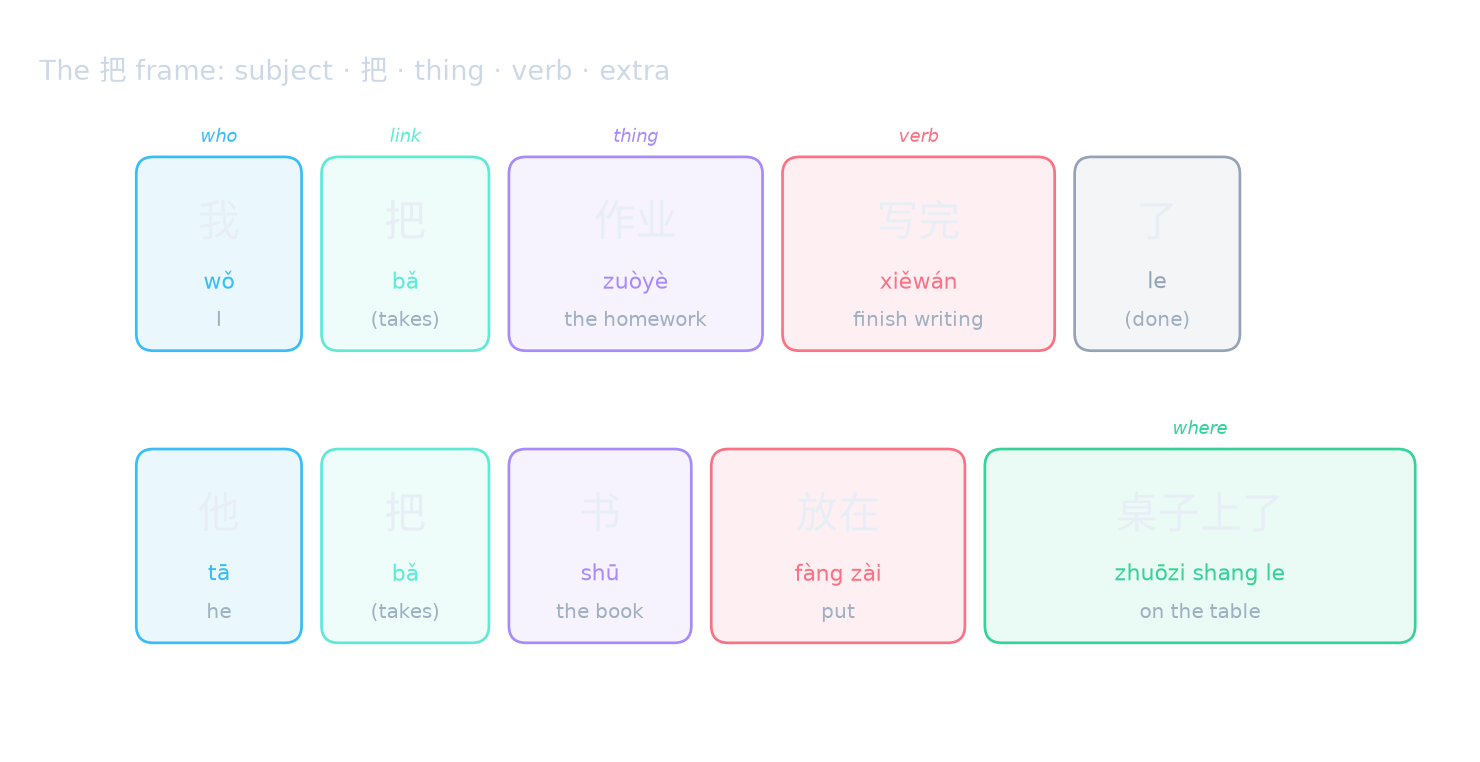
- Subject + (把: marks the object)把 + thing + verb + extra. The extra says what happened to the thing: a result (to close (a door)关上, to wash洗clean干净), a place (放在table桌子on; above; last (week)上) or (completed / change)了.
- I / me我(把: marks the object)把school assignment作业to write写to finish完(completed / change)了。 — "I finished my homework." he / him他(把: marks the object)把book书放在table桌子on; above; last (week)上(completed / change)了。 — "He put the book on the table."
I我(takes)把the homework作业finish writing写完了。
Build: “Please close the door.”
难度 3/5 · 今日首次完成可获 200 金币及少量额外奖励
请 + 把 + thing + verb + result.
Four moves for any (把: marks the object)把 item
- 1 Find the verb with its extra (to close (a door)关上, 放在…, to write写to finish完(completed / change)了). 2 Find the thing it acts on (door门, book书, school assignment作业).
- 3 Put (把: marks the object)把 + thing right before the verb. 4 Put the subject (or please; to invite请) first, and words like already已经 / don't不要 / not / haven't没 before (把: marks the object)把.
- Example: already已经 · (把: marks the object)把 · he / him他 · to sell卖(completed / change)了 · bicycle自行车 → he / him他already已经(把: marks the object)把bicycle自行车to sell卖(completed / change)了。 — "He has already sold his bike."
Build: “He has already sold his bike.”
难度 3/5 · 今日首次完成可获 200 金币及少量额外奖励
已经 goes before 把.
Build: “Put the milk in the fridge.”
难度 3/5 · 今日首次完成可获 200 金币及少量额外奖励
把 + thing + 放在 + place.
Build: “I've washed the clothes clean.”
难度 3/5 · 今日首次完成可获 200 金币及少量额外奖励
Verb + result (洗干净) + 了 at the end.
Two traps the exam loves
- Not / time words / want / will / need要 / can / be able to能 go before (把: marks the object)把: ✓ you你don't别(把: marks the object)把mobile phone手机to forget忘at / in在home家里 ✗ you你(把: marks the object)把mobile phone手机don't别to forget忘at / in在home家里. ✓ I / me我not / haven't没(把: marks the object)把money钱to bring带来 ✗ I / me我(把: marks the object)把money钱not / haven't没to bring带来.
- The verb never stands alone: ✗ I / me我to stand as a goalkeeper把门to close关 → ✓ I / me我to stand as a goalkeeper把门to close (a door)关上(completed / change)了. If a piece is a verb + result or a at / in在-place, it goes last.
Which sentence is correct?
难度 1/5 · 今日首次完成可获 100 金币及少量额外奖励
别 / 不 / 没 go before 把.
Which sentence is complete?
难度 1/5 · 今日首次完成可获 100 金币及少量额外奖励
The verb needs a result, place or 了.
Build: “I didn't bring my passport.”
难度 3/5 · 今日首次完成可获 200 金币及少量额外奖励
没 before 把; 带来 = verb + direction.
Recap
- Subject + (don't别 / not / haven't没 / already已经 / want / will / need要) + (把: marks the object)把 + thing + verb + result / place / (completed / change)了.
- Find the verb first, then the thing, then put (把: marks the object)把 between them.
Build: “Can you translate this sentence into English?”
难度 3/5 · 今日首次完成可获 200 金币及少量额外奖励
能 before 把; 翻译成 + language.
Build: “Don't put the medicine where children can reach it.”
难度 3/5 · 今日首次完成可获 200 金币及少量额外奖励
不要 + 把 + thing + 放在 + place.
You are leaving a note for your roommate before a trip. Write three requests with 把 (plants, rubbish, door).
Your answer need not copy the model. A partner or teacher must hear the spoken response to comment on pronunciation.