究竟
引入您的已保存位置保留在此浏览器中。恢复操作不会完成课程或回答其中的问题。
The question everyone asks
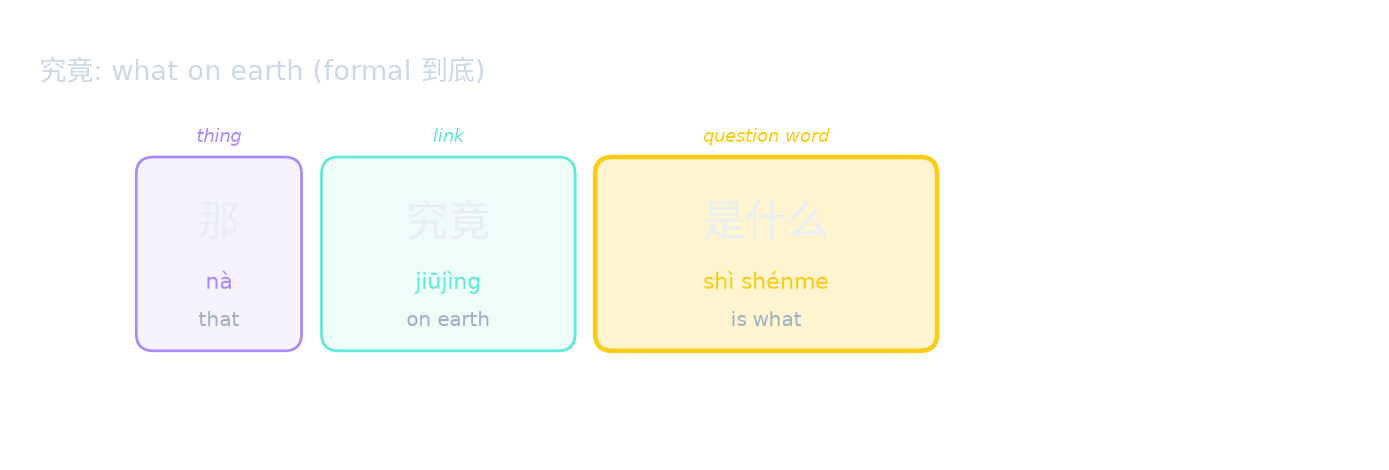
- A news report on a mysterious light in the sky ends with one question.
- that那exactly究竟is是what什么? — "What exactly was it?"
- Goal: ask "what exactly…?" with exactly究竟, the more formal partner of in the end到底.
exactly究竟 = exactly, on earth (more formal)
- exactly究竟 works like in the end到底 in questions, but sounds more serious and written.
- It needs a question word or A-not-A: exactly究竟why?为什么? ("Why exactly?") exactly究竟去不去? — "Are you going or not, after all?"
the problem问题exactly究竟lies在where哪儿?
Complete a formal question: “What exactly is the reason?” 原因____是什么?
难度 1/5 · 今日首次完成可获 100 金币及少量额外奖励
究竟 + question word.
In reports and discussions
- the accident's事故(modifier / structural particle)的cause原因exactly究竟is是what什么? — "What exactly caused the accident?"
- we / us我们exactly究竟should应该how / why怎么to do; to make做? — "What exactly should we do?"
the accident's事故的cause原因exactly究竟is是what什么?
Build: “What exactly should we do?”
难度 3/5 · 今日首次完成可获 200 金币及少量额外奖励
Subject + 究竟 + question.
Same rules as in the end到底
- No (yes/no ?)吗: you你exactly究竟to agree同意not不to agree同意? ("Do you agree or not, after all?"), not you你exactly究竟to agree同意(yes/no ?)吗?
- Put exactly究竟 after the topic and before the question part: cause原因exactly究竟is是what什么? — "What exactly is the reason?"
Which question is correct?
难度 1/5 · 今日首次完成可获 100 金币及少量额外奖励
究竟 needs A-not-A or a question word.
exactly究竟 versus in the end到底
- In questions they are interchangeable; exactly究竟 is more formal and calmer.
- in the end到底 has extra uses in statements (in the end到底still还是come来(completed / change)了 — "in the end he came"); exactly究竟 rarely does.
he他in the end到底still还是come来了。
究竟 sounds more formal than 到底.
难度 1/5 · 今日首次完成可获 100 金币及少量额外奖励
It suits reports and serious discussion.
Recap
- exactly究竟 + question = exactly / on earth, more formal than in the end到底.
- It needs a question word or A-not-A, never (yes/no ?)吗; in the end到底 also works in statements.
Read the full reference: HSK 4 grammar — Adverbs.
A news report on a mysterious light in the sky ends with one question. Close the examples. Say a Mandarin response, then write it in Chinese. Explain briefly in English what the lesson’s pattern adds. Compare with the model, then change one detail and try again.
This is supported productive practice. Compare meaning and structure; your answer need not copy the model. A partner or teacher must hear the spoken response to comment on pronunciation.