Question Word + 都 (every / all)
引入您的已保存位置保留在此浏览器中。恢复操作不会完成课程或回答其中的问题。
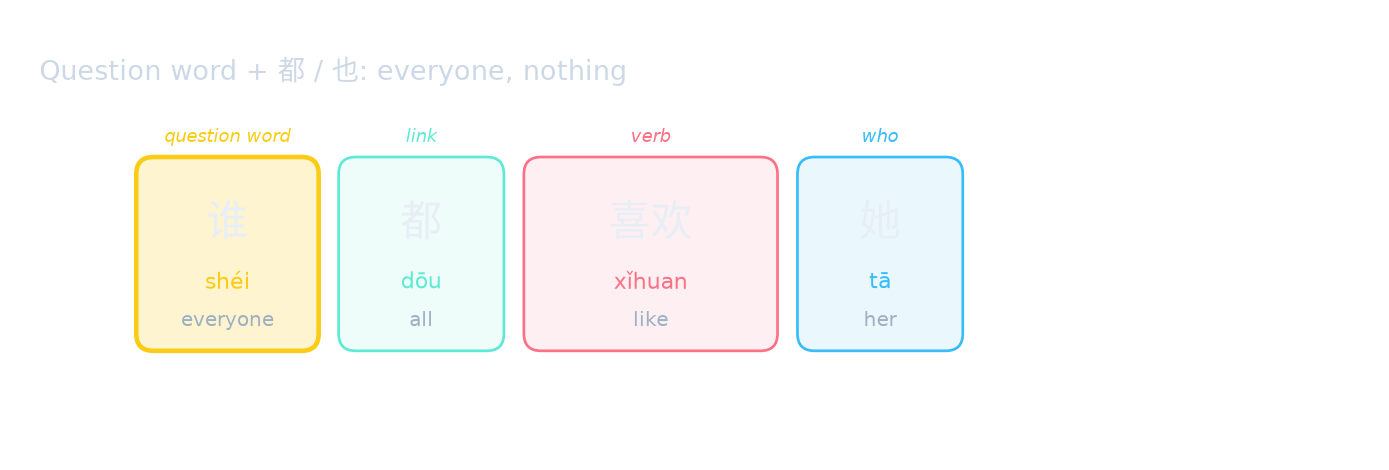
Everyone likes her
- A new teacher has just started at your school, and every student is talking about her.
- who谁all都to like喜欢she / her她。 — "Everyone likes her."
Question word + all都 / (at all)也
- QW + all都 + Verb = every-, any-: who谁all都 (everyone), anything什么all都 (everything), where哪儿all都 (everywhere).
- The question word goes before all都 and the verb, not after the verb.
I我anything什么all都eat吃。
Complete: “Everyone knows him.” 谁____认识他。
难度 1/5 · 今日首次完成可获 100 金币及少量额外奖励
QW + 都 + verb = every-.
With not不 / not没: nobody, nothing, nowhere
- he他anything什么(at all)也not没say说。 — "He didn't say anything."
- weekend周末I我where哪儿all都unexpectedly不想to go去。 — "I don't want to go anywhere this weekend."
he他anything什么(at all)也not没say说。
Build: “He didn't say anything.”
难度 3/5 · 今日首次完成可获 200 金币及少量额外奖励
Subject + QW + 也 + 没 + verb.
Word order
- The QW moves before all都 / (at all)也: I我anything什么all都eat吃, not I我eat吃anything什么all都.
- In the negative, (at all)也 and all都 both work: anything什么(at all)也unexpectedly不想eat吃 / anything什么all都unexpectedly不想eat吃.
Which says “I don't want to eat anything.”?
难度 1/5 · 今日首次完成可获 100 金币及少量额外奖励
QW + 都 + 不 + verb.
With a noun: which哪 + MW + Noun + all都
- every哪个 / which哪kind种 + noun + all都 = any of them: every哪个dish菜all都delicious好吃 — "Every dish is delicious."
- anything什么time; when时候all都can / may可以 — "Any time is fine."
every哪个dish菜all都delicious好吃。
哪个菜都好吃 means “every dish is delicious”.
难度 1/5 · 今日首次完成可获 100 金币及少量额外奖励
哪个 + noun + 都 = any/every one of them.
Recap
- QW + all都 + Verb = every-/any-: who谁all都, anything什么all都, where哪儿all都, anything什么time; when时候all都.
- QW + (at all)也/all都 + not不/not没 = no-one, nothing, nowhere. The QW comes before all都.
Read the full reference: HSK 3 grammar — Basic sentence patterns.
A new teacher has just started at your school, and every student is talking about her. Close the examples. Say a Mandarin response, then write it in Chinese. Explain briefly in English what the lesson’s pattern adds. Compare with the model, then change one detail and try again.
This is supported productive practice. Compare meaning and structure; your answer need not copy the model. A partner or teacher must hear the spoken response to comment on pronunciation.