被 sentences (the passive)
引入您的已保存位置保留在此浏览器中。恢复操作不会完成课程或回答其中的问题。
Where's my bike?
- You come out of the library and your bike is gone.
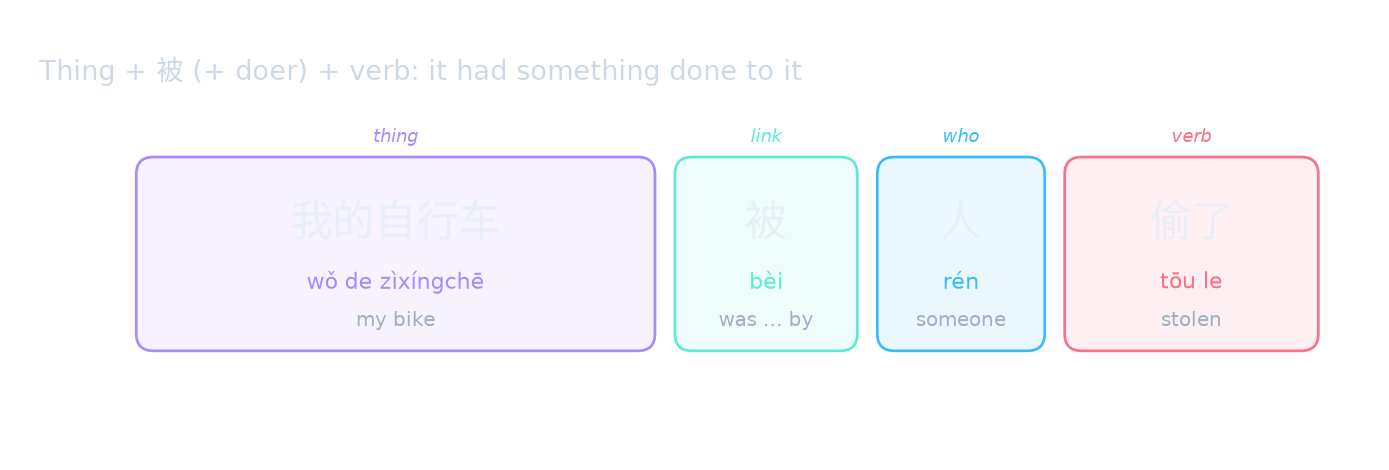
- my我(modifier / structural particle)的bike自行车(was)被person人stolen偷(completed / change)了! Wǒ de zìxíngchē bèi rén tōu le! — "My bike has been stolen!"
- Goal: use (was)被 to tell what happened to someone or something, often bad news, and know when Chinese needs no (was)被 at all.
1 · The shape: Receiver + (was)被 + (doer) + Verb + result
- The sentence starts with the one who receives the action. (was)被 comes next, then the doer if you want to name them.
- my我(modifier / structural particle)的mobile phone手机(was)被my younger brother弟弟弄坏了。 Wǒ de shǒujī bèi dìdi nòng huài le. — "My phone was broken by my little brother."
| Receiver | (was)被 | Doer (optional) | Verb + result |
|---|---|---|---|
| my我(modifier / structural particle)的mobile phone手机 | (was)被 | my younger brother弟弟 | 弄坏了 |
| my我(modifier / structural particle)的bike自行车 | (was)被 | person人 | stolen偷(completed / change)了 |
| he他 | (was)被 | the teacher老师 | criticise批评(completed / change)了 |
- When you don't know or don't care who did it, drop the doer or use person人: bike自行车(was)被stolen偷(completed / change)了。 / bike自行车(was)被person人stolen偷(completed / change)了。
my我的bike自行车(was)被stolen偷了。
Complete: “My wallet was stolen.” 我的钱包____偷了。
难度 1/5 · 今日首次完成可获 100 金币及少量额外奖励
Receiver + 被 + verb + 了.
2 · From (把: marks the object)把 to (was)被: same event, other starting point
- (把: marks the object)把 starts with the doer; (was)被 starts with the receiver. Swap the two people or things and change (把: marks the object)把 to (was)被:
- my younger brother弟弟(把: marks the object)把the cake蛋糕eat吃up完(completed / change)了。 Dìdi bǎ dàngāo chī wán le. — "My little brother ate up the cake."
- the cake蛋糕(was)被my younger brother弟弟eat吃up完(completed / change)了。 Dàngāo bèi dìdi chī wán le. — "The cake was eaten up by my little brother."
- Choose by what you are talking about. Talking about your brother → (把: marks the object)把. Talking about the cake (where did it go?) → (was)被.
the cake蛋糕by被my younger brother弟弟eat吃up完了。
Build: “The cake was eaten up by my little brother.”
难度 3/5 · 今日首次完成可获 200 金币及少量额外奖励
Receiver + 被 + doer + verb + result + 了.
Turn into a 被 sentence: 小狗把我的鞋咬坏了。 ("The puppy chewed up my shoe.")
难度 1/5 · 今日首次完成可获 100 金币及少量额外奖励
The receiver (我的鞋) comes first, then 被 + the doer (小狗), then the verb and result.
弟弟把蛋糕吃完了 and 蛋糕被弟弟吃完了 describe the same event.
难度 1/5 · 今日首次完成可获 100 金币及少量额外奖励
Both say the brother ate the cake; they start from different points.
3 · (was)被 usually brings bad news
- Most (was)被 sentences report something unwelcome: stolen, broken, told off, taken away.
- he他(was)被the teacher老师criticise批评(completed / change)了。 Tā bèi lǎoshī pīpíng le. — "He was told off by the teacher."
- my我(modifier / structural particle)的umbrella伞(was)被wind风刮走(completed / change)了。 Wǒ de sǎn bèi fēng guā zǒu le. — "My umbrella was blown away by the wind."
- Good news with (was)被 is possible but less common: he他(was)被to choose选for / (wéi) to be为class monitor班长(completed / change)了。 — "He was chosen as class monitor."
he他by被the teacher老师criticise批评了。
4 · Often Chinese needs no (was)被
- English says "The homework is done", "Dinner is ready". Chinese usually just puts the thing first, with no (was)被:
- ✓ school assignment作业to write写up完(completed / change)了。 Zuòyè xiě wán le. — "The homework is done." ✗ school assignment作业(was)被to write写up完(completed / change)了。
- ✓ dinner饭cook做ready好(completed / change)了。 Fàn zuò hǎo le. — "Dinner is ready." ✗ dinner饭(was)被cook做ready好(completed / change)了。
- Use (was)被 when the receiver was affected, usually for the worse, or when you name who did it.
dinner饭cook做ready好了。
Your mum calls from the kitchen: “Dinner is ready!” Which is the natural Chinese?
难度 1/5 · 今日首次完成可获 100 金币及少量额外奖励
Neutral “is done / is ready” needs no 被. Just put the thing first: 饭做好了。
Two rules about word order
- The verb needs something after it, as with (把: marks the object)把: ✗ bike自行车(was)被stolen偷。 ✓ bike自行车(was)被stolen偷(completed / change)了。
- not / haven't没, not不 and don't别 go before (was)被: ✓ my我(modifier / structural particle)的mobile phone手机not / haven't没(was)被stolen偷。 Wǒ de shǒujī méi bèi tōu. — "My phone wasn't stolen." ✗ my我(modifier / structural particle)的mobile phone手机(was)被not / haven't没stolen偷。
Which says “My phone wasn't taken”?
难度 1/5 · 今日首次完成可获 100 金币及少量额外奖励
没 goes before 被.
我的自行车被偷。 is a complete sentence.
难度 1/5 · 今日首次完成可获 100 金币及少量额外奖励
The verb needs something after it: 我的自行车被偷了。
Recap
- Receiver + (not / haven't没) + (was)被 + (doer / person人) + Verb + result or (completed / change)了 = something was done to the receiver.
- (把: marks the object)把 starts from the doer, (was)被 from the receiver: my younger brother弟弟(把: marks the object)把the cake蛋糕eat吃up完(completed / change)了 = the cake蛋糕(was)被my younger brother弟弟eat吃up完(completed / change)了.
- (was)被 mostly reports bad news. For neutral "is done / is ready", just put the thing first: school assignment作业to write写up完(completed / change)了.
Read the full reference: HSK 3 grammar — Sentence patterns.
You come out of the library and your bike is gone. Close the examples. Say a Mandarin response, then write it in Chinese. Explain briefly in English what the lesson’s pattern adds. Compare with the model, then change one detail and try again.
This is supported productive practice. Compare meaning and structure; your answer need not copy the model. A partner or teacher must hear the spoken response to comment on pronunciation.