介绍自己的名字并询问对方的
引入您的已保存位置保留在此浏览器中。恢复操作不会完成课程或回答其中的问题。
 4:32
HSK 1 · 介绍、身份与礼貌交流
你的第一次中文对话。介绍自己,询问他人姓名,并掌握开启每次交流的四句礼貌用语。此外,还有一个极小的字“吗”……
英文讲解与普通话例句 · 字幕与原声同步
本课内容
Meet Lin An
-
Lin An introduces herself: I / me我to call / be called / (animals) cry, bark叫林安。 Wǒ jiào Lín Ān. — My name is Lin An.
-
I / me我 wǒ means I; to call / be called / (animals) cry, bark叫 jiào introduces the name here. Use your own name after I / me我to call / be called / (animals) cry, bark叫, including a non-Chinese name.
-
Before you start: Recall a greeting from the first meeting lesson. This lesson adds a name question; a name is different from an identity such as student.
Someone asks for your name. Which information would answer that request?
难度 1/5 · 今日首次完成可获 100 金币及少量额外奖励
A name request needs a name. Your role and departure time answer different questions. The next steps teach the Mandarin frame.
Ask the other person’s name
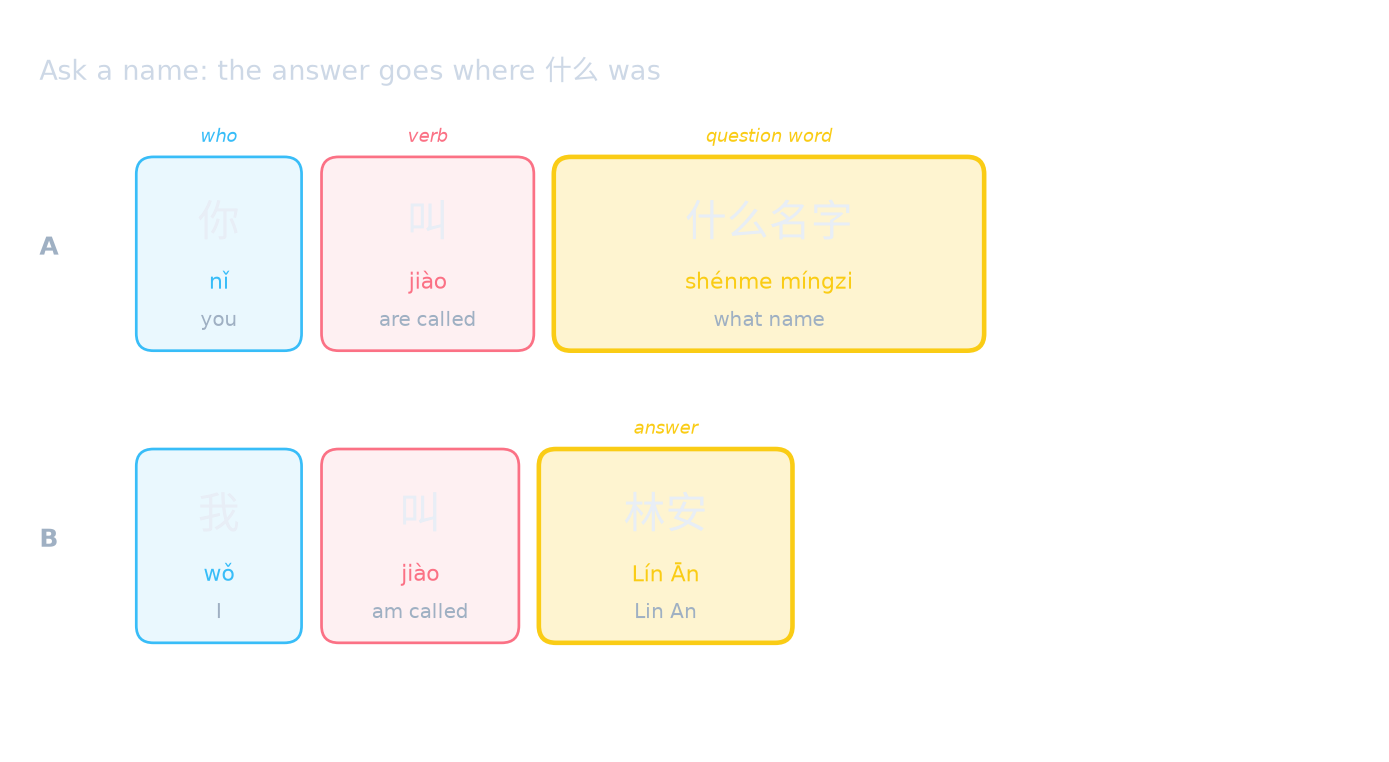
- you你to call / be called / (animals) cry, bark叫what什么name名字? Nǐ jiào shénme míngzi? — What is your name?
- you你 nǐ means you; what什么 shénme means what; name名字 míngzi means name. Learn what什么name名字 together: “what name”.
Complete the full name question: 你叫什么____?
难度 1/5 · 今日首次完成可获 100 金币及少量额外奖励
什么名字 means what name.
Compare question and answer
- Question: you你to call / be called / (animals) cry, bark叫what什么name名字? Answer: I / me我to call / be called / (animals) cry, bark叫林安。 Change you你 to I / me我 because the person answering speaks about themself.
- Keep this simple naming pattern: I / me我to call / be called / (animals) cry, bark叫…… . Do not add to be / is是 to the pattern we are practising.
A: hello你好!you你to call / be called / (animals) cry, bark叫what什么name名字? B: I / me我to call / be called / (animals) cry, bark叫林安。you你(and …? / softener)呢? — Hello! What is your name? My name is Lin An. And you? you你(and …? / softener)呢 nǐ ne is an optional follow-up phrase.
Work through a decision: In you你to call / be called / (animals) cry, bark叫what什么name名字?, you你 addresses the listener. When that listener answers, they become the speaker and use I / me我:I / me我to call / be called / (animals) cry, bark叫林安。Keep the real person fixed while changing the pronoun for the new turn.
Compare a near miss: you你to call / be called / (animals) cry, bark叫林安 means the person addressed is called Lin An. It does not introduce your own name. I / me我to be / is是student学生 may be true, but it gives an identity rather than the name requested.
Someone asks 你叫什么名字? Which answer gives your name?
难度 1/5 · 今日首次完成可获 100 金币及少量额外奖励
我叫林安 introduces the speaker’s name; 我是学生 gives an identity.
Match these words.
难度 2/5 · 今日首次完成可获 140 金币及少量额外奖励
我 is the speaker and 你 is the person addressed.
You are playing Lin An. A partner asks 你叫什么名字? Choose your own introduction.
难度 1/5 · 今日首次完成可获 100 金币及少量额外奖励
The answerer refers to themself with 我, and the given role is 林安. 你叫林安 describes the listener; 我叫王力 changes the name on the role card.
Hear a different name
- Play and find the name after to call / be called / (animals) cry, bark叫.
- Wang Li (a name)王力 is Wáng Lì. In these Chinese names, the surname is first: to rule王 / power力 and (bound form) woods林 / (bound form) calm安. You do not have to invent a Chinese name to study Chinese.
Learn the full polite question first. You may also hear the shorter you你to call / be called / (animals) cry, bark叫what什么? in conversation; it is not automatically an incomplete sentence.
Which name did you hear?
难度 1/5 · 今日首次完成可获 100 金币及少量额外奖励
The name after 叫 is 王力, Wáng Lì.
In 林安, 林 is the surname.
难度 1/5 · 今日首次完成可获 100 金币及少量额外奖励
These Chinese names put the family name before the given name.
A:我叫李明。你叫什么名字? B:我叫王力。In this fresh exchange, whose name is 王力?
难度 1/5 · 今日首次完成可获 100 金币及少量额外奖励
B says 我叫王力, so 王力 is B’s name. The 我 in A’s earlier turn refers to A, not to the same speaker throughout the dialogue. Track each turn before assigning a name.
Introduce yourself
- Say I / me我to call / be called / (animals) cry, bark叫 followed by your own name. Ask someone else’s name, or answer the recorded question without reading.
- Write or type your name sentence. An IME lets you enter pinyin and choose characters; see the typing guide.
I / me我to call / be called / (animals) cry, bark叫…… gives your name. you你to call / be called / (animals) cry, bark叫what什么name名字? asks for another person’s name.
Later recall: Tomorrow, ask and answer the name question without the model, using a different fictional name. Switch speakers and track I / me我 again. A few days later, explain why an identity alone does not answer the question; revisit “Compare question and answer” after a pronoun mix-up.
Next: say who someone is.
Greet, ask a name, then receive the answer.
难度 3/5 · 今日首次完成可获 200 金币及少量额外奖励
The order follows the situation given.
Write a new Mandarin greeting, name question and answer using a fictional name different from the lesson’s model. Say both roles aloud. Then switch roles and write the new answerer’s own name sentence; keep 我 tied to the current speaker.
Compare and revise your own wording. Written self-review does not assess pronunciation or conversation quality.
出了什么问题?只有网站团队能看到这些信息。