人格、临床与异常心理学
引入| English | 释义 | 拼音 |
|---|---|---|
| defence mechanism/dɪˈfens ˈmekənɪzəm/ | 防御机制 | fáng yù jī zhì |
| self-efficacy/self ˈefɪkəsi/ | 自我效能 | zì wǒ xiào néng |
| systematic desensitisation/ˌsɪstəˈmætɪk diːˌsensɪtaɪˈzeɪʃn/ | 系统脱敏 | xì tǒng tuō mǐn |
One observation leaves several questions
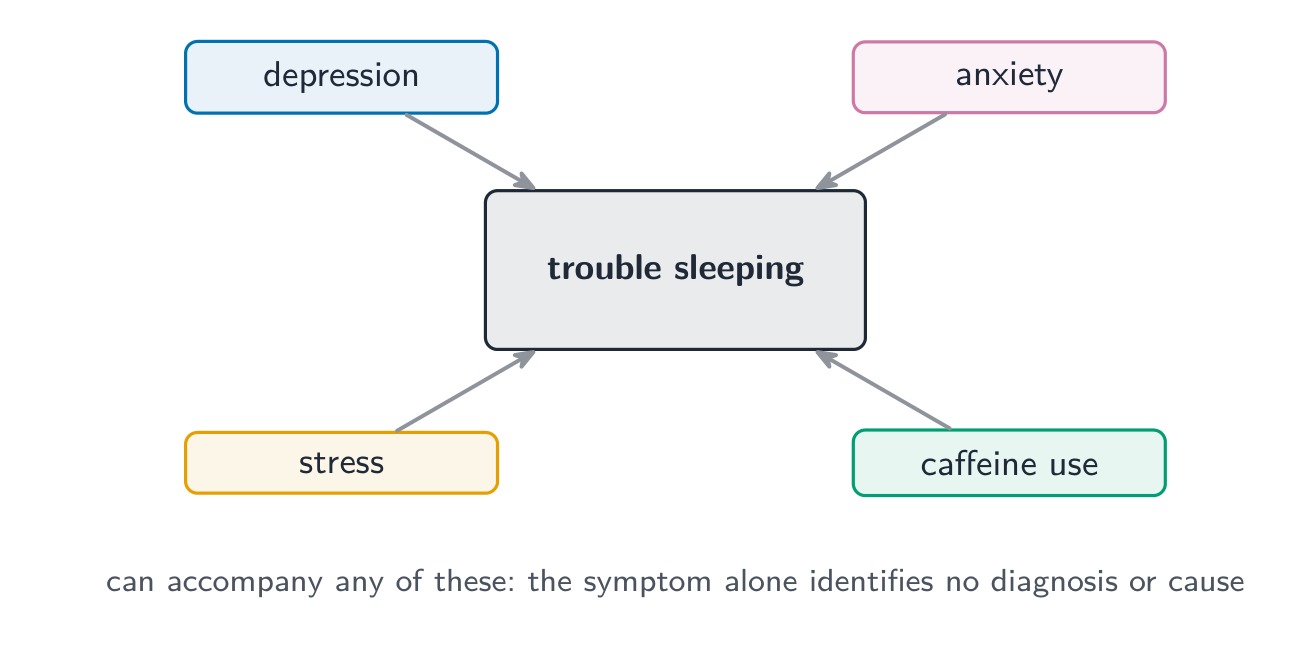
- Trouble sleeping can accompany anxiety, depression, stress, caffeine use or other influences. It does not identify one disorder by itself. In mania, reduced need for sleep can mean sleeping less without feeling tired; this is different from simply wanting to sleep but being unable to.
- This academic overview separates personality descriptions, explanatory theories, assessment methods and clinical evidence. A short vignette can test a concept without providing enough information to assess a real person.
Traits describe patterns, not fixed types
- The Big Five are openness, conscientiousness, extraversion, agreeableness and neuroticism. They describe broad dimensions of individual differences, not five types of person or a complete explanation of behaviour. Intelligence is not one of these five dimensions.
- Traits can show substantial stability, yet mean levels and individuals can change over time. Stability of relative standing is different from an unchanged score. Situation, time span and measurement method matter; a trait score does not predict every action.
Worked comparison. Two people both become more conscientious over several years while one remains higher than the other. Their levels changed, but their relative order stayed the same. Neither observation shows that traits are permanently fixed.
Which is NOT one of the Big Five traits?
难度 1/5 · 今日首次完成可获 100 金币及少量额外奖励
The Big Five are openness, conscientiousness, extraversion, agreeableness and neuroticism. They are broad dimensions; intelligence is a different construct.
A stable rank order of trait scores proves that every person’s score stayed unchanged.
难度 1/5 · 今日首次完成可获 100 金币及少量额外奖励
People can change in level while retaining the same relative order. Stability depends on what is measured and over what period.
Psychodynamic and humanistic accounts
- Freud's model uses id, ego and superego to describe drives, mediation and internalised standards. In this framework, defence mechanisms 防御机制 protect against anxiety: repression excludes material from awareness, while projection attributes one's unacceptable feelings to others. These are theoretical interpretations, not conclusions established by one behaviour.
- Humanistic accounts emphasise personal experience and growth. Rogers stressed empathy, genuineness and unconditional positive regard; Maslow discussed human needs and self-actualisation. Accepting a person's worth does not mean approving every action, and these perspectives are not personality test scores.
Worked distinction. Deliberately postponing an upsetting thought is a conscious choice. It is not, by that description alone, repression as an unconscious defence. Identify what a vignette actually states before assigning a theoretical label.
Rogers emphasised ____ positive regard.
难度 1/5 · 今日首次完成可获 100 金币及少量额外奖励
Unconditional positive regard concerns acceptance of the person’s worth, without requiring approval of every action.
A person consciously deciding to postpone a thought is, from that description alone, an example of unconscious repression.
难度 1/5 · 今日首次完成可获 100 金币及少量额外奖励
The description states a deliberate choice. Repression in the psychodynamic account is an unconscious process; do not infer it from any avoidance.
Social-cognitive accounts connect person and situation
- Bandura's self-efficacy 自我效能 concerns belief in one's capability for a particular action or task. It differs from actual skill, general self-worth and an expectation that an action will produce a desired outcome.
- Reciprocal determinism describes interacting personal factors, behaviour and environment; it does not require equal effects in every direction. Rotter's locus of control concerns expectations about whether outcomes depend on one's actions or on external influences. Beliefs about control do not establish how controllable a real situation is.

The arrows represent proposed reciprocal influences. Their presence does not establish the strength or cause of a particular observed change.
Which statement most directly expresses task-specific self-efficacy?
难度 1/5 · 今日首次完成可获 100 金币及少量额外奖励
Self-efficacy concerns perceived capability. The reward claim is an outcome expectation; neither belief is proof of actual skill or consequences.
Compare assessment methods and their limits
- A self-report inventory asks people to describe themselves using structured items; an informant rating asks someone who knows them. Self-knowledge, response style, impression management and the informant's opportunities to observe can affect results. Agreement or disagreement needs interpretation, not an automatic choice of one source as correct.
- Structured behavioural observation records specified actions in a defined setting. Projective methods ask for responses to ambiguous material; interpretations need evidence for the particular scoring method and use. No method label alone establishes reliability, validity or a diagnosis.
Worked assessment. A person rates their sociability across many settings, while a colleague rates only workplace behaviour. Different ratings may reflect context, perspective or measurement error. Compare the instructions, situations and evidence before treating the difference as dishonesty or a personality change.
这是哪种评估方法?
在解读人格分数之前,先确定来源和程序。
A self-rating across daily life differs from a colleague’s workplace-only rating. What is the best first interpretation?
难度 1/5 · 今日首次完成可获 100 金币及少量额外奖励
Sources can sample different situations or have different limitations. Disagreement alone does not settle its cause.
Classification uses a full pattern
- DSM-5-TR and ICD-11 organise clinical descriptions, but their requirements are not interchangeable. Review the relevant symptom pattern, course, distress or impairment, exclusions and cultural context. A screening score or one symptom does not supply this whole assessment.
- Broad groups include mood, anxiety and psychotic disorders, but features can overlap. A depressive episode is not by itself a complete disorder history, and hallucinations do not uniquely identify schizophrenia. Labels can aid communication without establishing a unique cause or defining all of a person's characteristics.
A positive screening score by itself supplies a complete clinical diagnosis and its cause.
难度 1/5 · 今日首次完成可获 100 金币及少量额外奖励
Screening can identify possible concerns, but a fuller relevant assessment is needed. A category does not establish a unique cause.
Therapy labels identify emphases
- Cognitive work associated with Beck or Ellis examines interpretations and beliefs. Behavioural methods include exposure and reinforcement-based procedures; historical systematic desensitisation 系统脱敏 pairs graded exposure with relaxation. CBT can combine cognitive and behavioural methods; exposure does not always require a relaxation component.
- Psychodynamic work explores patterns and conflicts, while person-centred work emphasises the therapeutic relationship and the person's experience. Biological treatments include medications selected through clinical assessment. These are proposed emphases and descriptions, not unique proven mechanisms or recommendations for an individual.
描述了哪种侧重点?
根据技术识别治疗方式。
Systematic desensitisation belongs to which approach?
难度 1/5 · 今日首次完成可获 100 金币及少量额外奖励
Historical systematic desensitisation is a behavioural method pairing graded exposure with relaxation. This is narrower than exposure in general.
Match each teaching label to its described emphasis, without assuming a unique proven mechanism.
难度 2/5 · 今日首次完成可获 140 金币及少量额外奖励
These are simplified descriptions of emphases. Methods can overlap, and matching a description does not establish how a particular outcome was caused.
Improvement has several possible explanations
- Change after treatment can include treatment effects, natural recovery, other help, expectations or changes in measurement. Regression to the mean is a different possibility: selection on extreme scores and imperfectly related repeat measurements can produce less extreme later scores without equivalent underlying improvement.
- A single group's before-and-after change cannot by itself separate these explanations. Regression is not inevitable in every study, and spontaneous improvement does not imply that everyone recovers without care. Name the conditions for the explanation rather than treating a list as proof.
If clients improve after therapy, the therapy caused the improvement.
难度 1/5 · 今日首次完成可获 100 金币及少量额外奖励
Uncontrolled improvement alone cannot separate treatment from natural change, other care, expectancy, measurement changes or regression under the relevant selection/retest conditions.
Which situation most directly makes regression to the mean a relevant alternative explanation?
难度 1/5 · 今日首次完成可获 100 金币及少量额外奖励
Extreme-score selection and imperfect repeat relations create the relevant statistical conditions. This is different from genuine natural recovery.
Ask what the comparison can establish
- A waitlist, an attention-matched comparison and another active treatment answer different questions. Proper random allocation strengthens comparisons by preventing systematic selection through allocation, but chance imbalance, missing outcomes and later departures from the design can remain.
- Randomised comparisons are often valuable evidence; they are not the only possible source of causal evidence. A non-randomised design also needs a justified comparison and credible assumptions that address alternative explanations. Study quality and the claim matter more than a design label alone.
Do not credit an uncontrolled pre/post change entirely to treatment. Equally, do not assume that random allocation proves a specific mechanism, universal benefit or freedom from all bias.
Calculate a contrast, then judge the claim
- In a fictional example, one group improves by 6 points and a comparison group by 4 over the same period. The observed difference in mean changes is $6-4=2$ points, relative to that comparator. This is different from the 6-point change within the first group.
- To interpret the contrast, examine allocation or other identification assumptions, outcome scale, follow-up, missing data and uncertainty. Outcome similarity between therapies does not alone prove equivalence or a shared mechanism; a group average does not promise an individual result.
Worked critique. A report calls the first group's 6-point improvement “six points caused by our unique method”. The comparator also changed, so six points is not the observed comparative contrast. Even the two-point contrast needs a suitable design and assumptions for a causal claim, and further evidence would be needed to identify a unique mechanism.
In a separate fictional example, mean improvement is 9 points in one group and 6 in a comparator over the same period. What is the observed difference in mean changes, in points?
难度 2/5 · 今日首次完成可获 140 金币及少量额外奖励
9 − 6 = 3 points relative to that comparison. A causal or practical interpretation needs the design, assumptions and scale context.
A report finds a two-point mean difference between two therapy groups and concludes that everyone benefits by two points through one unique mechanism. Identify two distinct gaps and name relevant additional evidence.
组间均值差异不能证明每个个体的结果;其因果解释需要适当的设计、假设、追踪及不确定性考量。结果差异也不能识别唯一机制;若需验证该机制,则应基于理论驱动的过程或成分研究进行测试,同时考虑替代解释。
Recap
- Separate trait dimensions, theoretical explanations and assessment methods.
- Distinguish task-specific capability beliefs, outcome expectations and control beliefs.
- Clinical classification needs the relevant full pattern and context.
- Identify a therapy's described emphasis without assuming a unique mechanism.
- Compare outcomes and evaluate assumptions before making causal or individual claims.
- defence mechanism: In psychodynamic theory, an unconscious process that protects against anxiety.
- self-efficacy: Belief in one's capability to carry out a particular action or task.
- systematic desensitisation: A historical behavioural method pairing graded exposure with relaxation.
A student feels confident about a specific task, receives a high conscientiousness rating and reports sleep difficulty. A report claims these three observations prove both a disorder and its cause. Explain how the observations answer different questions and why the conclusion is unsupported.
任务信心可以描述自我效能;尽责性评分描述特定评估下的一种广泛特质维度。睡眠困难是一种症状描述,可能有多种影响因素。这些观察结果并未提供临床模式、病程、功能损害、排除标准或文化背景,且它们的同时存在并不确立因果关系。应检查评估方法和相关完整证据,而不是将每个观察结果转化为诊断。