有符号透镜与镜面成像
引入| English | 释义 | 拼音 |
|---|---|---|
| virtual image/ˈvɜːtʃuːəl ˈɪmɪdʒ/ | 虚像 | xū xiàng |
| converging/kənˈvɜːdʒɪŋ/ | 会聚 | huì jù |
| magnification/ˌmæɡnɪfɪˈkeɪʃn/ | 放大率 | fàng dà lǜ |
A negative answer is a location
- Solving the lens equation gives $s' = -20$ cm. That is not an error to fix with an absolute value: it says the image is virtual, on the incoming side.
- GRE geometric optics tests signed lens and mirror equations, the character of the image, ray diagrams, lenses in contact and two-lens systems.
The sign convention
- Real-is-positive: real object $s > 0$, real image $s' > 0$, virtual image 虚像 $s' < 0$. $\dfrac1f = \dfrac1s + \dfrac1{s'}$, $M = -\dfrac{s'}{s}$.
- Converging 会聚 lens $f > 0$; diverging $f < 0$. Concave mirror $f = R/2 > 0$; convex $f < 0$. Lensmaker: $\dfrac1f = (n - 1)\left(\dfrac1{R_1} - \dfrac1{R_2}\right)$, so a lens in water ($n$ closer to the surroundings) gets a longer focal length.
A negative image distance should be replaced by its absolute value before interpreting it.
难度 1/5 · 今日首次完成可获 100 金币及少量额外奖励
The sign marks a virtual image.
A glass lens put into water has a longer focal length than in air.
难度 1/5 · 今日首次完成可获 100 金币及少量额外奖励
The lensmaker factor becomes $n_{\text{glass}}/n_{\text{water}} - 1$, smaller than $n_{\text{glass}} - 1$, so the lens bends light less.
Lens images and ray diagrams
- $s > 2f$: real, inverted, smaller. $f < s < 2f$: real, inverted, larger. $s < f$: virtual, upright, enlarged (magnifier). $s = f$: parallel rays, no image. Diverging lens with a real object: always virtual, upright, smaller.
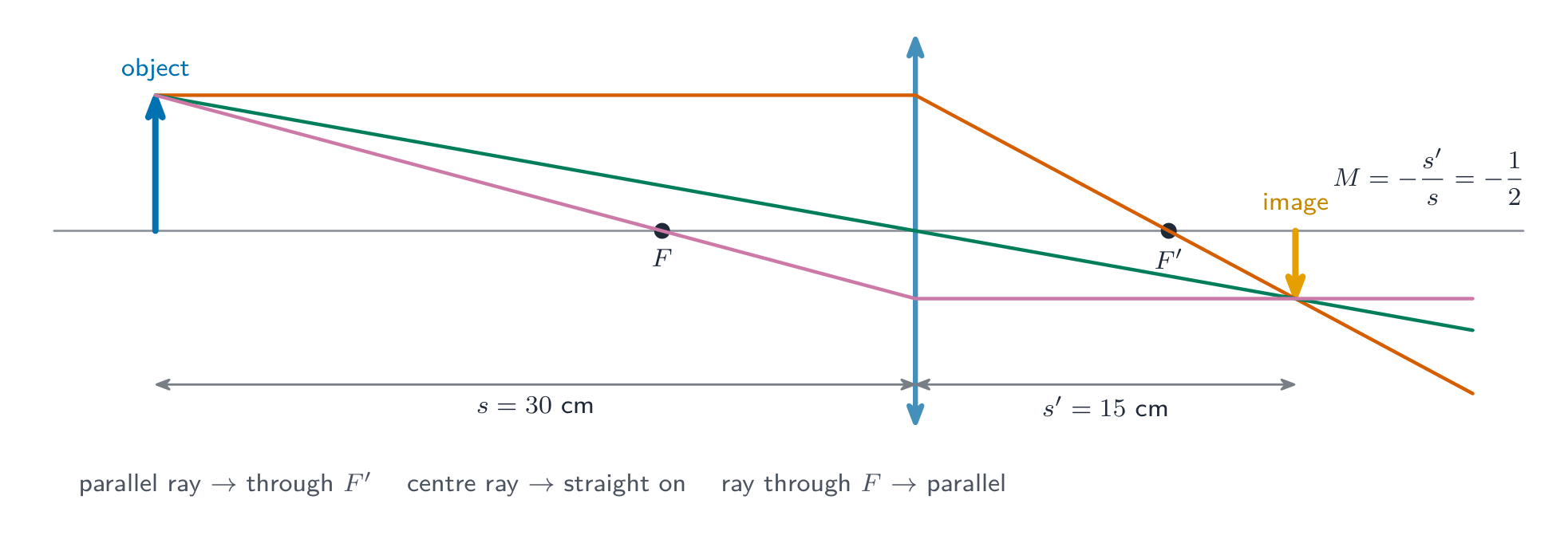
- Three rays locate any image: parallel to the axis → through the far focus $F'$; through the centre → straight on; through the near focus $F$ → parallel.
Converging lens $f = 20$ cm, object 60 cm away. Image distance in cm?
难度 2/5 · 今日首次完成可获 140 金币及少量额外奖励
The lens equation $1/s' = 1/f - 1/s = 1/20 - 1/60 = 1/30$ gives a real image 30 cm away.
Same lens, object 10 cm away. Magnification?
难度 2/5 · 今日首次完成可获 140 金币及少量额外奖励
With $s = 10$ cm inside the focal length, $1/s' = 1/20 - 1/10$, so $s' = -20$ cm (virtual) and $M = -s'/s = 2$.
Diverging lens $f = -15$ cm, object 30 cm away. Image distance in cm?
难度 2/5 · 今日首次完成可获 140 金币及少量额外奖励
$1/s' = 1/f - 1/s = -1/15 - 1/30 = -1/10$, so the image is virtual, 10 cm in front of the lens: $s' = -10$ cm.
An object stands $2f$ in front of a converging lens. Magnification?
难度 2/5 · 今日首次完成可获 140 金币及少量额外奖励
$1/s' = 1/f - 1/2f = 1/2f$, so $s' = 2f$ and $M = -1$: real, inverted, same size.
Mirrors
- Same equation and signs. A real mirror image sits in front of the mirror; virtual behind it.
- Convex mirror $f = -12$ cm, $s = 24$ cm: $\tfrac1{s'} = -\tfrac1{12} - \tfrac1{24}$, $s' = -8$ cm, $M = +\tfrac13$: upright, behind the mirror. This is why car side mirrors are convex: a wide view, but things look smaller and farther.
成像性质如何?
根据元件与物距预测成像特征。
A concave mirror with $R = 40$ cm and an object 30 cm away gives an image
难度 1/5 · 今日首次完成可获 100 金币及少量额外奖励
f = 20: 1/s′ = 1/20 − 1/30 = 1/60; M = −2.
Two lenses
- Thin lenses in contact add their powers: $\dfrac1f = \dfrac1{f_1} + \dfrac1{f_2}$ (power in dioptres is $1/f$ in metres).
- Separated lenses: find the first image, then measure the object distance for the second lens from its position; converging-in rays make a virtual object ($s < 0$). The total magnification 放大率 is $M = M_1M_2$.
$f = 10$ cm lens at $x = 0$, object at $x = -30$: image at $x = 15$, $M_1 = -\tfrac12$. Second $f = 10$ cm lens at $x = 40$: $s_2 = 25$, $s_2' = \tfrac{50}{3}$ cm, $M_2 = -\tfrac23$. Total $M = +\tfrac13$.
The spacing between two lenses is not automatically the second object distance: measure from the first image to the second lens, with its sign.
Two converging lenses of $f = 20$ cm and $f = 30$ cm are placed in contact. Focal length of the pair, in cm?
难度 2/5 · 今日首次完成可获 140 金币及少量额外奖励
$1/f = 1/20 + 1/30 = 5/60$, so $f = 12$ cm.
Worked GRE question: twice as large and inverted
A converging lens has focal length 10 cm. Where must an object be placed to give a real, inverted image twice its size?
- (A) 5 cm from the lens
- (B) 10 cm
- (C) 15 cm
- (D) 20 cm
- (E) 30 cm
Fast route. $M = -2$ means $s' = 2s$. Then $\dfrac1{10} = \dfrac1s + \dfrac1{2s} = \dfrac{3}{2s}$, so $s = 15$ cm (image at 30 cm). Answer (C).
Traps. (A) gives an image twice as large but virtual and upright ($M = +2$). (E) is the image distance. (D) is $2f$, where $M = -1$.
Worked GRE question: lenses in contact
A converging lens ($f = 10$ cm) is placed in contact with a diverging lens ($f = -15$ cm). The combination has a focal length of
- (A) $-30$ cm
- (B) $-6$ cm
- (C) 5 cm
- (D) 25 cm
- (E) 30 cm
Fast route. $\dfrac1f = \dfrac1{10} - \dfrac1{15} = \dfrac{1}{30}$: $f = 30$ cm, converging. Answer (E).
Traps. (C) and (D) add or subtract focal lengths instead of powers. (A) has the sign wrong: the stronger lens wins.
Common errors
- Taking absolute values. A negative $s'$ is information: a virtual image.
- Adding focal lengths. Lenses in contact add $1/f$.
- Using the lens spacing as the second object distance. Measure from the first image.
- Mirror image sides. Real mirror images are in front of the mirror, not behind it.
Recap
- $1/f = 1/s + 1/s'$, $M = -s'/s$, signs kept to the end.
- Negative $s'$: virtual image; positive $M$: upright; $f < s < 2f$ gives a larger real image.
- Lenses in contact: powers add. In a system, each lens takes the previous image as its object.
- converging: Bringing parallel rays together to a focus.
- magnification: The ratio of image height to object height, negative for an inverted image.
- virtual image: An image that light only appears to come from, so it cannot be shown on a screen.