散射、简并与泡利算符
引入| English | 释义 | 拼音 |
|---|---|---|
| degeneracy/dɪˈdʒenərəsi/ | 简并度 | jiǎn bìng dù |
| Pauli matrices/ˈpɔːli ˈmeɪtrɪsiːz/ | 泡利矩阵 | pào lì jǔ zhèn |
| transmission/trænˈsmɪʃn/ | 透射 | tòu shè |
Reflection from a downhill step
- A ball rolling off a ledge never bounces back. A quantum particle running onto a downward potential step partly reflects, even though no force pushes it back.
- GRE quantum questions here test scattering at a step, probability current, the degeneracy 简并度 of the 3D oscillator, and calculations with the Pauli matrices 泡利矩阵.
Steps and wave numbers
- In each flat region with $E > V$, the solution is $e^{\pm ikx}$ with $k = \sqrt{2m(E - V)}/\hbar$. A wave comes in from the left; on the far side there is only a transmitted wave. Match $\psi$ and $\psi'$ at the step:
- Any sudden change of $k$ reflects part of the wave, up or down, just as light partly reflects at glass. If $E < V$ on the far side, $k_2$ is imaginary: the wave decays into the step and all of it reflects, $R = 1$.
If $E < V$ beyond a step, part of the incoming wave is still transmitted to infinity.
难度 1/5 · 今日首次完成可获 100 金币及少量额外奖励
False. With $E < V$ the wave decays into the step ($k_2$ is imaginary), so no current flows to infinity: $R = 1$. The wave still penetrates a short distance.
Probability current
- The flow of probability is $j = \dfrac{\hbar k}{m}|A|^2$: a faster wave carries more probability per second for the same amplitude. So the transmission 透射 probability needs the speed ratio: $R = |r|^2$ but $T = \dfrac{k_2}{k_1}|t|^2 = \dfrac{4k_1k_2}{(k_1 + k_2)^2}$. Then $R + T = 1$.
- $R$ depends only on the ratio $k_2/k_1$ and is the same whichever way the particle crosses the step.
$k_2 = 3k_1$: $r = -\tfrac12$, $t = \tfrac12$. $R = \tfrac14$, $T = 3 \cdot \tfrac14 = \tfrac34$. Adding $|t|^2$ alone would give $R + |t|^2 = \tfrac12$, which loses probability.
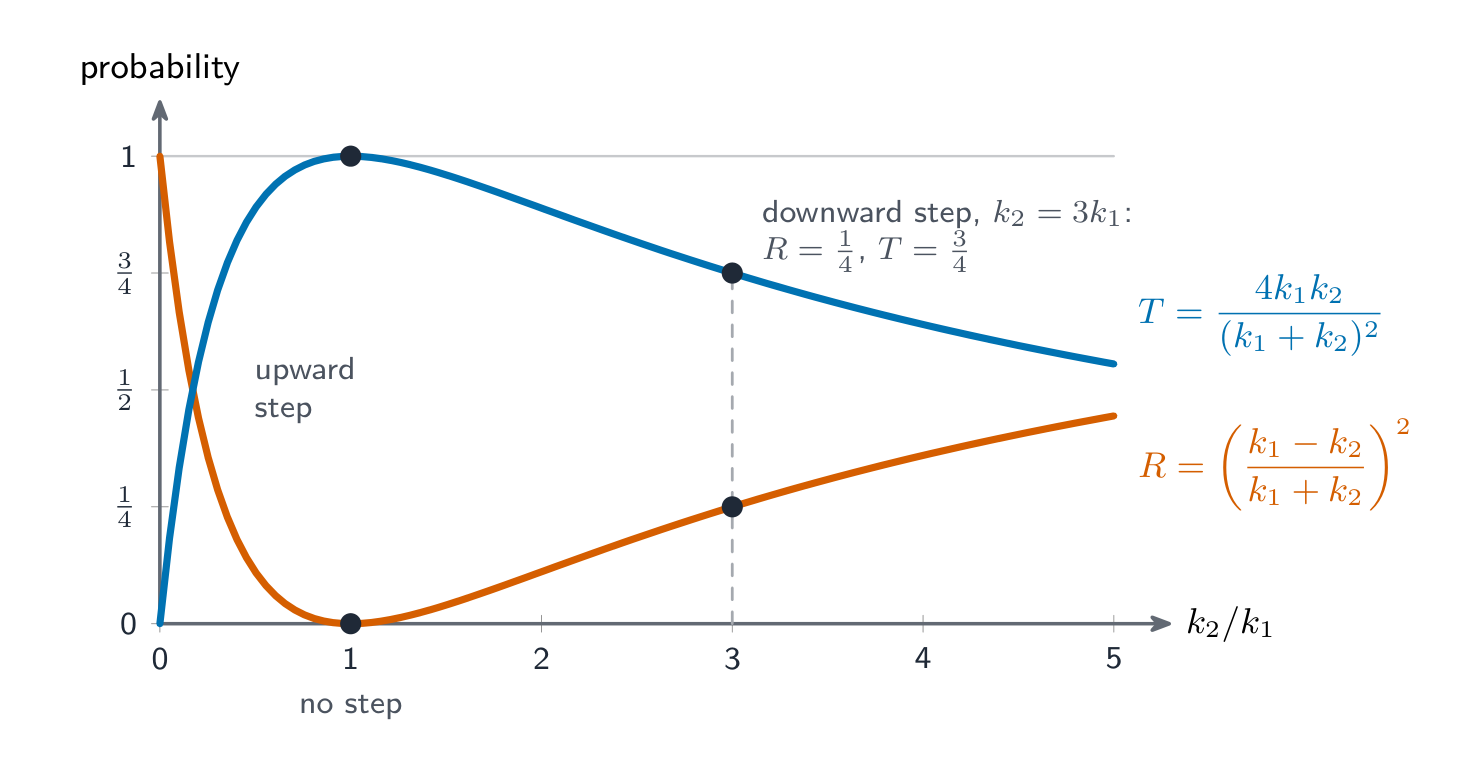
A step with $k_2 = 2k_1$. Reflection probability $R$ (three decimal places)?
难度 2/5 · 今日首次完成可获 140 金币及少量额外奖励
The reflection amplitude is $r = (k_1 - k_2)/(k_1 + k_2) = -1/3$, so $R = r^2 = 1/9 = 0.111$.
At a potential step, $R + |t|^2 = 1$.
难度 1/5 · 今日首次完成可获 100 金币及少量额外奖励
The current factor k₂/k₁ is needed.
Counting degenerate states
- 3D isotropic oscillator: $E = (N + \tfrac32)\hbar\omega$ with $N = n_x + n_y + n_z$. The number of ways to share $N$ quanta among three directions is $\dfrac{(N + 1)(N + 2)}{2}$: 1, 3, 6, 10, 15 (spin zero).
- Compare: a 1D oscillator is never degenerate; a 2D one has $N + 1$ states; hydrogen has $n^2$. Spin $\tfrac12$ doubles each count.
| $N$ | Energy | States $(n_x, n_y, n_z)$ | Degeneracy |
|---|---|---|---|
| 0 | $\tfrac32\hbar\omega$ | (0,0,0) | 1 |
| 1 | $\tfrac52\hbar\omega$ | (1,0,0) and permutations | 3 |
| 2 | $\tfrac72\hbar\omega$ | (2,0,0), (1,1,0) and permutations | 6 |
Spatial degeneracy of the level $E = \tfrac{11}{2}\hbar\omega$ of a 3D isotropic oscillator?
难度 2/5 · 今日首次完成可获 140 金币及少量额外奖励
$E = (N + \tfrac32)\hbar\omega$ gives $N = 4$; the degeneracy is $(N+1)(N+2)/2 = 15$.
Degeneracy of the $N = 3$ level of a 3D isotropic oscillator for a spin-½ particle?
难度 2/5 · 今日首次完成可获 140 金币及少量额外奖励
Spatial: $(3+1)(3+2)/2 = 10$. Two spin states each: $20$.
Pauli matrices and spin
- $\sigma_x = \begin{pmatrix} 0&1\\1&0 \end{pmatrix}$, $\sigma_y = \begin{pmatrix} 0&-i\\i&0 \end{pmatrix}$, $\sigma_z = \begin{pmatrix} 1&0\\0&-1 \end{pmatrix}$. Each squares to $I$ and has eigenvalues $\pm1$. $\sigma_x\sigma_y = i\sigma_z$ (cyclic $x \to y \to z$); reversed order flips the sign, so $[\sigma_x, \sigma_y] = 2i\sigma_z$.
- Spin: $S_i = \tfrac\hbar2\sigma_i$, so $[S_x, S_y] = i\hbar S_z$. In the state $|{+z}\rangle$, measuring $S_x$ gives $+\tfrac\hbar2$ or $-\tfrac\hbar2$ with probability $\tfrac12$ each, and $\langle S_x\rangle = 0$.
For any vector $\mathbf a$, $(\mathbf a\cdot\boldsymbol\sigma)^2 = |\mathbf a|^2 I$. So $\mathbf a\cdot\boldsymbol\sigma$ has eigenvalues $\pm|\mathbf a|$: no determinant needed.
泡利矩阵乘积
按循环顺序计算泡利矩阵的乘积。
$\sigma_y\sigma_z$ equals
难度 1/5 · 今日首次完成可获 100 金币及少量额外奖励
Pauli matrices obey $\sigma_j\sigma_k = i\epsilon_{jkl}\sigma_l$; in the cyclic order y, z, x this gives $\sigma_y\sigma_z = i\sigma_x$.
Each Pauli matrix squared equals the ____ matrix.
难度 1/5 · 今日首次完成可获 100 金币及少量额外奖励
Every Pauli matrix has eigenvalues ±1, so each squares to the identity: $\sigma_i^2 = I$.
A spin-½ particle is in the state $|{+z}\rangle$. Probability that a measurement of $S_x$ gives $+\hbar/2$? (decimal)
难度 2/5 · 今日首次完成可获 140 金币及少量额外奖励
$|{+z}\rangle = \tfrac{1}{\sqrt2}(|{+x}\rangle + |{-x}\rangle)$, so each outcome has probability $\left(\tfrac{1}{\sqrt2}\right)^2 = \tfrac12$.
Worked GRE question: a downward step
A particle of energy $E$ moves from a region where $V = 0$ into a region where $V = -3E$. What is the probability that it is reflected?
- (A) 0
- (B) $1/9$
- (C) $1/4$
- (D) $1/3$
- (E) $4/9$
Fast route. $k \propto \sqrt{E - V}$: $k_1 \propto \sqrt{E}$, $k_2 \propto \sqrt{4E}$, so $k_2 = 2k_1$. $R = \left(\dfrac{1 - 2}{1 + 2}\right)^2 = \dfrac19$. Answer (B).
Traps. (A) is the classical answer. (D) forgets to square $r$. (E) is $|t|^2$; the true transmission is $T = 2 \cdot \tfrac49 = \tfrac89$, which with $R = \tfrac19$ adds to 1.
Worked GRE question: eigenvalues of a spin matrix
What are the eigenvalues of $\sigma_x + \sigma_z$?
- (A) $\pm1$
- (B) $\pm\sqrt2$
- (C) 0 and 2
- (D) $\pm2$
- (E) $-1$, 0 and 1
Fast route. $\sigma_x + \sigma_z = \mathbf a\cdot\boldsymbol\sigma$ with $\mathbf a = (1, 0, 1)$, $|\mathbf a| = \sqrt2$. Its square is $2I$, so the eigenvalues are $\pm\sqrt2$. Answer (B). Check: the matrix is $\begin{pmatrix} 1&1\\1&-1 \end{pmatrix}$, trace 0 and determinant $-2$.
Traps. (C) and (D) add eigenvalues of matrices that do not commute. (E) has three eigenvalues for a $2\times2$ matrix.
Largest eigenvalue of $\sigma_x + \sigma_y + \sigma_z$ (three decimal places)?
难度 2/5 · 今日首次完成可获 140 金币及少量额外奖励
$\mathbf a = (1, 1, 1)$, $|\mathbf a| = \sqrt3$, so the eigenvalues are $\pm\sqrt3 = \pm1.732$.
Common errors
- Expecting no reflection at a downward step. Any change of $k$ reflects.
- Taking $T = |t|^2$. Multiply by $k_2/k_1$; check that $R + T = 1$.
- Adding eigenvalues of non-commuting matrices. Use $(\mathbf a\cdot\boldsymbol\sigma)^2 = |\mathbf a|^2 I$.
- Using $n^2$ for every 3D system. That is hydrogen; the isotropic oscillator has $(N+1)(N+2)/2$.
Recap
- Step: $r = (k_1 - k_2)/(k_1 + k_2)$; $R = r^2$; $T = 4k_1k_2/(k_1 + k_2)^2$; $E < V$ gives $R = 1$.
- Probability current $j = \hbar k|A|^2/m$ explains the $k_2/k_1$ factor.
- Oscillator degeneracy $(N+1)(N+2)/2$; hydrogen $n^2$.
- $\sigma_i\sigma_j = \delta_{ij}I + i\varepsilon_{ijk}\sigma_k$; $\mathbf a\cdot\boldsymbol\sigma$ has eigenvalues $\pm|\mathbf a|$.
- Pauli matrices: The three 2 by 2 matrices that represent spin one-half.
- transmission: The probability that a particle passes a step or barrier.
- degeneracy: The number of different states that share one energy.