量子力学与原子物理
引入| English | 释义 | 拼音 |
|---|---|---|
| normalisation/ˌnɔːməlaɪˈzeɪʃn/ | 归一化 | guī yī huà |
| commutator/ˈkɒmjuːteɪtə/ | 对易子 | duì yì zi |
| Hermitian/hɜːˈmɪʃn/ | 厄米的 | è mǐ de |
A box has no resting particle
- Confine an electron to a box and its lowest energy is not zero: the wavefunction must vanish at the walls, so it must curve, and curvature costs kinetic energy.
- Quantum mechanics is about an eighth of the GRE Physics test. It tests normalisation 归一化, measurement probabilities, the infinite well and the harmonic oscillator, time evolution, the uncertainty principle and commutators 对易子.
Probabilities from coefficients
- $\int |\psi|^2 = 1$. For orthonormal $\phi_j$, $\psi = \sum c_j\phi_j$ has $\sum |c_j|^2 = 1$; measuring gives $E_j$ with probability $|c_j|^2$, and the state then becomes $\phi_j$.
- $\psi = (\phi_1 + 2\phi_2)/\sqrt5$: $P(E_1) = \tfrac15$, $P(E_2) = \tfrac45$, and $\langle E\rangle = \tfrac15E_1 + \tfrac45E_2$. Relative phases affect position densities, not these probabilities.
For an equal superposition of 4 orthonormal states, each coefficient has magnitude 1/____.
难度 1/5 · 今日首次完成可获 100 金币及少量额外奖励
Normalisation needs $4|c|^2 = 1$, so $|c| = 1/\sqrt4 = 1/2$.
$\psi = (\phi_1 + 2\phi_2)/\sqrt5$. What is $\langle E\rangle$ in units of $E_1$ for an infinite well?
难度 2/5 · 今日首次完成可获 140 金币及少量额外奖励
$\tfrac15 \cdot 1 + \tfrac45 \cdot 4$.
Observables, averages, uncertainty
- Observables are Hermitian 厄米的 operators: real eigenvalues. $\langle A\rangle = \int \psi^* A\psi\,dx$ is an average over many preparations, not one result. If $A^4 = I$ and $A$ is Hermitian, its eigenvalues are $\pm1$; the complex fourth roots are excluded.
- $\Delta x\,\Delta p \ge \hbar/2$. For estimates, $p \sim \hbar/\Delta x$ gives $E \sim \hbar^2/2m(\Delta x)^2$: squeezing a particle raises its minimum energy.
The infinite well and the oscillator
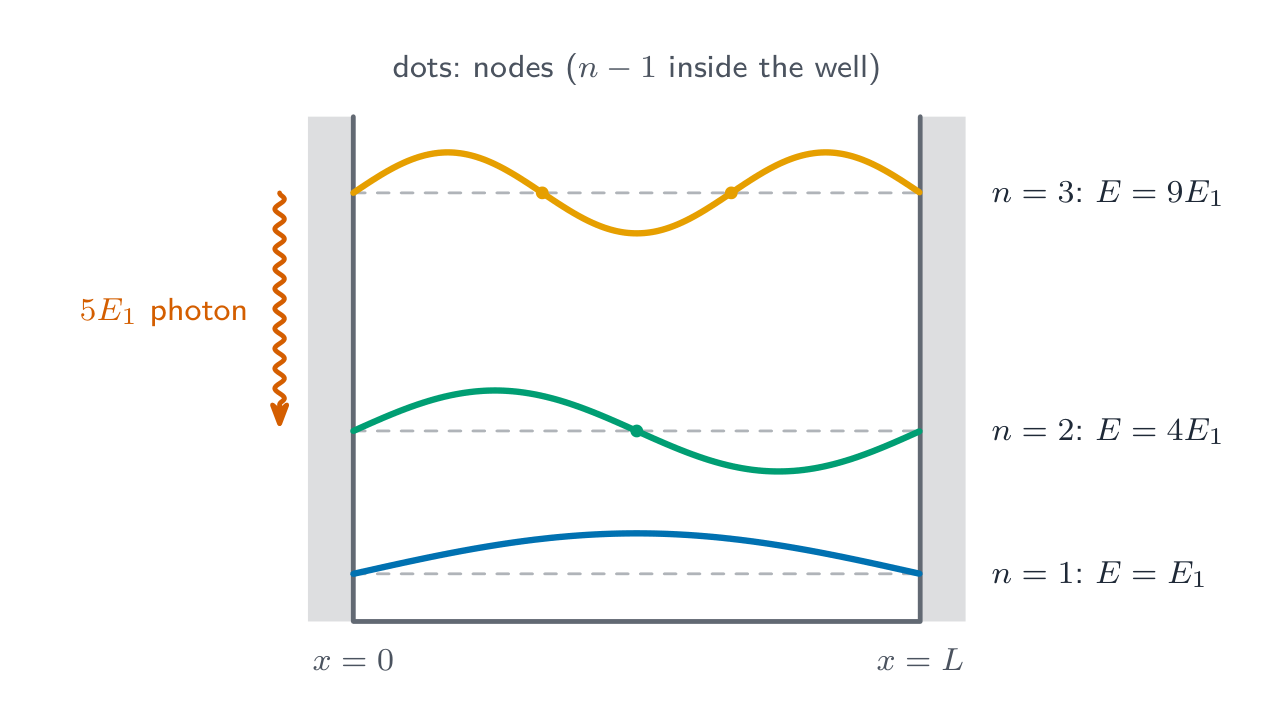
- Well, $0 < x < L$: $\psi_n = \sqrt{2/L}\sin(n\pi x/L)$, $E_n = \dfrac{n^2h^2}{8mL^2} = n^2E_1$, $n = 1, 2, \dots$ ($n = 0$ gives $\psi \equiv 0$, not a state). $\psi_n$ has $n - 1$ nodes; doubling $L$ divides every level by 4.
- Harmonic oscillator: $E_n = (n + \tfrac12)\hbar\omega$, $n = 0, 1, 2, \dots$: equally spaced, with zero-point energy $\tfrac12\hbar\omega$. Its dipole transitions change $n$ by 1, so it emits a single frequency $\omega$.
Do not swap $h$ and $\hbar$: $n^2h^2/8mL^2$ and $n^2\pi^2\hbar^2/2mL^2$ are the same number, but mixing the forms is off by $4\pi^2$.
The well width is tripled. The ground-state energy is multiplied by
难度 1/5 · 今日首次完成可获 100 金币及少量额外奖励
Since $E_n \propto 1/L^2$, tripling $L$ divides every level by $3^2 = 9$.
Photon energy of the $4 \to 2$ transition in an infinite well, in units of $E_1$?
难度 2/5 · 今日首次完成可获 140 金币及少量额外奖励
Infinite-well energies go as $n^2E_1$: $E_4 - E_2 = (16 - 4)E_1 = 12E_1$.
Energy difference between the $n = 3$ and $n = 1$ levels of a harmonic oscillator, in units of $\hbar\omega$?
难度 2/5 · 今日首次完成可获 140 金币及少量额外奖励
$E_3 - E_1 = (3.5 - 1.5)\hbar\omega = 2\hbar\omega$: the levels are equally spaced by $\hbar\omega$.
比率 $E_2/E_1$ of the first two levels of a harmonic oscillator ($n = 0$ and $n = 1$)?
难度 2/5 · 今日首次完成可获 140 金币及少量额外奖励
$\tfrac32\hbar\omega / \tfrac12\hbar\omega = 3$; for the infinite well the ratio is 4.
Time evolution and commutators
- A stationary state only gains a phase, $\phi_n e^{-iE_nt/\hbar}$, so its probabilities never change. A superposition of two levels has a density that oscillates at $\omega = (E_2 - E_1)/\hbar$; $|c_j|^2$ stay fixed.
- $[A, B] = AB - BA$. Commuting observables share an eigenbasis. $[x, p] = i\hbar$; $p$ commutes with $p^2/2m$ but not with $V(x)$; $[J_x, J_y] = i\hbar J_z$, and $J^2$ commutes with each component.
它们是否对易?
识别相容与不相容可观测量。
$H = p^2/2m + V(x)$ commutes with $p$ only when $V$ is constant.
难度 1/5 · 今日首次完成可获 100 金币及少量额外奖励
True. $[H, p] = [V(x), p] = i\hbar V'(x)$, which vanishes only if $V' = 0$; then momentum is conserved.
In a stationary state, the probability density $|\psi(x,t)|^2$ does not change with time.
难度 1/5 · 今日首次完成可获 100 金币及少量额外奖励
Only the overall phase $e^{-iEt/\hbar}$ changes, and it cancels in $|\psi|^2$.
Worked GRE question: where is the particle?
A particle in an infinite square well of width $L$ is in its first excited state ($n = 2$). The probability of finding it between $x = 0$ and $x = L/2$ is
- (A) 0
- (B) $1/4$
- (C) $1/2$
- (D) $3/4$
- (E) 1
Fast route. $|\psi_2|^2$ is symmetric about the centre, so each half holds half the probability. Answer (C). No integral needed.
Traps. (A) confuses "a node at $L/2$" with "never in the left half"; the node is one point. (E) pictures the left lobe only.
Worked GRE question: an oscillator superposition
A harmonic oscillator is in the state $\psi = (\phi_0 + \phi_1)/\sqrt2$. The expectation value of its energy is
- (A) $\tfrac12\hbar\omega$
- (B) $\tfrac{1}{\sqrt2}\hbar\omega$
- (C) $\hbar\omega$
- (D) $\tfrac32\hbar\omega$
- (E) $2\hbar\omega$
Fast route. $\langle E\rangle = \tfrac12\left(\tfrac12\hbar\omega\right) + \tfrac12\left(\tfrac32\hbar\omega\right) = \hbar\omega$. Answer (C). A single measurement gives $\tfrac12\hbar\omega$ or $\tfrac32\hbar\omega$, never $\hbar\omega$.
Traps. (E) adds the two energies without the probabilities. (B) uses the amplitude $1/\sqrt2$ instead of its square.
Common errors
- Probabilities from amplitudes. Square them: $|c_j|^2$.
- Expecting $\langle E\rangle$ as a measurement result. Only eigenvalues can be measured.
- Well and oscillator spacing. Well: $n^2$, starting at $n = 1$. Oscillator: equal steps, starting at $n = 0$ with $\tfrac12\hbar\omega$.
- Stationary means motionless. It means the probabilities do not change in time.
Recap
- Probabilities are $|c_j|^2$; normalise first; $\langle E\rangle = \sum |c_j|^2E_j$.
- Infinite well: $E_n = n^2E_1$, $E \propto 1/L^2$, $n - 1$ nodes; oscillator $E_n = (n + \tfrac12)\hbar\omega$.
- $\Delta x\Delta p \ge \hbar/2$; stationary states only change phase.
- Commuting operators can be measured together; $x, p$ and $J_x, J_y$ cannot.
- commutator: The operator AB minus BA.
- Hermitian: Equal to its own conjugate transpose, so with real eigenvalues.
- normalisation: Scaling a wavefunction so that the total probability is 1.