文本填空:两空及三空下的依赖语义
引入| English | 释义 | 拼音 |
|---|---|---|
| judicious/dʒuːˈdɪʃəs/ | 明智的 | míng zhì de |
| cue/kjuː/ | 线索 | xiàn suǒ |
One missing word can change the whole message
- A plain-looking manual can still give excellent instructions. In a passage with several blanks, a word that suits the cover may fail to describe the contents. Read the whole message before committing to an answer.
- Text Completion asks you to complete a coherent passage. This lesson uses original practice examples; they teach how to connect clues, not a rule that every passage contains one obvious signal word.
Separate columns, one complete answer
- In two- and three-blank questions, each blank has three choices. Choose one entry from each blank's own column. The choices are independent: selecting the top entry in one column does not force the top entry in another.
- The completed meaning must still work across all blanks. The official question earns credit only when the complete answer is correct; two correct blanks out of three do not earn partial credit.
A three-blank passage is best completed by the second entry in column (i), first in (ii), and third in (iii). Is that selection allowed?
难度 1/5 · 今日首次完成可获 100 金币及少量额外奖励
Select one entry from each corresponding column. The row positions need not match.
On an official three-blank Text Completion question, two correct blanks earn partial credit.
难度 1/5 · 今日首次完成可获 100 金币及少量额外奖励
The complete set must be correct. This refers to the official question, not a score prediction from the website’s individual teaching checks.
Read the policy example before the choices
- “The new policy, far from being (i) ___, proved (ii) ___; within a year, critics who had called it reckless were praising its (iii) ___.” The critics' view changes from expecting poor judgement to praising good judgement.
- Predict simple meanings first: (i) careless, (ii) sensible, (iii) careful judgement. A prediction is provisional: revise it if the actual choices or another clue require a more precise meaning.
Use the clearest clue to enter the passage
- The three columns are (i) prudent / rash / sensible; (ii) judicious / reckless / hasty; (iii) recklessness / brevity / prudence. Here rash means acting without enough care, and judicious 明智的 means showing sensible judgement.
- Start with the praise of prudence, which supports judicious in the middle. “Far from being” then rejects rash. The selected row positions are second, first and third; there is no matching-row rule.
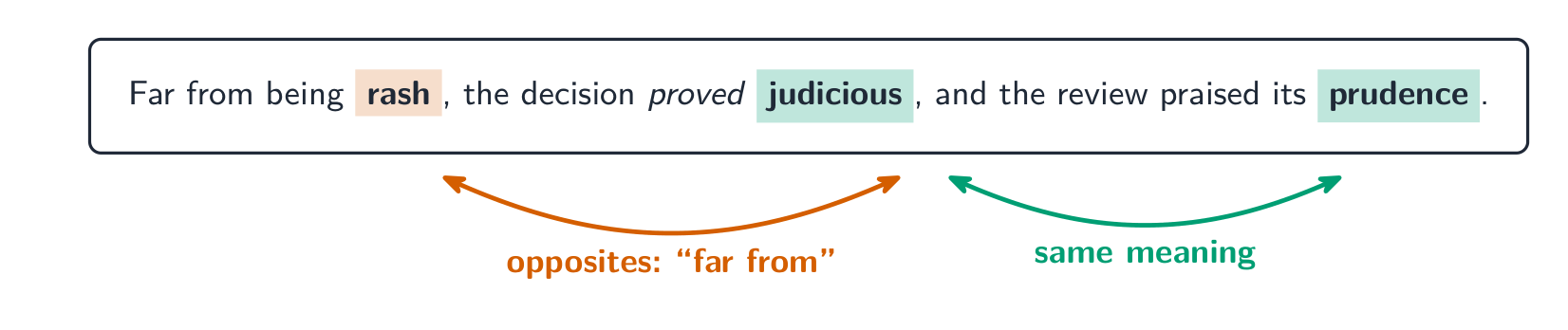
In the full policy passage, critics first called the policy reckless but later praised it as judicious. Which final noun fits “were praising its ___”?
难度 1/5 · 今日首次完成可获 100 金币及少量额外奖励
Prudence is careful judgement, fitting both the later praise and judicious. Recklessness repeats the earlier criticism; cost and brevity do not fit that change of judgement.
In multi-blank questions, you can start with the blank whose clue is strongest.
难度 1/5 · 今日首次完成可获 100 金币及少量额外奖励
True. Blanks need not be solved left to right; the strongest clue often fixes one blank and then constrains the others.
Follow links rather than separate guesses
- The final praise supports good judgement in blank (ii). “Far from being” puts blank (i) against that judgement. Each choice has a job in the passage, not just a pleasant or unpleasant meaning.
- In this example rash and judicious oppose each other. Contrast elsewhere can concern different qualities, such as a dull cover and useful contents; it does not always require dictionary antonyms.

“The new policy, far from being ___, proved judicious.” Which word fits?
难度 1/5 · 今日首次完成可获 100 金币及少量额外奖励
In this context judicious means sensible in judgement; far from rejects rash, meaning acting without enough care. Prudent and sensible would repeat the favourable judgement rather than supply the rejected description.
For the policy passage, explain why the complete set rash / judicious / prudence works, and why recklessness fails as the final word.
一种可能的解释。请将线索链接与您自己的措辞进行比较;该本地模型无法预测GRE分数。
A cue is a clue to a relationship
- A cue 线索 is a word or phrase that helps signal a relationship. “Indeed” can reinforce an idea; “in other words” can restate it. Read what the linked clauses actually say before predicting the blank.
- “Admittedly” concedes a point, often before a limiting response. It does not tell you, by itself, whether a missing word should be positive, negative or an opposite. The surrounding claims supply that information.
The same word can do different jobs
- “While the catalogue was being printed, the editor checked the index.” Here while connects events in time. “While the cover was dull, the instructions were excellent.” Here it contrasts two qualities.
- “Although the cover was dull, the instructions were excellent” expresses an unexpected contrast. The instructions are not the opposite of a cover: identify the expectation being challenged, not just two word labels.

在句子中阅读提示语。
对每个完整句子中的主要关系进行分类。单个单词可能具有不同的作用。
Match each phrase in its sentence to its main role.
难度 2/5 · 今日首次完成可获 140 金币及少量额外奖励
These roles come from the whole sentences. A cue is useful evidence, not a fixed rule for the meaning of every blank.
In “While the catalogue was being printed, the editor checked the index,” what does while primarily connect?
难度 1/5 · 今日首次完成可获 100 金币及少量额外奖励
The printing and checking occur during the same period. This use is temporal; while does not always introduce contrasting claims.
Work a two-blank example
- “Although its cover was (i) ___, the manual was (ii) ___: it gave clear directions for every task.” (i) dull / eye-catching / colourful. (ii) useless / comprehensive / misleading.
- “Every task” supports comprehensive, meaning covering all the required parts. The contrast is between an unappealing cover and useful, complete contents, so dull fits blank (i). “Colourful” gives no such contrast here; “misleading” conflicts with the clear directions.
“Although its cover was (i) ___, the manual was (ii) ___: it gave clear directions for every task.” Which pair best completes the passage?
难度 1/5 · 今日首次完成可获 100 金币及少量额外奖励
Dull contrasts the unappealing cover with complete, useful contents. Comprehensive agrees with directions for every task. The other pairs miss the contrast or contradict the contents.
Check the whole completed meaning
- Read the answer aloud in your mind: “Although its cover was dull, the manual was comprehensive: it gave clear directions for every task.” Check the contrast, the explanation after the colon and both word meanings.
- Correct grammar is necessary but not enough. “The manual was misleading” is grammatical, yet it conflicts with the stated clear directions. Reject a choice for a specific conflict, not because another word looks more advanced.
After choosing all blanks, read the ____ sentence to check it makes sense.
难度 1/5 · 今日首次完成可获 100 金币及少量额外奖励
Only the whole completed passage counts.
Keep track of negation
- “The reviewer was not (i) ___ to defects; she identified them, but her final judgement was (ii) ___ because every defect was minor.” (i) attentive / blind / alert. (ii) favourable / hostile / undecided.
- Identifying defects means she was not blind to them; it does not mean she ignored them. Favourable fits the final judgement because the defects were minor. Finding a flaw does not force an entirely negative verdict.
“The reviewer was not (i) ___ to defects; she identified them, but her final judgement was (ii) ___ because every defect was minor.” Choose the best pair.
难度 1/5 · 今日首次完成可获 100 金币及少量额外奖励
Not blind means she noticed the defects, matching identified them. Favourable fits a final judgement that treats those defects as minor.
Explain the difference between “not blind to defects” and “blind to defects.” Use the reviewer’s stated action and final judgement in your explanation.
一种可能的解释。请将线索链接与您自己的措辞进行比较;该本地模型无法预测GRE分数。
Ask whose view the words describe
- In the policy passage, “reckless” describes the critics' earlier view. Their later praise changes that view. A negative word in one clause does not make every blank negative.
- Pronouns and repeated ideas also connect sentences. In “The plan looked costly. This concern faded when the revised budget arrived,” this concern refers to the apparent cost. Track the reference before interpreting a later blank.
Recover from a tempting first choice
- Suppose you choose recklessness for the policy's final blank only because “reckless” appears earlier. The full ending would say the critics praised the very fault they had criticised, while the middle calls the policy judicious.
- Reopen the choice and use the change of judgement: prudence makes the praise agree with “judicious.” Do not keep an early guess just because you have already used it to fill another blank.
Transfer to a fresh three-blank passage
- “Although the instructions initially seemed (i) ___, a careful reading showed that they were (ii) ___: every step had one clear meaning. The team's final assessment therefore replaced doubt with (iii) ___.” (i) confusing / familiar / brief; (ii) ambiguous / precise / optional; (iii) resentment / haste / confidence.
- “One clear meaning” anchors precise, so confusing describes the initial impression that is overturned. Replacing doubt with confidence fits the team's final assessment. The whole answer records a change from apparent confusion to justified clarity.
“Although the instructions initially seemed (i) ___, a careful reading showed that they were (ii) ___: every step had one clear meaning. The team’s final assessment therefore replaced doubt with (iii) ___.” Choose the best complete set.
难度 1/5 · 今日首次完成可获 100 金币及少量额外奖励
Confusing is the initial impression; precise is anchored by one clear meaning. Confidence fits the resulting change from doubt. Each of the other sets breaks an explicit link.
Choose a word for its exact sense
- “Precise” here means clear and exact; “ambiguous” means allowing more than one interpretation. They are not interchangeable simply because both describe language. Use a short paraphrase to test the relevant sense.
- A plausible story from outside the passage is weaker than an explicit clue inside it. Do not invent a reason why a team resents clear instructions, or why critics praise recklessness, when the given wording points elsewhere.
Select all checks that use evidence from the passage rather than an unsupported shortcut.
难度 2/5 · 今日首次完成可获 140 金币及少量额外奖励
The scope of not and an explicit explanation constrain meaning. Matching rows and choosing an advanced-looking word do not establish contextual fit.
Compare “While the printer ran, Ana checked the draft” with “While the cover was plain, the instructions were excellent.” Explain why a memorised rule “while means contrast” fails.
一种可能的解释。请将线索链接与您自己的措辞进行比较;该本地模型无法预测GRE分数。
Practise a short evidence chain
- For a new passage, note a plain meaning for each blank and the words that support it. Then test the offered choices and explain at least one tempting rejection. Start with the clearest clue wherever it appears.
- If no complete set works, revisit your prediction, the scope of a negative word or whose view is being reported. Do not force a fixed “positive–negative” pattern onto a passage that says something more specific.
找出错误的核查点
每张卡片描述一名学习者的决策。对主要问题进行分类,或识别出基于证据的选择。
Complete this original practice passage and explain every choice: “The guide was initially dismissed as (i) ___ because it used ordinary language. Yet its arguments were (ii) ___: each conclusion followed from stated reasons. This later recognition replaced the initial dismissal with (iii) ___.” Columns: (i) superficial / expensive / recent; (ii) incoherent / rigorous / unfinished; (iii) impatience / suspicion / respect. Reject one alternative.
一种可能的解释。请将线索链接与您自己的措辞进行比较;该本地模型无法预测GRE分数。
Recap
- Choose one entry per column, use the strongest clues and reread the complete passage. Columns permit independent selections; the meanings must work together, and the official question has no partial credit.
- Interpret cues in context, track negation and changes of viewpoint, and justify choices with actual wording.
- judicious: Showing careful, sensible judgement.
- cue: A word or phrase that helps signal a relationship.