定量问题解决与数据分析
引入| English | 释义 | 拼音 |
|---|---|---|
| numeric entry/njuːˈmerɪk ˈentri/ | 数字填空 | shù zì tián kòng |
| average/ˈævrɪdʒ/ | 平均数 | píng jūn shù |
A calculator cannot choose the equation
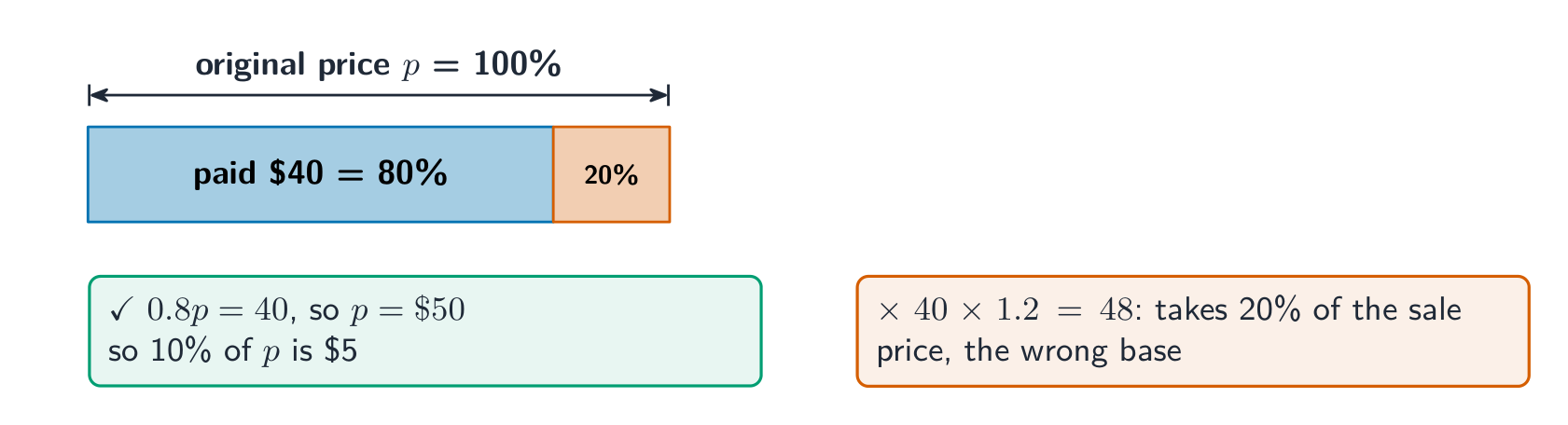
- A shop charges 40 dollars after a 20% discount. Multiplying 40 by 1.2 gives 48, but that does not undo the discount. The arithmetic can be correct while the model is wrong.
- Before calculating, identify the unknown, the starting quantity and the required answer form. A price before a reduction, a share of a total and a mean of several values need different equations.
Read the answer format separately from the maths
- A single-answer multiple-choice question asks for one choice. A multiple-answer question asks for the stated number of choices or all that apply; there may be one, several or all correct options. Check every listed option when asked for all.
- Numeric entry 数字填空 uses one box for an integer or decimal, or two boxes for a fraction's numerator and denominator. “Round to the nearest percent” describes precision, not necessarily the interface: a multiple-choice question can also ask for rounding.
Enter the quantity named by the box
- If 3 of 8 objects have a property, the proportion is $3/8=0.375$ and the percentage is 37.5%. A box labelled percent needs 37.5, while a decimal-proportion box needs 0.375. The same data can require different entries.
- Read units and scale labels: 1.25 million visits is 1,250 thousand visits. Use the requested fraction boxes or decimal box and check any printed unit beside it. Do not convert an exact fraction to a rounded decimal without a reason.
Round the final result to the stated precision
- Two out of seven is $200/7$ percent, approximately 28.5714%. To the nearest tenth of a percent, enter 28.6 in the percent-labelled box. To the nearest whole percent, enter 29. A different rounding instruction changes the required answer.
- Keep exact fractions or sufficient calculator digits through intermediate steps. Rounding $2/7$ to 0.3 before multiplying by 100 would give 30%, which is wrong at either of those requested precisions. If no rounding is requested, keep the exact answer.
明确要求的答题界面是什么?
每张卡片均标明选择指令或答案框。仅凭四舍五入或单位无法识别界面类型。
Two of seven objects have a property. Enter the percentage to the nearest tenth of a percent; the answer box is labelled percent.
难度 2/5 · 今日首次完成可获 140 金币及少量额外奖励
The exact percentage is 200/7 = 28.5714… . Round only the final result to one decimal place: 28.6. Do not enter the proportion 2/7.
Work the original discount examples
- Let p be the original shirt price. A 20% discount leaves 80% of p, so $0.8p=40$ and $p=50$ dollars. Check: 20% of 50 is 10, leaving 40. Adding 20% of the reduced price uses the wrong base.
- For the original jacket exercise, 72 dollars remains after a 10% discount. Thus $0.9p=72$, giving $p=80$ dollars. A reduced positive price should be smaller than its original price, which is a useful final check.
A jacket costs 72 dollars after a 10% discount. What was the original price in dollars?
难度 2/5 · 今日首次完成可获 140 金币及少量额外奖励
A 10% discount leaves 90% of the original p: 0.9p = 72, so p = 80. Check: 10% of 80 is 8, leaving 72.
Reverse a multiplier rather than changing its sign
- For a positive starting price, a 20% fall followed by a 20% rise gives $0.8\times1.2=0.96$ of the original. To undo the fall, multiply the reduced price by $1/0.8=1.25$: the required rise is 25% of the reduced price.
- “15% more than x” means $x+0.15x=1.15x$. Distinguish the new amount from the increase itself, $0.15x$. For a percentage change, name the base before choosing the multiplier.
A positive price that falls by 20% returns to its original value after a 20% increase.
难度 1/5 · 今日首次完成可获 100 金币及少量额外奖励
The two multipliers give 0.8 × 1.2 = 0.96 of the original. Restoring the original needs a 25% rise from the reduced price, since 1/0.8 = 1.25.
“15% more than x” can be written as ____x.
难度 1/5 · 今日首次完成可获 100 金币及少量额外奖励
The new amount is 100% + 15% = 115% of x, or 1.15x. The increase alone is 0.15x.
A positive price falls by 20%. By what percentage of the reduced price must it rise to return to its original value? Enter the percentage number.
难度 2/5 · 今日首次完成可获 140 金币及少量额外奖励
The reduced amount is 0.8p. The missing 0.2p is 0.2p/(0.8p) = 0.25 = 25% of the reduced price.
Turn an average into a sum
- The arithmetic average 平均数, or mean, is sum divided by count. If five values have mean 12, their sum is $5\times12=60$. A mean does not say every value equals 12.
- In the original exercise, four values have mean 15, so their sum is 60. The three known values total $10+12+20=42$; the missing value is $60-42=18$. Check: the four values add to 60 and divide by 4 to give 15.
The average of 4 numbers is 15. Three of them are 10, 12 and 20. What is the fourth?
难度 2/5 · 今日首次完成可获 140 金币及少量额外奖励
Four values with mean 15 total 60. The known three total 42, so the fourth is 18. Substitution gives (10 + 12 + 20 + 18)/4 = 15.
Weight group means by their counts
- Group A has 2 measurements with mean 10; group B has 6 with mean 20. Their sums are 20 and 120. The combined mean is $(20+120)/(2+6)=17.5$, not $(10+20)/2=15$.
- The larger group contributes more values. For groups with counts n and m and means a and b, combine their sums: $(na+mb)/(n+m)$. Averaging the two means directly works when group counts are equal; it can also happen to work when the means themselves are equal.

Group A has 2 measurements with mean 10. Group B has 6 with mean 20. What is the mean of all 8 measurements?
难度 2/5 · 今日首次完成可获 140 金币及少量额外奖励
The sums are 2 × 10 = 20 and 6 × 20 = 120. Divide the combined sum 140 by the combined count 8 to obtain 17.5.
A组有 3 个数据,平均值为 8;B组有 5 个数据,平均值为 16。求它们的总平均值,并解释为何不能直接对 8 和 16 取平均。
将你的列式、单位、验算及答案格式与范例和检查清单进行比对。
Read data with the correct denominator
- This fictional table counts orders on three separate days, with each order counted once. The total is $120+150+180=450$. Tuesday's share is $150/450=1/3$, about 33.3% to one decimal place.
| Day | Orders |
|---|---|
| Monday | 120 |
| Tuesday | 150 |
| Wednesday | 180 |
- The increase from Monday to Tuesday is 30 orders, or $30/120=25\%$ of Monday's count. “Share of the three-day total” and “increase from Monday” use different bases. Neither asks for a percentage-point change between two percentages.
A fictional order table records Monday 120, Tuesday 150 and Wednesday 180 orders on separate days. What percentage of the three-day total was on Tuesday? Enter the percentage to one decimal place.
难度 2/5 · 今日首次完成可获 140 金币及少量额外奖励
The total is 450. Tuesday’s share is 150/450 = 1/3, or 33.333…%, which rounds to 33.3%. The denominator is the total, not Monday’s 120.
一张虚构表格记录了周一 80 笔订单、周二 100 笔和周三 120 笔订单,每笔订单仅计算一次。(i)求周二的份额占三天总数的百分比(保留一位小数);(ii)求从周一到周二的百分比增幅。写出两个分母。
将你的列式、单位、验算及答案格式与范例和检查清单进行比对。
Separate area from perimeter
- A rectangle is 12 cm by 8 cm. Cut a right triangle from a corner, with perpendicular legs 3 cm and 4 cm along the rectangle's sides. The remaining area is $12\times8-\tfrac12\times3\times4=90\text{ cm}^2$.
- The triangle's sloping side is 5 cm by Pythagoras. The perimeter changes from 40 cm to $40-3-4+5=38\text{ cm}$. Removing area need not remove the same fraction of perimeter. Use the given dimensions, rather than estimating from a sketch.

A rectangle is 12 cm by 8 cm. A right triangle with perpendicular legs 3 cm and 4 cm is cut from one corner. Find the remaining area in square centimetres.
难度 2/5 · 今日首次完成可获 140 金币及少量额外奖励
The rectangle has area 96 cm² and the triangle has area (1/2) × 3 × 4 = 6 cm². The remaining area is 90 cm².
Convert dimensions before using a formula
- A length of 1 cm is 10 mm, so an area of $1\text{ cm}^2$ is $100\text{ mm}^2$. The remaining area of $90\text{ cm}^2$ is therefore $9{,}000\text{ mm}^2$, not 900. Area conversions square the length factor.
- For mixed units, convert each length to one common unit before multiplying or adding. A rectangle 1.2 m by 80 cm is 1.2 m by 0.8 m and has area $0.96\text{ m}^2$. Keep a length answer distinct from an area answer.
一个矩形长 1.2 m、宽 80 cm。从一个角剪去一个直角三角形,其两条直角边分别沿矩形的两边,长度为 30 cm 和 40 cm。求剩余部分的面积(平方米)和周长(米)。
将你的列式、单位、验算及答案格式与范例和检查清单进行比对。
Check candidates in the original equation
- To solve $\sqrt{x+6}=x$, the right-hand side must be nonnegative, so $x\ge0$. Squaring gives $x^2-x-6=0$, or $(x-3)(x+2)=0$. This produces candidates 3 and $-2$.
- At 3, both sides equal 3. At −2, the sides are 2 and −2, so this candidate fails. Squaring can add candidates; a candidate is not a solution until it meets the original equation and its domain.
Which listed real values satisfy $\sqrt{x+6}=x$? Select all that apply.
难度 2/5 · 今日首次完成可获 140 金币及少量额外奖励
Squaring gives candidates 3 and −2, but the principal square root is nonnegative. Only 3 satisfies the original equation; −2 gives 2 on the left and −2 on the right.
Apply every condition in a select-all task
- For the original options 2, 3, 4, 6 and 8, select the numbers dividing both 48 and 30. The answers are 2, 3 and 6. The options 4 and 8 divide 48 but not 30, so they fail the “both” condition.
- The common positive divisors are divisors of $\gcd(48,30)=6$: 1, 2, 3 and 6. But 1 is not offered in this task, so do not invent an extra option. “Divides both” requires two successful tests; dividing only one number is insufficient.
Which numbers divide both 48 and 30? Select all that apply.
难度 2/5 · 今日首次完成可获 140 金币及少量额外奖励
2, 3 and 6 divide both 48 and 30. The offered 4 and 8 fail the second test because neither divides 30. Select every listed value that passes both conditions.
Bounds can make an option list manageable
- For an integer n satisfying $n^2<10$, $|n|\le3$: the integers from $-3$ through 3 work, while $4^2=16$ is already too large. For a positive integer n, only 1, 2 and 3 remain.
- Use bounds to narrow the candidates, then check the actual list and endpoint. A strict inequality excludes equality at its boundary. If a question says “select two,” give two; if it says “select all,” do not stop after finding two.
Which listed integers satisfy $n^2<10$? Select all that apply.
难度 2/5 · 今日首次完成可获 140 金币及少量额外奖励
The integer solutions are −3 through 3. From the offered list, −3, −2, 0 and 3 work. Both −4 and 4 have square 16 and fail the strict inequality.
对于每个方程,从$\{-3,-2,0,2,3\}$中选择所有解:(i) $\sqrt{x+6}=x$;(ii) $x^2=9$。解释为何仅检验(i)的平方形式会多选一个值。
将你的列式、单位、验算及答案格式与范例和检查清单进行比对。
Use the calculator after an estimate
- Before computing $198\times0.51$, estimate $200\times0.5=100$. The exact result is 100.98, close to that estimate. An entry of 10,098 should trigger a decimal-place check rather than immediate submission.
- Set up parentheses and units before keying numbers. A calculator can evaluate a weighted sum, but it cannot decide whether the correct denominator is 2, 8, 120 or 450. Exact arithmetic and a rough estimate provide different checks.
Solve the single-answer problem before matching choices
- Three identical notebooks plus a delivery fee of 2 dollars cost 17 dollars. If each notebook costs p, write $3p+2=17$. Subtract the fee before dividing: $p=(17-2)/3=5$ dollars.
- Substitute the chosen answer into the original total: $3\times5+2=17$. Working backwards from options is also valid when convenient, but check the same total and units. A plausible price alone does not establish the answer.
Check the result and its required form
- For two nonempty groups, the combined mean lies between their means; a share lies between 0 and 1, or between 0% and 100%. A discounted price is below its original positive price. Use checks suited to the actual assumptions.
- Then answer the stated question: original or final price, total or average, area or perimeter, percentage or proportion. Preserve exactness until any required final rounding, and review all selected options in a multiple-answer task.
在计算前检查设置
每张卡片包含题目及拟议的设置或输入。指出其有效或无效的具体原因。
Recap
- Model the problem before calculating. Track percentage bases, sums and counts, dimensions and units; verify candidates in the original conditions.
- Check the format separately: one choice, the requested set of choices, or a numerical entry with the required units and precision. Keep the final answer consistent with the question.
- numeric entry: A question type in which an answer is entered as a number rather than selected from choices.
- average: The arithmetic mean: the sum of the values divided by the number of values.