| English | 释义 | 拼音 |
|---|---|---|
| atom/ˈætəm/ | 原子 | yuán zi |
| atomic number/əˈtɒmɪk ˈnʌmbə/ | 原子序数 | yuán zi xù shù |
| mass number/mæs ˈnʌmbə/ | 质量数 | zhì liàng shù |
| isotopes/ˈaɪsətəʊps/ | 同位素 | tóng wèi sù |
| periodic table/ˌpɪərɪˈɒdɪk ˈteɪbl/ | 元素周期表 | yuán sù zhōu qī biǎo |
| ionic bonds/aɪˈɒnɪk bɒndz/ | 离子键 | lí zi jiàn |
| covalent bonds/ˈkəʊvələnt bɒndz/ | 共价键 | gòng jià jiàn |
An ion changes electrons, not element identity
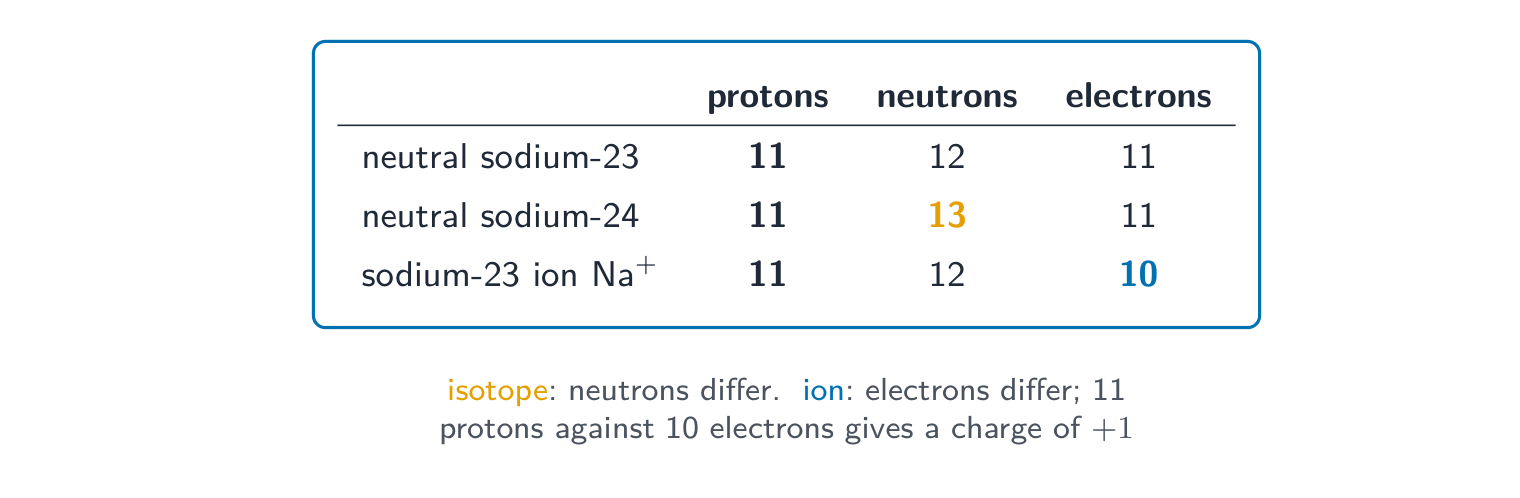
- Neutral sodium-23 has 11 protons, 12 neutrons and 11 electrons. After it loses one electron, Na⁺ has 10 electrons but still has 11 protons and remains sodium.
- An atom 原子 contains a nucleus and electrons in the introductory model. Atomic number 原子序数 counts protons; mass number 质量数 counts protons plus neutrons.
一个原子属于哪种元素,由什么决定?
难度 1/5 · 今日首次完成可获 100 金币及少量额外奖励
原子序数就是元素本身。改变中子数,得到的是同一元素的同位素。
Find neutrons from the two numbers
- Neutron number follows $N=A-Z$. For sodium-23, $N=23-11=12$; for sodium-24, $N=24-11=13$.
- Isotopes 同位素 share proton number and differ in neutrons. Hydrogen-1 has one proton and no neutrons, so “every nucleus contains neutrons” is false.

Protons, neutrons and electrons in Na⁺
Sodium-23 has 11 protons and 12 neutrons; Na⁺ has lost one electron, leaving 10. Change the neutrons for another isotope, the electrons for another charge, the protons for another element.
钠-24 的原子序数为11。它含有多少个中子?
难度 2/5 · 今日首次完成可获 140 金币及少量额外奖励
N = A - Z = 24 - 11 = 13.
Connect table position to bounded patterns
- The periodic table 元素周期表 orders elements by atomic number. Introductory main-group patterns connect similar outer-electron arrangements with similarities in chemical behaviour.
- A group does not make all its elements identical. Use the model at its stated level rather than extending a simple outer-electron rule to every element and property.
在一个介绍性的主族元素模型中,什么有助于解释周期表中同族元素的相似性?
难度 1/5 · 今日首次完成可获 100 金币及少量额外奖励
外层排布有助于解释主族元素的规律。但这并不使同族元素完全相同,也不能替代针对每种元素的更详细模型。
Distinguish ion formation from the ionic bond
- Electron transfer can explain ion formation. Ionic bonds 离子键 are electrostatic attractions between opposite ion charges; the transfer itself is not the attraction.
- In the sodium/chlorine model, Na⁺ has 11 protons and 10 electrons, while Cl⁻ has 17 protons and 18 electrons. Opposite charges attract; bulk sodium chloride forms an ionic structure, not separate NaCl molecules in this model.
将每种成键模型与其定义特征相匹配。
难度 2/5 · 今日首次完成可获 140 金币及少量额外奖励
电子转移可以解释离子的形成;离子键是它们的静电引力。共价键模型使用共用电子对。
在提供的模型中,Na⁺在中性钠失去一个电子后仍保留11个质子。剩余多少个电子?
难度 2/5 · 今日首次完成可获 140 金币及少量额外奖励
中性钠有11个电子;失去一个后剩10个。
Use a different model for shared electron pairs
- Covalent bonds 共价键 involve shared electron pairs. For a simple H₂ molecule, the bond is described by a pair of electrons shared between the hydrogen atoms.
- A compound's properties depend on structure and bonding, not just a list of constituent elements. Do not infer that a compound must behave like the separate elements or must be unreactive.
Atoms do not “want” electrons. Explain particle counts, electrostatic attraction and the appropriate bonding model; follow approved procedures for any real chemical work.
化合物的性质必须与其组成元素相同
难度 1/5 · 今日首次完成可获 100 金币及少量额外奖励
结构和成键很重要。不要从组成成分推断出相同的性质,也不要描述化合物具有普遍的不反应性。
Check all three particle counts
- Changing neutrons gives a different isotope of the same element; changing electrons gives a different charge state. Changing proton number changes element identity.
- For each supplied example, write protons, neutrons and electrons before naming its isotope or charge. A positive charge means fewer electrons than protons, not necessarily extra protons.
Use $Z=\text{protons}$, $A=\text{protons}+\text{neutrons}$ and charge balance separately. Keep ion formation, ionic attraction and covalent sharing distinct.
解释为什么在提供的粒子模型中 Na⁺ 有十个电子但仍然是钠。
难度 3/5 · 今日首次完成可获 200 金币及少量额外奖励
示例:“失去一个电子后剩下十个,但保持不变的十一个质子仍能将其识别为钠。”
失去电子的钠原子仍然是钠元素。
难度 1/5 · 今日首次完成可获 100 金币及少量额外奖励
正确。元素的身份由质子数决定,失去电子时质子数不变;它变为钠离子,Na⁺。