| English | 释义 | 拼音 |
|---|---|---|
| accuracy/ˈækjʊrəsi/ | 准确度 | zhǔn què dù |
| precision/prɪˈsɪʒn/ | 精密度 | jīng mì dù |
| units/ˈjuːnɪts/ | 单位 | dān wèi |
| uncertainty/ʌnˈsɜːtənti/ | 不确定度 | bù què dìng dù |
| significant figures/sɪɡˈnɪfɪkənt ˈfɪɡəz/ | 有效数字 | yǒu xiào shù zì |
Close readings can share a fault
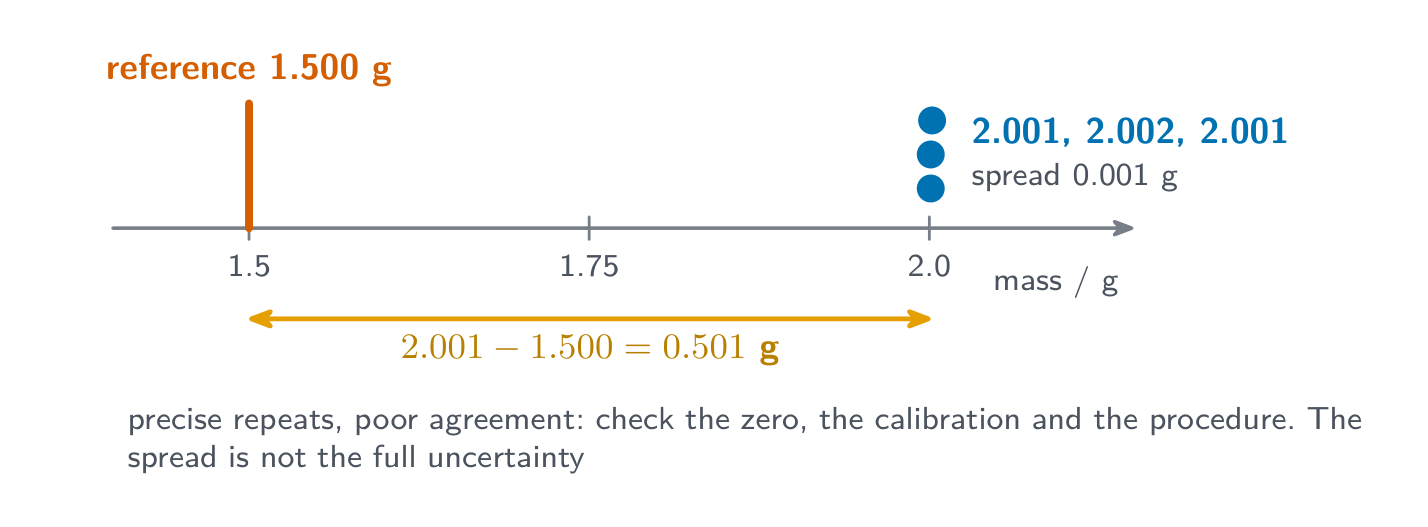
- A balance gives 2.001, 2.002 and 2.001 g for a supplied reliable 1.500 g reference mass. The readings are close to one another, but all are far above the reference.
- Repeating the unknown object alone cannot settle whether the balance has an offset. Check a suitable reference and the zero reading before trusting the result.
Distinguish accuracy from precision
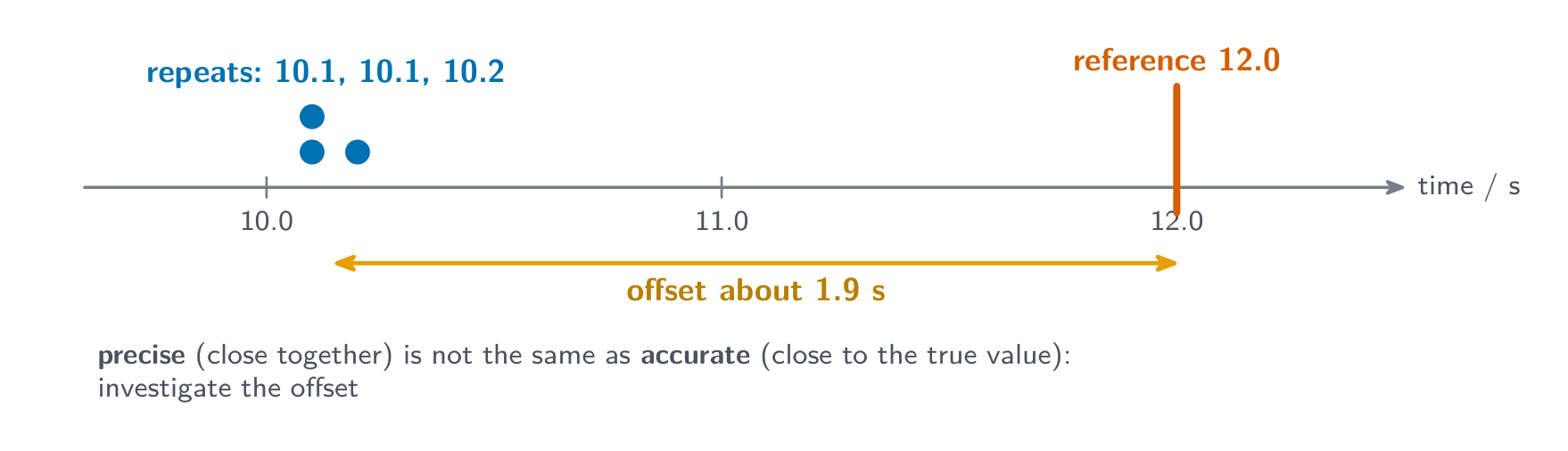
- Accuracy 准确度 means closeness to a suitable reference or true value; precision 精密度 describes agreement between repeated readings under stated conditions. Precise results need not be accurate.
- These readings span only 0.001 g but exceed the reference by about 0.501 g. The pattern suggests investigating a systematic fault; it does not identify the cause by itself.
天平读数为2.001、2.002、2.001 g,已知质量为1.500 g。这是什么误差?
难度 1/5 · 今日首次完成可获 100 金币及少量额外奖励
重复读数彼此接近但与所给参考值不同。系统性偏差是一个需要调查的问题;仅凭三次读数无法确定其成因或误差是否完全相同。
Convert units without changing the quantity
- Units 单位 state the scale of a physical quantity. A side of 10.0 cm is 0.100 m. For a square, $A=L^2=(0.100\ \text{m})^2=0.0100\ \text{m}^2$.
- Square the length conversion factor for area: $1\ \text{cm}^2=(0.01\ \text{m})^2=0.0001\ \text{m}^2$. Counts and ratios may be dimensionless but still need a clear definition.
正方形边长为 10.0 cm。其面积是多少平方米?
难度 2/5 · 今日首次完成可获 140 金币及少量额外奖励
L = 0.100 m;A = L² = 0.0100 m²。将长度换算因子平方。
State the supplied uncertainty honestly
- Uncertainty 不确定度 can include resolution, procedure and repeat variation. Significant figures 有效数字 communicate supported numerical precision. Extra calculator digits do not establish finer measurements, and half a scale division is not every measurement's full uncertainty.
- For a length supplied as 12.4 cm with uncertainty 0.05 cm, report $12.40\pm0.05\ \text{cm}$. Under the task's interval interpretation, the limits are 12.35 and 12.45 cm; no confidence level is supplied.
Match the value's decimal place to the stated uncertainty when reporting it. Do not invent an uncertainty, a confidence level or a justified exclusion to make data agree with a prediction.
你用毫米刻度尺量得 12.4 cm,为什么不写成 12.437 cm?
难度 1/5 · 今日首次完成可获 100 金币及少量额外奖励
计算器显示的额外位数并不代表额外的测量精度。报告惯例取决于测量值、程序和 stated uncertainty( stated uncertainty 在此语境下指“已声明的不确定度”)。
报告提供的长度 12.4 cm,不确定度为 0.05 cm,数值的小数位数需与不确定度对齐。
难度 1/5 · 今日首次完成可获 100 金币及少量额外奖励
报告 12.40 ± 0.05 cm:包含数值、提供的不确定度和单位。题目给出了不确定度但未给出置信水平。
根据题目的区间解释,12.40 ± 0.05 cm的下限是多少厘米(cm)?
难度 2/5 · 今日首次完成可获 140 金币及少量额外奖励
下限 = 12.40 - 0.05 = 12.35 cm。未提供置信水平。
Choose and interpret a derived quantity
- Average speed over an interval is distance divided by elapsed time: $\bar v=d/t$. With supplied distance 3.60 m and time 48.0 s, $\bar v=3.60/48.0=0.0750\ \dfrac{\text{m}}{\text{s}}$.
- The three-significant-figure result reflects the supplied inputs. It does not tell us the speed at every moment; a car can stop and move faster during parts of the interval.
提供的距离和时间表明物体在每个时刻都以恰好 0.0750 m/s的速度运动。
难度 1/5 · 今日首次完成可获 100 金币及少量额外奖励
错误:距离除以时间得出的是该时间段内的平均值,而非每个瞬时速度。
Check faults instead of averaging them away
- A consistent instrument offset can remain in the mean after many repeats. Compare with a suitable reference, document a suspected fault, and apply a correction only when the evidence justifies it.
- Keep the original readings and distinguish their spread from their difference from a reference. Record the units, procedure and uncertainty so the result can be interpreted.
Precision, accuracy and uncertainty answer different questions. Small repeat spread does not prove small total uncertainty or agreement with the reference.
多次重复测量并不能消除系统误差。
难度 1/5 · 今日首次完成可获 100 金币及少量额外奖励
正确。无论读取多少次,一致的偏移量都会保留在平均值中;应将仪器与合适的参考标准进行比对检查。
用一句话说明:你会怎样发现天平存在系统误差。
难度 3/5 · 今日首次完成可获 200 金币及少量额外奖励
例如:“Weigh a standard 100 g calibration mass and see whether the balance reads 100 g.”