Third and mixed conditionals · 第三与混合条件句
Imagining a different past
- The third conditional imagines a past that didn't happen.
- If I had studied, I would have passed. (but I didn't, so I failed)
- It often expresses regret or blame.
If I had left earlier, I would have spent more time waiting at the station.
想象一个不同的过去
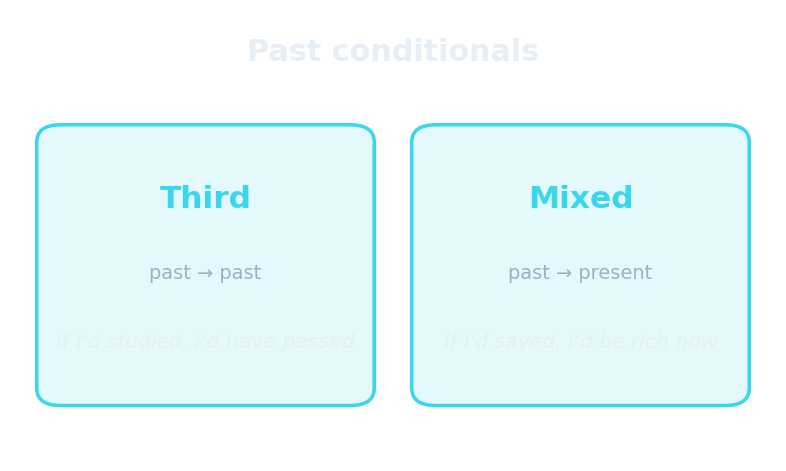
- 第三条件句 (third conditional) 想象一个没有发生的过去。
- 如果If 我I (过去完成)had 学习studied 我, I 会would (完成)have 通过passed.(如果我当时学了,就会通过了。)
- 它常表达遗憾或责备。
如果我早点出门,就能在车站多等一会儿了。
Third conditional
If + past perfect, would have + past participle.- For an unreal past — the opposite of what really happened.
- If they had left earlier, they would have caught the train.
第三条件句
If + 过去完成时, would have + 过去分词。- 表示与过去事实相反的假设。
- If they had left earlier, they would have caught the train.
Complete the third conditional: If I had studied, I ___ the exam. · 补全第三条件句:If I had studied, I ___ the exam。
Third conditional: If + past perfect, would HAVE + past participle. · 第三条件句:If + 过去完成时, would HAVE + 过去分词。
Complete: If they had left earlier, they would have ___ (catch) the train. · 填空:If they had left earlier, they would have ___ (catch) the train。
would have + past participle: catch → caught. · would have + 过去分词:catch → caught。
Translate into English: 如果我当时学习了,就会通过考试了。 · 翻译成英语:如果我当时学习了,就会通过考试了。
Unreal past → third conditional: “If I had studied, I would have passed.” · 与过去事实相反 → 第三条件句:If I had studied, I would have passed。
Mixed conditional
- A past cause with a present result.
If + past perfect, would + base verb.- If I had saved money, I would be rich now. (would, not would have)
混合条件句
- 过去的原因带来现在的结果。
If + 过去完成时, would + 动词原形。- 如果If 我I (过去完成)had 存saved 钱money 我, I 会would (是)be 富有rich 现在now.(如果我当初存了钱,现在就富有了。)
Third or mixed? Watch the result · 第三还是混合?盯住结果
Both start with 'if + past perfect' — the RESULT clause decides: past result → third, present result → mixed. · 两种都以 if + 过去完成时开头——看主句:结果在过去 → 第三条件句;结果在现在 → 混合条件句。
Mixed (past cause → present result): “If I had saved money, I would be rich now.” Correct? · 混合条件句(过去原因 → 现在结果):“If I had saved money, I would be rich now.” 对吗?
Yes — past perfect in the if-clause, “would + base verb” for the present result. · 对 —— if 从句用过去完成时,主句用 would + 动词原形表示现在的结果。
All conditionals at a glance
- Zero / first: real (present + will).
- Second: unreal present (past + would).
- Third: unreal past (past perfect + would have).
条件句总览
- 零 / 第一:真实(现在 + will)。
- 第二:与现在相反(过去 + would)。
- 第三:与过去相反(过去完成 + would have)。
Common mistakes
- ❌ If I would have known, I would have come. → ✓ If I had known… — no would in the if-clause.
- ❌ If I had studied, I would pass yesterday. → ✓ …I would have passed. — a past result needs would have.
- Decode I'd: + past participle = had; + have + participle = would.
常见错误
- ❌ If I would have known, I would have come. → ✓ If I had known…—— if 从句里永远没有 would。
- ❌ If I had studied, I would pass yesterday. → ✓ …I would have passed。—— 过去的结果用 would have + 过去分词。
- 解码 I'd:后接过去分词 = had;后接 have + 过去分词 = would。
Match each if-clause to its result. · 把 if 从句和对应的结果配对。
Past cause → present result = mixed; past cause → past result = third; unreal now = second. · 过去原因→现在结果 = 混合;过去原因→过去结果 = 第三;现在不真实 = 第二。
If she ___ the bus, she would have been on time.
Third conditional: If + past perfect, would have + participle. · 第三条件句:If + 过去完成时, would have + 过去分词。
- Third conditional (unreal past): If + past perfect, would have + p.p.
- Mixed (past cause → present result): If + past perfect, would + base verb.
- The if-clause's tense tells you which conditional it is.
- 第三条件句(与过去相反):If + 过去完成时, would have + 过去分词。
- 混合(过去原因 → 现在结果):If + 过去完成时, would + 动词原形。
- if 从句的时态决定它是哪类条件句。
Think of a past regret. Write one third-conditional sentence (If + past perfect, would have + past participle). · 想一件过去的遗憾。写一个第三条件句(If + 过去完成时, would have + 过去分词)。
Example: “If I had woken up earlier, I wouldn't have missed the bus.” · 例如:If I had woken up earlier, I wouldn't have missed the bus。