Gerunds and infinitives · 动名词与不定式
-ing or to …?
- After some verbs, use the -ing form (gerund).
- After others, use to + base verb (infinitive).
- You learn these by meeting them often.
I enjoy reading, but I keep forgetting to return the books.
用 -ing 还是 to …?
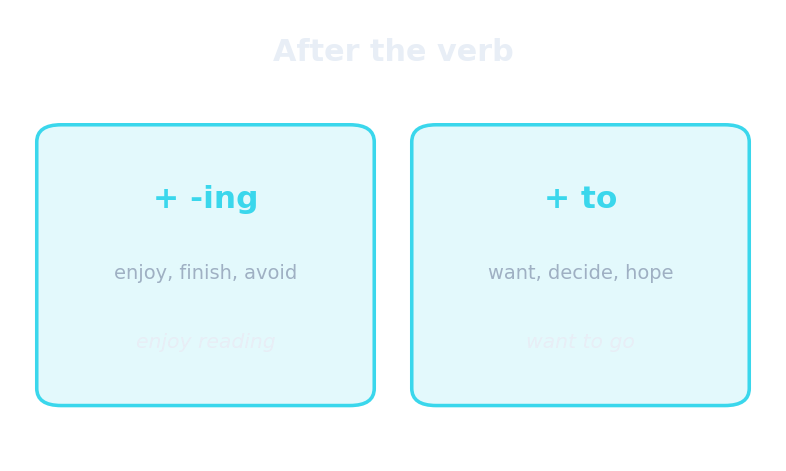
- 有些动词后面用 -ing 形式(动名词)。
- 有些后面用 to + 动词原形(不定式)。
- 这些靠多读多见来掌握。
我喜欢读书,却老是忘记还书。
verb + -ing
- enjoy, finish, stop, mind, suggest, avoid + -ing.
- I enjoy reading. She finished doing her homework.
- The -ing form acts like a noun.
动词 + -ing
- enjoy、finish、stop、mind、suggest、avoid + -ing。
- 我I 喜欢enjoy 阅读reading.(我喜欢阅读。)
- -ing 形式相当于一个名词。
Choose: I enjoy ___ to music. · 选一选:I enjoy ___ to music。
“enjoy” is followed by -ing: “I enjoy listening …”. · enjoy 后面跟 -ing:I enjoy listening …。
verb + to-infinitive
- want, need, decide, hope, promise, learn, would like + to + base verb.
- I want to learn English. They decided to stay.
- Some verbs take either, with little change: like, love, start.
动词 + 不定式
- want、need、decide、hope、promise、learn、would like + to + 动词原形。
- 他们They 决定decided (不定式)to 留下stay.(他们决定留下。)
- 有些动词两者都行,意思相近:like、love、start。
After this verb — -ing or to? · 这个动词后面 —— -ing 还是 to?
Some verbs take a gerund (-ing), others a to-infinitive. · 有些动词后接动名词(-ing),有些后接不定式(to)。
Complete: They decided ___ stay. (one word before the verb) · 填空:They decided ___ stay。(动词前的一个词)
“decide” is followed by a to-infinitive: “decided to stay”. · decide 后面跟不定式:decided to stay。
Translate into English: 我想学英语。 · 翻译成英语:我想学英语。
“want” + to-infinitive: “I want to learn English.” · want + 不定式:I want to learn English。
After prepositions → -ing
- After a preposition (at, of, about, for, in), use -ing.
- She's good at drawing. Thank you for helping.
- Never a base verb after a preposition.
介词后用 -ing
- 介词(at、of、about、for、in)后面用 -ing。
- 她She's 擅长good at 画画drawing.(她擅长画画。)
- 介词后绝不跟动词原形。
Is this correct? “She is good at draw.” · 这句对吗? “She is good at draw.”
After a preposition (at), use -ing: “good at drawing”. · 介词(at)后面用 -ing:good at drawing。
Common mistakes
- ❌ I enjoy to read. → ✓ I enjoy reading. — enjoy only takes -ing.
- ❌ I want reading. → ✓ I want to read. — want only takes to + verb.
- ❌ I look forward to see you. → ✓ …look forward to seeing you. — this to is a preposition.
常见错误
- ❌ I enjoy to read. → ✓ I enjoy reading。—— enjoy 只接 -ing。
- ❌ I want reading. → ✓ I want to read。—— want 只接不定式。
- ❌ I look forward to see you. → ✓ …look forward to seeing you。—— 这里的 to 是介词,接 -ing。
Match the verb to a correct ending. · 把动词和正确的接续配对。
enjoy / avoid take -ing; hope / promise take to + verb — learn verbs in these two families. · enjoy / avoid 接 -ing;hope / promise 接 to + 原形——按两大类记动词。
The teacher came in, and the class went quiet: “Everyone stopped ___.” · 老师进来,教室安静了:“Everyone stopped ___.”
stop + -ing = quit doing it; stop + to = pause in order to do it. · stop + -ing 是停止做这件事;stop + to 是停下来去做另一件事。
- Some verbs take -ing (enjoy, finish, avoid).
- Some take to + base verb (want, decide, hope).
- After a preposition, always use -ing.
- 有些动词跟 -ing(enjoy、finish、avoid)。
- 有些跟 to + 动词原形(want、decide、hope)。
- 介词后面一律用 -ing。
Write one sentence about something you enjoy doing, using a verb + -ing (a gerund). · 用「动词 + -ing」(动名词)写一句话,说说你喜欢做的一件事。
Example: “I enjoy playing basketball with my friends.” · 例如:I enjoy playing basketball with my friends。